The Japanese yen is caught in a bind by three forces; can interest rate hikes and intervention stem the tide of the yen breaking through the 160 level?
2026-06-03 18:29:56
On Wednesday (June 3), during the Asian and European sessions, the USD/JPY pair showed signs of heavy central bank intervention, but ultimately rebounded sharply after hitting a low. The intervention did not lead to a significant appreciation of the yen as expected.
The current yen market is witnessing one of the most exciting financial "three-way battles" of this century.
This is no longer just a simple issue of currency appreciation or depreciation, but an extreme tug-of-war between three forces: Japanese domestic political hawks (Sanae Takaichi), the US Treasury (Bessenter), and the Bank of Japan (Kazuo Ueda).
In this grand drama, three key aspects have intertwined to form the deadlock in Japan's monetary policy:
Sanae Takaichi's "Lacquer Will": As a hardliner in Japanese politics, Sanae Takaichi firmly advocated for the continuation of "Abenomics," strongly opposed interest rate hikes, and believed that maintaining low interest rates and a loose monetary environment was the only remedy to save the Japanese economy.
Bessant's "Red Line" for US Treasury Bonds: New US Treasury Secretary Bessant has been frequently pressuring Japan, and his red line is clear: Japan cannot frantically sell off US Treasury bonds to save the yen (this would drive up US Treasury yields and damage the US financial market).
Faced with runaway hyperinflation: persistently high international oil prices and imported inflation that is rapidly eroding the wallets of ordinary Japanese people, the Bank of Japan is forced to consider further interest rate hikes.
Faced with pressure from Bessant, the Japanese Ministry of Finance and the Bank of Japan, while unwilling, actually devised an extremely clever "exchange of interests" logic.
In the past, if Japan "intervened without raising interest rates," it would indeed look bad on the international stage—meaning that Japan was only concerned with itself, enjoying low interest rates while transferring the crisis to the United States by selling US Treasury bonds, which was tantamount to openly provoking Bessant.
However, if Japan raises interest rates as scheduled this month, the situation will be completely different: Japan will have paid its dues by raising interest rates, indicating that it has already complied with the United States' wishes on the "price side," paying the price of a cooling domestic economy and soaring mortgage payments, thus narrowing the interest rate differential between the United States and Japan.
Reclaiming the "right to intervene": With the face of raising interest rates, Japan can then conduct a large-scale "sell US Treasury bonds and buy yen" intervention when the yen falls below 160, leaving the US with nothing to say.
Japan could confidently say to Bessant, "We've already raised interest rates under domestic pressure, and the market is still maliciously shorting us. It's reasonable for me to sell some US Treasury bonds to cooperate with the intervention, isn't it?"
Therefore, the expected interest rate hike will inevitably be accompanied by a further intensification and legalization of yen exchange rate intervention.
However, this combination of "interest rate hikes + intervention," which was acceptable internationally, backfired spectacularly on Japan's domestic political landscape—it completely contradicted Sanae Takaichi's insistence on an absolutely loose monetary policy.
What political forces like Sanae Takaichi are most worried about is that raising interest rates will trigger the landmine of Japan's government debt, which is as high as 250%, and crush the fragile domestic consumption.
If the Bank of Japan succumbs to external pressure and raises interest rates this month, it would be tantamount to publicly slapping the face of domestic easing advocates.
This contradiction—"acceptable internationally but completely torn apart domestically"—has put Bank of Japan Governor Kazuo Ueda on the brink of disaster.
He must find an irrefutable reason that can both explain himself to the United States and push for interest rate hikes, while also appeasing the political anger of people like Sanae Takaichi in the United States.
It is against this backdrop of internal and external difficulties that Bank of Japan Governor Kazuo Ueda delivered a crucial speech today.
His statement not only failed to refute the aforementioned logic, but also perfectly confirmed and complemented this game, becoming his best shield.
In his statement, Kazuo Ueda pointed out that the turmoil caused by the situation in the Middle East has not subsided as quickly as initially expected, and the situation remains unclear to this day.
The price transmission from rising oil prices is likely to be faster than ever before and more easily spread to a wider range of goods.
The central bank will carefully assess the impact of supply shocks on the economy and how rising oil prices affect core inflation.
The central bank will strive to fulfill its responsibility to achieve price stability through appropriate monetary policy.
Kazuo Ueda truly is a master of tai chi; through these words, he cleverly shifted the "political blame" for the interest rate hike onto the Middle East and oil prices:
This is not a threat from the United States, but a war in the Middle East: He repeatedly emphasized that the situation in the Middle East and the transmission of oil prices are accelerating, and he is using objective data to make a defensive statement to domestic easing advocates such as Sanae Kaoshi: "It's not that I want to betray your easing policy, nor that I'm afraid of the United States' Bessant."
The fighting in the Middle East has driven up imported oil prices too high. As the central bank, I have a duty to control inflation; if I don't raise interest rates, ordinary people won't be able to afford food!
In his speech, he clarified the meaning of "reducing bond purchases" and implied that policy normalization was irreversible: He mentioned that "progress has been made in reducing government bond purchases, the market is steadily improving, and financial stability has been guaranteed."
This is an attempt to curry favor with the US and the market—look, I've already "exited" as planned, prevented the Treasury market from collapsing, and done my best to normalize monetary policy.
The most comfortable approach for Japan is to keep interest rates unchanged, but with minor interventions to keep the yen relatively cheap without accelerating its depreciation.
Currently, the overnight Japanese yen index swap (OIS) indicates that the probability of a rate hike by the Bank of Japan in June is around 80%. If the central bank chooses to raise interest rates, it will certainly cooperate with government intervention, and the current yen trend already shows signs of such intervention.
However, given that Sanae Takashi's loose monetary policy, coupled with rising energy costs, is detrimental to the fundamentals of Japanese companies and the country, the yen is likely to continue to depreciate after a rapid adjustment following intervention and interest rate hikes.
Alternatively, the USD/JPY pair might quickly break through 160 before Japan announces an interest rate hike, then force a short squeeze, and finally rise rapidly before initiating a significant correction.
From a technical perspective, the USD/JPY pair has rebounded back to the middle line of its upward channel and is currently supported by the middle line and the 5-day moving average. It is expected to continue rising and break through the 160 level.
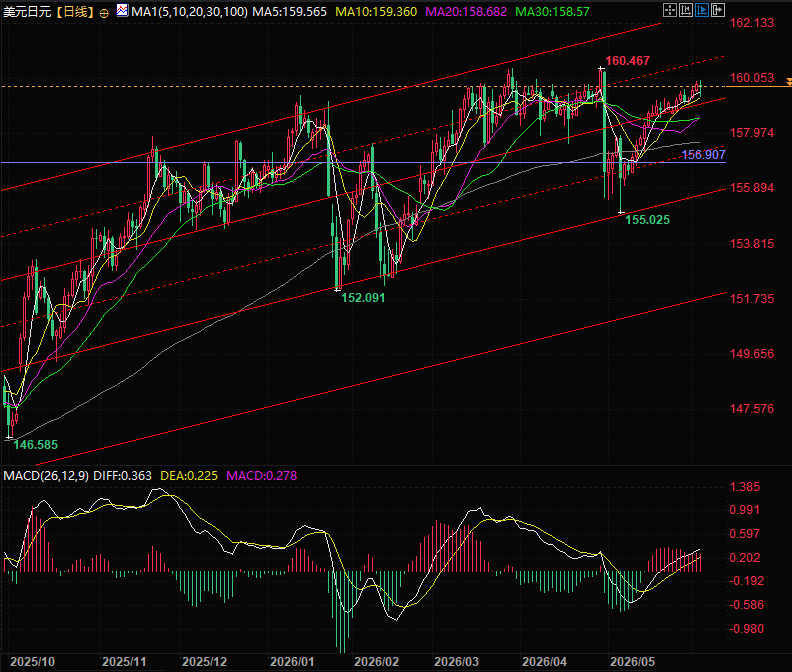
(USD/JPY daily chart, source: FX678)
At 18:27 Beijing time, the USD/JPY exchange rate was 159.82/83.
The current yen market is witnessing one of the most exciting financial "three-way battles" of this century.
This is no longer just a simple issue of currency appreciation or depreciation, but an extreme tug-of-war between three forces: Japanese domestic political hawks (Sanae Takaichi), the US Treasury (Bessenter), and the Bank of Japan (Kazuo Ueda).
Key highlights: A historic power struggle among three forces.
In this grand drama, three key aspects have intertwined to form the deadlock in Japan's monetary policy:
Sanae Takaichi's "Lacquer Will": As a hardliner in Japanese politics, Sanae Takaichi firmly advocated for the continuation of "Abenomics," strongly opposed interest rate hikes, and believed that maintaining low interest rates and a loose monetary environment was the only remedy to save the Japanese economy.
Bessant's "Red Line" for US Treasury Bonds: New US Treasury Secretary Bessant has been frequently pressuring Japan, and his red line is clear: Japan cannot frantically sell off US Treasury bonds to save the yen (this would drive up US Treasury yields and damage the US financial market).
Faced with runaway hyperinflation: persistently high international oil prices and imported inflation that is rapidly eroding the wallets of ordinary Japanese people, the Bank of Japan is forced to consider further interest rate hikes.
A brilliant diplomatic maneuver: "I've already raised interest rates, so surely selling some more US Treasury bonds will make ends meet?"
Faced with pressure from Bessant, the Japanese Ministry of Finance and the Bank of Japan, while unwilling, actually devised an extremely clever "exchange of interests" logic.
In the past, if Japan "intervened without raising interest rates," it would indeed look bad on the international stage—meaning that Japan was only concerned with itself, enjoying low interest rates while transferring the crisis to the United States by selling US Treasury bonds, which was tantamount to openly provoking Bessant.
However, if Japan raises interest rates as scheduled this month, the situation will be completely different: Japan will have paid its dues by raising interest rates, indicating that it has already complied with the United States' wishes on the "price side," paying the price of a cooling domestic economy and soaring mortgage payments, thus narrowing the interest rate differential between the United States and Japan.
Reclaiming the "right to intervene": With the face of raising interest rates, Japan can then conduct a large-scale "sell US Treasury bonds and buy yen" intervention when the yen falls below 160, leaving the US with nothing to say.
Japan could confidently say to Bessant, "We've already raised interest rates under domestic pressure, and the market is still maliciously shorting us. It's reasonable for me to sell some US Treasury bonds to cooperate with the intervention, isn't it?"
Therefore, the expected interest rate hike will inevitably be accompanied by a further intensification and legalization of yen exchange rate intervention.
Internal divisions: a head-on collision with Sanae Takaichi's lenient approach
However, this combination of "interest rate hikes + intervention," which was acceptable internationally, backfired spectacularly on Japan's domestic political landscape—it completely contradicted Sanae Takaichi's insistence on an absolutely loose monetary policy.
What political forces like Sanae Takaichi are most worried about is that raising interest rates will trigger the landmine of Japan's government debt, which is as high as 250%, and crush the fragile domestic consumption.
If the Bank of Japan succumbs to external pressure and raises interest rates this month, it would be tantamount to publicly slapping the face of domestic easing advocates.
This contradiction—"acceptable internationally but completely torn apart domestically"—has put Bank of Japan Governor Kazuo Ueda on the brink of disaster.
He must find an irrefutable reason that can both explain himself to the United States and push for interest rate hikes, while also appeasing the political anger of people like Sanae Takaichi in the United States.
Kazuo Ueda's latest statement: Offering a perfect "political fig leaf"
It is against this backdrop of internal and external difficulties that Bank of Japan Governor Kazuo Ueda delivered a crucial speech today.
His statement not only failed to refute the aforementioned logic, but also perfectly confirmed and complemented this game, becoming his best shield.
In his statement, Kazuo Ueda pointed out that the turmoil caused by the situation in the Middle East has not subsided as quickly as initially expected, and the situation remains unclear to this day.
The price transmission from rising oil prices is likely to be faster than ever before and more easily spread to a wider range of goods.
The central bank will carefully assess the impact of supply shocks on the economy and how rising oil prices affect core inflation.
The central bank will strive to fulfill its responsibility to achieve price stability through appropriate monetary policy.
Kazuo Ueda truly is a master of tai chi; through these words, he cleverly shifted the "political blame" for the interest rate hike onto the Middle East and oil prices:
This is not a threat from the United States, but a war in the Middle East: He repeatedly emphasized that the situation in the Middle East and the transmission of oil prices are accelerating, and he is using objective data to make a defensive statement to domestic easing advocates such as Sanae Kaoshi: "It's not that I want to betray your easing policy, nor that I'm afraid of the United States' Bessant."
The fighting in the Middle East has driven up imported oil prices too high. As the central bank, I have a duty to control inflation; if I don't raise interest rates, ordinary people won't be able to afford food!
In his speech, he clarified the meaning of "reducing bond purchases" and implied that policy normalization was irreversible: He mentioned that "progress has been made in reducing government bond purchases, the market is steadily improving, and financial stability has been guaranteed."
This is an attempt to curry favor with the US and the market—look, I've already "exited" as planned, prevented the Treasury market from collapsing, and done my best to normalize monetary policy.
Summary and Technical Analysis:
The most comfortable approach for Japan is to keep interest rates unchanged, but with minor interventions to keep the yen relatively cheap without accelerating its depreciation.
Currently, the overnight Japanese yen index swap (OIS) indicates that the probability of a rate hike by the Bank of Japan in June is around 80%. If the central bank chooses to raise interest rates, it will certainly cooperate with government intervention, and the current yen trend already shows signs of such intervention.
However, given that Sanae Takashi's loose monetary policy, coupled with rising energy costs, is detrimental to the fundamentals of Japanese companies and the country, the yen is likely to continue to depreciate after a rapid adjustment following intervention and interest rate hikes.
Alternatively, the USD/JPY pair might quickly break through 160 before Japan announces an interest rate hike, then force a short squeeze, and finally rise rapidly before initiating a significant correction.
From a technical perspective, the USD/JPY pair has rebounded back to the middle line of its upward channel and is currently supported by the middle line and the 5-day moving average. It is expected to continue rising and break through the 160 level.
(USD/JPY daily chart, source: FX678)
At 18:27 Beijing time, the USD/JPY exchange rate was 159.82/83.
- Risk Warning and Disclaimer
- The market involves risk, and trading may not be suitable for all investors. This article is for reference only and does not constitute personal investment advice, nor does it take into account certain users’ specific investment objectives, financial situation, or other needs. Any investment decisions made based on this information are at your own risk.