The Bank of Japan is finally raising interest rates! But there are two possible approaches: one will cause a sharp drop in the USD/JPY pair, while the other will just be a "false break."
2026-06-03 20:29:30
On Wednesday (June 3), the USD/JPY exchange rate was consolidating around 159.8, after rising nearly 400 points from around 156 to a high of 159.995 before slightly retreating. Amid rising global bond market interest rates, Japanese government bond yields also rose to around 2.65%, with market expectations of potential policy adjustments by the Bank of Japan becoming a key variable influencing the yen.
U.S. Treasury yields climbed above 4.44%, partly due to energy price pressures and fiscal deficit concerns, which pushed up global borrowing costs. As a major creditor nation, Japan's bond market dynamics and the possibility of exchange rate intervention are jointly shaping the current yen environment. The prevailing market view is that the moderate rise in Japanese bond yields reflects an adaptation to inflation expectations, while also testing the Bank of Japan's ability to balance maintaining policy stability and responding to exchange rate fluctuations.
The yield on 10-year Japanese government bonds recently rose to around 2.65%, a significant increase from the previous period, with the 30-year yield also rising in tandem. This change occurs against the backdrop of a tightening global interest rate environment, with the pressure from the widening US fiscal deficit and rising service debt costs being transmitted to international markets. Analysts from well-known institutions point out that the rise in interest rates stems partly from expectations of continued borrowing, and partly from inflationary pressures driven by geopolitically related energy costs.
The impact of rising Japanese government bond yields on the yen is not one-way, but rather involves a clear layered game. The first and most direct layer is that rising yields narrow the spread with US Treasury bonds, reducing the attractiveness of carry trades and leading to the unwinding of some leveraged positions, theoretically supporting a stronger yen. The second layer is that if the yield rises too quickly, it could exacerbate domestic financing costs, dragging down economic growth. Whether the Bank of Japan's policy response is proactive or reactive will determine the sustainability of the yen's trend — proactive tightening implies a hawkish signal with greater potential benefits; reactive following could be interpreted by the market as reluctance, potentially leading to fluctuations after the benefits are realized . The Bank of Japan needs to weigh these two options. The market anticipates a possible interest rate hike at its mid-June meeting , which is the core catalyst for the current exchange rate game.
Recently, Japan's Ministry of Finance intervened on a large scale when the exchange rate approached the 160 mark, with a significant cumulative scale, aiming to alleviate excessive depreciation pressure. However, intervention alone can only "buy time" and is unlikely to reverse the trend. What truly has deterrent power is a combination of " intervention defense" and "interest rate hike offense "—suppressing short-selling on the defensive end and fundamentally narrowing interest rate differentials on the offensive end; only through the synergy of both can the high foundation of the USD/JPY exchange rate be truly shaken. The current mainstream market view emphasizes that only in conjunction with policy interest rate adjustments can more sustainable support be provided for the yen.
From a fundamental perspective, uncertainty surrounding the US fiscal path has pushed up US Treasury yields, while domestic inflation expectations and energy import costs in Japan are jointly driving adjustments in Japanese government bonds. This transmission ultimately manifests in exchange rates: widening interest rate differentials tend to strengthen the US dollar, while potential actions by the Bank of Japan could provide a temporary boost to the yen. In the current environment, any signals regarding verbal or actual intervention by the Bank of Japan will directly impact market risk appetite.
Technical charts show that USD/JPY is within an upward trend channel on the 4-hour chart, but momentum is showing signs of weakening. The price is trading above the Bollinger Band middle line at 159.611, with the upper line around 160.096 acting as short-term resistance. The lower line at 159.127 is key support; a break below this level could weaken the trend.
In terms of candlestick patterns, the previous period was dominated by bullish candlesticks, but small-bodied candlesticks and doji stars appeared at the highs, indicating weakening bullish momentum. The MACD indicator formed a bearish divergence: when the price made a new high, the DIFF line failed to rise in tandem, and the histogram contracted to a low level, suggesting a "last gasp" characteristic. Although a second golden cross appeared above the zero line, the overall momentum was significantly weaker than the previous peak.
The Bollinger Bands are sloping upwards but of moderate width. The price rebounded after retracing to the middle band, consistent with a healthy consolidation within a strong uptrend. The current price of 159.818 is between the middle and upper bands, placing the market at a directional decision point.
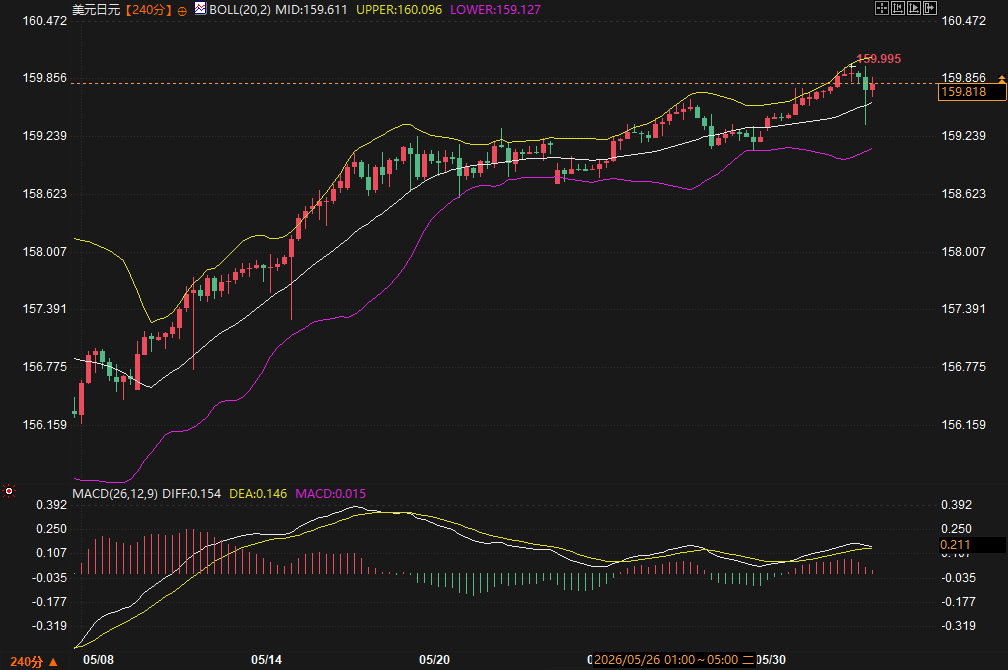
The support and resistance range is predicted with reference to the main contract. The short-term strong resistance level is 160.096 (Upper Bollinger Band), a break above which could open up a potential range of 160.50-161.00. Short-term support is at 159.611 (Middle Bollinger Band), serving as a key level for determining bullish or bearish sentiment; a break below this level would test the Lower Bollinger Band at 159.127. Key events to watch include the release of US economic data and any official statements from Japan regarding exchange rates or policy. These variables could disrupt the current 159.10-160.10 trading range.
The overall technical structure remains bullish, but the bearish divergence and weakening momentum suggest a significant risk of a pullback. Fundamental factors, including Japanese government bond yields and policy signals, will determine the direction of any technical breakout.
Looking ahead to the next two or three days, the most likely scenario for USD/JPY is high-level consolidation within the upper and lower Bollinger Bands, awaiting a clear catalyst. The continued moderate rise in Japanese government bond yields, coupled with expectations of potential action from the Bank of Japan, may temporarily limit the upside potential of the dollar. If the price effectively breaks above 160.10 with increased trading volume, the upward trend is likely to continue; conversely, if it falls below 159.61 and continues to face resistance, the risk of a pullback to the 158.50 area will increase.
In the long term, the global interest rate environment, the coordination of Japan's fiscal and monetary policies, and the direction of capital flows will dominate the yen's performance. The market needs to continuously monitor the results of Japanese bond auctions and signals from the central bank, as these factors are having an increasingly significant marginal impact on the exchange rate. Overall, the current environment remains one of cautious observation, and policy uncertainty necessitates being fully prepared for volatility.
What direct impact does the rise in Japanese bond yields have on the USD/JPY exchange rate?
Rising Japanese bond yields help narrow the US-Japan interest rate differential, providing some support for the yen. However, if the upward trend is accompanied by concerns about economic growth, the Bank of Japan's policy pace may slow, and the exchange rate will remain easily influenced by external interest rate differentials. The current 10-year yield of around 2.65% reflects the market's adaptation to inflation, while also increasing discussion about the necessity of intervention.
Is it possible that the Bank of Japan will raise interest rates at its next meeting to directly support the yen?
Market pricing suggests a probability of an interest rate hike, but policy decisions must balance economic growth and exchange rate stability. Historical experience shows that policy adjustment signals often have a greater impact on short-term exchange rates than the actual magnitude of the change. Any hawkish statement could quickly boost the yen, but the sustainability of this effect depends on changes in the global interest rate environment.
How should we assess the actual effect of recent exchange rate interventions on the yen's exchange rate?
The intervention created a significant pullback in the short term, but failed to completely reverse the upward trend. The main reason is that fundamental interest rate differentials and capital flows still favor the US dollar. The intervention served more as a "buying time" measure, creating a window for policy adjustments, rather than replacing the fundamental driving factors.
Does a bearish divergence signal on a technical chart indicate a trend reversal?
A bearish divergence suggests weakening momentum and increases the probability of a pullback, but a single indicator is insufficient to confirm a reversal. It needs to be assessed in conjunction with the effectiveness of the Bollinger Band middle line support and fundamental catalysts. If the price holds above 159.611 and regains upward momentum, the trend may continue; otherwise, a deeper correction is likely.
What key market variables should investors pay attention to in order to determine the next direction of the Japanese yen?
Key variables include changes in the Japanese government bond yield curve, official Japanese exchange rate statements, the impact of US economic data on US Treasury bonds, and breakouts of key Bollinger Band levels. These intertwined factors determine whether the short-term balance is broken; therefore, a comprehensive assessment using multiple timeframes is recommended, rather than relying on a single signal.
U.S. Treasury yields climbed above 4.44%, partly due to energy price pressures and fiscal deficit concerns, which pushed up global borrowing costs. As a major creditor nation, Japan's bond market dynamics and the possibility of exchange rate intervention are jointly shaping the current yen environment. The prevailing market view is that the moderate rise in Japanese bond yields reflects an adaptation to inflation expectations, while also testing the Bank of Japan's ability to balance maintaining policy stability and responding to exchange rate fluctuations.
The Impact of Japanese Bond Yield Trends and Potential Actions by the Bank of Japan
The yield on 10-year Japanese government bonds recently rose to around 2.65%, a significant increase from the previous period, with the 30-year yield also rising in tandem. This change occurs against the backdrop of a tightening global interest rate environment, with the pressure from the widening US fiscal deficit and rising service debt costs being transmitted to international markets. Analysts from well-known institutions point out that the rise in interest rates stems partly from expectations of continued borrowing, and partly from inflationary pressures driven by geopolitically related energy costs.
The impact of rising Japanese government bond yields on the yen is not one-way, but rather involves a clear layered game. The first and most direct layer is that rising yields narrow the spread with US Treasury bonds, reducing the attractiveness of carry trades and leading to the unwinding of some leveraged positions, theoretically supporting a stronger yen. The second layer is that if the yield rises too quickly, it could exacerbate domestic financing costs, dragging down economic growth. Whether the Bank of Japan's policy response is proactive or reactive will determine the sustainability of the yen's trend — proactive tightening implies a hawkish signal with greater potential benefits; reactive following could be interpreted by the market as reluctance, potentially leading to fluctuations after the benefits are realized . The Bank of Japan needs to weigh these two options. The market anticipates a possible interest rate hike at its mid-June meeting , which is the core catalyst for the current exchange rate game.
Recently, Japan's Ministry of Finance intervened on a large scale when the exchange rate approached the 160 mark, with a significant cumulative scale, aiming to alleviate excessive depreciation pressure. However, intervention alone can only "buy time" and is unlikely to reverse the trend. What truly has deterrent power is a combination of " intervention defense" and "interest rate hike offense "—suppressing short-selling on the defensive end and fundamentally narrowing interest rate differentials on the offensive end; only through the synergy of both can the high foundation of the USD/JPY exchange rate be truly shaken. The current mainstream market view emphasizes that only in conjunction with policy interest rate adjustments can more sustainable support be provided for the yen.
From a fundamental perspective, uncertainty surrounding the US fiscal path has pushed up US Treasury yields, while domestic inflation expectations and energy import costs in Japan are jointly driving adjustments in Japanese government bonds. This transmission ultimately manifests in exchange rates: widening interest rate differentials tend to strengthen the US dollar, while potential actions by the Bank of Japan could provide a temporary boost to the yen. In the current environment, any signals regarding verbal or actual intervention by the Bank of Japan will directly impact market risk appetite.
USD/JPY Technical Analysis and Key Ranges
Technical charts show that USD/JPY is within an upward trend channel on the 4-hour chart, but momentum is showing signs of weakening. The price is trading above the Bollinger Band middle line at 159.611, with the upper line around 160.096 acting as short-term resistance. The lower line at 159.127 is key support; a break below this level could weaken the trend.
In terms of candlestick patterns, the previous period was dominated by bullish candlesticks, but small-bodied candlesticks and doji stars appeared at the highs, indicating weakening bullish momentum. The MACD indicator formed a bearish divergence: when the price made a new high, the DIFF line failed to rise in tandem, and the histogram contracted to a low level, suggesting a "last gasp" characteristic. Although a second golden cross appeared above the zero line, the overall momentum was significantly weaker than the previous peak.
The Bollinger Bands are sloping upwards but of moderate width. The price rebounded after retracing to the middle band, consistent with a healthy consolidation within a strong uptrend. The current price of 159.818 is between the middle and upper bands, placing the market at a directional decision point.
The support and resistance range is predicted with reference to the main contract. The short-term strong resistance level is 160.096 (Upper Bollinger Band), a break above which could open up a potential range of 160.50-161.00. Short-term support is at 159.611 (Middle Bollinger Band), serving as a key level for determining bullish or bearish sentiment; a break below this level would test the Lower Bollinger Band at 159.127. Key events to watch include the release of US economic data and any official statements from Japan regarding exchange rates or policy. These variables could disrupt the current 159.10-160.10 trading range.
The overall technical structure remains bullish, but the bearish divergence and weakening momentum suggest a significant risk of a pullback. Fundamental factors, including Japanese government bond yields and policy signals, will determine the direction of any technical breakout.
Future Trend Outlook
Looking ahead to the next two or three days, the most likely scenario for USD/JPY is high-level consolidation within the upper and lower Bollinger Bands, awaiting a clear catalyst. The continued moderate rise in Japanese government bond yields, coupled with expectations of potential action from the Bank of Japan, may temporarily limit the upside potential of the dollar. If the price effectively breaks above 160.10 with increased trading volume, the upward trend is likely to continue; conversely, if it falls below 159.61 and continues to face resistance, the risk of a pullback to the 158.50 area will increase.
In the long term, the global interest rate environment, the coordination of Japan's fiscal and monetary policies, and the direction of capital flows will dominate the yen's performance. The market needs to continuously monitor the results of Japanese bond auctions and signals from the central bank, as these factors are having an increasingly significant marginal impact on the exchange rate. Overall, the current environment remains one of cautious observation, and policy uncertainty necessitates being fully prepared for volatility.
Frequently Asked Questions
What direct impact does the rise in Japanese bond yields have on the USD/JPY exchange rate?
Rising Japanese bond yields help narrow the US-Japan interest rate differential, providing some support for the yen. However, if the upward trend is accompanied by concerns about economic growth, the Bank of Japan's policy pace may slow, and the exchange rate will remain easily influenced by external interest rate differentials. The current 10-year yield of around 2.65% reflects the market's adaptation to inflation, while also increasing discussion about the necessity of intervention.
Is it possible that the Bank of Japan will raise interest rates at its next meeting to directly support the yen?
Market pricing suggests a probability of an interest rate hike, but policy decisions must balance economic growth and exchange rate stability. Historical experience shows that policy adjustment signals often have a greater impact on short-term exchange rates than the actual magnitude of the change. Any hawkish statement could quickly boost the yen, but the sustainability of this effect depends on changes in the global interest rate environment.
How should we assess the actual effect of recent exchange rate interventions on the yen's exchange rate?
The intervention created a significant pullback in the short term, but failed to completely reverse the upward trend. The main reason is that fundamental interest rate differentials and capital flows still favor the US dollar. The intervention served more as a "buying time" measure, creating a window for policy adjustments, rather than replacing the fundamental driving factors.
Does a bearish divergence signal on a technical chart indicate a trend reversal?
A bearish divergence suggests weakening momentum and increases the probability of a pullback, but a single indicator is insufficient to confirm a reversal. It needs to be assessed in conjunction with the effectiveness of the Bollinger Band middle line support and fundamental catalysts. If the price holds above 159.611 and regains upward momentum, the trend may continue; otherwise, a deeper correction is likely.
What key market variables should investors pay attention to in order to determine the next direction of the Japanese yen?
Key variables include changes in the Japanese government bond yield curve, official Japanese exchange rate statements, the impact of US economic data on US Treasury bonds, and breakouts of key Bollinger Band levels. These intertwined factors determine whether the short-term balance is broken; therefore, a comprehensive assessment using multiple timeframes is recommended, rather than relying on a single signal.
- Risk Warning and Disclaimer
- The market involves risk, and trading may not be suitable for all investors. This article is for reference only and does not constitute personal investment advice, nor does it take into account certain users’ specific investment objectives, financial situation, or other needs. Any investment decisions made based on this information are at your own risk.