$100 has become a psychological curse! Oil prices could collapse if they break through, but it's even more dangerous if they don't?
2026-06-04 14:59:53
On Thursday, the core variable in the crude oil market shifted from a single geopolitical risk premium to a rebalancing of ceasefire expectations, inventory contraction, and the speed of transportation recovery. Brent crude is currently fluctuating around $96.80 per barrel, and West Texas Intermediate crude is around $95.20 per barrel. While prices are below the $100 per barrel mark, there has been no sharp drop following a complete retreat of the risk premium.

Israel and Lebanon have agreed to a ceasefire, with conditions including Hezbollah ceasing fire and withdrawing from south of the Litani River. Direct negotiations will follow to address outstanding issues. The first impact of this news on oil prices is that it lowers previous pricing regarding tail risks related to Middle Eastern supply chains.
However, traders are distinguishing between "ceasefire news" and "logistics recovery." The former changes sentiment, while the latter alters the physical balance. Shipping in the Strait of Hormuz remains below pre-conflict levels, and the resumption of some vessel activity does not equate to a synchronized normalization of insurance, freight rates, loading schedules, and refinery procurement cycles. As long as the efficiency of key shipping lanes has not fully recovered, the risk premium for crude oil will be difficult to completely return to zero.
The latest weekly report from the Energy Information Administration shows that for the week ending May 29, commercial crude oil inventories decreased by 8 million barrels to 433.7 million barrels, about 3% lower than the five-year average for the same period. Refinery utilization was 94.7%, with crude oil processing volume at approximately 16.9 million barrels per day. Gasoline inventories increased by 3.4 million barrels, and distillate fuel inventories increased by 1.5 million barrels.
The key point of this data set is not the weekly inventory reduction itself, but the structure. Tight crude oil supplies coupled with restocking of refined products indicate that refineries are still operating at high capacity to process raw materials, but the elasticity of end-user oil demand is beginning to diverge. For oil prices, this structure means that prices are not solely driven by geopolitical sentiment; physical inventories are also providing a floor. If a ceasefire subsequently leads to the resumption of shipping routes, the market will shift from a pricing framework of "whether there is an oil shortage" to "what type of oil is in short supply, for how long, and what can replace it."
At its May 3 meeting, the OPEC+ alliance decided that the seven participating countries would implement a production adjustment of 188,000 barrels per day starting in June, and emphasized that it would handle the pace of voluntary production cut withdrawal gradually and flexibly according to market conditions. This statement does not mean simply increasing supply, but rather retaining the flexibility to suspend, withdraw, or continue adjusting.
The International Energy Agency's May report projects global oil demand at 104 million barrels per day in 2026, a decrease of 420,000 barrels per day year-on-year. Meanwhile, global supply fell to 95.1 million barrels per day in April, a cumulative loss of 12.8 million barrels per day since February. The report also noted that global visible inventories decreased by 129 million barrels and 117 million barrels in March and April, respectively.
This means that the current oil market is not a typical demand-driven rally, but rather a combination of supply disruptions, passive inventory depletion, and demand being suppressed by high prices. Brent crude's failure to reach $100/barrel does not signify the disappearance of supply risks, but rather that the market is assessing whether demand disruptions can offset the supply gap.
Looking at the daily chart for Brent crude oil, the latest price is approximately $96.78 per barrel, below the middle Bollinger Band at $102.91 per barrel, with the upper band at $115.87 per barrel and the lower band at $89.95 per barrel. The price previously rebounded after touching $89.93 per barrel, but the rebound has not yet allowed it to regain the middle Bollinger Band. In the MACD indicator, the DIFF is -2.22, the DEA is -1.43, and the histogram is -1.58, indicating that the trend correction remains in a weak phase.
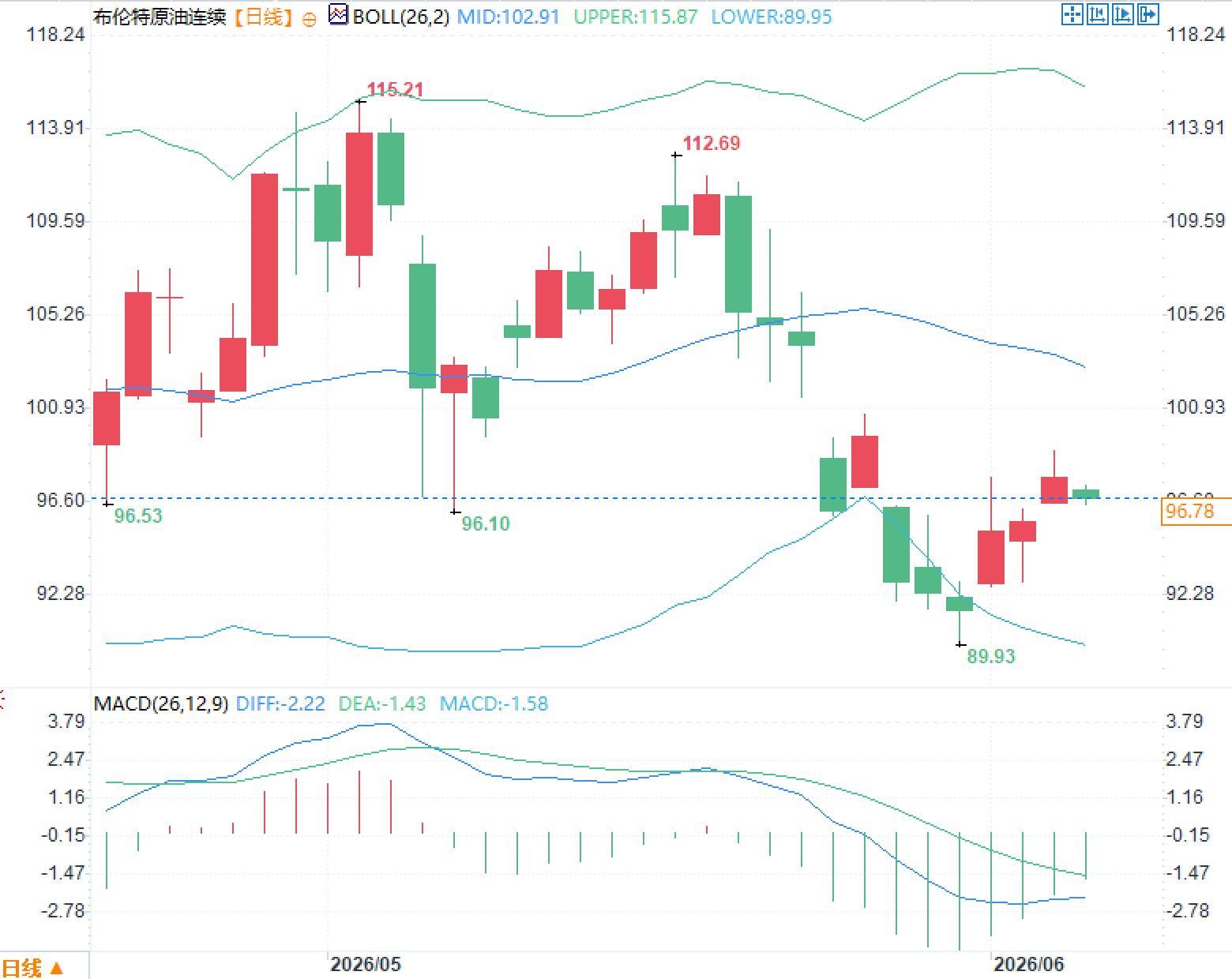
Technical structure and fundamentals are not contradictory. The ceasefire news lowered the upside risk premium, while inventory contraction supported the downside pricing, resulting in oil prices remaining resilient above $90/barrel, but lacking sustained confirmation of a breakout near $100/barrel. Short-term trading logic is closer to "wide-range fluctuations driven by news" rather than unilateral trend pricing.
Question 1: Why didn't the ceasefire announcement cause Brent crude to quickly fall below $90 per barrel?
A: Because the ceasefire improves expectations, it doesn't mean that key shipping routes, insurance, freight rates, and loading schedules will all resume simultaneously. Inventory data still shows a tight supply of crude oil, and there are still physical constraints on prices.
Question 2: Does Brent crude falling below $100 per barrel indicate the end of the risk?
A: That's not the right way to interpret it. $100/barrel is more of a sentiment level; what truly determines the trend is the speed of supply recovery, inventory reduction, and the pace of refinery procurement.
Question 3: What is the most critical variable in the current oil market?
A: The key questions are whether the ceasefire can translate into stable logistics, whether inventory levels continue to decline, and whether the high oil prices will further suppress demand for shipping, chemicals, and transportation fuels.
The ceasefire announcement altered short-term pricing, but did not eliminate the risk premium.
Israel and Lebanon have agreed to a ceasefire, with conditions including Hezbollah ceasing fire and withdrawing from south of the Litani River. Direct negotiations will follow to address outstanding issues. The first impact of this news on oil prices is that it lowers previous pricing regarding tail risks related to Middle Eastern supply chains.
However, traders are distinguishing between "ceasefire news" and "logistics recovery." The former changes sentiment, while the latter alters the physical balance. Shipping in the Strait of Hormuz remains below pre-conflict levels, and the resumption of some vessel activity does not equate to a synchronized normalization of insurance, freight rates, loading schedules, and refinery procurement cycles. As long as the efficiency of key shipping lanes has not fully recovered, the risk premium for crude oil will be difficult to completely return to zero.
Inventory contraction provides some resilience for oil prices on the downside.
The latest weekly report from the Energy Information Administration shows that for the week ending May 29, commercial crude oil inventories decreased by 8 million barrels to 433.7 million barrels, about 3% lower than the five-year average for the same period. Refinery utilization was 94.7%, with crude oil processing volume at approximately 16.9 million barrels per day. Gasoline inventories increased by 3.4 million barrels, and distillate fuel inventories increased by 1.5 million barrels.
The key point of this data set is not the weekly inventory reduction itself, but the structure. Tight crude oil supplies coupled with restocking of refined products indicate that refineries are still operating at high capacity to process raw materials, but the elasticity of end-user oil demand is beginning to diverge. For oil prices, this structure means that prices are not solely driven by geopolitical sentiment; physical inventories are also providing a floor. If a ceasefire subsequently leads to the resumption of shipping routes, the market will shift from a pricing framework of "whether there is an oil shortage" to "what type of oil is in short supply, for how long, and what can replace it."
Supply policy signals are cautious, and demand expectations have been compressed by high oil prices.
At its May 3 meeting, the OPEC+ alliance decided that the seven participating countries would implement a production adjustment of 188,000 barrels per day starting in June, and emphasized that it would handle the pace of voluntary production cut withdrawal gradually and flexibly according to market conditions. This statement does not mean simply increasing supply, but rather retaining the flexibility to suspend, withdraw, or continue adjusting.
The International Energy Agency's May report projects global oil demand at 104 million barrels per day in 2026, a decrease of 420,000 barrels per day year-on-year. Meanwhile, global supply fell to 95.1 million barrels per day in April, a cumulative loss of 12.8 million barrels per day since February. The report also noted that global visible inventories decreased by 129 million barrels and 117 million barrels in March and April, respectively.
This means that the current oil market is not a typical demand-driven rally, but rather a combination of supply disruptions, passive inventory depletion, and demand being suppressed by high prices. Brent crude's failure to reach $100/barrel does not signify the disappearance of supply risks, but rather that the market is assessing whether demand disruptions can offset the supply gap.
Technical analysis shows that the rebound is still being suppressed by the middle band.
Looking at the daily chart for Brent crude oil, the latest price is approximately $96.78 per barrel, below the middle Bollinger Band at $102.91 per barrel, with the upper band at $115.87 per barrel and the lower band at $89.95 per barrel. The price previously rebounded after touching $89.93 per barrel, but the rebound has not yet allowed it to regain the middle Bollinger Band. In the MACD indicator, the DIFF is -2.22, the DEA is -1.43, and the histogram is -1.58, indicating that the trend correction remains in a weak phase.
Technical structure and fundamentals are not contradictory. The ceasefire news lowered the upside risk premium, while inventory contraction supported the downside pricing, resulting in oil prices remaining resilient above $90/barrel, but lacking sustained confirmation of a breakout near $100/barrel. Short-term trading logic is closer to "wide-range fluctuations driven by news" rather than unilateral trend pricing.
Frequently Asked Questions
Question 1: Why didn't the ceasefire announcement cause Brent crude to quickly fall below $90 per barrel?
A: Because the ceasefire improves expectations, it doesn't mean that key shipping routes, insurance, freight rates, and loading schedules will all resume simultaneously. Inventory data still shows a tight supply of crude oil, and there are still physical constraints on prices.
Question 2: Does Brent crude falling below $100 per barrel indicate the end of the risk?
A: That's not the right way to interpret it. $100/barrel is more of a sentiment level; what truly determines the trend is the speed of supply recovery, inventory reduction, and the pace of refinery procurement.
Question 3: What is the most critical variable in the current oil market?
A: The key questions are whether the ceasefire can translate into stable logistics, whether inventory levels continue to decline, and whether the high oil prices will further suppress demand for shipping, chemicals, and transportation fuels.
- Risk Warning and Disclaimer
- The market involves risk, and trading may not be suitable for all investors. This article is for reference only and does not constitute personal investment advice, nor does it take into account certain users’ specific investment objectives, financial situation, or other needs. Any investment decisions made based on this information are at your own risk.