The euro strengthened as expectations of a European Central Bank rate hike rose, and the euro rebounded slightly against the yen.
2026-06-04 15:09:46
The euro/yen (EUR/JPY) pair maintained a slightly bullish trend in early European trading on Thursday, hovering around 185.60. The European Central Bank (ECB) continued its hawkish stance, while Japan signaled potential intervention in the currency market; these two factors jointly dominated the current market movement. The euro's recent performance has been supported by expectations of ECB policy changes. Faced with rising energy prices and renewed inflation risks, ECB officials generally favor maintaining a tight monetary policy. The market expects the ECB to further raise deposit rates at its policy meeting this month and may raise rates again in September.

Market research indicates that the European Central Bank's deposit rate is expected to rise to 2.25%. This expectation is keeping European bond yields high and enhancing the attractiveness of euro assets to international capital. For the foreign exchange market, interest rates are a crucial factor influencing capital flows. When European interest rates continue to rise while Japanese interest rates remain relatively low, capital tends to flow to higher-yielding euro assets, thus driving up the euro against the yen.
Meanwhile, Japan's focus on exchange rate fluctuations has clearly intensified. Japanese Finance Minister Satsuki Katayama stated that the Japanese government is closely monitoring foreign exchange market dynamics and will take appropriate measures to address excessive volatility if necessary. She also stated that the Japanese government and the Bank of Japan maintain a high degree of coordination on multiple policy issues. The market generally interprets this statement as a typical signal of verbal intervention. With the continued depreciation of the yen, the Japanese government's concerns about imported inflation and rising energy import costs are increasing, thus the possibility of further actual intervention cannot be ruled out.
In fact, the Japanese economy still faces significant external pressures. As one of the world's major energy importers, Japan is highly sensitive to changes in international energy prices. Recent tensions in the Middle East and persistently high international oil prices have placed greater pressure on Japanese businesses and households regarding energy expenditures. The Strait of Hormuz handles approximately 20% of global seaborne crude oil transport. With tensions between the United States and Iran showing no significant easing, the market remains wary of the risk of energy supply disruptions, further increasing imported inflationary pressures on the Japanese economy.
On the other hand, the Bank of Japan's monetary policy adjustments remain relatively cautious. Although some market participants are calling for further interest rate hikes to stabilize the exchange rate, the fundamentals of Japan's economic growth remain fragile, and the recovery in consumption and business investment is limited, making it difficult for the Bank of Japan to significantly tighten monetary policy. In contrast, while European economic growth has slowed, inflationary pressures remain above the central bank's target level. Rising energy prices and a tight labor market give the European Central Bank reasons to maintain a hawkish policy stance.
This clear divergence in monetary policy has become the core driver of the euro's rise against the yen. Investors generally believe that as long as the European Central Bank continues to raise interest rates while the Bank of Japan maintains its accommodative policy, the overall trend for the euro against the yen will remain strong. However, the market also faces some short-term uncertainties. On the one hand, the risk of Japanese government intervention is increasing; on the other hand, developments in the US-Iran situation may still affect global risk appetite and capital flows. Therefore, short-term exchange rate volatility may intensify significantly.
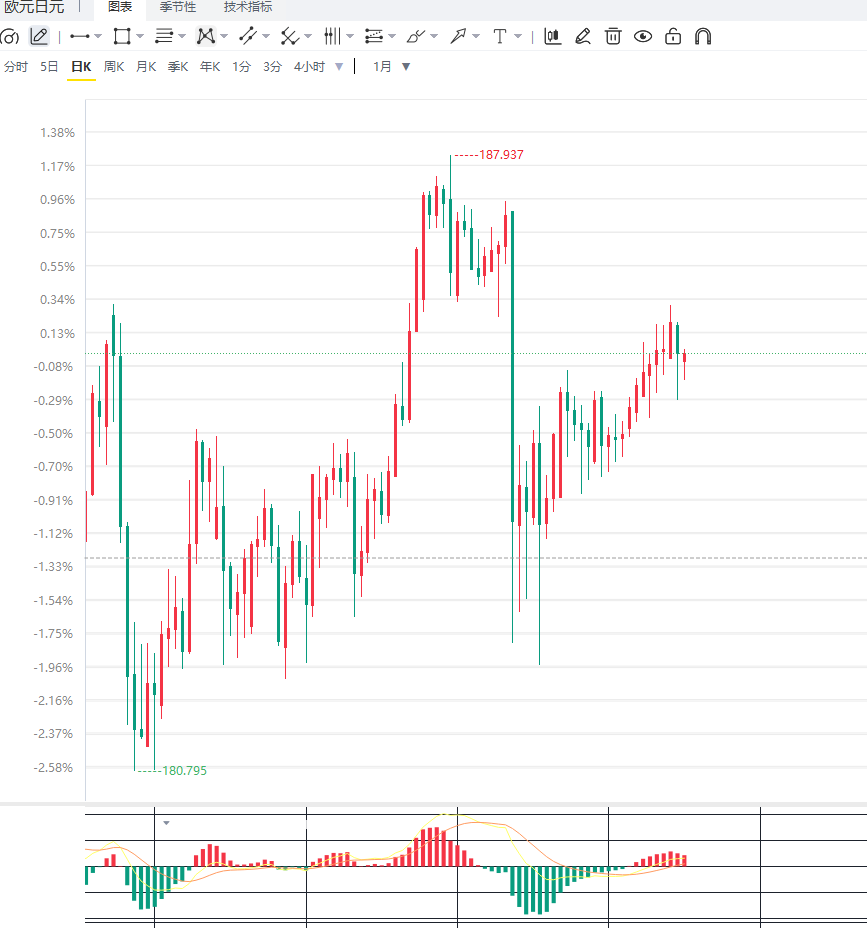
From a daily chart perspective, the EUR/JPY pair maintains an overall upward trend with fluctuations. The price continues to trade above the 100-day moving average, indicating that the medium-term bullish structure remains intact. Currently, the 100-day simple moving average is around 184.50, a key support area. The Bollinger Band middle line is around 185.20, and the price's continued trading above this line suggests a generally bullish market. Technically, the RSI is around 55, indicating stable upward momentum but not yet entering overbought territory. The MACD indicator remains above the zero line, suggesting that bullish forces still hold the upper hand.
From a 4-hour chart perspective, the exchange rate is gradually approaching the upper Bollinger Band around 186.00. A decisive break above 186.00 could open up further upside potential and challenge new highs for the current phase. Initial support is at 185.00, followed by 184.50 and the 184.00 area. A break below these support levels could trigger a period of correction.
Editor's Summary : The recent sustained rise in the euro against the yen mainly reflects the significant differences in monetary policy between Europe and Japan. The European Central Bank's (ECB) expectations of interest rate hikes are increasing, while the Bank of Japan maintains a relatively accommodative stance, giving the euro a clear interest rate advantage. Meanwhile, rising energy prices due to the Middle East situation have exacerbated imported inflation pressures on the Japanese economy. In the short term, the ECB's policy meeting and the Japanese government's attitude towards exchange rate fluctuations will be the focus of market attention. If the ECB releases further hawkish signals, the euro/yen exchange rate is likely to maintain its upward trend. However, as the exchange rate approaches historical highs, the risk of stronger intervention measures by the Japanese authorities is also rising, and investors need to be wary of sharp fluctuations caused by policy factors.
Market research indicates that the European Central Bank's deposit rate is expected to rise to 2.25%. This expectation is keeping European bond yields high and enhancing the attractiveness of euro assets to international capital. For the foreign exchange market, interest rates are a crucial factor influencing capital flows. When European interest rates continue to rise while Japanese interest rates remain relatively low, capital tends to flow to higher-yielding euro assets, thus driving up the euro against the yen.
Meanwhile, Japan's focus on exchange rate fluctuations has clearly intensified. Japanese Finance Minister Satsuki Katayama stated that the Japanese government is closely monitoring foreign exchange market dynamics and will take appropriate measures to address excessive volatility if necessary. She also stated that the Japanese government and the Bank of Japan maintain a high degree of coordination on multiple policy issues. The market generally interprets this statement as a typical signal of verbal intervention. With the continued depreciation of the yen, the Japanese government's concerns about imported inflation and rising energy import costs are increasing, thus the possibility of further actual intervention cannot be ruled out.
In fact, the Japanese economy still faces significant external pressures. As one of the world's major energy importers, Japan is highly sensitive to changes in international energy prices. Recent tensions in the Middle East and persistently high international oil prices have placed greater pressure on Japanese businesses and households regarding energy expenditures. The Strait of Hormuz handles approximately 20% of global seaborne crude oil transport. With tensions between the United States and Iran showing no significant easing, the market remains wary of the risk of energy supply disruptions, further increasing imported inflationary pressures on the Japanese economy.
On the other hand, the Bank of Japan's monetary policy adjustments remain relatively cautious. Although some market participants are calling for further interest rate hikes to stabilize the exchange rate, the fundamentals of Japan's economic growth remain fragile, and the recovery in consumption and business investment is limited, making it difficult for the Bank of Japan to significantly tighten monetary policy. In contrast, while European economic growth has slowed, inflationary pressures remain above the central bank's target level. Rising energy prices and a tight labor market give the European Central Bank reasons to maintain a hawkish policy stance.
This clear divergence in monetary policy has become the core driver of the euro's rise against the yen. Investors generally believe that as long as the European Central Bank continues to raise interest rates while the Bank of Japan maintains its accommodative policy, the overall trend for the euro against the yen will remain strong. However, the market also faces some short-term uncertainties. On the one hand, the risk of Japanese government intervention is increasing; on the other hand, developments in the US-Iran situation may still affect global risk appetite and capital flows. Therefore, short-term exchange rate volatility may intensify significantly.
From a daily chart perspective, the EUR/JPY pair maintains an overall upward trend with fluctuations. The price continues to trade above the 100-day moving average, indicating that the medium-term bullish structure remains intact. Currently, the 100-day simple moving average is around 184.50, a key support area. The Bollinger Band middle line is around 185.20, and the price's continued trading above this line suggests a generally bullish market. Technically, the RSI is around 55, indicating stable upward momentum but not yet entering overbought territory. The MACD indicator remains above the zero line, suggesting that bullish forces still hold the upper hand.
From a 4-hour chart perspective, the exchange rate is gradually approaching the upper Bollinger Band around 186.00. A decisive break above 186.00 could open up further upside potential and challenge new highs for the current phase. Initial support is at 185.00, followed by 184.50 and the 184.00 area. A break below these support levels could trigger a period of correction.
Editor's Summary : The recent sustained rise in the euro against the yen mainly reflects the significant differences in monetary policy between Europe and Japan. The European Central Bank's (ECB) expectations of interest rate hikes are increasing, while the Bank of Japan maintains a relatively accommodative stance, giving the euro a clear interest rate advantage. Meanwhile, rising energy prices due to the Middle East situation have exacerbated imported inflation pressures on the Japanese economy. In the short term, the ECB's policy meeting and the Japanese government's attitude towards exchange rate fluctuations will be the focus of market attention. If the ECB releases further hawkish signals, the euro/yen exchange rate is likely to maintain its upward trend. However, as the exchange rate approaches historical highs, the risk of stronger intervention measures by the Japanese authorities is also rising, and investors need to be wary of sharp fluctuations caused by policy factors.
- Risk Warning and Disclaimer
- The market involves risk, and trading may not be suitable for all investors. This article is for reference only and does not constitute personal investment advice, nor does it take into account certain users’ specific investment objectives, financial situation, or other needs. Any investment decisions made based on this information are at your own risk.