A stunning reversal! Improved shipping prospects could lead to global condemnation of the US.
2026-06-04 19:45:58
On Thursday (June 4), during the Asian and European sessions, the US dollar index suddenly retreated, erasing all of yesterday's gains. Gold also remained strong. The previous gold article pointed out that the agreement Trump mentioned was an empty promise, meaning that from the US perspective, the entire peace talks had no progress and no hope. Therefore, the protracted US-Iran issue would push up oil prices and suppress gold. In other words, the support for gold from Trump's verbal statements may only be limited to today.
However, from Iran's perspective, the situation may take a turn for the better. The draft resolution on the management of the Strait of Hormuz has entered the review stage, and Oman has withstood pressure from the United States to help improve the navigation mechanism based on the draft resolution.
If completed, Iran will become a country that helps lower global oil prices, while the United States will only be able to play the bad guy because it obstructs this passage mechanism. Companies that receive lower raw material costs and insurance prices will then choose to accept Iran's passage mechanism. At this point, an awkward scene will occur when passing ships pay Iran, meaning that all this good thing is thanks to the United States.
In terms of news, US President Trump stated that the House vote on war powers was meaningless and that the US is conducting final negotiations to end the war with Iran.

Iran's control over the Strait of Hormuz is shifting from diplomatic statements to institutional implementation.
According to Iran's Mehr News Agency on June 3, the draft law on the management of the Strait of Hormuz has officially entered the review stage of the Supreme National Security Council, and will be submitted to the plenary parliament for a vote after the final opinions are integrated.
This long-awaited institutional design embodies the consensus of several core committees of the Iranian parliament—the National Security and Foreign Policy Committee, the Construction Committee, and the Internal Affairs Committee, among others. Multiple versions of the proposals previously put forward have been coordinated through several rounds of discussions to form a unified text, marking a substantial step forward in Iran's attempt to establish its control over the Straits through domestic legislation.
It is noteworthy that the core objective of this draft is not limited to regulating navigation order, but also implicitly includes Iran's strategic consideration of reshaping its regional energy discourse power. This stands in stark contrast to the "imminent negotiation agreement" touted by the Trump administration, and if ultimately implemented, it will fundamentally alter the existing landscape of the US-Iran rivalry.
The navigation dispute in the Strait of Hormuz has escalated from a bilateral game to a multilateral struggle and legal conflict.
Oman has explicitly resisted US pressure to sever diplomatic ties with Iran, insisting on negotiating with Tehran on a Straits governance system in accordance with international law. Even in the face of bombing threats from the Trump administration and public accusations from Secretary of State Rubio, Oman has maintained its neutral mediating role.
Iran, meanwhile, is simultaneously pushing forward with practical controls by establishing the Persian Gulf Straits Authority (which has been sanctioned by the US Treasury Department), requiring all vessels to obtain permits for passage, and proposing to charge non-discriminatory environmental restoration fees. However, this plan has been explicitly opposed by the International Maritime Organization, whose Secretary-General emphasized to the UN Security Council on April 27 that there is no legal basis for charging passage fees in international straits and that it violates the core principle of the "right of transit" in the United Nations Convention on the Law of the Sea.
Sharp clashes between various parties have pushed Oman to the diplomatic brink, and the US Treasury Department's May 29 ban—prohibiting US citizens from receiving any air traffic-related services from Iran—has further exacerbated geopolitical tensions, making the conflict over navigation rules in the Strait even more difficult to resolve through diplomatic channels.
The navigation restrictions imposed by the conflict did not completely block oil transport in the Strait of Hormuz; instead, they spurred the emergence of a new, covert shipping model.
According to monitoring data, only three oil tankers openly entered and exited the strait each day after the conflict (about one-tenth of the normal level). However, in May, 65% of fully loaded oil tankers leaving port chose to turn off their Automatic Identification System (AIS) and "pass secretly," only restoring their signals at their destination several weeks later. The number of such vessels sailing covertly has surged by nearly 600% compared to before.
Behind the concealed flow is a slow recovery on the supply side: Kpler data shows that the amount of oil tankers in the Gulf has dropped from a peak of 184 million barrels in March to 148 million barrels this week, with an average daily destocking rate of 710,000 barrels since May. Some of the oil tankers that are secretly sailing are suspected of using the corridor designated by Iran or passing close to the coastline of Oman, and may even have the tacit approval of the US Navy.
However, this recovery is unlikely to solve the fundamental predicament—the shutdown of approximately 11 million barrels per day of oil fields has been delayed due to a lack of export confidence, shipowners remain wary of risky areas, and Iran's attempt to control navigation rights through a toll system is forcing Gulf countries to accelerate the development of alternative oil pipelines. The global energy landscape is evolving in a more covert and fragmented direction, and the traditional strategic position of the Strait of Hormuz is facing permanent weakening.
As mentioned in previous articles on gold, the price of gold may continue to fall after this rebound, because the United States has no control over the agreement and negotiations, and the negotiations are currently in vain.
However, from Iran's perspective, we can see that if gold continues to strengthen, it might be based on the logic discussed in this article: although the United States does not have the dominant power, Iran and Oman do have the ability to help restore shipping lanes. At the same time, it can instantly reverse the American public's and even the market's evaluation of the US war effort, making the US the bad guy, and a not-so-smart bad guy who shot himself in the foot.
At the same time, as Israel's ally, the market will re-examine Israel's actions and reflect on the United States accordingly. As the saying goes, "one is influenced by one's surroundings," and the evaluation of the United States' military action will be negatively affected.
Technical Analysis: Spot gold is currently hovering near the middle of its descending channel. Theoretically, this presents an opportunity to reduce positions on rallies. However, if the price of gold holds strongly above 4500, it may form a reversal pattern, consistent with the logic presented in this article.
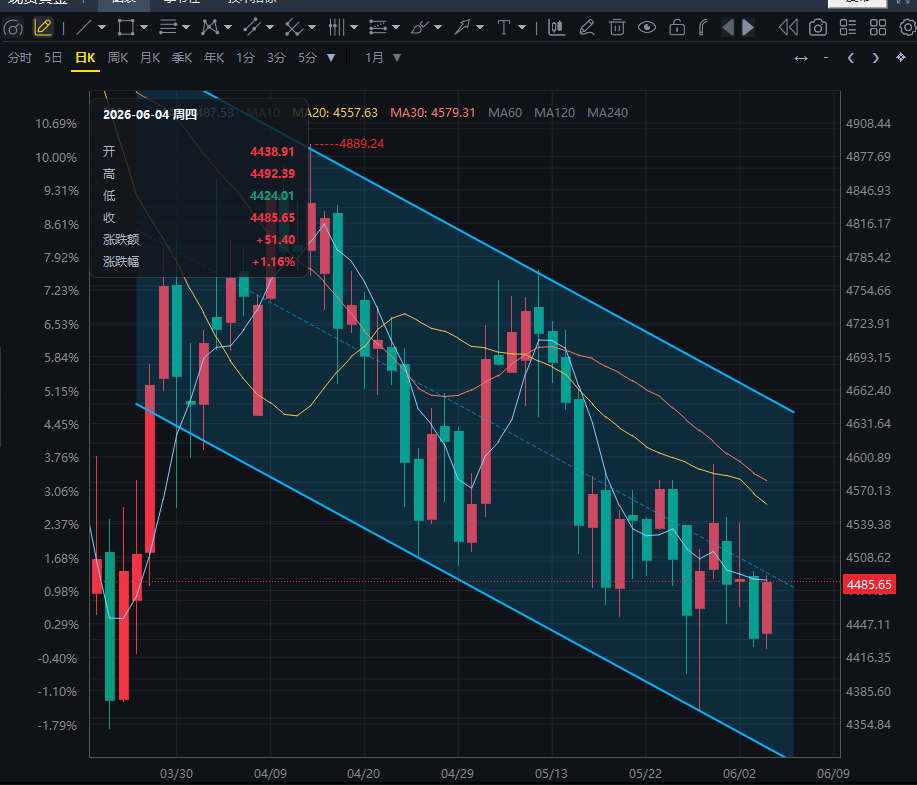
(Spot gold daily chart, source: FX678)
The US dollar index also weakened in tandem. This was due to two factors: first, the House of Representatives passed a vote against the power to wage war, which could restrain the US military from the perspectives of public opinion and future military spending; second, Trump stated that the ceasefire would continue as long as Iran did not cause any US casualties. However, in reality, the US military does not have the capability to continue a full-scale war, because launching a full-scale war after more than 60 days requires congressional approval, and Trump himself said that such applications are generally difficult to obtain.
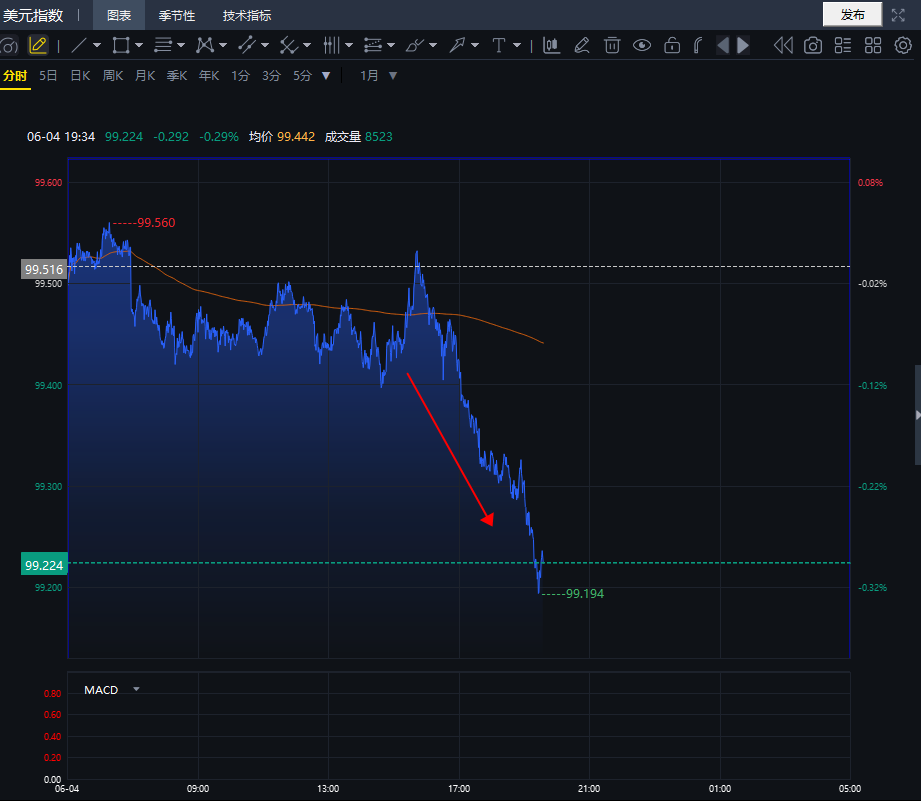
(US Dollar Index Daily Chart, Source: FX678)
However, from Iran's perspective, the situation may take a turn for the better. The draft resolution on the management of the Strait of Hormuz has entered the review stage, and Oman has withstood pressure from the United States to help improve the navigation mechanism based on the draft resolution.
If completed, Iran will become a country that helps lower global oil prices, while the United States will only be able to play the bad guy because it obstructs this passage mechanism. Companies that receive lower raw material costs and insurance prices will then choose to accept Iran's passage mechanism. At this point, an awkward scene will occur when passing ships pay Iran, meaning that all this good thing is thanks to the United States.
In terms of news, US President Trump stated that the House vote on war powers was meaningless and that the US is conducting final negotiations to end the war with Iran.
The draft law on the management of the Iranian Straits has entered a crucial stage of review, marking a substantial step forward in the restructuring of navigation rules.
Iran's control over the Strait of Hormuz is shifting from diplomatic statements to institutional implementation.
According to Iran's Mehr News Agency on June 3, the draft law on the management of the Strait of Hormuz has officially entered the review stage of the Supreme National Security Council, and will be submitted to the plenary parliament for a vote after the final opinions are integrated.
This long-awaited institutional design embodies the consensus of several core committees of the Iranian parliament—the National Security and Foreign Policy Committee, the Construction Committee, and the Internal Affairs Committee, among others. Multiple versions of the proposals previously put forward have been coordinated through several rounds of discussions to form a unified text, marking a substantial step forward in Iran's attempt to establish its control over the Straits through domestic legislation.
It is noteworthy that the core objective of this draft is not limited to regulating navigation order, but also implicitly includes Iran's strategic consideration of reshaping its regional energy discourse power. This stands in stark contrast to the "imminent negotiation agreement" touted by the Trump administration, and if ultimately implemented, it will fundamentally alter the existing landscape of the US-Iran rivalry.
Oman's refusal to sever diplomatic ties in response to pressure has sparked a dispute over international law, exacerbating geopolitical tensions and creating uncertainty regarding air traffic.
The navigation dispute in the Strait of Hormuz has escalated from a bilateral game to a multilateral struggle and legal conflict.
Oman has explicitly resisted US pressure to sever diplomatic ties with Iran, insisting on negotiating with Tehran on a Straits governance system in accordance with international law. Even in the face of bombing threats from the Trump administration and public accusations from Secretary of State Rubio, Oman has maintained its neutral mediating role.
Iran, meanwhile, is simultaneously pushing forward with practical controls by establishing the Persian Gulf Straits Authority (which has been sanctioned by the US Treasury Department), requiring all vessels to obtain permits for passage, and proposing to charge non-discriminatory environmental restoration fees. However, this plan has been explicitly opposed by the International Maritime Organization, whose Secretary-General emphasized to the UN Security Council on April 27 that there is no legal basis for charging passage fees in international straits and that it violates the core principle of the "right of transit" in the United Nations Convention on the Law of the Sea.
Sharp clashes between various parties have pushed Oman to the diplomatic brink, and the US Treasury Department's May 29 ban—prohibiting US citizens from receiving any air traffic-related services from Iran—has further exacerbated geopolitical tensions, making the conflict over navigation rules in the Strait even more difficult to resolve through diplomatic channels.
More than 60% of oil tankers secretly cross the strait, while cruise ship navigation sees marginal improvement.
The navigation restrictions imposed by the conflict did not completely block oil transport in the Strait of Hormuz; instead, they spurred the emergence of a new, covert shipping model.
According to monitoring data, only three oil tankers openly entered and exited the strait each day after the conflict (about one-tenth of the normal level). However, in May, 65% of fully loaded oil tankers leaving port chose to turn off their Automatic Identification System (AIS) and "pass secretly," only restoring their signals at their destination several weeks later. The number of such vessels sailing covertly has surged by nearly 600% compared to before.
Behind the concealed flow is a slow recovery on the supply side: Kpler data shows that the amount of oil tankers in the Gulf has dropped from a peak of 184 million barrels in March to 148 million barrels this week, with an average daily destocking rate of 710,000 barrels since May. Some of the oil tankers that are secretly sailing are suspected of using the corridor designated by Iran or passing close to the coastline of Oman, and may even have the tacit approval of the US Navy.
However, this recovery is unlikely to solve the fundamental predicament—the shutdown of approximately 11 million barrels per day of oil fields has been delayed due to a lack of export confidence, shipowners remain wary of risky areas, and Iran's attempt to control navigation rights through a toll system is forcing Gulf countries to accelerate the development of alternative oil pipelines. The global energy landscape is evolving in a more covert and fragmented direction, and the traditional strategic position of the Strait of Hormuz is facing permanent weakening.
Summary and Technical Analysis:
As mentioned in previous articles on gold, the price of gold may continue to fall after this rebound, because the United States has no control over the agreement and negotiations, and the negotiations are currently in vain.
However, from Iran's perspective, we can see that if gold continues to strengthen, it might be based on the logic discussed in this article: although the United States does not have the dominant power, Iran and Oman do have the ability to help restore shipping lanes. At the same time, it can instantly reverse the American public's and even the market's evaluation of the US war effort, making the US the bad guy, and a not-so-smart bad guy who shot himself in the foot.
At the same time, as Israel's ally, the market will re-examine Israel's actions and reflect on the United States accordingly. As the saying goes, "one is influenced by one's surroundings," and the evaluation of the United States' military action will be negatively affected.
Technical Analysis: Spot gold is currently hovering near the middle of its descending channel. Theoretically, this presents an opportunity to reduce positions on rallies. However, if the price of gold holds strongly above 4500, it may form a reversal pattern, consistent with the logic presented in this article.
(Spot gold daily chart, source: FX678)
The US dollar index also weakened in tandem. This was due to two factors: first, the House of Representatives passed a vote against the power to wage war, which could restrain the US military from the perspectives of public opinion and future military spending; second, Trump stated that the ceasefire would continue as long as Iran did not cause any US casualties. However, in reality, the US military does not have the capability to continue a full-scale war, because launching a full-scale war after more than 60 days requires congressional approval, and Trump himself said that such applications are generally difficult to obtain.
(US Dollar Index Daily Chart, Source: FX678)
- Risk Warning and Disclaimer
- The market involves risk, and trading may not be suitable for all investors. This article is for reference only and does not constitute personal investment advice, nor does it take into account certain users’ specific investment objectives, financial situation, or other needs. Any investment decisions made based on this information are at your own risk.