Global tech stocks plunge, gold shows resilience as US-Iran power struggle begins
2026-06-05 16:24:43
On Friday (June 5), spot gold rebounded slightly after hitting a low during the Asian and European sessions. It fell as much as 1% during the session and is currently trading around 4461, down 0.3%. Gold prices have shown strong resilience in the face of a contraction in risk appetite caused by a sharp pullback in global capital markets technology stocks.
The short-term decline in gold prices was mainly due to the temporary strengthening of the US dollar and the short-term suppression of the high-interest-rate environment. However, the substantial stagnation in US-Iran negotiations and the accelerated implementation of the Strait of Hormuz navigation regime reform have solidified the medium- and long-term geopolitical and inflationary support logic, limiting the deep weakening of gold prices. After the US dollar surged, it fluctuated and corrected, resulting in a divergent market trend.
Previously, the market was boosted by Trump's verbal promise of "reaching a peace agreement in the short term," as well as Iran's steady progress in implementing new regulations for the Strait of Hormuz and Oman's efforts to improve the navigation mechanism despite pressure from the United States, which led to a short-term rebound in gold prices. Currently, the US and Iran have different statements and are vying for control of the situation.

Trump had previously announced multiple times that a ceasefire agreement was imminent, and the two sides had agreed on a 60-day temporary ceasefire framework. The agreement was originally awaiting Trump's signature to take effect, but the US side proposed additional amendments at the last minute, bringing the negotiation process to an abrupt halt. The exchange of information between the two sides regarding the memorandum of understanding has been suspended for several days.
Iran has accurately identified the weaknesses of the United States: on the one hand, the United States is facing a shortage of key weapons and the replenishment cycle is as long as three years, making it difficult to launch another large-scale airstrike; on the other hand, the United States is divided in its domestic politics and its allies generally oppose the use of force. Relying on these dual advantages, Iran has firmly adhered to its bottom line at the negotiating table and refused to budge an inch.
Despite the completion of two rounds of indirect negotiations between the US and Iran in Oman, sporadic skirmishes have occurred repeatedly at sea recently. While the US claims that negotiations are progressing, the actual consultations have stalled, and Iran continues to hold the initiative in the negotiations.
The Strait of Hormuz carries a quarter of the world's seaborne crude oil trade. Previous geopolitical turmoil has driven up shipping insurance costs and reduced ship turnaround efficiency, continuously raising international oil prices and triggering imported inflation in many countries.
The draft bill on the management of the Iranian Straits is currently under review by the Supreme National Security Council and will be submitted to parliament for a vote. The bill plans to charge fees for supporting services such as navigation, search and rescue, waterway security, and marine pollution cleanup. Unlike transit tariffs, Iran believes that the relevant fees are in accordance with international maritime regulations. Oman is not afraid of pressure from the United States and insists on cooperating with Iran to build a standardized navigation system.
After the new regulations are implemented, although ships will need to pay additional service fees, the legalization and standardization of navigation rules will dispel most ship owners' concerns about risk aversion. A large number of oil tankers that previously sailed covertly can now clear customs in a regular manner. The total amount of crude oil circulation will increase, and the overall increase in supply can offset the increased passage costs per ship, thereby playing a role in stabilizing oil prices. As a result, the United States, which deliberately obstructed the implementation of the navigation mechanism, has gradually fallen into a passive position in public opinion.
Navigation has shown marginal improvement at present. Data shows that more than 60% of fully loaded oil tankers choose to turn off their ship positioning systems and secretly pass through the strait, and crude oil inventories in the Gulf continue to decline.
However, the covert shipping model lacks institutional guarantees, the stability of transportation is questionable, ship owners still have a risk-averse mentality, and due to the uncertainty of export prospects, there are still tens of millions of barrels of shut-down oil fields that have been unable to resume production for a long time, and the problem of high energy costs is difficult to solve in the short term.
The Trump administration is mired in a double dilemma of domestic and foreign policy: domestically, Democrats are attacking Republican war policies by focusing on high oil prices and inflation, several Republican lawmakers have defected, the House of Representatives is pushing forward a bill to limit the president’s power to wage war, and hawks in the party are opposing a hasty withdrawal of troops, resulting in a political tug-of-war.
Externally, Gulf states are concerned about potential retaliatory attacks from Iran on their domestic oil and gas facilities and have unanimously resisted the US plan to resume bombing operations.
On the Iran nuclear issue, Trump refused to replicate the 2015 Iran nuclear deal but was unable to come up with a viable alternative negotiation plan, resulting in a stalemate of neither war nor peace.
Iran, relying on the reality of the US's military shortcomings and the dual pressure from both inside and outside the country, has insisted on leaving the US no room for negotiation victory and has begun to take the initiative in the negotiations.
Gold prices have retreated in the short term due to the pressure from a strong dollar and high interest rates, but uncertainties surrounding US-Iran negotiations and energy and inflationary variables brought about by reforms to cross-strait navigation continue to provide bottom support for gold prices.
Recently, Federal Reserve Vice Chairman Williams stated that he remains optimistic that long-term inflation is under control.
Global central banks' continued gold purchases have solidified the medium- to long-term fundamentals of gold prices. 2025 marks the 16th consecutive year that global central banks have been net buyers of gold. In the first quarter, the increase in global official gold reserves remained stable. Many countries, including China, have optimized their foreign exchange reserve structures and enhanced the risk resistance of their assets by increasing their gold holdings.
The future trend of gold prices will be largely anchored to the progress of US-Iran negotiations and the pace of implementation of new regulations in the Taiwan Strait: if the two sides successfully reach a peace agreement and the Taiwan Strait achieves full and normalized navigation, the significant recovery in crude oil supply will drive up oil prices, and gold prices are expected to rebound sharply.
However, the recent contraction in global risk appetite may constrain gold prices. If gold prices rebound under pressure at this time, it will further reinforce the market's optimistic view on the Straits Exchange Foundation and the logic that inflation will decline.
Technical Analysis: Spot gold continues to trade within a descending channel, with the 5-day moving average and the middle channel line currently acting as key resistance levels.
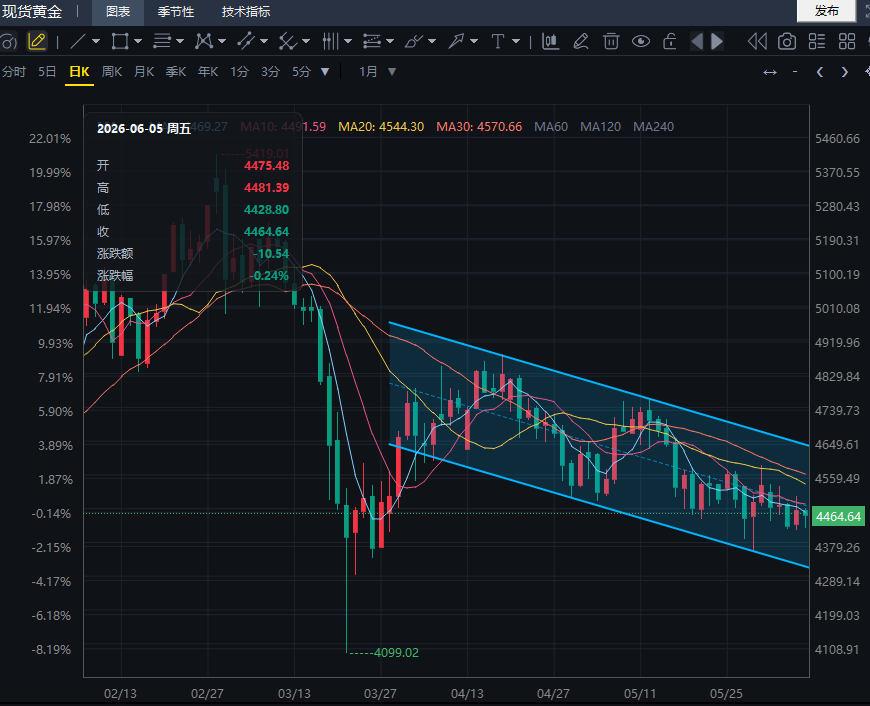
(Spot gold daily chart, source: FX678)
At 16:23 Beijing time, spot gold was trading at $4,463 per ounce.
The short-term decline in gold prices was mainly due to the temporary strengthening of the US dollar and the short-term suppression of the high-interest-rate environment. However, the substantial stagnation in US-Iran negotiations and the accelerated implementation of the Strait of Hormuz navigation regime reform have solidified the medium- and long-term geopolitical and inflationary support logic, limiting the deep weakening of gold prices. After the US dollar surged, it fluctuated and corrected, resulting in a divergent market trend.
Previously, the market was boosted by Trump's verbal promise of "reaching a peace agreement in the short term," as well as Iran's steady progress in implementing new regulations for the Strait of Hormuz and Oman's efforts to improve the navigation mechanism despite pressure from the United States, which led to a short-term rebound in gold prices. Currently, the US and Iran have different statements and are vying for control of the situation.
Negotiations repeatedly falter: Verbal promises fail to materialize, US-Iran talks stall in substance.
Trump had previously announced multiple times that a ceasefire agreement was imminent, and the two sides had agreed on a 60-day temporary ceasefire framework. The agreement was originally awaiting Trump's signature to take effect, but the US side proposed additional amendments at the last minute, bringing the negotiation process to an abrupt halt. The exchange of information between the two sides regarding the memorandum of understanding has been suspended for several days.
Iran has accurately identified the weaknesses of the United States: on the one hand, the United States is facing a shortage of key weapons and the replenishment cycle is as long as three years, making it difficult to launch another large-scale airstrike; on the other hand, the United States is divided in its domestic politics and its allies generally oppose the use of force. Relying on these dual advantages, Iran has firmly adhered to its bottom line at the negotiating table and refused to budge an inch.
Despite the completion of two rounds of indirect negotiations between the US and Iran in Oman, sporadic skirmishes have occurred repeatedly at sea recently. While the US claims that negotiations are progressing, the actual consultations have stalled, and Iran continues to hold the initiative in the negotiations.
The implementation of cross-strait regulations is accelerating: Iran and Afghanistan jointly establish new navigation rules, quietly transforming the shipping landscape.
The Strait of Hormuz carries a quarter of the world's seaborne crude oil trade. Previous geopolitical turmoil has driven up shipping insurance costs and reduced ship turnaround efficiency, continuously raising international oil prices and triggering imported inflation in many countries.
The draft bill on the management of the Iranian Straits is currently under review by the Supreme National Security Council and will be submitted to parliament for a vote. The bill plans to charge fees for supporting services such as navigation, search and rescue, waterway security, and marine pollution cleanup. Unlike transit tariffs, Iran believes that the relevant fees are in accordance with international maritime regulations. Oman is not afraid of pressure from the United States and insists on cooperating with Iran to build a standardized navigation system.
After the new regulations are implemented, although ships will need to pay additional service fees, the legalization and standardization of navigation rules will dispel most ship owners' concerns about risk aversion. A large number of oil tankers that previously sailed covertly can now clear customs in a regular manner. The total amount of crude oil circulation will increase, and the overall increase in supply can offset the increased passage costs per ship, thereby playing a role in stabilizing oil prices. As a result, the United States, which deliberately obstructed the implementation of the navigation mechanism, has gradually fallen into a passive position in public opinion.
Navigation has shown marginal improvement at present. Data shows that more than 60% of fully loaded oil tankers choose to turn off their ship positioning systems and secretly pass through the strait, and crude oil inventories in the Gulf continue to decline.
However, the covert shipping model lacks institutional guarantees, the stability of transportation is questionable, ship owners still have a risk-averse mentality, and due to the uncertainty of export prospects, there are still tens of millions of barrels of shut-down oil fields that have been unable to resume production for a long time, and the problem of high energy costs is difficult to solve in the short term.
The United States is beset by internal and external troubles: a split in government and opposition, and multiple predicaments hindering decision-making.
The Trump administration is mired in a double dilemma of domestic and foreign policy: domestically, Democrats are attacking Republican war policies by focusing on high oil prices and inflation, several Republican lawmakers have defected, the House of Representatives is pushing forward a bill to limit the president’s power to wage war, and hawks in the party are opposing a hasty withdrawal of troops, resulting in a political tug-of-war.
Externally, Gulf states are concerned about potential retaliatory attacks from Iran on their domestic oil and gas facilities and have unanimously resisted the US plan to resume bombing operations.
On the Iran nuclear issue, Trump refused to replicate the 2015 Iran nuclear deal but was unable to come up with a viable alternative negotiation plan, resulting in a stalemate of neither war nor peace.
Iran, relying on the reality of the US's military shortcomings and the dual pressure from both inside and outside the country, has insisted on leaving the US no room for negotiation victory and has begun to take the initiative in the negotiations.
Institutional backing and geopolitical factors suggest gold may find a bottom.
Gold prices have retreated in the short term due to the pressure from a strong dollar and high interest rates, but uncertainties surrounding US-Iran negotiations and energy and inflationary variables brought about by reforms to cross-strait navigation continue to provide bottom support for gold prices.
Recently, Federal Reserve Vice Chairman Williams stated that he remains optimistic that long-term inflation is under control.
Global central banks' continued gold purchases have solidified the medium- to long-term fundamentals of gold prices. 2025 marks the 16th consecutive year that global central banks have been net buyers of gold. In the first quarter, the increase in global official gold reserves remained stable. Many countries, including China, have optimized their foreign exchange reserve structures and enhanced the risk resistance of their assets by increasing their gold holdings.
Summary and Technical Analysis:
The future trend of gold prices will be largely anchored to the progress of US-Iran negotiations and the pace of implementation of new regulations in the Taiwan Strait: if the two sides successfully reach a peace agreement and the Taiwan Strait achieves full and normalized navigation, the significant recovery in crude oil supply will drive up oil prices, and gold prices are expected to rebound sharply.
However, the recent contraction in global risk appetite may constrain gold prices. If gold prices rebound under pressure at this time, it will further reinforce the market's optimistic view on the Straits Exchange Foundation and the logic that inflation will decline.
Technical Analysis: Spot gold continues to trade within a descending channel, with the 5-day moving average and the middle channel line currently acting as key resistance levels.
(Spot gold daily chart, source: FX678)
At 16:23 Beijing time, spot gold was trading at $4,463 per ounce.
- Risk Warning and Disclaimer
- The market involves risk, and trading may not be suitable for all investors. This article is for reference only and does not constitute personal investment advice, nor does it take into account certain users’ specific investment objectives, financial situation, or other needs. Any investment decisions made based on this information are at your own risk.