Warnings of yen intervention failed to halt the decline, with the pound/yen pair returning above 215 and approaching a three-week low.
2026-06-05 17:02:13
The British pound (GBP/JPY) strengthened again against the Japanese yen (JPY) during Friday's Asian trading session after a brief pullback, rebounding from an intraday low of 214.59 to above 215.00. As of press time, the pair is holding steady around 215, continuing its recent upward trend and poised for its third consecutive week of gains.

Previously, the yen had benefited from market speculation that the Japanese government might intervene in the foreign exchange market again, but this rebound was short-lived. As the market refocused on the significant interest rate differential between Japan and the UK, buying of the pound once again took the lead.
Recently, Japanese officials have frequently issued warnings about the currency market. On Friday, Finance Minister Takayama reiterated that the authorities are prepared to take "decisive action" against excessively volatile foreign exchange markets if necessary. This is one of a series of intervention signals released by the Japanese government this week.
However, judging from market reactions, these verbal interventions have had limited effect on reversing the yen's weakness. Investors generally believe that policy warnings alone are insufficient to change current global capital flows and the logic of carry trades. In fact, since rumors circulated in late April that Japanese authorities might intervene, most of the yen's gains have already been gradually absorbed by the market. Currently, the USD/JPY exchange rate is approaching the important 160 level again, reflecting the market's continued caution regarding the overall outlook for the yen.
Besides intervention factors, Japan's economic fundamentals have also limited the yen's performance. Recent high international energy prices have raised concerns that Japan, as an energy importer, will face greater cost pressures. Increased energy import costs could weaken corporate profits and household consumption, thus impacting overall economic growth prospects. Meanwhile, although Japanese government bond yields have risen somewhat, they remain relatively low compared to major European and American economies. This lower yield environment allows the yen to continue playing its role as a funding currency in the global foreign exchange market, leading to a continued flow of funds into asset markets with higher yields.
Bank of Japan Governor Kazuo Ueda recently made hawkish remarks, emphasizing that inflation has become a key consideration for future monetary policy. The market widely expects the Bank of Japan to raise interest rates further at its upcoming meeting. However, even so, Japanese interest rates remain significantly lower than those in the UK. The market believes that even if the Bank of Japan continues to tighten policy, its impact on narrowing the interest rate differential between the UK and Japan will be limited, thus unlikely to fundamentally change the medium- to long-term upward trend of the pound against the yen.
From a market sentiment perspective, investors still tend to leverage interest rate differentials for carry trades. The relatively high interest rate environment in the UK continues to attract international capital inflows, while the yen continues to face selling pressure from funding transactions.
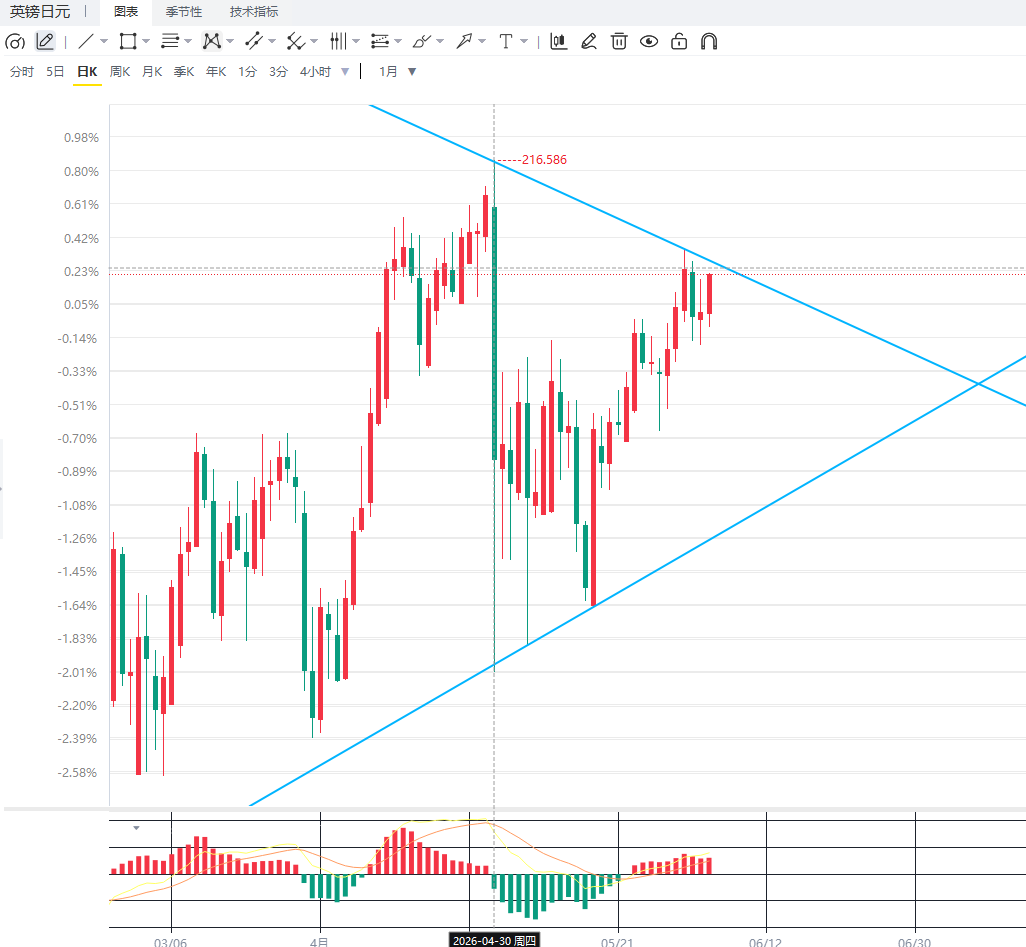
From a daily chart perspective, the GBP/JPY pair maintains a clear upward trend. The exchange rate has consistently traded above the upward trend line formed since mid-May, indicating that the bullish market structure remains solid. The current price is gradually approaching the previous high area, and bullish sentiment remains active. Technically, the daily MACD remains above the zero line, indicating that the medium-term upward trend has not been broken. The RSI indicator is in the neutral-to-strong zone, suggesting that the market still has room for further gains, but it is gradually approaching overbought territory in the short term.
From a 4-hour chart perspective, the exchange rate is currently consolidating around the 215 level. The RSI indicator is near the 60 level, indicating that the market maintains a mild bullish momentum. Although the MACD indicator is still slightly in negative territory, the bearish momentum is weakening, suggesting limited downward pressure. On the upside resistance front, the first resistance level to watch is the area around Thursday's high of 215.15, followed by the week's high of 215.55. A decisive break above these resistance levels could see the market further challenge the high of 216.60 reached on April 30th. On the downside support front, the 214.70 area, where the current upward trendline is located, forms the first support level; further support lies near the previous consolidation low of 214.35. A break below these areas could trigger a deeper correction, potentially testing the 213.30 area near the lows of May 21st and May 28th.
Editor's Summary : The current GBP/JPY exchange rate remains primarily driven by the UK-Japan interest rate differential. Despite the Japanese government's continued warnings of currency market intervention and the Bank of Japan's gradual signaling of policy normalization, the market still believes these factors are insufficient to fundamentally reverse the yen's weakness. In the short term, whether the Japanese government will take actual intervention action will be the focus of market attention. However, given the backdrop of high UK interest rates and relatively low Japanese yields, the GBP/JPY exchange rate is generally expected to maintain a relatively strong trend. Going forward, investors should pay close attention to the impact of the Bank of Japan's policy meeting, UK economic data, and changes in global risk sentiment on the exchange rate.
Previously, the yen had benefited from market speculation that the Japanese government might intervene in the foreign exchange market again, but this rebound was short-lived. As the market refocused on the significant interest rate differential between Japan and the UK, buying of the pound once again took the lead.
Recently, Japanese officials have frequently issued warnings about the currency market. On Friday, Finance Minister Takayama reiterated that the authorities are prepared to take "decisive action" against excessively volatile foreign exchange markets if necessary. This is one of a series of intervention signals released by the Japanese government this week.
However, judging from market reactions, these verbal interventions have had limited effect on reversing the yen's weakness. Investors generally believe that policy warnings alone are insufficient to change current global capital flows and the logic of carry trades. In fact, since rumors circulated in late April that Japanese authorities might intervene, most of the yen's gains have already been gradually absorbed by the market. Currently, the USD/JPY exchange rate is approaching the important 160 level again, reflecting the market's continued caution regarding the overall outlook for the yen.
Besides intervention factors, Japan's economic fundamentals have also limited the yen's performance. Recent high international energy prices have raised concerns that Japan, as an energy importer, will face greater cost pressures. Increased energy import costs could weaken corporate profits and household consumption, thus impacting overall economic growth prospects. Meanwhile, although Japanese government bond yields have risen somewhat, they remain relatively low compared to major European and American economies. This lower yield environment allows the yen to continue playing its role as a funding currency in the global foreign exchange market, leading to a continued flow of funds into asset markets with higher yields.
Bank of Japan Governor Kazuo Ueda recently made hawkish remarks, emphasizing that inflation has become a key consideration for future monetary policy. The market widely expects the Bank of Japan to raise interest rates further at its upcoming meeting. However, even so, Japanese interest rates remain significantly lower than those in the UK. The market believes that even if the Bank of Japan continues to tighten policy, its impact on narrowing the interest rate differential between the UK and Japan will be limited, thus unlikely to fundamentally change the medium- to long-term upward trend of the pound against the yen.
From a market sentiment perspective, investors still tend to leverage interest rate differentials for carry trades. The relatively high interest rate environment in the UK continues to attract international capital inflows, while the yen continues to face selling pressure from funding transactions.
From a daily chart perspective, the GBP/JPY pair maintains a clear upward trend. The exchange rate has consistently traded above the upward trend line formed since mid-May, indicating that the bullish market structure remains solid. The current price is gradually approaching the previous high area, and bullish sentiment remains active. Technically, the daily MACD remains above the zero line, indicating that the medium-term upward trend has not been broken. The RSI indicator is in the neutral-to-strong zone, suggesting that the market still has room for further gains, but it is gradually approaching overbought territory in the short term.
From a 4-hour chart perspective, the exchange rate is currently consolidating around the 215 level. The RSI indicator is near the 60 level, indicating that the market maintains a mild bullish momentum. Although the MACD indicator is still slightly in negative territory, the bearish momentum is weakening, suggesting limited downward pressure. On the upside resistance front, the first resistance level to watch is the area around Thursday's high of 215.15, followed by the week's high of 215.55. A decisive break above these resistance levels could see the market further challenge the high of 216.60 reached on April 30th. On the downside support front, the 214.70 area, where the current upward trendline is located, forms the first support level; further support lies near the previous consolidation low of 214.35. A break below these areas could trigger a deeper correction, potentially testing the 213.30 area near the lows of May 21st and May 28th.
Editor's Summary : The current GBP/JPY exchange rate remains primarily driven by the UK-Japan interest rate differential. Despite the Japanese government's continued warnings of currency market intervention and the Bank of Japan's gradual signaling of policy normalization, the market still believes these factors are insufficient to fundamentally reverse the yen's weakness. In the short term, whether the Japanese government will take actual intervention action will be the focus of market attention. However, given the backdrop of high UK interest rates and relatively low Japanese yields, the GBP/JPY exchange rate is generally expected to maintain a relatively strong trend. Going forward, investors should pay close attention to the impact of the Bank of Japan's policy meeting, UK economic data, and changes in global risk sentiment on the exchange rate.
- Risk Warning and Disclaimer
- The market involves risk, and trading may not be suitable for all investors. This article is for reference only and does not constitute personal investment advice, nor does it take into account certain users’ specific investment objectives, financial situation, or other needs. Any investment decisions made based on this information are at your own risk.