Unexpectedly strong non-farm payrolls and geopolitical events sent gold prices into a panic.
2026-06-05 21:20:32
The U.S. Bureau of Labor Statistics (BLS) released its May non-farm payrolls report on Friday morning, completely shattering market pessimism about the U.S. economy falling into "stagflation" due to geopolitics. At the same time, the double whammy of Lebanon's rejection of the ceasefire agreement caused gold to plunge by more than 1.5%, currently trading at $4,418 per ounce.
Data shows that the U.S. added 172,000 non-farm jobs in May, far exceeding the market's previous expectation of 85,000; even more shockingly, the April non-farm payrolls increase was revised up significantly from the initially announced 115,000 to 179,000.
Against the backdrop of two consecutive months of soaring unemployment, the US unemployment rate has remained steady at a low of 4.3% for the third consecutive month.
This comprehensive report sends a clear signal to the financial markets: after last year's downturn, the U.S. labor market is regaining momentum with an almost aggressive pace.
Previously, the market was extremely worried that the Iran war that broke out on February 28 (which led to a retail gasoline price increase of over 40% and a diesel price surge of 55%) and the bankruptcy of Spirit Airlines would trigger a chain of layoffs.
However, the actual data for May gave a negative answer. Mainstream Wall Street economists pointed out that the current US labor market is in a very rare state of resilient equilibrium characterized by "low hiring and low layoffs":
The wave of layoffs has not spread: Although Spirit Airlines went bankrupt in May, resulting in the loss of 18,000 jobs, and there were also some AI-related layoffs in the tech industry, the overall layoff rate in the United States remains firmly at a historical low.
The four-week moving average of initial jobless claims remains at a historical low, indicating that businesses are still inclined to "hoard labor" even in the face of high energy costs.
The Diffusion Index has improved substantially: the previous figure for April was revised upward by 64,000, directly overturning the previous assumption that the industry was "relying solely on the healthcare sector as a single engine for growth."
Hiring in more cyclical sectors of the private sector (such as construction, manufacturing, and trade and transportation) rebounded across the board in May, proving that the economy is not "inflated" but has substantial endogenous momentum.
On the wage side, the average hourly wage growth rate in May remained at 3.4% year-on-year (0.3% month-on-month). Although this figure has declined from the post-pandemic peak, it has become a "double-edged sword" in the eyes of the Federal Reserve in the current environment of high inflation.
On the one hand, the sustained wage growth rate of over 3.4% has provided a valuable purchasing power buffer for American consumers in the face of "inflation accelerating to 3.8% in April and wholesale inflation soaring to 6%", which is also the underlying logic for the continued strong hiring in industries such as retail, leisure and hospitality.
On the other hand, according to hawkish officials such as Federal Reserve Governor Cook and Cleveland Fed President Hammark, with trillions of dollars in AI investment driving up chip and data center prices and geopolitical crises pushing up oil prices, a wage growth of up to 3.4% is very likely to resonate with imported inflation, triggering the "wage-inflation spiral" that the market is most resistant to.
This non-farm payroll report, which far exceeded expectations, has undoubtedly set an absolutely hawkish tone for the upcoming Federal Reserve's June interest rate meeting.
It not only completely declared the bankruptcy of the "interest rate cut" option in the short term, but also pushed the market to the brink of "higher for longer".
Cleveland Fed President Hammark had previously warned that "current monetary policy may not be tight enough to bring inflation down to 2%." The 172,000 new jobs added in May and the significant upward revision of the previous figure provided hawkish officials with solid ground for their confidence.
The economy's resilience provides the Federal Reserve with a wider moat: strong job growth confirms that the real economy has not been crushed by high interest rates.
This means that while waging a “protracted war” against imported inflation triggered by the war with Iran, the Federal Reserve has ample room to maintain high interest rates for longer without worrying about the economy suddenly stalling.
The door to restarting interest rate hikes has been opened: Wall Street's swap market quickly reassessed the policy path after the data release. Some aggressive macro hedge fund analysts pointed out that if the May CPI inflation data to be released next week continues to rise along with the PPI, this "extremely excited" employment data will no longer just "support maintaining the current interest rate," but will force the Federal Reserve to reconsider "whether further interest rate hikes are needed" in the second half of the year.
The May non-farm payroll report shocked Wall Street with its stark figures, and the withdrawal of Lebanon from the ceasefire agreement dealt a significant blow to gold.
This non-farm payroll report, which showed a much larger-than-expected 172,000 jobs and a significant upward revision of the previous figure, directly cut off any chance for gold to rise in the short term.
The "hammer" of soaring real interest rates: Strong employment has completely shattered the Fed's recent illusion of rate cuts, and the swap market's expectations for a "higher for longer" period of high interest rates have been extended again.
This directly pushed up the real yields of US Treasury bonds and strongly boosted the US dollar, putting immense selling pressure on gold, a non-interest-bearing asset, in terms of holding costs.
Looking ahead, gold is caught in a tug-of-war between "geopolitical premium" and "the iron fist of the Federal Reserve".
Despite the supply chain crisis caused by the Iran war and wholesale inflation (PPI 6%) still providing long-term inflation-resistant support for gold prices, as long as this exciting jobs report keeps the Federal Reserve firmly on the "fight against inflation" interest rate hike chariot in the summer of 2026, a sword of Damocles will always hang over gold.
Whether gold bulls can mount an effective counterattack depends entirely on the May CPI inflation data to be released next week, which may trigger the ultimate alarm for the Federal Reserve to "restart interest rate hikes".
However, the good news is that the Governor of the Bank of England said that the initial value of the US non-farm payrolls is no longer reliable because it is always revised significantly. At the same time, the US-Iran conflict may lead the Trump camp to use non-farm payroll data to conclude that war is beneficial to the US economy. In addition, the holding of the World Cup may lead to an earlier shortage of service industry talent, which will affect the labor market.
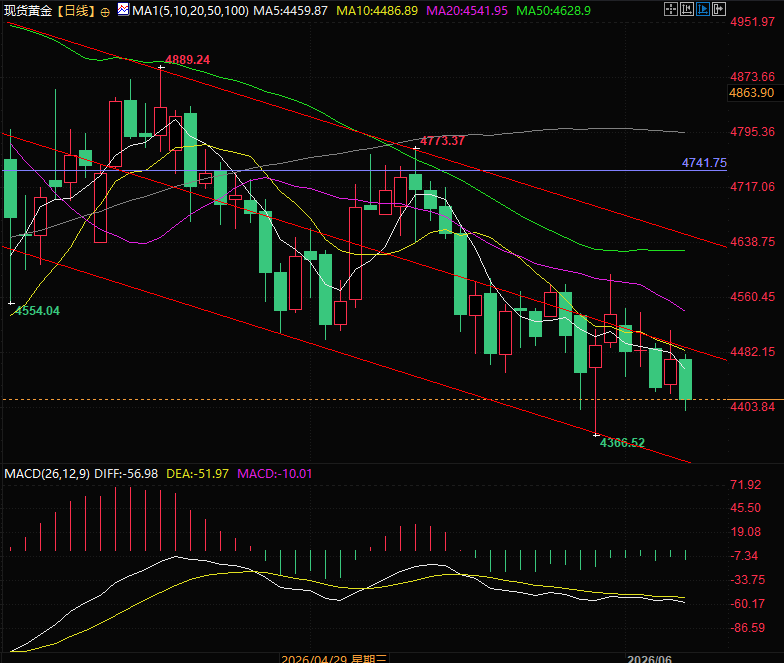
(Spot gold daily chart, source: FX678)
At 21:17 Beijing time, spot gold was trading at $4,416 per ounce.
Data shows that the U.S. added 172,000 non-farm jobs in May, far exceeding the market's previous expectation of 85,000; even more shockingly, the April non-farm payrolls increase was revised up significantly from the initially announced 115,000 to 179,000.
Against the backdrop of two consecutive months of soaring unemployment, the US unemployment rate has remained steady at a low of 4.3% for the third consecutive month.
This comprehensive report sends a clear signal to the financial markets: after last year's downturn, the U.S. labor market is regaining momentum with an almost aggressive pace.
"Low layoffs" form an impenetrable defense; geopolitical oil price impacts have not yet materialized.
Previously, the market was extremely worried that the Iran war that broke out on February 28 (which led to a retail gasoline price increase of over 40% and a diesel price surge of 55%) and the bankruptcy of Spirit Airlines would trigger a chain of layoffs.
However, the actual data for May gave a negative answer. Mainstream Wall Street economists pointed out that the current US labor market is in a very rare state of resilient equilibrium characterized by "low hiring and low layoffs":
The wave of layoffs has not spread: Although Spirit Airlines went bankrupt in May, resulting in the loss of 18,000 jobs, and there were also some AI-related layoffs in the tech industry, the overall layoff rate in the United States remains firmly at a historical low.
The four-week moving average of initial jobless claims remains at a historical low, indicating that businesses are still inclined to "hoard labor" even in the face of high energy costs.
The Diffusion Index has improved substantially: the previous figure for April was revised upward by 64,000, directly overturning the previous assumption that the industry was "relying solely on the healthcare sector as a single engine for growth."
Hiring in more cyclical sectors of the private sector (such as construction, manufacturing, and trade and transportation) rebounded across the board in May, proving that the economy is not "inflated" but has substantial endogenous momentum.
Wages and inflation are locked in a stalemate, with underlying tensions in "real purchasing power".
On the wage side, the average hourly wage growth rate in May remained at 3.4% year-on-year (0.3% month-on-month). Although this figure has declined from the post-pandemic peak, it has become a "double-edged sword" in the eyes of the Federal Reserve in the current environment of high inflation.
On the one hand, the sustained wage growth rate of over 3.4% has provided a valuable purchasing power buffer for American consumers in the face of "inflation accelerating to 3.8% in April and wholesale inflation soaring to 6%", which is also the underlying logic for the continued strong hiring in industries such as retail, leisure and hospitality.
On the other hand, according to hawkish officials such as Federal Reserve Governor Cook and Cleveland Fed President Hammark, with trillions of dollars in AI investment driving up chip and data center prices and geopolitical crises pushing up oil prices, a wage growth of up to 3.4% is very likely to resonate with imported inflation, triggering the "wage-inflation spiral" that the market is most resistant to.
The policy space has been completely opened up, and the Fed hawks have gained full control.
This non-farm payroll report, which far exceeded expectations, has undoubtedly set an absolutely hawkish tone for the upcoming Federal Reserve's June interest rate meeting.
It not only completely declared the bankruptcy of the "interest rate cut" option in the short term, but also pushed the market to the brink of "higher for longer".
Cleveland Fed President Hammark had previously warned that "current monetary policy may not be tight enough to bring inflation down to 2%." The 172,000 new jobs added in May and the significant upward revision of the previous figure provided hawkish officials with solid ground for their confidence.
The economy's resilience provides the Federal Reserve with a wider moat: strong job growth confirms that the real economy has not been crushed by high interest rates.
This means that while waging a “protracted war” against imported inflation triggered by the war with Iran, the Federal Reserve has ample room to maintain high interest rates for longer without worrying about the economy suddenly stalling.
The door to restarting interest rate hikes has been opened: Wall Street's swap market quickly reassessed the policy path after the data release. Some aggressive macro hedge fund analysts pointed out that if the May CPI inflation data to be released next week continues to rise along with the PPI, this "extremely excited" employment data will no longer just "support maintaining the current interest rate," but will force the Federal Reserve to reconsider "whether further interest rate hikes are needed" in the second half of the year.
Conclusion and Market Outlook: Gold Bull Market Suffers "Hawkish Blitz," Strong Non-Farm Payrolls Data Overturns Bullish Defenses
The May non-farm payroll report shocked Wall Street with its stark figures, and the withdrawal of Lebanon from the ceasefire agreement dealt a significant blow to gold.
This non-farm payroll report, which showed a much larger-than-expected 172,000 jobs and a significant upward revision of the previous figure, directly cut off any chance for gold to rise in the short term.
The "hammer" of soaring real interest rates: Strong employment has completely shattered the Fed's recent illusion of rate cuts, and the swap market's expectations for a "higher for longer" period of high interest rates have been extended again.
This directly pushed up the real yields of US Treasury bonds and strongly boosted the US dollar, putting immense selling pressure on gold, a non-interest-bearing asset, in terms of holding costs.
Looking ahead, gold is caught in a tug-of-war between "geopolitical premium" and "the iron fist of the Federal Reserve".
Despite the supply chain crisis caused by the Iran war and wholesale inflation (PPI 6%) still providing long-term inflation-resistant support for gold prices, as long as this exciting jobs report keeps the Federal Reserve firmly on the "fight against inflation" interest rate hike chariot in the summer of 2026, a sword of Damocles will always hang over gold.
Whether gold bulls can mount an effective counterattack depends entirely on the May CPI inflation data to be released next week, which may trigger the ultimate alarm for the Federal Reserve to "restart interest rate hikes".
However, the good news is that the Governor of the Bank of England said that the initial value of the US non-farm payrolls is no longer reliable because it is always revised significantly. At the same time, the US-Iran conflict may lead the Trump camp to use non-farm payroll data to conclude that war is beneficial to the US economy. In addition, the holding of the World Cup may lead to an earlier shortage of service industry talent, which will affect the labor market.
(Spot gold daily chart, source: FX678)
At 21:17 Beijing time, spot gold was trading at $4,416 per ounce.
- Risk Warning and Disclaimer
- The market involves risk, and trading may not be suitable for all investors. This article is for reference only and does not constitute personal investment advice, nor does it take into account certain users’ specific investment objectives, financial situation, or other needs. Any investment decisions made based on this information are at your own risk.