Did non-farm payroll data trigger a massive sell-off in the bond market? Bonds surged by 93,000 in the first two months! What dramatic twists and turns will the Fed's June meeting bring?
2026-06-05 21:59:29
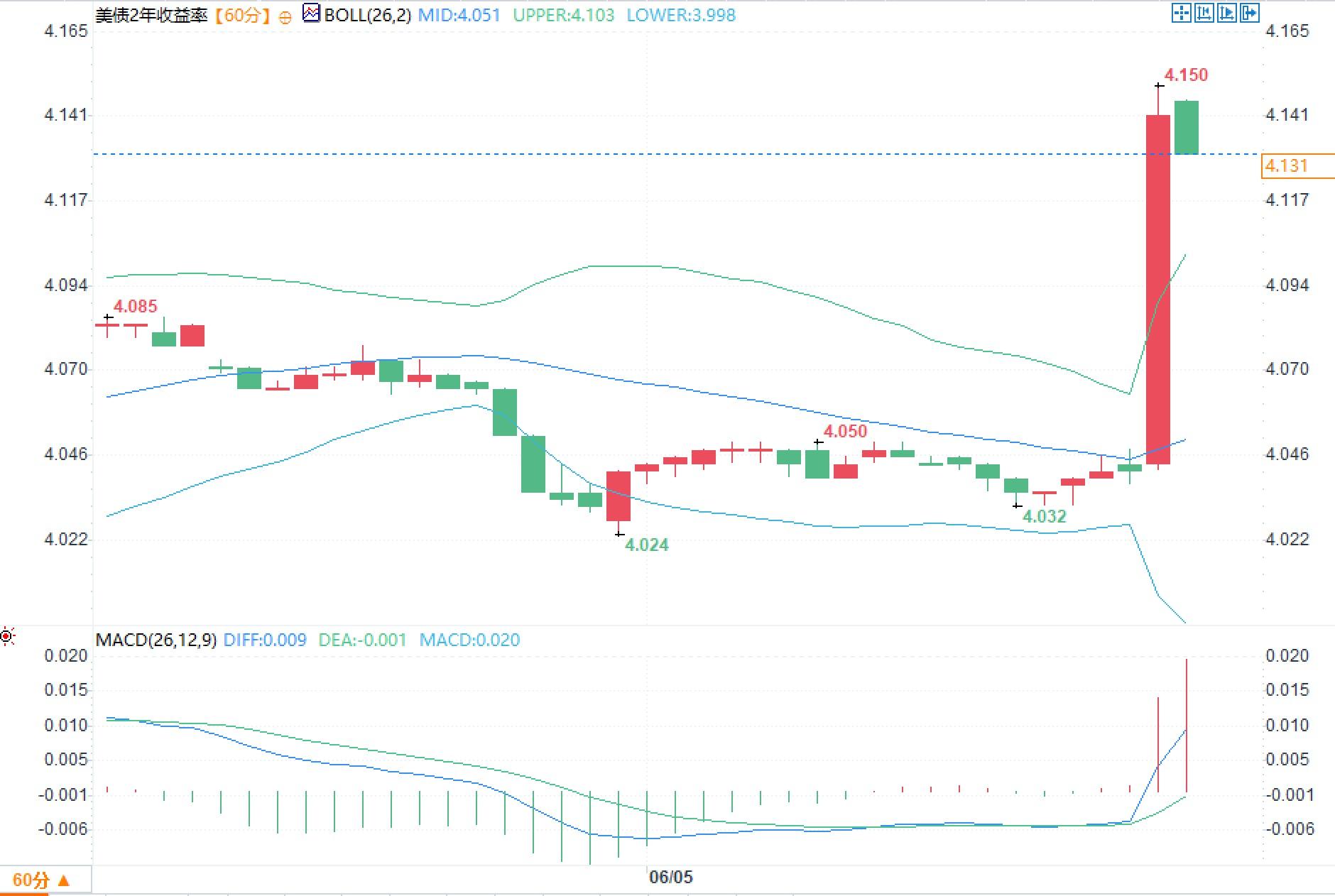
On Friday, June 5th, the market's main focus was on the repricing of the US May employment data. The US added 172,000 non-farm payroll jobs in May, the unemployment rate remained at 4.3%, the labor force participation rate was 61.8%, and average hourly earnings rose 3.4% year-on-year. This data significantly weakened the narrative of declining interest rates and caused US Treasury yields to rise across the board after the data release. The 2-year Treasury yield rose to approximately 4.13%, and the 10-year Treasury yield rose to approximately 4.54%, indicating that the short end reacted more directly to the policy path.

The core impact of this jobs report lies not in the absolute number of 172,000 jobs added in a single month, but in its continuity with the upward revisions of the previous two months. March's non-farm payrolls were revised upward from 185,000 to 214,000, and April's from 115,000 to 179,000, a total upward revision of 93,000 over the two months. This means that the market's previous narrative of "low hiring, low layoffs, and cooling demand" has cracked, and the labor market has not weakened as quickly as expected.
From a pricing perspective, the policy-sensitive 2-year yield reacted more strongly, indicating that the market is repricing the Fed's response function. Previously, interest rate futures still held the expectation of further easing this year, but after the employment data release, the probability of a December rate hike was significantly revised upwards. Some market analysts indicate that the probability of a year-end rate hike has risen to 65%, higher than the 48% before the data release. This does not confirm that the Fed will inevitably raise rates, but rather indicates that the yield curve needs to absorb the combined risks of "unreceding inflation and persistently strong employment."
The breakdown by sector shows that employment improvement was concentrated in the service sector and the public sector. The leisure and hospitality industry added 70,000 jobs, far exceeding the 12-month average monthly increase of 14,000, with 48,000 of those coming from food and beverage establishments; local government added 55,000; and healthcare added 35,000. Conversely, financial activities saw a decrease of 22,000 jobs, air transport a decrease of 9,000, and overall transportation and warehousing employment saw limited change. This structure indicates that demand was not uniformly increasing, but rather that service consumption, healthcare, and public sector filling gaps while some interest rate-sensitive sectors contracted.
Wages did not signal a runaway trend. Average hourly earnings rose 0.3% month-over-month and 3.4% year-over-year in May, with average weekly hours remaining stable at 34.3. For bond traders, this means stronger-than-expected employment figures, but the evidence for a wage-price spiral is insufficient. What truly worries the market is that moderate wages cannot offset the pressure on inflation expectations from energy prices, tariff transmission, and supply shocks. In other words, the hawkish implication of this data stems from "employment resilience increasing policy tolerance," rather than simply from runaway wages.
In the current context, the Federal Reserve is not only facing employment data. The Middle East conflict has kept energy prices high; WTI crude oil was still around $92 per barrel on June 5th, and Brent crude oil was around $94 per barrel, with oil prices still significantly higher than the same period last year. The impact of energy prices on inflation is not limited to gasoline; it also spreads along the transportation, aviation fuel, chemical, and food logistics chains.
Market analysts believe that the cost of tariffs is gradually being reflected in inflation, and higher oil prices are also putting new pressure on overall inflation, potentially pushing back the expected return of US inflation to the 2% target from mid-2027 to the end of 2027. The market's real concern is that the Federal Reserve lacks a reason to quickly shift to an easing stance, especially given that the employment situation has not weakened significantly.
The Federal Reserve is currently maintaining its target range for the federal funds rate at 3.5% to 3.75%, and emphasizing that it will adjust policy based on employment, inflation, expectations, and international financial conditions. In other words, the current policy stance is not pre-set for rate cuts, but rather data-dependent. Following the stronger-than-expected non-farm payrolls data in May, the June meeting is likely to remain on the sidelines.
Interest rate strategists believe that the recent acceleration in employment data, coupled with inflation risks related to the Strait of Hormuz, has given the market a second reason to reconsider the risks of interest rate hikes. This statement highlights the core of this round of US Treasury sell-offs: it's not a single employment data point that alters the year's trajectory, but rather that employment, oil prices, inflation expectations, and central bank communication have collectively compressed the bond market's margin for error.
Question 1: Why did the May non-farm payrolls report significantly impact US Treasury bonds?
A: Because the number of new jobs increased by 172,000, and the total number of jobs in the first two months was revised upward by 93,000, it indicates that labor demand is stronger than the market previously estimated. This weakens the case for the Federal Reserve to cut interest rates in the short term, making short-term yields more sensitive.
Question 2: Does a 3.4% year-on-year increase in wages mean that inflation is out of control?
A: It doesn't directly mean out of control, but with high oil prices and tariffs at play, modest wages are not enough to dispel inflation alarms.
Question 3: Is an interest rate hike this year a foregone conclusion?
A: No. Futures probabilities reflect market risk pricing and are not equivalent to policy commitments. Futures outcomes still depend on inflation, employment revisions, energy prices, and communication with the Federal Reserve.
The better-than-expected non-farm payrolls data shifted the market's focus from hopes for interest rate cuts to the risk of interest rate hikes.
The core impact of this jobs report lies not in the absolute number of 172,000 jobs added in a single month, but in its continuity with the upward revisions of the previous two months. March's non-farm payrolls were revised upward from 185,000 to 214,000, and April's from 115,000 to 179,000, a total upward revision of 93,000 over the two months. This means that the market's previous narrative of "low hiring, low layoffs, and cooling demand" has cracked, and the labor market has not weakened as quickly as expected.
From a pricing perspective, the policy-sensitive 2-year yield reacted more strongly, indicating that the market is repricing the Fed's response function. Previously, interest rate futures still held the expectation of further easing this year, but after the employment data release, the probability of a December rate hike was significantly revised upwards. Some market analysts indicate that the probability of a year-end rate hike has risen to 65%, higher than the 48% before the data release. This does not confirm that the Fed will inevitably raise rates, but rather indicates that the yield curve needs to absorb the combined risks of "unreceding inflation and persistently strong employment."
The employment structure is not overheated across the board, but it is enough to change policy communication.
The breakdown by sector shows that employment improvement was concentrated in the service sector and the public sector. The leisure and hospitality industry added 70,000 jobs, far exceeding the 12-month average monthly increase of 14,000, with 48,000 of those coming from food and beverage establishments; local government added 55,000; and healthcare added 35,000. Conversely, financial activities saw a decrease of 22,000 jobs, air transport a decrease of 9,000, and overall transportation and warehousing employment saw limited change. This structure indicates that demand was not uniformly increasing, but rather that service consumption, healthcare, and public sector filling gaps while some interest rate-sensitive sectors contracted.
Wages did not signal a runaway trend. Average hourly earnings rose 0.3% month-over-month and 3.4% year-over-year in May, with average weekly hours remaining stable at 34.3. For bond traders, this means stronger-than-expected employment figures, but the evidence for a wage-price spiral is insufficient. What truly worries the market is that moderate wages cannot offset the pressure on inflation expectations from energy prices, tariff transmission, and supply shocks. In other words, the hawkish implication of this data stems from "employment resilience increasing policy tolerance," rather than simply from runaway wages.
Oil prices and inflation expectations create a second layer of pressure.
In the current context, the Federal Reserve is not only facing employment data. The Middle East conflict has kept energy prices high; WTI crude oil was still around $92 per barrel on June 5th, and Brent crude oil was around $94 per barrel, with oil prices still significantly higher than the same period last year. The impact of energy prices on inflation is not limited to gasoline; it also spreads along the transportation, aviation fuel, chemical, and food logistics chains.
Market analysts believe that the cost of tariffs is gradually being reflected in inflation, and higher oil prices are also putting new pressure on overall inflation, potentially pushing back the expected return of US inflation to the 2% target from mid-2027 to the end of 2027. The market's real concern is that the Federal Reserve lacks a reason to quickly shift to an easing stance, especially given that the employment situation has not weakened significantly.
The signal from the yield curve: not a one-sided strength, but a return to normalcy in the policy premium.
The Federal Reserve is currently maintaining its target range for the federal funds rate at 3.5% to 3.75%, and emphasizing that it will adjust policy based on employment, inflation, expectations, and international financial conditions. In other words, the current policy stance is not pre-set for rate cuts, but rather data-dependent. Following the stronger-than-expected non-farm payrolls data in May, the June meeting is likely to remain on the sidelines.
Interest rate strategists believe that the recent acceleration in employment data, coupled with inflation risks related to the Strait of Hormuz, has given the market a second reason to reconsider the risks of interest rate hikes. This statement highlights the core of this round of US Treasury sell-offs: it's not a single employment data point that alters the year's trajectory, but rather that employment, oil prices, inflation expectations, and central bank communication have collectively compressed the bond market's margin for error.
Frequently Asked Questions
Question 1: Why did the May non-farm payrolls report significantly impact US Treasury bonds?
A: Because the number of new jobs increased by 172,000, and the total number of jobs in the first two months was revised upward by 93,000, it indicates that labor demand is stronger than the market previously estimated. This weakens the case for the Federal Reserve to cut interest rates in the short term, making short-term yields more sensitive.
Question 2: Does a 3.4% year-on-year increase in wages mean that inflation is out of control?
A: It doesn't directly mean out of control, but with high oil prices and tariffs at play, modest wages are not enough to dispel inflation alarms.
Question 3: Is an interest rate hike this year a foregone conclusion?
A: No. Futures probabilities reflect market risk pricing and are not equivalent to policy commitments. Futures outcomes still depend on inflation, employment revisions, energy prices, and communication with the Federal Reserve.
- Risk Warning and Disclaimer
- The market involves risk, and trading may not be suitable for all investors. This article is for reference only and does not constitute personal investment advice, nor does it take into account certain users’ specific investment objectives, financial situation, or other needs. Any investment decisions made based on this information are at your own risk.