A chart shows that the Baltic Dry Index closed lower, with freight rates for most major vessel types weakening and recording a significant weekly decline.
2026-06-05 22:43:47
The latest data shows that the Baltic Dry Index (BDI) was 2981 points on June 5, 2026, a new low since May 21, 2026, down 1.84% month-on-month, marking the sixth consecutive day of decline (including zero growth). Looking at the short-term charts, the recent 11 BDI data points show: 4 positive increases, 7 negative increases, and 0 zero increases. Specifically, the Panamax Freight Index (BPI) was 2236 points, down 0.80% from the previous value; the Capesize Freight Index (BCI) was 4893 points, down 2.92%; and the Supramax Freight Index (BSI) was 1588 points, up 0.25%. For detailed 720-day and 10-year trend charts of the Baltic Dry Index and its three main sub-indices, please refer to the specially designed charts.
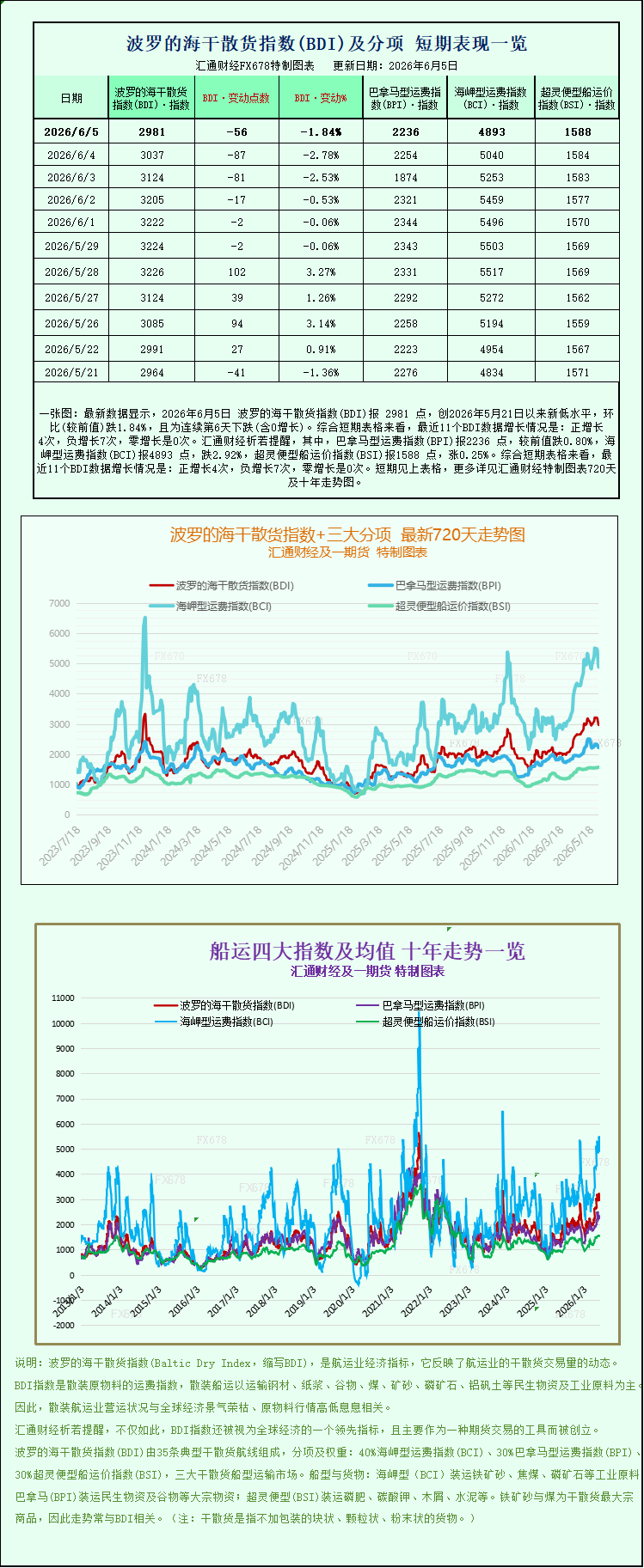
The international shipping market continued its weakening trend, with the Baltic Dry Index (BDI) falling again on Friday, ultimately closing with a significant weekly decline, highlighting the overall sluggish demand in the market. This decline was primarily driven by a sharp drop in freight rates for the two main types of dry bulk carriers: Capesize and Panamax. As the mainstay of the dry bulk shipping market, the decline in these two vessel types directly dragged down the overall index, reflecting a temporary cooling in global demand for dry bulk commodity transportation.
Data shows that the Baltic Dry Index, which tracks freight rates for the three major bulk carrier types—Capesize, Panamax, and Supramax—fell 56 points on the day, a daily drop of 1.8%, closing at 2981 points. Looking at the weekly trend, the index has fallen sharply by 7.5% this week, ending its previous period of stability and marking a significant weekly pullback, indicating a substantial decline in overall shipping market sentiment.
The Capesize vessel market, the mainstay of large dry bulk shipping, faced the most significant pressure, experiencing the largest decline among all vessel types. The Capesize freight rate index fell sharply by 147 points on the day, a daily drop of 2.9%, closing at 4893 points. The cumulative decline this week reached a staggering 11.1%, becoming the core factor dragging down the overall market. In terms of market profitability, the equivalent daily earnings of Capesize vessels with a deadweight tonnage of 150,000 tons, primarily carrying bulk industrial raw materials such as iron ore and coal, declined sharply, with daily revenue decreasing by $1333, and the latest average daily earnings falling to $40871. The profit margin for large industrial raw material shipping continues to shrink.
Weak demand for raw materials is the core reason suppressing Capesize freight rates. On Friday, international iron ore prices fluctuated, with relatively limited price movements, but the fundamental weakness remained unchanged. As the world's largest iron ore consumer, China's domestic steel producers are experiencing continuously narrowing profit margins. Pressure on industry profitability has led to generally low purchasing intentions among steel mills, with a significant decrease in their willingness to replenish inventory and actively acquire goods, directly resulting in weak spot demand for iron ore. Affected by this, iron ore prices are likely to continue their downward trend, potentially marking the fourth consecutive week of decline. Insufficient upstream raw material demand will further transmit to the shipping market, suppressing demand and freight rates for large bulk carriers.
Panamax vessels, the main medium-sized vessel type, also failed to escape the downward trend, with market performance weakening accordingly. Data shows that the Panamax freight rate index fell slightly by 18 points to close at 2236 points, with a cumulative weekly decline of 4.6%, indicating a cooling in the medium-sized dry bulk shipping market. In terms of revenue, the average daily earnings of Panamax vessels, which mainly carry 60,000 to 70,000 tons of commodities such as coal and grain, also shrank, decreasing by $164 per day to a latest average daily earnings of $20,121, reflecting a temporary weakness in demand for industrial energy and food shipping.
In the small vessel sector, the Supramax bulk carrier index followed the overall market trend, with the market generally weak. Affected by the cooling demand in the overall dry bulk market and the decline in freight rates for major vessel types, the small bulk carrier transportation market was also under pressure. The entire category of bulk shipping market showed a general decline, and the overall industry prosperity declined in the short term.
The international shipping market continued its weakening trend, with the Baltic Dry Index (BDI) falling again on Friday, ultimately closing with a significant weekly decline, highlighting the overall sluggish demand in the market. This decline was primarily driven by a sharp drop in freight rates for the two main types of dry bulk carriers: Capesize and Panamax. As the mainstay of the dry bulk shipping market, the decline in these two vessel types directly dragged down the overall index, reflecting a temporary cooling in global demand for dry bulk commodity transportation.
Data shows that the Baltic Dry Index, which tracks freight rates for the three major bulk carrier types—Capesize, Panamax, and Supramax—fell 56 points on the day, a daily drop of 1.8%, closing at 2981 points. Looking at the weekly trend, the index has fallen sharply by 7.5% this week, ending its previous period of stability and marking a significant weekly pullback, indicating a substantial decline in overall shipping market sentiment.
The Capesize vessel market, the mainstay of large dry bulk shipping, faced the most significant pressure, experiencing the largest decline among all vessel types. The Capesize freight rate index fell sharply by 147 points on the day, a daily drop of 2.9%, closing at 4893 points. The cumulative decline this week reached a staggering 11.1%, becoming the core factor dragging down the overall market. In terms of market profitability, the equivalent daily earnings of Capesize vessels with a deadweight tonnage of 150,000 tons, primarily carrying bulk industrial raw materials such as iron ore and coal, declined sharply, with daily revenue decreasing by $1333, and the latest average daily earnings falling to $40871. The profit margin for large industrial raw material shipping continues to shrink.
Weak demand for raw materials is the core reason suppressing Capesize freight rates. On Friday, international iron ore prices fluctuated, with relatively limited price movements, but the fundamental weakness remained unchanged. As the world's largest iron ore consumer, China's domestic steel producers are experiencing continuously narrowing profit margins. Pressure on industry profitability has led to generally low purchasing intentions among steel mills, with a significant decrease in their willingness to replenish inventory and actively acquire goods, directly resulting in weak spot demand for iron ore. Affected by this, iron ore prices are likely to continue their downward trend, potentially marking the fourth consecutive week of decline. Insufficient upstream raw material demand will further transmit to the shipping market, suppressing demand and freight rates for large bulk carriers.
Panamax vessels, the main medium-sized vessel type, also failed to escape the downward trend, with market performance weakening accordingly. Data shows that the Panamax freight rate index fell slightly by 18 points to close at 2236 points, with a cumulative weekly decline of 4.6%, indicating a cooling in the medium-sized dry bulk shipping market. In terms of revenue, the average daily earnings of Panamax vessels, which mainly carry 60,000 to 70,000 tons of commodities such as coal and grain, also shrank, decreasing by $164 per day to a latest average daily earnings of $20,121, reflecting a temporary weakness in demand for industrial energy and food shipping.
In the small vessel sector, the Supramax bulk carrier index followed the overall market trend, with the market generally weak. Affected by the cooling demand in the overall dry bulk market and the decline in freight rates for major vessel types, the small bulk carrier transportation market was also under pressure. The entire category of bulk shipping market showed a general decline, and the overall industry prosperity declined in the short term.
- Risk Warning and Disclaimer
- The market involves risk, and trading may not be suitable for all investors. This article is for reference only and does not constitute personal investment advice, nor does it take into account certain users’ specific investment objectives, financial situation, or other needs. Any investment decisions made based on this information are at your own risk.