Gold Trading Alert: Breaking News! Iranian missiles strike Israeli airbase at night, oil prices jump, is the battle to defend gold at $4,300 underway?
2026-06-08 07:17:05
Amidst the rapidly deteriorating situation in the Middle East, the international gold market is experiencing significant volatility. From the evening of June 7th to the early morning of June 8th, 2026, the Iranian Revolutionary Guard launched multiple ballistic missile strikes against an airbase in northern Israel. This "warning" strike directly impacted the already fragile US-Iran ceasefire agreement and further pressured the global energy supply chain. Although oil prices jumped over 3% to $93.90 per barrel in early trading on Monday (June 8th), spot gold gradually recovered its losses after a slight dip on Monday, currently trading around $4330 per ounce. The safe-haven logic of geopolitical conflict and the strong downward pressure from expectations of a Fed rate hike are locked in a struggle, making the future direction of gold highly uncertain.

Late on June 7 local time, the Iranian Islamic Revolutionary Guard Corps Aerospace Force launched a ballistic missile attack on the Ramat David Air Base in northern Israel. Iran stated explicitly that this action was a response to Israel's recent military operations in southern Lebanon and the southern suburbs of Beirut, aimed at warning Israel to cease its hostile actions. If Israel continues to escalate its actions, Iran's response will likely expand further, potentially covering more US and Israeli targets.
The Israeli military responded swiftly, claiming to have successfully intercepted all incoming missiles and announcing a "strong response." An IDF spokesperson emphasized that the military would continue operations throughout Lebanon and intensify its crackdown on Hezbollah. Israel was placed on high alert nationwide, with air raid sirens sounding, educational activities banned, and public gatherings strictly restricted.
This series of events brought the already fragile regional ceasefire agreement to the brink of collapse. The Strait of Hormuz, a global energy chokepoint, was almost completely closed, severely impacting the supply chains of crude oil, refined petroleum products, and natural gas, directly driving up international oil prices. WTI crude oil rose by more than 3% at one point, reaching a high of $93.90 per barrel, before slightly retreating to around $92.80 following comments from Trump.
The intervention of US President Trump has added further complexity to the situation. On the one hand, Trump received a briefing on the situation and declared that US troops were on high alert; on the other hand, he explicitly urged Iran to "return to the negotiating table and reach an agreement." He expressed his dissatisfaction with Israel's earlier airstrikes on the southern outskirts of Beirut and stated that he would personally call Israeli Prime Minister Netanyahu to pressure him not to retaliate.
Trump emphasized that a US-Iran agreement was "within reach," and that Iran's missile strikes would not change the negotiation process. He even stated bluntly that Netanyahu "had no choice but to accept the agreement," leaving everything to him. If the agreement ultimately fails, he did not rule out considering a raid on Iran or maintaining a strong blockade. These statements limited oil price increases to some extent and injected some uncertainty into the gold market—short-term risk aversion increased, but if the conflict de-escalates quickly, risk assets may rebound.
According to Al Jazeera, citing Israel's Channel 12, during a phone call with US President Trump, Israeli Prime Minister Benjamin Netanyahu attempted to oppose Trump's demand for "no retaliation against Iran." However, Netanyahu ultimately accepted this position.
Over the past week, hostilities in the Middle East have continued to escalate, dimming the prospects for peace talks. This months-long conflict has not only impacted energy prices but also exacerbated global inflation concerns.
According to Iran's semi-official Tasnim News Agency, citing military sources, Iran has prepared a sufficient number of missiles that can be launched at any time should Israel take retaliatory action.
Sources say Iran's next wave of attacks will be larger and will extend to more targets within Israel. Iran is prepared for a larger-scale confrontation should Israel respond, aiming to deter and demonstrate its retaliatory capabilities.
Gold's weakness is not solely due to geopolitical events. Last Friday (June 5th), the US released its May non-farm payroll report, far exceeding expectations, with 172,000 new jobs added, double the market forecast, and the unemployment rate remaining stable at 4.3%. This strong data significantly solidified market expectations that the Federal Reserve would maintain high interest rates or even raise them.
Spot gold fell about 3.3% on Friday, hitting a low of $4,311.74 per ounce, its lowest level since March 24, with a cumulative decline of nearly 4.68% for the week. August gold futures also fell sharply. Analysts pointed out that although gold is traditionally a tool for hedging against inflation, the high-interest-rate environment significantly increases the opportunity cost of holding non-interest-bearing assets. A stronger dollar and rising US Treasury yields further suppressed gold prices.
TD Securities and other institutions believe that given the high energy prices and significant inflationary pressures, the Federal Reserve is unlikely to shift to an easing stance anytime soon. The CME FedWatch tool shows the probability of a December rate hike has risen to approximately 70%. Weak gold demand from India and China has also failed to provide sufficient support.
Currently, spot gold is fluctuating between $4310 and $4330. On Monday morning, it dipped slightly to $4310.24 due to a jump in oil prices, but subsequently recovered its losses following Trump's "no retaliation" statement. This movement reflects market divergence on the evolution of the conflict: on the one hand, Iranian attacks and potential Israeli retaliation could push up oil prices and exacerbate inflation, benefiting gold's safe-haven appeal; on the other hand, if Trump successfully mediates and negotiations return to normal, easing risk sentiment would put downward pressure on gold.
From a longer-term perspective, gold prices have fallen by more than 17% since the outbreak of related conflicts at the end of February. In the current environment, gold faces dual pressures: geopolitical risks provide support, but the Federal Reserve's policy path poses a major obstacle. The upcoming US May CPI data this week will be a key indicator—if inflation exceeds expectations, market expectations for interest rate hikes may further intensify, putting pressure on gold prices; if the data is moderate, gold may have a chance to breathe.
Overall, the Iranian missile attack on Israel once again highlights the fragility of the Middle East situation, which may continue to provide safe-haven buying support for gold in the short term. However, strong US economic data and the potential path of interest rate hikes by the Federal Reserve remain the main obstacles to gold price increases. Investors need to closely monitor the progress of US-Iran negotiations, Israel's subsequent actions, and next week's US inflation data.
In the current complex environment, gold is not in a one-sided trend. Aggressive investors may focus on support around $4,300 and potential rebounds, while a more conservative strategy suggests waiting for further clarity on the situation. Geopolitical risks and macroeconomic policy maneuvering will continue to dominate the gold market, and any dominance by either side could trigger significant volatility. As a traditional safe-haven asset, gold retains strategic value in times of uncertainty, but short-term trading requires close monitoring for the risk of a shift in market sentiment.
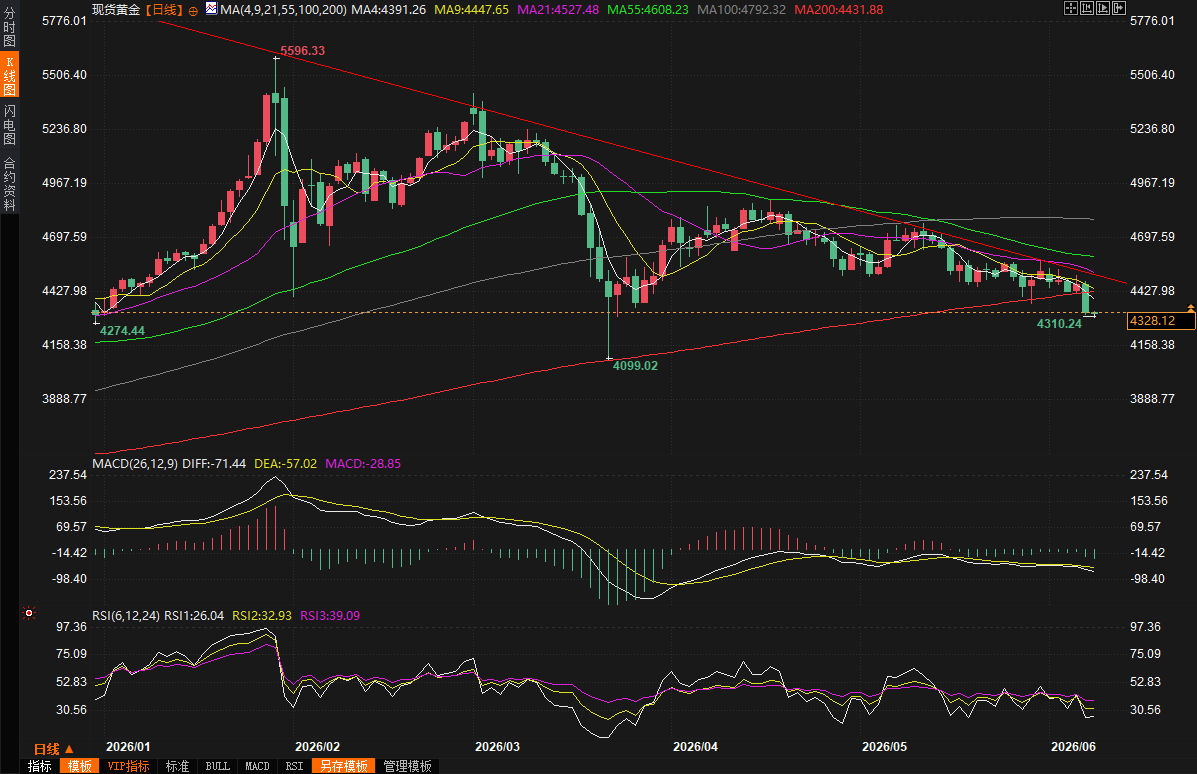
(Spot gold daily chart, source: FX678)
At 07:15 Beijing time, spot gold was trading at $4330.76 per ounce.
Conflict Escalates: Iran's "Warning" Missile Ignites Middle East Powder Keg
Late on June 7 local time, the Iranian Islamic Revolutionary Guard Corps Aerospace Force launched a ballistic missile attack on the Ramat David Air Base in northern Israel. Iran stated explicitly that this action was a response to Israel's recent military operations in southern Lebanon and the southern suburbs of Beirut, aimed at warning Israel to cease its hostile actions. If Israel continues to escalate its actions, Iran's response will likely expand further, potentially covering more US and Israeli targets.
The Israeli military responded swiftly, claiming to have successfully intercepted all incoming missiles and announcing a "strong response." An IDF spokesperson emphasized that the military would continue operations throughout Lebanon and intensify its crackdown on Hezbollah. Israel was placed on high alert nationwide, with air raid sirens sounding, educational activities banned, and public gatherings strictly restricted.
This series of events brought the already fragile regional ceasefire agreement to the brink of collapse. The Strait of Hormuz, a global energy chokepoint, was almost completely closed, severely impacting the supply chains of crude oil, refined petroleum products, and natural gas, directly driving up international oil prices. WTI crude oil rose by more than 3% at one point, reaching a high of $93.90 per barrel, before slightly retreating to around $92.80 following comments from Trump.
Trump's mediation: The prospects for US-Iran negotiations remain uncertain.
The intervention of US President Trump has added further complexity to the situation. On the one hand, Trump received a briefing on the situation and declared that US troops were on high alert; on the other hand, he explicitly urged Iran to "return to the negotiating table and reach an agreement." He expressed his dissatisfaction with Israel's earlier airstrikes on the southern outskirts of Beirut and stated that he would personally call Israeli Prime Minister Netanyahu to pressure him not to retaliate.
Trump emphasized that a US-Iran agreement was "within reach," and that Iran's missile strikes would not change the negotiation process. He even stated bluntly that Netanyahu "had no choice but to accept the agreement," leaving everything to him. If the agreement ultimately fails, he did not rule out considering a raid on Iran or maintaining a strong blockade. These statements limited oil price increases to some extent and injected some uncertainty into the gold market—short-term risk aversion increased, but if the conflict de-escalates quickly, risk assets may rebound.
According to Al Jazeera, citing Israel's Channel 12, during a phone call with US President Trump, Israeli Prime Minister Benjamin Netanyahu attempted to oppose Trump's demand for "no retaliation against Iran." However, Netanyahu ultimately accepted this position.
Over the past week, hostilities in the Middle East have continued to escalate, dimming the prospects for peace talks. This months-long conflict has not only impacted energy prices but also exacerbated global inflation concerns.
According to Iran's semi-official Tasnim News Agency, citing military sources, Iran has prepared a sufficient number of missiles that can be launched at any time should Israel take retaliatory action.
Sources say Iran's next wave of attacks will be larger and will extend to more targets within Israel. Iran is prepared for a larger-scale confrontation should Israel respond, aiming to deter and demonstrate its retaliatory capabilities.
Strong employment data: Fed rate hike expectations weigh on gold prices
Gold's weakness is not solely due to geopolitical events. Last Friday (June 5th), the US released its May non-farm payroll report, far exceeding expectations, with 172,000 new jobs added, double the market forecast, and the unemployment rate remaining stable at 4.3%. This strong data significantly solidified market expectations that the Federal Reserve would maintain high interest rates or even raise them.
Spot gold fell about 3.3% on Friday, hitting a low of $4,311.74 per ounce, its lowest level since March 24, with a cumulative decline of nearly 4.68% for the week. August gold futures also fell sharply. Analysts pointed out that although gold is traditionally a tool for hedging against inflation, the high-interest-rate environment significantly increases the opportunity cost of holding non-interest-bearing assets. A stronger dollar and rising US Treasury yields further suppressed gold prices.
TD Securities and other institutions believe that given the high energy prices and significant inflationary pressures, the Federal Reserve is unlikely to shift to an easing stance anytime soon. The CME FedWatch tool shows the probability of a December rate hike has risen to approximately 70%. Weak gold demand from India and China has also failed to provide sufficient support.
Gold Short-Term Trend: Intense Battle Between Safe-Haven Demand and Interest Rate Hike Expectations
Currently, spot gold is fluctuating between $4310 and $4330. On Monday morning, it dipped slightly to $4310.24 due to a jump in oil prices, but subsequently recovered its losses following Trump's "no retaliation" statement. This movement reflects market divergence on the evolution of the conflict: on the one hand, Iranian attacks and potential Israeli retaliation could push up oil prices and exacerbate inflation, benefiting gold's safe-haven appeal; on the other hand, if Trump successfully mediates and negotiations return to normal, easing risk sentiment would put downward pressure on gold.
From a longer-term perspective, gold prices have fallen by more than 17% since the outbreak of related conflicts at the end of February. In the current environment, gold faces dual pressures: geopolitical risks provide support, but the Federal Reserve's policy path poses a major obstacle. The upcoming US May CPI data this week will be a key indicator—if inflation exceeds expectations, market expectations for interest rate hikes may further intensify, putting pressure on gold prices; if the data is moderate, gold may have a chance to breathe.
Market Outlook: Gold Investment Requires Caution and Risk Balancing
Overall, the Iranian missile attack on Israel once again highlights the fragility of the Middle East situation, which may continue to provide safe-haven buying support for gold in the short term. However, strong US economic data and the potential path of interest rate hikes by the Federal Reserve remain the main obstacles to gold price increases. Investors need to closely monitor the progress of US-Iran negotiations, Israel's subsequent actions, and next week's US inflation data.
In the current complex environment, gold is not in a one-sided trend. Aggressive investors may focus on support around $4,300 and potential rebounds, while a more conservative strategy suggests waiting for further clarity on the situation. Geopolitical risks and macroeconomic policy maneuvering will continue to dominate the gold market, and any dominance by either side could trigger significant volatility. As a traditional safe-haven asset, gold retains strategic value in times of uncertainty, but short-term trading requires close monitoring for the risk of a shift in market sentiment.
(Spot gold daily chart, source: FX678)
At 07:15 Beijing time, spot gold was trading at $4330.76 per ounce.
- Risk Warning and Disclaimer
- The market involves risk, and trading may not be suitable for all investors. This article is for reference only and does not constitute personal investment advice, nor does it take into account certain users’ specific investment objectives, financial situation, or other needs. Any investment decisions made based on this information are at your own risk.