Shipping in the Strait of Hormuz has nearly ground to a halt, and oil prices are at risk of a sharp rise.
2026-06-08 10:35:50
As a core global energy corridor, the Strait of Hormuz has experienced severe shipping turmoil, with tanker traffic significantly reduced compared to before the conflict. Ships are generally adopting a silent navigation mode. Coupled with uncertainties in geopolitical negotiations and low crude oil inventories, the international oil market is facing a sharp increase in uncertainty and the potential risk of a significant rise in oil prices.
Industry analysts generally estimate that the number of oil tankers passing through the Strait of Hormuz has decreased by 90% to 95% compared to before the tensions. Currently, a small number of oil tankers still transit through the strait sporadically, but the overall navigation environment is becoming increasingly opaque, making it difficult to track oil and gas transport routes, and it is impossible for outsiders to accurately calculate the total amount of energy actually delivered to buyers.
Shipping data in recent weeks shows a slight increase in the number of vessels passing through the strait; however, a new navigation pattern has emerged: a large number of ships are turning off their Automatic Identification Systems (AIS) after passing through the strait and leaving the area, and ships entering the Persian Gulf to load cargo are following suit. Previously, turning off the AIS was mostly a means for specific vessels to circumvent restrictions, but now it has become the preferred method for the vast majority of commercial vessels in the strait.
According to shipping data agency Wotech, silent navigation accounts for 57% of all cross-strait sailings, reaching a peak of 65.2% in May. Claire Jungman, Director of Maritime Risk and Intelligence at Wotech, stated that ships turning off their positioning systems is no longer solely for circumventing restrictions, but rather a common practice in the market to address geopolitical risks and ensure energy transport. This model also obscures the transport routes of refined oil products, liquefied petroleum gas, and liquefied natural gas, further interfering with market assessments of inventory, supply, and demand.
The statistics are current as of early Friday morning, June 4th. Due to conflicting news regarding US-Iran negotiations, the future situation in the Taiwan Strait remains unpredictable. Back in March, the market was generally optimistic that the conflict would end in May and shipping would return to normal in June. However, now in June, the situation has been deadlocked for four months, and shipping and the geopolitical environment have still not returned to normal.
Iran continues to strengthen its control over passage through the Strait of Hormuz and intends to retain actual dominance in subsequent negotiations. This traditional energy route is no longer considered a safe route, and the volume of traffic is unlikely to return to the level of February this year.
Although the market is hoping for an agreement between the two sides, and international Brent crude oil prices have remained below $100 per barrel for the past week, potential risks have gradually emerged.
With global crude oil inventories being depleted and market buffering capacity weakening, executives from the two major international oil giants have issued warnings.
At an industry conference, ExxonMobil Senior Vice President Neil Chapman stated that crude oil inventories have fallen to historically low levels. According to industry models, as inventories continue to decline, the spot Brent crude oil price may surge to $150 to $160 per barrel. Chevron CEO Mike Wirth stated at the same conference that the market's ability to withstand supply and demand imbalances has significantly decreased, and supply and demand pressures will be directly transmitted to the spot market. The upward pressure on oil prices will continue to intensify in June and July.
In summary , the oil market is in a high-risk phase due to the triple risks of shipping disruptions in the Strait of Hormuz, geopolitical stalemate, and critically low crude oil inventories. Shipping is unlikely to recover in the short term, and oil prices could surge at any time.
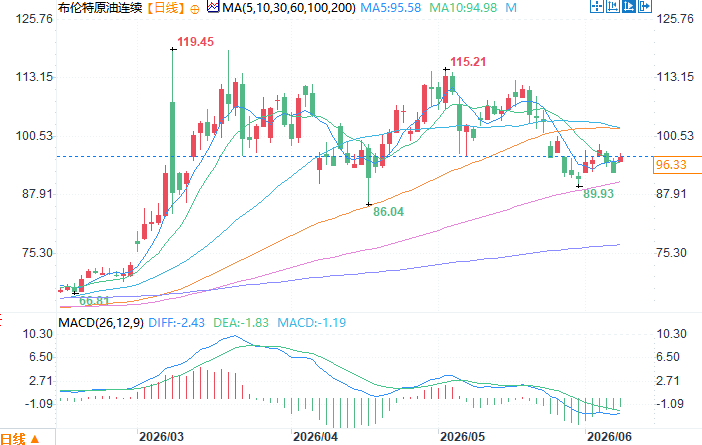
Brent crude oil daily chart source: EasyForex
At 10:35 AM Beijing time on June 8, Brent crude oil futures were trading at $96.61 per barrel.
Shipping volume has plummeted, and silent navigation has become the norm.
Industry analysts generally estimate that the number of oil tankers passing through the Strait of Hormuz has decreased by 90% to 95% compared to before the tensions. Currently, a small number of oil tankers still transit through the strait sporadically, but the overall navigation environment is becoming increasingly opaque, making it difficult to track oil and gas transport routes, and it is impossible for outsiders to accurately calculate the total amount of energy actually delivered to buyers.
Shipping data in recent weeks shows a slight increase in the number of vessels passing through the strait; however, a new navigation pattern has emerged: a large number of ships are turning off their Automatic Identification Systems (AIS) after passing through the strait and leaving the area, and ships entering the Persian Gulf to load cargo are following suit. Previously, turning off the AIS was mostly a means for specific vessels to circumvent restrictions, but now it has become the preferred method for the vast majority of commercial vessels in the strait.
According to shipping data agency Wotech, silent navigation accounts for 57% of all cross-strait sailings, reaching a peak of 65.2% in May. Claire Jungman, Director of Maritime Risk and Intelligence at Wotech, stated that ships turning off their positioning systems is no longer solely for circumventing restrictions, but rather a common practice in the market to address geopolitical risks and ensure energy transport. This model also obscures the transport routes of refined oil products, liquefied petroleum gas, and liquefied natural gas, further interfering with market assessments of inventory, supply, and demand.
Geopolitical negotiations have been volatile, and the resumption of air traffic remains a long way off.
The statistics are current as of early Friday morning, June 4th. Due to conflicting news regarding US-Iran negotiations, the future situation in the Taiwan Strait remains unpredictable. Back in March, the market was generally optimistic that the conflict would end in May and shipping would return to normal in June. However, now in June, the situation has been deadlocked for four months, and shipping and the geopolitical environment have still not returned to normal.
Iran continues to strengthen its control over passage through the Strait of Hormuz and intends to retain actual dominance in subsequent negotiations. This traditional energy route is no longer considered a safe route, and the volume of traffic is unlikely to return to the level of February this year.
Although the market is hoping for an agreement between the two sides, and international Brent crude oil prices have remained below $100 per barrel for the past week, potential risks have gradually emerged.
Inventories have fallen to dangerous levels, sounding alarms for a potential surge in oil prices.
With global crude oil inventories being depleted and market buffering capacity weakening, executives from the two major international oil giants have issued warnings.
At an industry conference, ExxonMobil Senior Vice President Neil Chapman stated that crude oil inventories have fallen to historically low levels. According to industry models, as inventories continue to decline, the spot Brent crude oil price may surge to $150 to $160 per barrel. Chevron CEO Mike Wirth stated at the same conference that the market's ability to withstand supply and demand imbalances has significantly decreased, and supply and demand pressures will be directly transmitted to the spot market. The upward pressure on oil prices will continue to intensify in June and July.
In summary , the oil market is in a high-risk phase due to the triple risks of shipping disruptions in the Strait of Hormuz, geopolitical stalemate, and critically low crude oil inventories. Shipping is unlikely to recover in the short term, and oil prices could surge at any time.
Brent crude oil daily chart source: EasyForex
At 10:35 AM Beijing time on June 8, Brent crude oil futures were trading at $96.61 per barrel.
- Risk Warning and Disclaimer
- The market involves risk, and trading may not be suitable for all investors. This article is for reference only and does not constitute personal investment advice, nor does it take into account certain users’ specific investment objectives, financial situation, or other needs. Any investment decisions made based on this information are at your own risk.