Better-than-expected non-farm payrolls vs. slower-than-expected Japanese GDP growth: USD/JPY poised for a seven-day winning streak.
2026-06-08 10:45:28
On Monday (June 8) during the Asian session, the US dollar continued to rise against the Japanese yen as the US May non-farm payroll data significantly exceeded expectations and the escalating situation in the Middle East boosted demand for the US dollar as a safe haven. The exchange rate is currently trading around 160.35 and is on track for its seventh consecutive day of gains.
Weak economic data further exacerbated the yen's weakness, giving the USD/JPY pair additional upward momentum during the Asian trading session.
Revised data released Monday showed that Japan's economy lost momentum in the first quarter of this year, with growth slowing quarter-on-quarter, dragged down by weak corporate capital spending. The revised annualized GDP growth rate was 1.8%, down from the initial estimate of 2.1%, but slightly higher than economists' expectations of 1.3%.
Faced with rising energy costs due to the conflict in the Middle East, the Japanese government has approved a supplementary budget of $19 billion to ease the burden on households, while the Bank of Japan is expected to raise interest rates further at its meeting this month unless the situation in the Middle East deteriorates sharply.

Japan's Cabinet Office released revised GDP data on Monday, showing that the annualized growth rate of the economy in the first quarter of this year was 1.8%, lower than the initial estimate of 2.1%, but higher than the median forecast of 1.3% by economists. On a non-annualized basis, first-quarter GDP grew by 0.5% quarter-on-quarter, slightly higher than the market expectation of 0.3%, and unchanged from the initial estimate. Overall, the Japanese economy maintained an expansionary trend in the first quarter, but the growth rate slowed compared to previous estimates, indicating that growth momentum is weakening.
From a structural perspective, private consumption, which accounts for more than half of Japan's economy, grew by 0.3% month-on-month, consistent with the initial estimate. This data indicates that despite rising energy prices pushing up the cost of living, household spending has shown some resilience, providing fundamental support for the economy.
However, corporate capital expenditure became a major drag on the economy in the first quarter. Data shows that capital expenditure contracted by 0.7% quarter-on-quarter, a significant downward revision of 1 percentage point from the initial estimate (0.3% growth). This means that corporate investment, which was originally considered a positive sign, actually contracted.
Analysts point out that soaring energy prices and global supply chain uncertainties caused by the Middle East conflict are likely the main reasons why companies are postponing or cutting investment. Although the 0.7% decline is still better than the market expectation of a 0.9% drop, the signal that investment has turned from positive to negative is cause for concern.
On the external demand side, exports minus imports contributed 0.3 percentage points to GDP, unchanged from the initial estimate; domestic demand contributed 0.2 percentage points, also without revision. This indicates that net exports were the main driver of economic growth in the first quarter, while the contribution of domestic demand was relatively limited, and the moderate growth in private consumption failed to fully offset the decline in capital expenditure.
Mathieu Savary, chief strategist for developed markets at BCA Research, points out that Japan is one of the most directly impacted and vulnerable major economies globally due to the situation in the Middle East. He cites key data showing that Japan's oil and gas imports account for approximately 3.2% of its GDP, a proportion second only to South Korea among major economies, and far higher than the United States and Eurozone countries.
Savari warned that if the Strait of Hormuz closure lasts longer than expected, the probability of Japan falling into recession will increase significantly. This judgment is based on two core logics: first, Japan is extremely dependent on Middle Eastern oil (approximately 95% of its crude oil imports come from the region), with virtually no alternative sources; second, compared to other developed economies, Japan has an extremely low energy self-sufficiency rate and lacks strategic buffer capabilities.
The continued rise in fuel costs is impacting the Japanese economy through three channels.
The first channel is to push up inflation. Soaring energy prices are directly reflected in electricity and gas costs, driving up the overall CPI. For Japan, which has just emerged from deflation, imported inflation is not a "good thing" because it erodes real purchasing power rather than representing benign inflation driven by excessive demand.
The second channel is the erosion of household purchasing power. Due to persistently weak wage growth in Japan, the increased cost of living resulting from rising energy prices is difficult to offset by income growth. This means a decline in consumers' real disposable income, which in turn suppresses private consumption. Private consumption accounts for more than half of Japan's GDP and is a core pillar of economic growth; its weakness will have a profound impact on the overall economy.
The third channel is the compression of corporate profit margins. Energy-intensive industries such as manufacturing, transportation, and logistics are facing pressure from rapidly rising costs. For Japanese SMEs, whose profit margins are already thin, this could lead to losses or even bankruptcy, thereby suppressing capital expenditures and employment. Once corporate investment intentions decline, the momentum of economic recovery will be further weakened.
These three channels are interconnected and mutually reinforcing, forming a complete transmission chain of energy price shocks to the Japanese economy. From inflation to consumption, from profits to investment, every link is under pressure. If the blockade of the Strait of Hormuz continues, this shock will evolve from short-term fluctuations into long-term structural pressures, and the risk of recession facing the Japanese economy will increase significantly.
To mitigate the impact of rising energy costs caused by the Middle East crisis on Japanese households, the cabinet led by Prime Minister Sanae Takaichi approved a supplementary budget of 19 billion US dollars for the current fiscal year last Wednesday. This funding will primarily be used for subsidies on electricity and gas bills, as well as cash assistance to low-income households, to curb rising utility bills and cope with soaring prices of necessities. Analysts point out that this measure aims to prevent energy shocks from eroding household purchasing power and avoid dragging down already weak private consumption. The government emphasized that "swift and forceful" measures must be taken to support the economy.
Meanwhile, the Bank of Japan is expected to announce an interest rate hike at its policy meeting next week, unless the conflict in the Middle East escalates sharply and severely disrupts financial markets.
According to media reports, a consensus is forming within the central bank regarding interest rate hikes, primarily based on factors such as inflation remaining above the 2% target, the depreciation of the yen increasing import costs, and some companies beginning to raise wages. However, if a blockade of the Strait of Hormuz leads to a surge in oil prices or severe turmoil in financial markets, the central bank may choose to remain on hold to maintain financial stability.
Overall, the Japanese government and central bank are addressing the challenges from the fiscal and monetary ends, respectively: the government is focusing on supporting people's livelihoods, while the central bank is working on policy normalization.
The USD/JPY pair is showing a clear upward trend on the daily chart, with the price oscillating higher since the March low of 155.53 and currently approaching the previous high near 160.45. The moving average system is in a bullish alignment, with the price above the 20-day, 50-day, 100-day, and 200-day moving averages. Support levels are at 159.19, 158.86, and 155.42, respectively, indicating a healthy medium-term uptrend.
In terms of indicators, the MACD histogram continues to expand, with the DIFF line above the DEA line, indicating increasing bullish momentum. The RSI is around 64.6, not yet in overbought territory, suggesting further upside potential. The key short-term resistance level is in the 160.45-160.50 range; a break above this level could open up new upside potential. If resistance is encountered and the price falls back, support is seen around 159.40-158.86. Overall, the exchange rate is in a high-level, slightly bullish consolidation phase, with a clear bullish trend. Going forward, close attention should be paid to whether the previous high is broken and to changes in fundamentals.
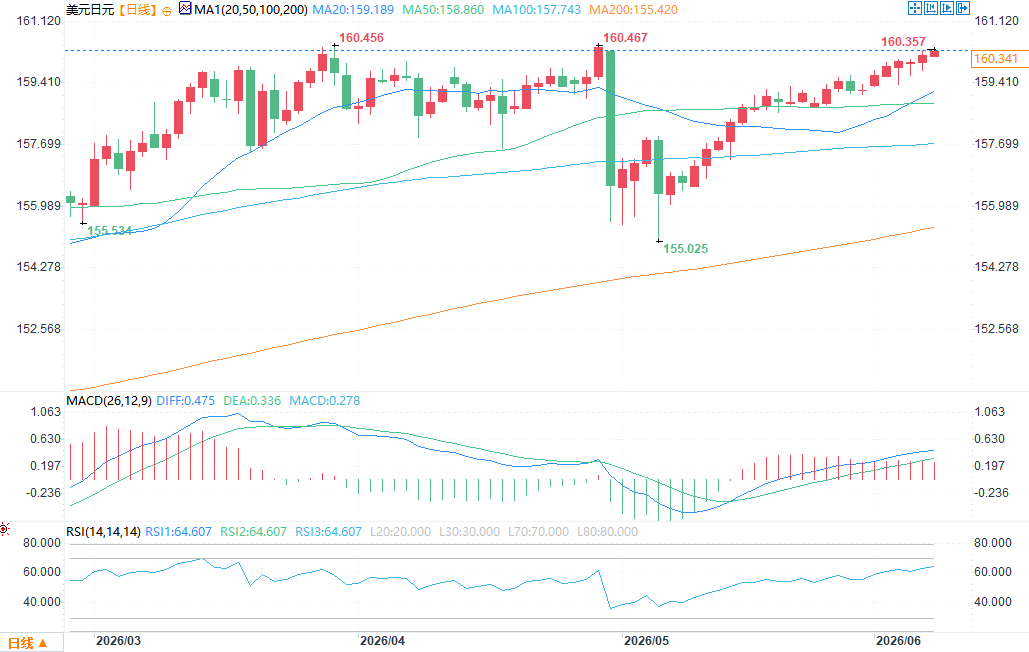
(USD/JPY daily chart, source: FX678)
At 10:44 AM Beijing time on June 8, the exchange rate of the US dollar against the Japanese yen was 160.34/35.
Weak economic data further exacerbated the yen's weakness, giving the USD/JPY pair additional upward momentum during the Asian trading session.
Revised data released Monday showed that Japan's economy lost momentum in the first quarter of this year, with growth slowing quarter-on-quarter, dragged down by weak corporate capital spending. The revised annualized GDP growth rate was 1.8%, down from the initial estimate of 2.1%, but slightly higher than economists' expectations of 1.3%.
Faced with rising energy costs due to the conflict in the Middle East, the Japanese government has approved a supplementary budget of $19 billion to ease the burden on households, while the Bank of Japan is expected to raise interest rates further at its meeting this month unless the situation in the Middle East deteriorates sharply.
First-quarter GDP growth was revised downward, with capital expenditure becoming the main drag.
Japan's Cabinet Office released revised GDP data on Monday, showing that the annualized growth rate of the economy in the first quarter of this year was 1.8%, lower than the initial estimate of 2.1%, but higher than the median forecast of 1.3% by economists. On a non-annualized basis, first-quarter GDP grew by 0.5% quarter-on-quarter, slightly higher than the market expectation of 0.3%, and unchanged from the initial estimate. Overall, the Japanese economy maintained an expansionary trend in the first quarter, but the growth rate slowed compared to previous estimates, indicating that growth momentum is weakening.
From a structural perspective, private consumption, which accounts for more than half of Japan's economy, grew by 0.3% month-on-month, consistent with the initial estimate. This data indicates that despite rising energy prices pushing up the cost of living, household spending has shown some resilience, providing fundamental support for the economy.
However, corporate capital expenditure became a major drag on the economy in the first quarter. Data shows that capital expenditure contracted by 0.7% quarter-on-quarter, a significant downward revision of 1 percentage point from the initial estimate (0.3% growth). This means that corporate investment, which was originally considered a positive sign, actually contracted.
Analysts point out that soaring energy prices and global supply chain uncertainties caused by the Middle East conflict are likely the main reasons why companies are postponing or cutting investment. Although the 0.7% decline is still better than the market expectation of a 0.9% drop, the signal that investment has turned from positive to negative is cause for concern.
On the external demand side, exports minus imports contributed 0.3 percentage points to GDP, unchanged from the initial estimate; domestic demand contributed 0.2 percentage points, also without revision. This indicates that net exports were the main driver of economic growth in the first quarter, while the contribution of domestic demand was relatively limited, and the moderate growth in private consumption failed to fully offset the decline in capital expenditure.
The Middle East conflict has driven up energy costs, posing a serious challenge to the Japanese economy.
Mathieu Savary, chief strategist for developed markets at BCA Research, points out that Japan is one of the most directly impacted and vulnerable major economies globally due to the situation in the Middle East. He cites key data showing that Japan's oil and gas imports account for approximately 3.2% of its GDP, a proportion second only to South Korea among major economies, and far higher than the United States and Eurozone countries.
Savari warned that if the Strait of Hormuz closure lasts longer than expected, the probability of Japan falling into recession will increase significantly. This judgment is based on two core logics: first, Japan is extremely dependent on Middle Eastern oil (approximately 95% of its crude oil imports come from the region), with virtually no alternative sources; second, compared to other developed economies, Japan has an extremely low energy self-sufficiency rate and lacks strategic buffer capabilities.
The continued rise in fuel costs is impacting the Japanese economy through three channels.
The first channel is to push up inflation. Soaring energy prices are directly reflected in electricity and gas costs, driving up the overall CPI. For Japan, which has just emerged from deflation, imported inflation is not a "good thing" because it erodes real purchasing power rather than representing benign inflation driven by excessive demand.
The second channel is the erosion of household purchasing power. Due to persistently weak wage growth in Japan, the increased cost of living resulting from rising energy prices is difficult to offset by income growth. This means a decline in consumers' real disposable income, which in turn suppresses private consumption. Private consumption accounts for more than half of Japan's GDP and is a core pillar of economic growth; its weakness will have a profound impact on the overall economy.
The third channel is the compression of corporate profit margins. Energy-intensive industries such as manufacturing, transportation, and logistics are facing pressure from rapidly rising costs. For Japanese SMEs, whose profit margins are already thin, this could lead to losses or even bankruptcy, thereby suppressing capital expenditures and employment. Once corporate investment intentions decline, the momentum of economic recovery will be further weakened.
These three channels are interconnected and mutually reinforcing, forming a complete transmission chain of energy price shocks to the Japanese economy. From inflation to consumption, from profits to investment, every link is under pressure. If the blockade of the Strait of Hormuz continues, this shock will evolve from short-term fluctuations into long-term structural pressures, and the risk of recession facing the Japanese economy will increase significantly.
The government has introduced a supplementary budget, and the central bank is expected to raise interest rates this month.
To mitigate the impact of rising energy costs caused by the Middle East crisis on Japanese households, the cabinet led by Prime Minister Sanae Takaichi approved a supplementary budget of 19 billion US dollars for the current fiscal year last Wednesday. This funding will primarily be used for subsidies on electricity and gas bills, as well as cash assistance to low-income households, to curb rising utility bills and cope with soaring prices of necessities. Analysts point out that this measure aims to prevent energy shocks from eroding household purchasing power and avoid dragging down already weak private consumption. The government emphasized that "swift and forceful" measures must be taken to support the economy.
Meanwhile, the Bank of Japan is expected to announce an interest rate hike at its policy meeting next week, unless the conflict in the Middle East escalates sharply and severely disrupts financial markets.
According to media reports, a consensus is forming within the central bank regarding interest rate hikes, primarily based on factors such as inflation remaining above the 2% target, the depreciation of the yen increasing import costs, and some companies beginning to raise wages. However, if a blockade of the Strait of Hormuz leads to a surge in oil prices or severe turmoil in financial markets, the central bank may choose to remain on hold to maintain financial stability.
Overall, the Japanese government and central bank are addressing the challenges from the fiscal and monetary ends, respectively: the government is focusing on supporting people's livelihoods, while the central bank is working on policy normalization.
Technical Analysis
The USD/JPY pair is showing a clear upward trend on the daily chart, with the price oscillating higher since the March low of 155.53 and currently approaching the previous high near 160.45. The moving average system is in a bullish alignment, with the price above the 20-day, 50-day, 100-day, and 200-day moving averages. Support levels are at 159.19, 158.86, and 155.42, respectively, indicating a healthy medium-term uptrend.
In terms of indicators, the MACD histogram continues to expand, with the DIFF line above the DEA line, indicating increasing bullish momentum. The RSI is around 64.6, not yet in overbought territory, suggesting further upside potential. The key short-term resistance level is in the 160.45-160.50 range; a break above this level could open up new upside potential. If resistance is encountered and the price falls back, support is seen around 159.40-158.86. Overall, the exchange rate is in a high-level, slightly bullish consolidation phase, with a clear bullish trend. Going forward, close attention should be paid to whether the previous high is broken and to changes in fundamentals.
(USD/JPY daily chart, source: FX678)
At 10:44 AM Beijing time on June 8, the exchange rate of the US dollar against the Japanese yen was 160.34/35.
- Risk Warning and Disclaimer
- The market involves risk, and trading may not be suitable for all investors. This article is for reference only and does not constitute personal investment advice, nor does it take into account certain users’ specific investment objectives, financial situation, or other needs. Any investment decisions made based on this information are at your own risk.