Crude oil trading alert: OPEC+'s announced production increase failed to offset supply-side pressures, leading to a sharp rebound in oil prices.
2026-06-08 09:24:18
On Monday during Asian trading hours, the international crude oil market continued its strong performance. Influenced by the ongoing security tensions in the Middle East, WTI crude oil gapped up at the open and maintained its upward trend, trading around $93.90 per barrel, a new recent high. The immediate trigger for this price increase was the renewed escalation of tensions between Iran and Israel. Market surveys indicate that Iran launched multiple missiles towards Israel and warned of further countermeasures if military action in the region continues to escalate. Although the Israeli military stated that all missiles were successfully intercepted without causing casualties, the market is concerned that the regional situation could further spiral out of control, thereby affecting the security of the global energy supply chain.

Meanwhile, Israel launched a new round of military operations against parts of Lebanon, putting the already fragile ceasefire agreement to a new test. Previously, the market widely expected that a de-escalation of the Middle East situation would allow energy transportation to return to normal and provide greater supply security for the global oil market. However, with the renewed escalation of the conflict, investors have become more cautious about the prospects for peace negotiations, and market risk aversion has clearly increased.
The market's primary concern remains the Strait of Hormuz. As one of the world's most important energy transport routes, the strait handles approximately 20% of global seaborne crude oil shipments and a significant amount of liquefied natural gas exports. If the resumption of transport continues to be delayed, the global energy supply system will continue to face immense pressure.
US President Trump expressed concern over recent military actions and called on all parties to avoid further escalation of the situation. Meanwhile, the US also urged Iran to return to the negotiating table. However, given the current situation, diplomatic progress remains slow, and market expectations for the duration of the conflict have clearly increased.
It's worth noting that the crude oil market had previously experienced a correction due to expectations of easing tensions between the US and Iran. However, the latest developments have quickly reversed market sentiment, pushing risk premiums back in. Most of the previous price declines have been fully recovered. On the supply side, the OPEC+ meeting over the weekend decided to continue its production increase plan, approving a 188,000 barrel per day increase in July. On the surface, this decision helps stabilize market expectations, but its actual effect may be relatively limited.
Currently, production in many OPEC+ member countries remains below target levels, and some oil-producing nations are struggling to rapidly increase exports due to transportation bottlenecks and infrastructure problems. Furthermore, following recent damage to Russian energy facilities, the recovery of some of its production capacity is slower than market expectations. Therefore, even if the nominal production target is revised upwards, the actual new supply entering the international market may be far lower than the theoretical level.
Observing market fund flows, funds and large institutional investors are increasing their allocation to the energy sector again. Safe-haven funds continue to flow into the energy and precious metals markets, while global stock markets have experienced some volatility, indicating that investors remain highly vigilant about future economic and energy security issues.
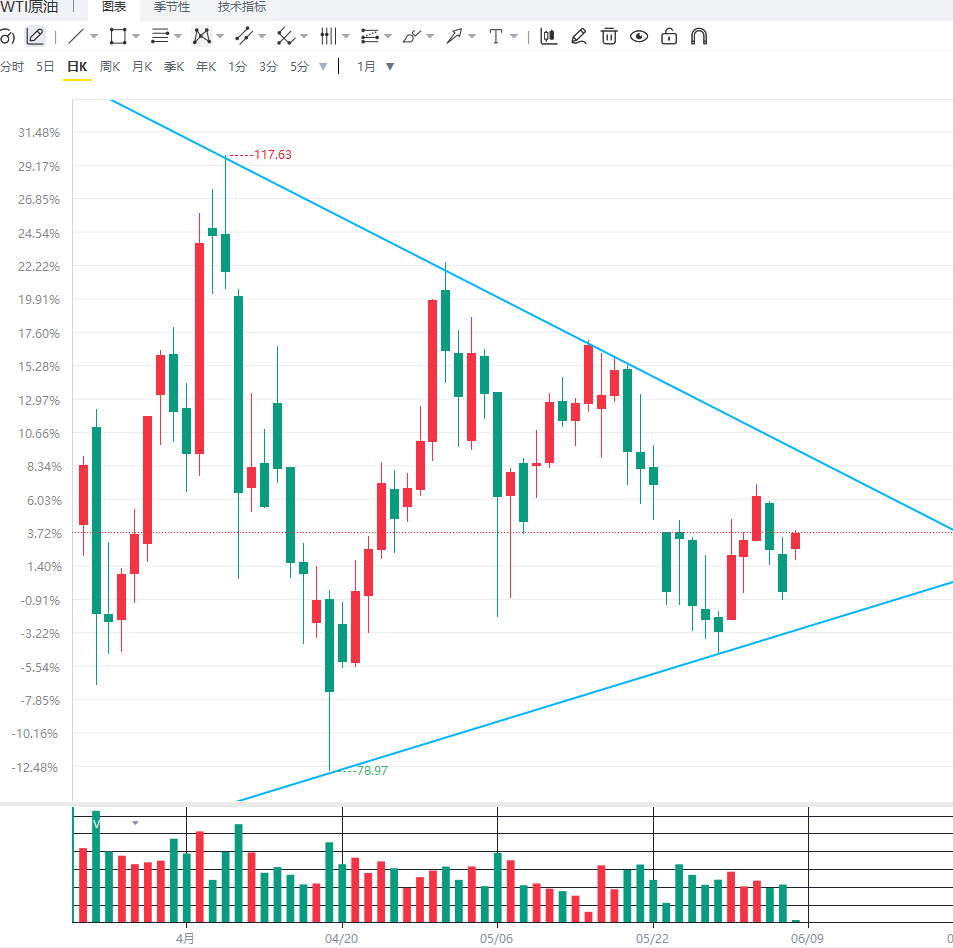
From a technical perspective, the WTI crude oil daily chart is currently in a consolidation phase, with prices trading within a range and no clear directional breakout yet. Short-term moving averages are converging, indicating a temporary balance between bullish and bearish forces. The MACD indicator is above the zero line, but momentum has slowed, reflecting a weakening of the upward trend. The RSI indicator is in the neutral-to-strong zone, yet has not released a clear trend signal. Overall, oil prices are facing a test of a dense resistance area above; if a decisive breakout fails, the range-bound trading is likely to continue. Key resistance to watch is around $95, while important support lies around $90.
From a 4-hour chart perspective, oil prices have recently maintained a range-bound pattern, with highs and lows gradually converging, indicating a growing wait-and-see attitude in the market. Short-term moving averages are repeatedly intertwined, suggesting that a directional move is not yet complete. The MACD indicator is fluctuating around the zero line, indicating a relatively balanced supply and demand. If geopolitical tensions escalate further and push prices above the $95 resistance level, new upside potential could be unlocked; conversely, if buying momentum is insufficient, oil prices may still fall back to test the $90 support area. Until a breakout occurs, the overall outlook remains one of range-bound trading.
Editor's Summary : The resurgence of tensions in the Middle East is becoming a core driver of rising international oil prices. The continued delays in the resumption of shipping through the Strait of Hormuz are escalating global energy supply risks, and the increased production from OPEC+ is unlikely to effectively fill the potential gap in the short term. With geopolitical risk premiums being re-incorporated into the market, WTI crude oil has successfully broken through the $92 mark. The market focus will now be on developments in the Middle East, the progress of shipping resumption through the Strait of Hormuz, and the actual implementation of OPEC+ production increases. If the conflict continues to escalate, oil prices may further challenge $95 or even higher; if diplomatic negotiations achieve a breakthrough, there is a risk of a high-level correction in oil prices. Overall, the crude oil market will likely remain highly volatile in the short term, and investors need to closely monitor changes on the supply side and the evolution of the geopolitical situation.
Meanwhile, Israel launched a new round of military operations against parts of Lebanon, putting the already fragile ceasefire agreement to a new test. Previously, the market widely expected that a de-escalation of the Middle East situation would allow energy transportation to return to normal and provide greater supply security for the global oil market. However, with the renewed escalation of the conflict, investors have become more cautious about the prospects for peace negotiations, and market risk aversion has clearly increased.
The market's primary concern remains the Strait of Hormuz. As one of the world's most important energy transport routes, the strait handles approximately 20% of global seaborne crude oil shipments and a significant amount of liquefied natural gas exports. If the resumption of transport continues to be delayed, the global energy supply system will continue to face immense pressure.
US President Trump expressed concern over recent military actions and called on all parties to avoid further escalation of the situation. Meanwhile, the US also urged Iran to return to the negotiating table. However, given the current situation, diplomatic progress remains slow, and market expectations for the duration of the conflict have clearly increased.
It's worth noting that the crude oil market had previously experienced a correction due to expectations of easing tensions between the US and Iran. However, the latest developments have quickly reversed market sentiment, pushing risk premiums back in. Most of the previous price declines have been fully recovered. On the supply side, the OPEC+ meeting over the weekend decided to continue its production increase plan, approving a 188,000 barrel per day increase in July. On the surface, this decision helps stabilize market expectations, but its actual effect may be relatively limited.
Currently, production in many OPEC+ member countries remains below target levels, and some oil-producing nations are struggling to rapidly increase exports due to transportation bottlenecks and infrastructure problems. Furthermore, following recent damage to Russian energy facilities, the recovery of some of its production capacity is slower than market expectations. Therefore, even if the nominal production target is revised upwards, the actual new supply entering the international market may be far lower than the theoretical level.
Observing market fund flows, funds and large institutional investors are increasing their allocation to the energy sector again. Safe-haven funds continue to flow into the energy and precious metals markets, while global stock markets have experienced some volatility, indicating that investors remain highly vigilant about future economic and energy security issues.
From a technical perspective, the WTI crude oil daily chart is currently in a consolidation phase, with prices trading within a range and no clear directional breakout yet. Short-term moving averages are converging, indicating a temporary balance between bullish and bearish forces. The MACD indicator is above the zero line, but momentum has slowed, reflecting a weakening of the upward trend. The RSI indicator is in the neutral-to-strong zone, yet has not released a clear trend signal. Overall, oil prices are facing a test of a dense resistance area above; if a decisive breakout fails, the range-bound trading is likely to continue. Key resistance to watch is around $95, while important support lies around $90.
From a 4-hour chart perspective, oil prices have recently maintained a range-bound pattern, with highs and lows gradually converging, indicating a growing wait-and-see attitude in the market. Short-term moving averages are repeatedly intertwined, suggesting that a directional move is not yet complete. The MACD indicator is fluctuating around the zero line, indicating a relatively balanced supply and demand. If geopolitical tensions escalate further and push prices above the $95 resistance level, new upside potential could be unlocked; conversely, if buying momentum is insufficient, oil prices may still fall back to test the $90 support area. Until a breakout occurs, the overall outlook remains one of range-bound trading.
Editor's Summary : The resurgence of tensions in the Middle East is becoming a core driver of rising international oil prices. The continued delays in the resumption of shipping through the Strait of Hormuz are escalating global energy supply risks, and the increased production from OPEC+ is unlikely to effectively fill the potential gap in the short term. With geopolitical risk premiums being re-incorporated into the market, WTI crude oil has successfully broken through the $92 mark. The market focus will now be on developments in the Middle East, the progress of shipping resumption through the Strait of Hormuz, and the actual implementation of OPEC+ production increases. If the conflict continues to escalate, oil prices may further challenge $95 or even higher; if diplomatic negotiations achieve a breakthrough, there is a risk of a high-level correction in oil prices. Overall, the crude oil market will likely remain highly volatile in the short term, and investors need to closely monitor changes on the supply side and the evolution of the geopolitical situation.
- Risk Warning and Disclaimer
- The market involves risk, and trading may not be suitable for all investors. This article is for reference only and does not constitute personal investment advice, nor does it take into account certain users’ specific investment objectives, financial situation, or other needs. Any investment decisions made based on this information are at your own risk.