The ceasefire agreement is on the verge of collapse, WTI crude oil jumps 3%, and the market faces three key scenarios.
2026-06-08 11:44:34
On Monday (June 8) during Asian trading hours, WTI crude oil opened sharply higher and is currently up over 3%, trading around $93.50 per barrel. Iran launched multiple missiles into Israel on Sunday, threatening the already fragile US-Iran ceasefire agreement and further complicating the already stalled peace talks.
The market is weighing multiple factors: weak summer demand, rising inventories, increased OPEC+ production, and ongoing geopolitical risks in the Middle East.
With the Middle East supply shock entering its 100th day, whether oil prices can rebound from the $86 support level has become the focus of investors' attention.
Scenario 1: Rebound within the range
A rebound from the $86 support level could allow oil prices to continue trading within their existing consolidation range, targeting the $95-$100 resistance zone. This scenario reflects ongoing uncertainty surrounding global supply disruptions, geopolitical risks, and the demand growth outlook.
Scenario 2: Bullish Breakout <br/>If oil prices break through the upper boundary of the consolidation range, it could open up upside potential to the $130-$150 area. This move could require a significant escalation of tensions in the Middle East, a prolonged supply disruption, or renewed market concerns about the availability of crude oil supplies along key shipping routes.
Scenario 3: Bearish Breakout <br />If oil prices clearly break below the $88 support level and the broader $86 structural support area, it could trigger a deeper pullback towards $74 or even $67. This outcome could reflect easing geopolitical tensions, improved supply flows, stronger production growth, and reduced energy security concerns.
Summer demand and inventory trends
Crude oil demand is facing increasing pressure due to both persistently high energy prices and signs of slowing import demand from China. High fuel costs are suppressing end-user consumption, particularly in the transportation and industrial sectors, while slower demand growth in major global crude oil importers is further dampening market optimism for the peak summer consumption season.
Meanwhile, U.S. crude oil inventories remain at high levels, raising concerns about short-term consumption growth momentum. Typically, the summer driving season is a traditional peak season for crude oil demand, and inventories should see a seasonal decline. However, the current high inventory levels suggest that the supply and demand fundamentals are not as tight as expected.
OPEC+ Production Policy <br/>On the supply side, OPEC+ has agreed to raise its crude oil production target by approximately 188,000 barrels per day in June, marking the fourth consecutive month of production increases by the organization. Theoretically, the release of additional supply should help alleviate tensions in global markets exacerbated by the Middle East conflict.
However, actual supply disruptions caused by geopolitical conflicts continue, particularly the closure of the Strait of Hormuz, which prevents major Gulf oil-producing countries such as Saudi Arabia and Kuwait from transporting crude oil smoothly. Therefore, OPEC+'s commitment to increase production remains largely on paper, and its actual impact on the global spot market has been severely weakened.
US-Iran Negotiations and the Strait of Hormuz <br />Market participants are still closely watching any potential diplomatic agreement between the United States and Iran, as any breakthrough could create conditions for safe passage through the Strait of Hormuz. This strait carries approximately one-fifth of global oil shipments, and its normal operation is crucial for the stability of global energy supplies.
However, negotiations between the US and Iran remain deadlocked, with significant differences between the two sides on key issues, and the hope for substantial progress in the short term is slim. This means that supply risks in the Strait of Hormuz will remain high for some time, thus continuing to provide geopolitical premium support for oil prices.
Alternative Export Routes <br/>To reduce over-reliance on the Strait of Hormuz as a single passage, several countries are actively promoting the construction of alternative export infrastructure. These projects aim to open new shipping routes bypassing the strait, thereby enhancing the resilience of global energy supplies. For example, the UAE has been continuously advancing the export infrastructure construction of the port of Fujairah, located outside the Strait of Hormuz, enabling direct export of crude oil to the Indian Ocean without passing through the strait.
As these alternative routes gradually expand and come online in the coming years, the global crude oil market supply chain will become more diversified, which will help reduce the geopolitical risk premium that has repeatedly arisen due to geopolitical conflicts.
Bullish Scenario: If oil prices continue to break through $95, $102, and $112, it could open up further upside potential to $127, $135, and $157 this year, levels that align with Fibonacci extension ratios. This scenario requires both the RSI and price action to break above the downtrend line formed since March.
Bearish Scenario: If oil prices continue to be capped below the $88-91 resistance zone, and the closing price falls below $85, $82, and $79, it will open the way for a retest of the previous high of $76-74, and could potentially extend the decline further towards $67. This scenario would be consistent with the characteristic of a continued weakening RSI and the formation of lower highs since March 2026.
In summary, WTI crude oil prices remain within a multi-month consolidation range and are capped by the 2023 high of $95, increasing the risk of a sharp decline befitting the steep rise preceding this consolidation. This situation provides some relief to the bond market, but bullish risks persist—crude oil remains above the key support level of $86, and ongoing military action in the Middle East means a bearish reversal is not yet fully confirmed. Investors need to closely monitor the $86 support level, as well as developments in the Middle East situation, OPEC+ policy, and demand data.
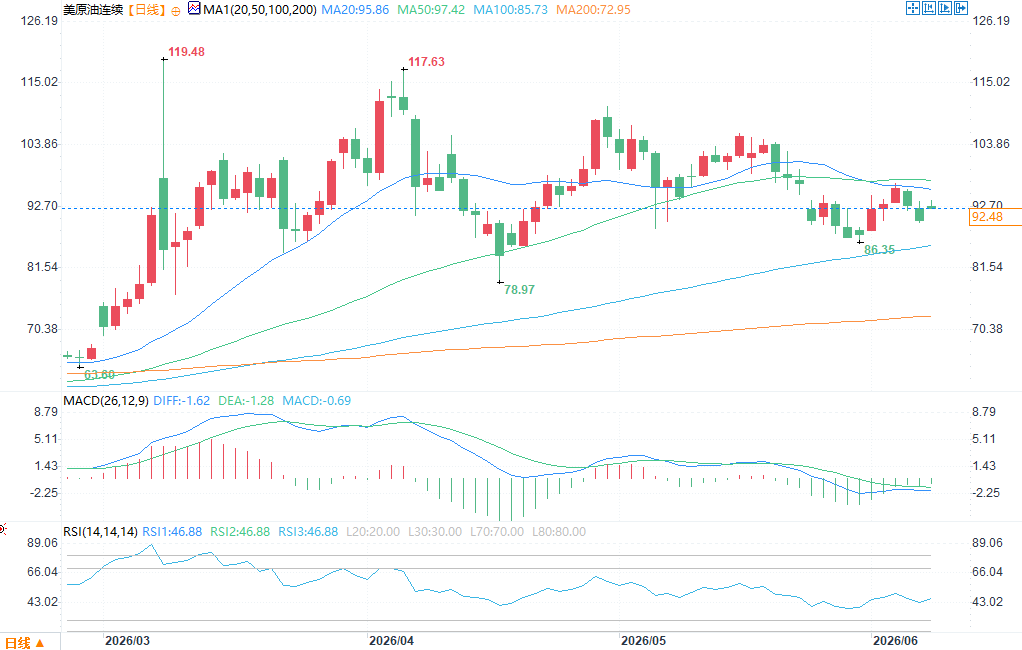
(US crude oil futures daily chart, source: FX678)
At 11:32 AM Beijing time on June 8, US crude oil futures were trading at $93.46 per barrel.
The market is weighing multiple factors: weak summer demand, rising inventories, increased OPEC+ production, and ongoing geopolitical risks in the Middle East.
With the Middle East supply shock entering its 100th day, whether oil prices can rebound from the $86 support level has become the focus of investors' attention.
Three key scenarios for WTI crude oil
Scenario 1: Rebound within the range
A rebound from the $86 support level could allow oil prices to continue trading within their existing consolidation range, targeting the $95-$100 resistance zone. This scenario reflects ongoing uncertainty surrounding global supply disruptions, geopolitical risks, and the demand growth outlook.
Scenario 2: Bullish Breakout <br/>If oil prices break through the upper boundary of the consolidation range, it could open up upside potential to the $130-$150 area. This move could require a significant escalation of tensions in the Middle East, a prolonged supply disruption, or renewed market concerns about the availability of crude oil supplies along key shipping routes.
Scenario 3: Bearish Breakout <br />If oil prices clearly break below the $88 support level and the broader $86 structural support area, it could trigger a deeper pullback towards $74 or even $67. This outcome could reflect easing geopolitical tensions, improved supply flows, stronger production growth, and reduced energy security concerns.
Key factors affecting crude oil price fluctuations
Summer demand and inventory trends
Crude oil demand is facing increasing pressure due to both persistently high energy prices and signs of slowing import demand from China. High fuel costs are suppressing end-user consumption, particularly in the transportation and industrial sectors, while slower demand growth in major global crude oil importers is further dampening market optimism for the peak summer consumption season.
Meanwhile, U.S. crude oil inventories remain at high levels, raising concerns about short-term consumption growth momentum. Typically, the summer driving season is a traditional peak season for crude oil demand, and inventories should see a seasonal decline. However, the current high inventory levels suggest that the supply and demand fundamentals are not as tight as expected.
OPEC+ Production Policy <br/>On the supply side, OPEC+ has agreed to raise its crude oil production target by approximately 188,000 barrels per day in June, marking the fourth consecutive month of production increases by the organization. Theoretically, the release of additional supply should help alleviate tensions in global markets exacerbated by the Middle East conflict.
However, actual supply disruptions caused by geopolitical conflicts continue, particularly the closure of the Strait of Hormuz, which prevents major Gulf oil-producing countries such as Saudi Arabia and Kuwait from transporting crude oil smoothly. Therefore, OPEC+'s commitment to increase production remains largely on paper, and its actual impact on the global spot market has been severely weakened.
US-Iran Negotiations and the Strait of Hormuz <br />Market participants are still closely watching any potential diplomatic agreement between the United States and Iran, as any breakthrough could create conditions for safe passage through the Strait of Hormuz. This strait carries approximately one-fifth of global oil shipments, and its normal operation is crucial for the stability of global energy supplies.
However, negotiations between the US and Iran remain deadlocked, with significant differences between the two sides on key issues, and the hope for substantial progress in the short term is slim. This means that supply risks in the Strait of Hormuz will remain high for some time, thus continuing to provide geopolitical premium support for oil prices.
Alternative Export Routes <br/>To reduce over-reliance on the Strait of Hormuz as a single passage, several countries are actively promoting the construction of alternative export infrastructure. These projects aim to open new shipping routes bypassing the strait, thereby enhancing the resilience of global energy supplies. For example, the UAE has been continuously advancing the export infrastructure construction of the port of Fujairah, located outside the Strait of Hormuz, enabling direct export of crude oil to the Indian Ocean without passing through the strait.
As these alternative routes gradually expand and come online in the coming years, the global crude oil market supply chain will become more diversified, which will help reduce the geopolitical risk premium that has repeatedly arisen due to geopolitical conflicts.
Technical Outlook
Bullish Scenario: If oil prices continue to break through $95, $102, and $112, it could open up further upside potential to $127, $135, and $157 this year, levels that align with Fibonacci extension ratios. This scenario requires both the RSI and price action to break above the downtrend line formed since March.
Bearish Scenario: If oil prices continue to be capped below the $88-91 resistance zone, and the closing price falls below $85, $82, and $79, it will open the way for a retest of the previous high of $76-74, and could potentially extend the decline further towards $67. This scenario would be consistent with the characteristic of a continued weakening RSI and the formation of lower highs since March 2026.
In summary, WTI crude oil prices remain within a multi-month consolidation range and are capped by the 2023 high of $95, increasing the risk of a sharp decline befitting the steep rise preceding this consolidation. This situation provides some relief to the bond market, but bullish risks persist—crude oil remains above the key support level of $86, and ongoing military action in the Middle East means a bearish reversal is not yet fully confirmed. Investors need to closely monitor the $86 support level, as well as developments in the Middle East situation, OPEC+ policy, and demand data.
(US crude oil futures daily chart, source: FX678)
At 11:32 AM Beijing time on June 8, US crude oil futures were trading at $93.46 per barrel.
- Risk Warning and Disclaimer
- The market involves risk, and trading may not be suitable for all investors. This article is for reference only and does not constitute personal investment advice, nor does it take into account certain users’ specific investment objectives, financial situation, or other needs. Any investment decisions made based on this information are at your own risk.