The US dollar index remains strong: safe-haven demand from the Middle East and better-than-expected non-farm payrolls data; focus on the June Fed meeting.
2026-06-08 14:13:04
On Monday (June 8) during the Asian session, the US dollar index fluctuated at a two-month high, briefly hitting a two-month high of 100.17 in the early morning, and is currently trading around 100.10.
The US dollar index surged 0.6% to a two-month high in the previous trading session, supported by escalating tensions in the Middle East, better-than-expected US non-farm payroll data in May, and significantly increased market expectations for a Federal Reserve rate hike this year. Meanwhile, the Trump administration is attempting to restrain Israeli retaliatory actions to prevent a complete breakdown of the ceasefire agreement.
On Monday, hours after Iran launched multiple missile strikes into northern Israel, the Israel Defense Forces (IDF) said it had struck military targets in western and central Iran.
Iranian state television reported hearing explosions in Isfahan, Tabriz, and Tehran, but did not immediately provide details.
US President Donald Trump said on Sunday, in response to the Iranian missile attack, that he would tell Israeli Prime Minister Benjamin Netanyahu not to retaliate. The Iranian missile attack was a response to an attack on the outskirts of Beirut.
The continued escalation of tensions in the Middle East could further boost safe-haven inflows, thus supporting the dollar's performance against other major currencies in the short term.
The U.S. economy achieved its third consecutive month of strong job growth in May. Data released by the Bureau of Labor Statistics last Friday showed that non-farm payrolls increased by 172,000 in May, with the previous month's figure revised upward from 115,000 to 179,000. This figure significantly exceeded market expectations of 85,000. Meanwhile, the unemployment rate remained at 4.3% in May, in line with market expectations.
According to data from the CME FedWatch tool, the market is currently pricing in a greater than 70% probability of a Fed rate hike in December, a significant increase from 45% a week ago.
"The U.S. jobs report paints a picture of a strengthening U.S. labor market despite the current energy price shock," said Jonas Gortman, chief market economist at Capital Economics. "This combination makes it increasingly likely that the Fed will tighten policy later this year... We now expect the FOMC to raise rates by 25 basis points twice later this year to address the energy supply shock and the renewed acceleration of the U.S. labor market."
OCBC strategists Sim Moh Siong and Christopher Wong hold a neutral view on the dollar's trajectory, believing it will remain strong in the short term but will generally trade within a range.
They pointed out that the US economy has shown strong resilience, while inflation remains stubborn, providing fundamental support for the dollar. At the same time, the Federal Reserve's monetary policy stance is gradually shifting from an easing bias to a neutral one, which further solidifies the dollar's relative advantage.
However, both strategists cautioned that if the US and Iran reach an agreement and the Strait of Hormuz reopens, oil prices could fall significantly, negatively impacting the dollar. Even so, the US economy's leading advantage over other major economies is expected to limit the dollar's downside.
Morgan Stanley warns that the June Federal Reserve meeting is the most significant and underpriced risk event in the current foreign exchange market. The first meeting chaired by new Chairman Kevin Warsh could end the low-volatility environment that has dominated the market this year and pose a challenge to widespread arbitrage trading strategies.
The bank's strategy team pointed out that the euro, yen, Australian dollar, and New Zealand dollar are highly sensitive to changes in the yield on the two-year US Treasury bond. If Warsh releases hawkish signals, it could quickly push up volatility and trigger the unwinding of carry trades. In either case, the dollar's volatility is likely to exceed current market pricing.
The US dollar index is currently in a strong upward trend on the daily chart, with prices rebounding steadily from the May low of 97.6229 and recently breaking through the 100 mark, indicating strong overall bullish momentum. The moving average system is in a bullish alignment, with the price above the MA20, MA50, MA100, and MA200. Support levels are at 99.12 and 98.57, while key resistance is at 100.64.
In terms of indicators, the MACD DIFF line is above the DEA line, and the red bars continue to expand, indicating that the bullish momentum is still strengthening; the RSI value is 65.38, which is in the bullish range but has not yet entered the overbought zone, and there is still room for upward movement.
Overall, the short-term trend of the US dollar index is clearly bullish, with technical signals supporting further upward movement. A break above the 100.64 high would open up further upside potential; if it encounters resistance and falls back, support levels to watch are the 100.00 level and the 20-day moving average (MA20). A pullback would not alter the medium-term bullish trend.
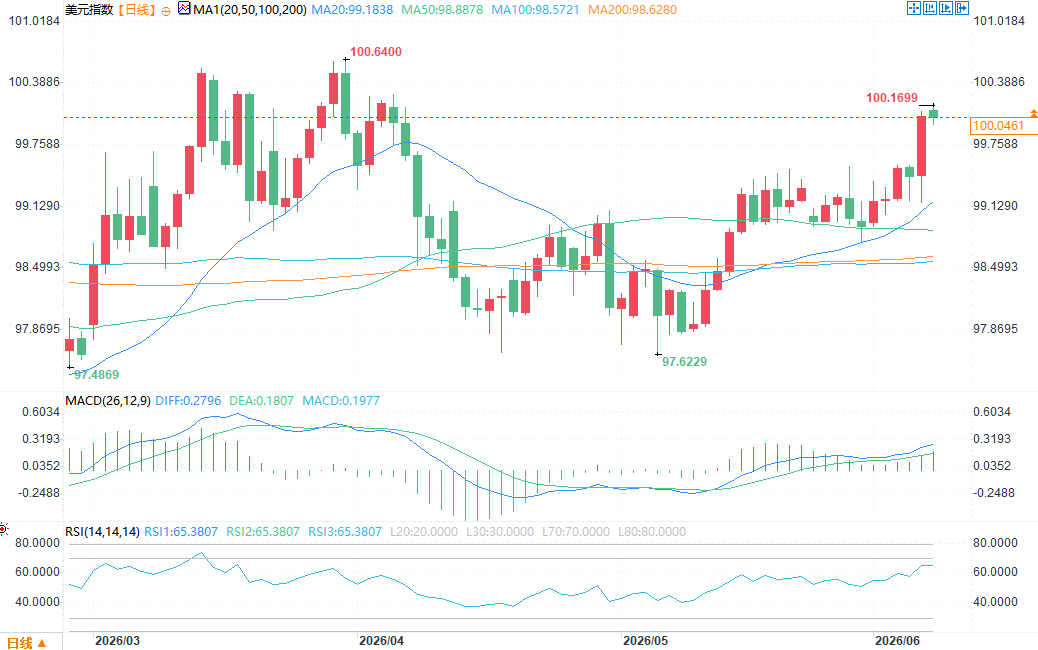
(US Dollar Index Daily Chart, Source: FX678)
At 14:12 Beijing time on June 8, the US dollar index was at 100.10.
The US dollar index surged 0.6% to a two-month high in the previous trading session, supported by escalating tensions in the Middle East, better-than-expected US non-farm payroll data in May, and significantly increased market expectations for a Federal Reserve rate hike this year. Meanwhile, the Trump administration is attempting to restrain Israeli retaliatory actions to prevent a complete breakdown of the ceasefire agreement.
Tensions continue in the Middle East, leading to safe-haven flows into the US dollar.
On Monday, hours after Iran launched multiple missile strikes into northern Israel, the Israel Defense Forces (IDF) said it had struck military targets in western and central Iran.
Iranian state television reported hearing explosions in Isfahan, Tabriz, and Tehran, but did not immediately provide details.
US President Donald Trump said on Sunday, in response to the Iranian missile attack, that he would tell Israeli Prime Minister Benjamin Netanyahu not to retaliate. The Iranian missile attack was a response to an attack on the outskirts of Beirut.
The continued escalation of tensions in the Middle East could further boost safe-haven inflows, thus supporting the dollar's performance against other major currencies in the short term.
Strong US jobs data fuels expectations of a Federal Reserve rate hike.
The U.S. economy achieved its third consecutive month of strong job growth in May. Data released by the Bureau of Labor Statistics last Friday showed that non-farm payrolls increased by 172,000 in May, with the previous month's figure revised upward from 115,000 to 179,000. This figure significantly exceeded market expectations of 85,000. Meanwhile, the unemployment rate remained at 4.3% in May, in line with market expectations.
According to data from the CME FedWatch tool, the market is currently pricing in a greater than 70% probability of a Fed rate hike in December, a significant increase from 45% a week ago.
"The U.S. jobs report paints a picture of a strengthening U.S. labor market despite the current energy price shock," said Jonas Gortman, chief market economist at Capital Economics. "This combination makes it increasingly likely that the Fed will tighten policy later this year... We now expect the FOMC to raise rates by 25 basis points twice later this year to address the energy supply shock and the renewed acceleration of the U.S. labor market."
Institutional Views
OCBC strategists Sim Moh Siong and Christopher Wong hold a neutral view on the dollar's trajectory, believing it will remain strong in the short term but will generally trade within a range.
They pointed out that the US economy has shown strong resilience, while inflation remains stubborn, providing fundamental support for the dollar. At the same time, the Federal Reserve's monetary policy stance is gradually shifting from an easing bias to a neutral one, which further solidifies the dollar's relative advantage.
However, both strategists cautioned that if the US and Iran reach an agreement and the Strait of Hormuz reopens, oil prices could fall significantly, negatively impacting the dollar. Even so, the US economy's leading advantage over other major economies is expected to limit the dollar's downside.
Morgan Stanley warns that the June Federal Reserve meeting is the most significant and underpriced risk event in the current foreign exchange market. The first meeting chaired by new Chairman Kevin Warsh could end the low-volatility environment that has dominated the market this year and pose a challenge to widespread arbitrage trading strategies.
The bank's strategy team pointed out that the euro, yen, Australian dollar, and New Zealand dollar are highly sensitive to changes in the yield on the two-year US Treasury bond. If Warsh releases hawkish signals, it could quickly push up volatility and trigger the unwinding of carry trades. In either case, the dollar's volatility is likely to exceed current market pricing.
Technical Analysis
The US dollar index is currently in a strong upward trend on the daily chart, with prices rebounding steadily from the May low of 97.6229 and recently breaking through the 100 mark, indicating strong overall bullish momentum. The moving average system is in a bullish alignment, with the price above the MA20, MA50, MA100, and MA200. Support levels are at 99.12 and 98.57, while key resistance is at 100.64.
In terms of indicators, the MACD DIFF line is above the DEA line, and the red bars continue to expand, indicating that the bullish momentum is still strengthening; the RSI value is 65.38, which is in the bullish range but has not yet entered the overbought zone, and there is still room for upward movement.
Overall, the short-term trend of the US dollar index is clearly bullish, with technical signals supporting further upward movement. A break above the 100.64 high would open up further upside potential; if it encounters resistance and falls back, support levels to watch are the 100.00 level and the 20-day moving average (MA20). A pullback would not alter the medium-term bullish trend.
(US Dollar Index Daily Chart, Source: FX678)
At 14:12 Beijing time on June 8, the US dollar index was at 100.10.
- Risk Warning and Disclaimer
- The market involves risk, and trading may not be suitable for all investors. This article is for reference only and does not constitute personal investment advice, nor does it take into account certain users’ specific investment objectives, financial situation, or other needs. Any investment decisions made based on this information are at your own risk.