Escalating Middle East conflict offset the impact of OPEC+ production increases, while market doubts about the ability to bring in the additional 188,000 barrels of oil pushed oil prices up by 5%.
2026-06-08 16:16:49
The international crude oil market continued to be affected by the escalating situation in the Middle East on Monday. Although OPEC+ announced an increase in production quotas, the market did not regard it as a negative factor that could effectively alleviate the current supply shortage. Instead, the focus was on the deteriorating geopolitical risks.

Following its weekend meeting, OPEC+ decided to raise its July crude oil production target by 188,000 barrels per day. Traditionally, increased production would alleviate supply concerns and put downward pressure on oil prices. However, the market reaction this time was quite different. Oil prices not only failed to fall due to the production increase news, but instead continued to rise during Monday's Asian trading session, with some crude oil contracts rising by nearly 5% intraday.
The core reason for this phenomenon is that the market generally believes the increased production is more of a nominal adjustment than a significant increase in actual supply. Allianz Chief Economist El-Erian points out that the increased production announced by OPEC+ may be difficult to deliver in reality. In fact, even if some member countries raise their production targets, they face real obstacles in transportation and export.
The biggest concern in the market remains the Strait of Hormuz. As one of the world's most important energy transport routes, the strait handles approximately 20% of global seaborne crude oil shipments and is also a crucial gateway for energy exports from major oil-producing countries in the Gulf region.
As tensions between Iran and Israel continue to escalate, markets are concerned that the resumption of energy transportation in the region will be further delayed, thus continuing to constrain global crude oil supplies. In recent weeks, the market had held hopes for a de-escalation of the situation in the Middle East.
US President Trump previously stated that the parties were close to reaching a peace agreement and emphasized that Israel needed to cooperate with the diplomatic arrangements promoted by the US. This briefly led to market expectations that energy transportation might return to normal, and international oil prices saw a temporary pullback. However, the situation deteriorated again over the weekend. A new round of military confrontation erupted between Iran and Israel, with both sides launching attacks, significantly increasing regional security risks. Meanwhile, Israel's military operations in Lebanon also showed signs of expansion.
These events quickly shifted market sentiment. Investors began to reassess energy supply risks and worried that any further escalation could pose a greater threat to energy exports from the Gulf region. From a market pricing perspective, the crude oil market is no longer solely focused on production figures, but is now paying more attention to actual exportable supply capacity.
Even if OPEC+ members have the capacity to increase production, the additional crude oil output will be insufficient to effectively meet international market demand if transportation channels cannot be restored. Meanwhile, some OPEC+ members are already operating at near-maximum capacity utilization, limiting their potential for rapidly increasing exports. Furthermore, recent disruptions to some energy infrastructure due to conflict have also raised concerns about future supply stability.
On the demand side, global energy consumption remains resilient. With the peak summer oil consumption season approaching, the market maintains optimistic expectations for increased demand for transportation and power generation fuels. The combined effect of supply risks and stable demand is further driving up oil prices.
In terms of fund flows, more and more speculative funds are re-entering the energy market. Risk aversion and supply concerns are jointly driving investors to increase their long positions in crude oil, resulting in a significant widening of the market risk premium.
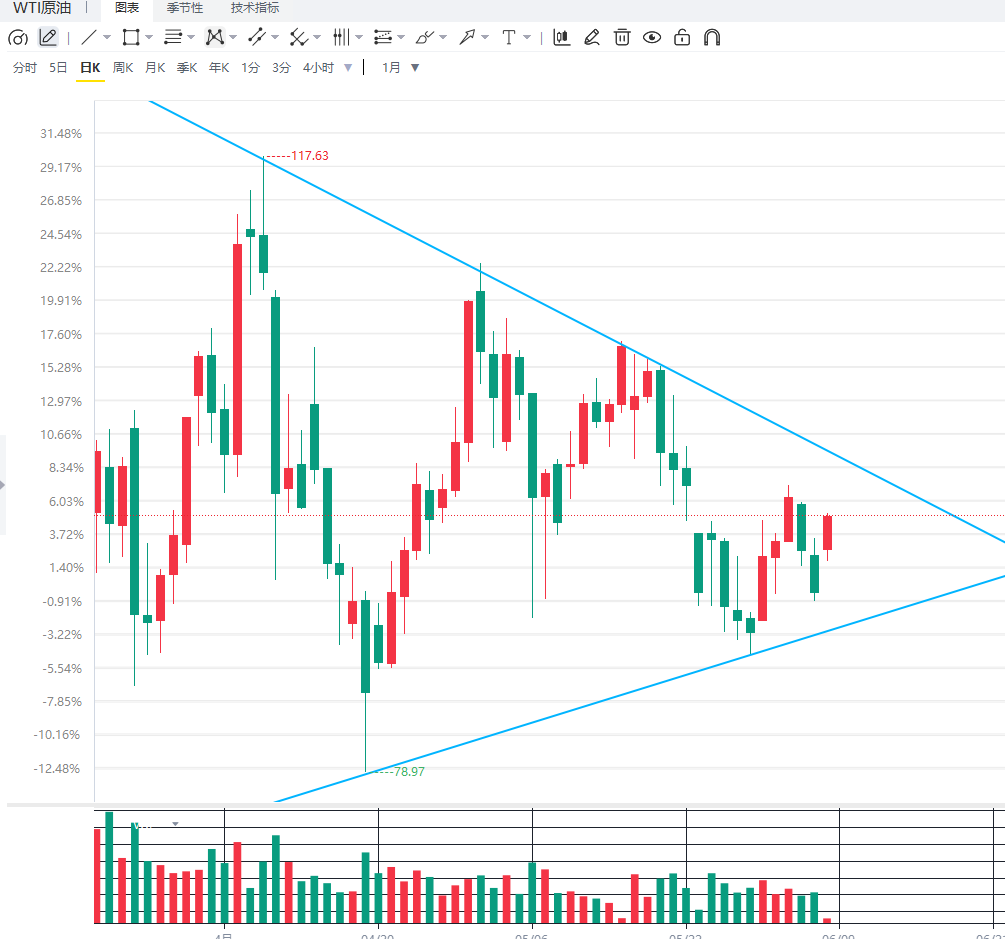
From a technical perspective, the WTI crude oil daily chart has formed a clear upward breakout trend. After opening higher, oil prices stabilized above the $90 mark, indicating strong buying power in the market. The MACD indicator maintains its golden cross and continues to diverge upwards, with the red bars further expanding, reflecting strengthening bullish momentum. The RSI indicator has risen to around 70, entering strong territory, but has not yet shown a clear topping signal. Key resistance levels to watch are the $96 and $98 areas.
From a 4-hour chart perspective, oil prices are maintaining an upward channel. Short-term moving averages are in a bullish alignment, and market sentiment is clearly optimistic. Due to the gap created over the weekend, there is some short-term technical need for filling the gap, but as long as prices remain above $90, the bullish structure will remain intact. Key support levels to watch are $88, $85, and $82.
Editor's Summary : The current international crude oil market has entered a phase dominated by geopolitical risks. Although OPEC+ has announced an increase in production targets, the market is more focused on actual supply capacity than the nominal increase. Disruptions to shipping in the Strait of Hormuz and escalating conflicts in the Middle East are continuously pushing up energy market risk premiums. In the short term, geopolitical situations remain the core variable determining oil price trends. If conflicts in relevant regions escalate further, crude oil prices may continue to rise; conversely, if peace negotiations make substantial progress and energy transportation resumes, market risk premiums are expected to gradually decline. Investors should pay close attention to changes in the Middle East situation, OPEC+ actual export data, and changes in global inventory levels.
Following its weekend meeting, OPEC+ decided to raise its July crude oil production target by 188,000 barrels per day. Traditionally, increased production would alleviate supply concerns and put downward pressure on oil prices. However, the market reaction this time was quite different. Oil prices not only failed to fall due to the production increase news, but instead continued to rise during Monday's Asian trading session, with some crude oil contracts rising by nearly 5% intraday.
The core reason for this phenomenon is that the market generally believes the increased production is more of a nominal adjustment than a significant increase in actual supply. Allianz Chief Economist El-Erian points out that the increased production announced by OPEC+ may be difficult to deliver in reality. In fact, even if some member countries raise their production targets, they face real obstacles in transportation and export.
The biggest concern in the market remains the Strait of Hormuz. As one of the world's most important energy transport routes, the strait handles approximately 20% of global seaborne crude oil shipments and is also a crucial gateway for energy exports from major oil-producing countries in the Gulf region.
As tensions between Iran and Israel continue to escalate, markets are concerned that the resumption of energy transportation in the region will be further delayed, thus continuing to constrain global crude oil supplies. In recent weeks, the market had held hopes for a de-escalation of the situation in the Middle East.
US President Trump previously stated that the parties were close to reaching a peace agreement and emphasized that Israel needed to cooperate with the diplomatic arrangements promoted by the US. This briefly led to market expectations that energy transportation might return to normal, and international oil prices saw a temporary pullback. However, the situation deteriorated again over the weekend. A new round of military confrontation erupted between Iran and Israel, with both sides launching attacks, significantly increasing regional security risks. Meanwhile, Israel's military operations in Lebanon also showed signs of expansion.
These events quickly shifted market sentiment. Investors began to reassess energy supply risks and worried that any further escalation could pose a greater threat to energy exports from the Gulf region. From a market pricing perspective, the crude oil market is no longer solely focused on production figures, but is now paying more attention to actual exportable supply capacity.
Even if OPEC+ members have the capacity to increase production, the additional crude oil output will be insufficient to effectively meet international market demand if transportation channels cannot be restored. Meanwhile, some OPEC+ members are already operating at near-maximum capacity utilization, limiting their potential for rapidly increasing exports. Furthermore, recent disruptions to some energy infrastructure due to conflict have also raised concerns about future supply stability.
On the demand side, global energy consumption remains resilient. With the peak summer oil consumption season approaching, the market maintains optimistic expectations for increased demand for transportation and power generation fuels. The combined effect of supply risks and stable demand is further driving up oil prices.
In terms of fund flows, more and more speculative funds are re-entering the energy market. Risk aversion and supply concerns are jointly driving investors to increase their long positions in crude oil, resulting in a significant widening of the market risk premium.
From a technical perspective, the WTI crude oil daily chart has formed a clear upward breakout trend. After opening higher, oil prices stabilized above the $90 mark, indicating strong buying power in the market. The MACD indicator maintains its golden cross and continues to diverge upwards, with the red bars further expanding, reflecting strengthening bullish momentum. The RSI indicator has risen to around 70, entering strong territory, but has not yet shown a clear topping signal. Key resistance levels to watch are the $96 and $98 areas.
From a 4-hour chart perspective, oil prices are maintaining an upward channel. Short-term moving averages are in a bullish alignment, and market sentiment is clearly optimistic. Due to the gap created over the weekend, there is some short-term technical need for filling the gap, but as long as prices remain above $90, the bullish structure will remain intact. Key support levels to watch are $88, $85, and $82.
Editor's Summary : The current international crude oil market has entered a phase dominated by geopolitical risks. Although OPEC+ has announced an increase in production targets, the market is more focused on actual supply capacity than the nominal increase. Disruptions to shipping in the Strait of Hormuz and escalating conflicts in the Middle East are continuously pushing up energy market risk premiums. In the short term, geopolitical situations remain the core variable determining oil price trends. If conflicts in relevant regions escalate further, crude oil prices may continue to rise; conversely, if peace negotiations make substantial progress and energy transportation resumes, market risk premiums are expected to gradually decline. Investors should pay close attention to changes in the Middle East situation, OPEC+ actual export data, and changes in global inventory levels.
- Risk Warning and Disclaimer
- The market involves risk, and trading may not be suitable for all investors. This article is for reference only and does not constitute personal investment advice, nor does it take into account certain users’ specific investment objectives, financial situation, or other needs. Any investment decisions made based on this information are at your own risk.