Rising energy prices are increasing inflation risks; could the European Central Bank raise interest rates by 25 basis points this week?
2026-06-08 16:20:50
The upcoming European Central Bank (ECB) interest rate decision this week is a major focus for global financial markets. Amidst rising international energy prices and heightened tensions in the Middle East, market expectations regarding the ECB's future policy path are evolving.

A recent research report from Nordea Bank in Sweden indicates that the European Central Bank may announce a 25 basis point increase in its three key policy rates this Thursday to address the potential new round of inflation risks from rising energy prices. Although current Eurozone inflation data does not fully reflect the impact of energy prices, policymakers may be inclined to take preemptive action to prevent further spread of future inflationary pressures.
The international crude oil market has recently experienced significant volatility. Escalating tensions in the Middle East caused a sharp rise in international oil prices. Market concerns have arisen regarding potential disruptions to energy transport through the Strait of Hormuz, thereby driving up global energy costs. For Europe, which is heavily reliant on energy imports, rising oil prices will not only directly impact consumer spending but may also increase production costs for businesses.
Economists generally believe that rising energy prices typically affect overall inflation through multiple channels. First, they directly drive up fuel, electricity, and transportation costs; second, they gradually transmit these costs to the prices of industrial goods and services through corporate cost-passing mechanisms; and finally, they may affect wage negotiations and residents' inflation expectations, creating a so-called second-round inflation effect. The current market concern is precisely this longer-term risk of price transmission.
While the latest data shows that overall inflation in the Eurozone has declined somewhat, new developments in the energy market may challenge the cooling process in the coming months. Against this backdrop, if the European Central Bank chooses to implement tightening measures ahead of schedule, its primary aim will be to stabilize market expectations regarding future inflation.
At the same time, the European Central Bank faces a complex policy environment. On the one hand, rising energy prices increase the risk of future inflation; on the other hand, economic growth in the Eurozone remains weak, with limited recovery in manufacturing and consumer activity in some countries.
Previously released data on German factory orders showed that orders fell 3.8% month-on-month in April, far worse than market expectations. This reflects the continued pressure on the recovery of the manufacturing sector in the Eurozone's core economies. Therefore, the European Central Bank still needs to maintain a balance between controlling inflation and supporting economic growth.
The market anticipates that, in addition to the interest rate decision itself, ECB President Christine Lagarde's press conference will also be a key focus of this meeting. Investors will pay close attention to the ECB's latest economic forecasts, inflation assessment, and statements regarding future policy direction.
Analysts generally believe that Lagarde may spend a considerable amount of time explaining the latest staff forecasts and emphasizing the current risk factors. Given the significant uncertainties surrounding geopolitical situations, energy prices, and the global economic growth outlook, the European Central Bank is not expected to make a clear commitment to further interest rate hikes.
Instead, policymakers are more likely to emphasize that future policies will be flexibly adjusted based on changes in economic data. This statement implies that even if an interest rate hike is implemented this week, the subsequent policy path will remain open.
From a market pricing perspective, investors have already largely priced in the expected rate hike. Therefore, the impact of the ECB's meeting statement and Lagarde's speech on the euro's trajectory may exceed that of the rate decision itself. If the ECB signals further tightening of policy, the euro may receive additional support; conversely, if the policy statement emphasizes economic risks and demonstrates a clearly cautious attitude, the euro's upside potential may be limited.
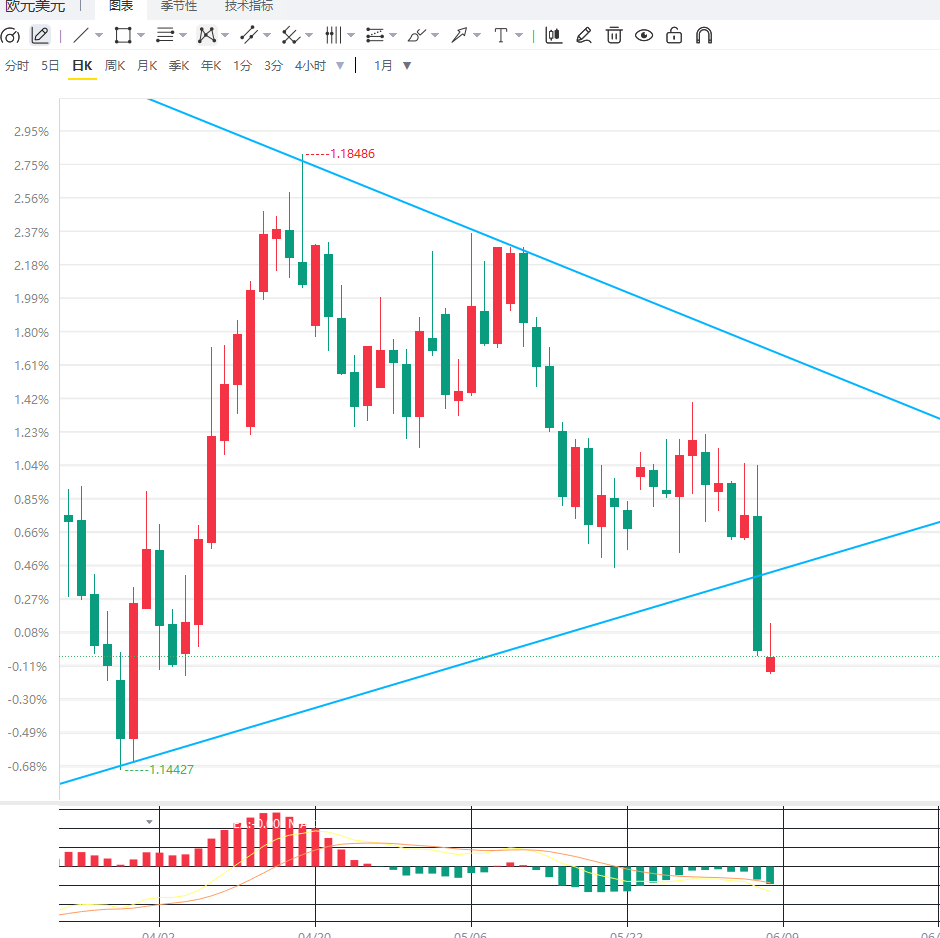
From a technical perspective, the EUR/USD pair is currently trading around 1.1520 on the daily chart, in a phase of consolidation and pullback. The price has broken below some moving average support levels in the short term, indicating a cautious market sentiment. The MACD indicator is near the zero line and maintaining a downward trend, with the green bars gradually expanding, reflecting the dominance of bearish forces. The RSI indicator is around 45, indicating that the market has not yet entered oversold territory, and there is still room for short-term correction. Key support levels to watch are 1.1480 and 1.1400, while resistance levels are around 1.1600 and 1.1680.
From a 4-hour chart perspective, the euro/dollar pair maintains a descending channel structure. Short-term moving averages are in a bearish alignment, indicating continued short-term pressure. However, with the European Central Bank meeting approaching, market sentiment is cautious, and the exchange rate may enter a consolidation phase, awaiting new policy guidance.
Editor's Summary : Faced with the potential inflationary risks from rising energy prices, the probability of the European Central Bank (ECB) raising interest rates this week has increased significantly. Although current inflation data does not fully reflect the impact of the energy shock, policymakers may want to stabilize market expectations by tightening policy ahead of schedule. However, given the continued challenges to Eurozone economic growth, the ECB is not expected to make a clear commitment to further interest rate hikes, but rather maintain its "data-driven policy" strategy. The market will focus on Lagarde's statements regarding inflation risks, economic growth, and the policy outlook, as these signals will be crucial in determining the euro's trajectory.
A recent research report from Nordea Bank in Sweden indicates that the European Central Bank may announce a 25 basis point increase in its three key policy rates this Thursday to address the potential new round of inflation risks from rising energy prices. Although current Eurozone inflation data does not fully reflect the impact of energy prices, policymakers may be inclined to take preemptive action to prevent further spread of future inflationary pressures.
The international crude oil market has recently experienced significant volatility. Escalating tensions in the Middle East caused a sharp rise in international oil prices. Market concerns have arisen regarding potential disruptions to energy transport through the Strait of Hormuz, thereby driving up global energy costs. For Europe, which is heavily reliant on energy imports, rising oil prices will not only directly impact consumer spending but may also increase production costs for businesses.
Economists generally believe that rising energy prices typically affect overall inflation through multiple channels. First, they directly drive up fuel, electricity, and transportation costs; second, they gradually transmit these costs to the prices of industrial goods and services through corporate cost-passing mechanisms; and finally, they may affect wage negotiations and residents' inflation expectations, creating a so-called second-round inflation effect. The current market concern is precisely this longer-term risk of price transmission.
While the latest data shows that overall inflation in the Eurozone has declined somewhat, new developments in the energy market may challenge the cooling process in the coming months. Against this backdrop, if the European Central Bank chooses to implement tightening measures ahead of schedule, its primary aim will be to stabilize market expectations regarding future inflation.
At the same time, the European Central Bank faces a complex policy environment. On the one hand, rising energy prices increase the risk of future inflation; on the other hand, economic growth in the Eurozone remains weak, with limited recovery in manufacturing and consumer activity in some countries.
Previously released data on German factory orders showed that orders fell 3.8% month-on-month in April, far worse than market expectations. This reflects the continued pressure on the recovery of the manufacturing sector in the Eurozone's core economies. Therefore, the European Central Bank still needs to maintain a balance between controlling inflation and supporting economic growth.
The market anticipates that, in addition to the interest rate decision itself, ECB President Christine Lagarde's press conference will also be a key focus of this meeting. Investors will pay close attention to the ECB's latest economic forecasts, inflation assessment, and statements regarding future policy direction.
Analysts generally believe that Lagarde may spend a considerable amount of time explaining the latest staff forecasts and emphasizing the current risk factors. Given the significant uncertainties surrounding geopolitical situations, energy prices, and the global economic growth outlook, the European Central Bank is not expected to make a clear commitment to further interest rate hikes.
Instead, policymakers are more likely to emphasize that future policies will be flexibly adjusted based on changes in economic data. This statement implies that even if an interest rate hike is implemented this week, the subsequent policy path will remain open.
From a market pricing perspective, investors have already largely priced in the expected rate hike. Therefore, the impact of the ECB's meeting statement and Lagarde's speech on the euro's trajectory may exceed that of the rate decision itself. If the ECB signals further tightening of policy, the euro may receive additional support; conversely, if the policy statement emphasizes economic risks and demonstrates a clearly cautious attitude, the euro's upside potential may be limited.
From a technical perspective, the EUR/USD pair is currently trading around 1.1520 on the daily chart, in a phase of consolidation and pullback. The price has broken below some moving average support levels in the short term, indicating a cautious market sentiment. The MACD indicator is near the zero line and maintaining a downward trend, with the green bars gradually expanding, reflecting the dominance of bearish forces. The RSI indicator is around 45, indicating that the market has not yet entered oversold territory, and there is still room for short-term correction. Key support levels to watch are 1.1480 and 1.1400, while resistance levels are around 1.1600 and 1.1680.
From a 4-hour chart perspective, the euro/dollar pair maintains a descending channel structure. Short-term moving averages are in a bearish alignment, indicating continued short-term pressure. However, with the European Central Bank meeting approaching, market sentiment is cautious, and the exchange rate may enter a consolidation phase, awaiting new policy guidance.
Editor's Summary : Faced with the potential inflationary risks from rising energy prices, the probability of the European Central Bank (ECB) raising interest rates this week has increased significantly. Although current inflation data does not fully reflect the impact of the energy shock, policymakers may want to stabilize market expectations by tightening policy ahead of schedule. However, given the continued challenges to Eurozone economic growth, the ECB is not expected to make a clear commitment to further interest rate hikes, but rather maintain its "data-driven policy" strategy. The market will focus on Lagarde's statements regarding inflation risks, economic growth, and the policy outlook, as these signals will be crucial in determining the euro's trajectory.
- Risk Warning and Disclaimer
- The market involves risk, and trading may not be suitable for all investors. This article is for reference only and does not constitute personal investment advice, nor does it take into account certain users’ specific investment objectives, financial situation, or other needs. Any investment decisions made based on this information are at your own risk.