The US dollar has risen for seven consecutive days against the Canadian dollar. Will the Bank of Canada intervene this time?
2026-06-08 16:52:58
On Monday (June 8), the US dollar rose slightly against the Canadian dollar during the European session, currently trading around 1.3945, after rising for six consecutive trading days.
Behind this surge is the growing market expectation that the Bank of Canada will keep interest rates unchanged.
BNY Mellon analyst Bob Savage expects the Bank of Canada (BoC) to keep interest rates unchanged at its meeting this Wednesday, amid a backdrop of a technical recession and slowing economic growth. Despite recent unexpectedly positive labor data, the tone of the policy statement and discussions of recession risks will be key factors influencing the Canadian dollar (CAD) and Canadian interest rates.
At the same time, market pricing in a more hawkish Federal Reserve is shifting, and coupled with trade headwinds, the Canadian dollar may continue to be under pressure.

Savage points out that the Bank of Canada will hold a policy meeting on Wednesday, amid a backdrop of weak economic growth. Despite a strong latest labor force report—showing job growth exceeding market expectations—the Canadian economy has entered a technical recession, meaning two consecutive quarters of negative GDP growth. This paradoxical situation makes this policy decision more closely watched by the market than usual.
On the one hand, strong employment data indicates that the labor market remains resilient, with wage growth and consumer spending not yet showing significant deterioration, providing the central bank with some buffer to maintain the status quo. On the other hand, the real pressure of a technical recession cannot be ignored. Economic growth continues to shrink, business investment is sluggish, and the impact of the high-interest-rate environment on interest rate-sensitive sectors such as real estate and manufacturing is gradually becoming apparent. In this context of "strong employment, weak growth," the Bank of Canada faces a dilemma: premature easing could lead to a rebound in inflation, while continuing to tighten could further deepen the recession.
The market widely expects the Bank of Canada to keep interest rates unchanged, remaining on hold. However, what truly affects traders is not the rate decision itself, but rather the tone of the policy statement and any discussion of recession risks. If the statement leans dovish, suggesting a possible shift towards easing, the Canadian dollar may come under downward pressure; conversely, if the central bank emphasizes that inflation risks remain and that it is not yet time to discuss rate cuts, it may provide short-term support for the Canadian dollar.
Furthermore, Savage cautioned that the Bank of Canada's characterization of the recession risk—whether it is a "temporary slowdown" or a "needs a policy response"—will directly influence market pricing of the subsequent interest rate path, thus having a significant impact on the Canadian dollar exchange rate and Canadian bond yields.
Savage also stated that the key question for the market is whether the upcoming CPI data will confirm the recent hawkish repricing of Canadian interest rates or leave room for a policy shift. If May's inflation data remains high, or even unexpectedly rises, the Bank of Canada may be forced to maintain a hawkish stance to curb deeply entrenched inflation expectations, even if the economy is on the verge of recession. This would further reinforce the market's pricing in "higher and longer" interest rates, thus providing some support for the Canadian dollar.
Conversely, if CPI data shows a clear easing of inflationary pressures, especially with core inflation showing signs of cooling against the backdrop of high energy prices, then market expectations for the Bank of Canada to maintain its tightening stance will soften. At that point, investors may begin pricing in the possibility of a rate cut later in 2026 or early 2027, which would put additional downward pressure on the Canadian dollar.
Savage concludes that CPI data will be a key variable in the short-term movement of the Canadian dollar. With the interplay of strong labor market performance and signs of economic recession, inflation readings will help the market determine which side the Bank of Canada cares more about—the still-high inflation or the shrinking economy. This judgment will directly determine the direction of the Canadian dollar in the coming weeks.
The Canadian dollar may continue to face downward pressure as the market prices the Federal Reserve's policy in the opposite direction—namely, interest rate hikes—coupled with tough trade negotiations between Canada and the United States about to begin.
From a monetary policy perspective, the policy paths of the central banks of the US and Canada are diverging significantly. In the US, May's non-farm payroll data far exceeded expectations, and the market has already fully priced in a 25 basis point rate hike by the Federal Reserve before the end of the year, with some traders even betting on earlier tightening. Meanwhile, while the Bank of Canada is likely to maintain its interest rate unchanged due to a technical recession, its policy stance is relatively dovish. This policy divergence between the US and Canada suggests that the US-Canada interest rate differential may widen further, thus exerting structural pressure on the Canadian dollar.
From a trade policy perspective, trade negotiations between the US and Canada have always been fraught with uncertainty. The current negotiations are particularly complex—following the US military strike against Iran, global supply chains have been severely disrupted, and Canada, as one of the US's largest trading partners, relies heavily on US market demand for its exports. If negotiations stall, the US may impose tariffs on Canadian goods or erect new trade barriers, directly impacting Canada's pillar industries such as automobiles, timber, and dairy products. Escalating trade frictions will not only hinder Canada's economic recovery but also weaken investor confidence in the Canadian dollar.
Furthermore, rising global risk aversion could exacerbate the weakness of the Canadian dollar. Continued tensions in the Middle East are driving funds towards traditional safe-haven assets like the US dollar, while the Canadian dollar, as a commodity currency, often underperforms when market risk appetite declines. Overall, under the triple pressures of diverging monetary policies, uncertainty in trade negotiations, and risk aversion, the Canadian dollar's short-term outlook is likely to be under pressure.
The USD/CAD pair is currently in a strong uptrend on the daily chart, having rebounded steadily from its May low of 1.3549. It recently broke through previous highs and is approaching the resistance levels of 1.3966 and 1.3951. The moving average system is in a bullish alignment, with the price above the 20-day, 50-day, 100-day, and 200-day moving averages. Support levels below are around 1.3804 and 1.3761, indicating strong support.
In terms of indicators, the MACD DIFF line is above the DEA line, and the red bars continue to expand, indicating that the bullish momentum is still strengthening; the RSI value is 73.11, which has entered the overbought zone, and there is short-term technical pullback pressure.
Overall, the short-term trend for USD/CAD is clearly bullish, with technical indicators supporting further upward movement. A break above the 1.3966 high would open up further upside potential; if it encounters resistance and falls back, support levels to watch are the 1.39 level and the 20-day moving average (MA20). A pullback would not alter the medium-term bullish trend.
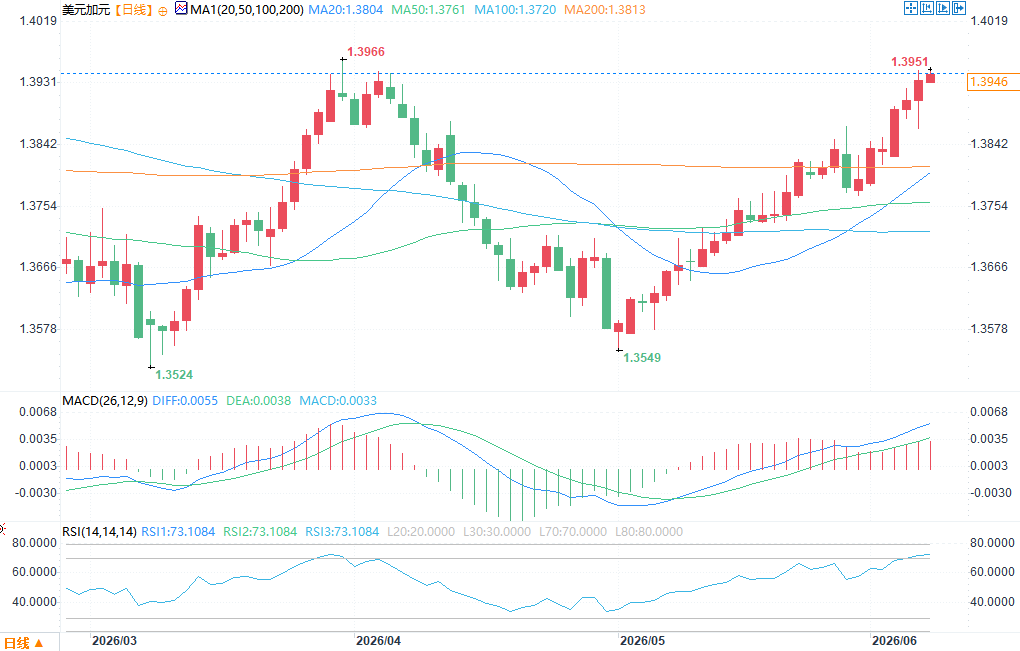
(USD/CAD daily chart, source: EasyForex)
At 16:46 Beijing time on June 8, the USD/CAD exchange rate was 1.3949/50.
Behind this surge is the growing market expectation that the Bank of Canada will keep interest rates unchanged.
BNY Mellon analyst Bob Savage expects the Bank of Canada (BoC) to keep interest rates unchanged at its meeting this Wednesday, amid a backdrop of a technical recession and slowing economic growth. Despite recent unexpectedly positive labor data, the tone of the policy statement and discussions of recession risks will be key factors influencing the Canadian dollar (CAD) and Canadian interest rates.
At the same time, market pricing in a more hawkish Federal Reserve is shifting, and coupled with trade headwinds, the Canadian dollar may continue to be under pressure.
The tone of the policy statement becomes the focus
Savage points out that the Bank of Canada will hold a policy meeting on Wednesday, amid a backdrop of weak economic growth. Despite a strong latest labor force report—showing job growth exceeding market expectations—the Canadian economy has entered a technical recession, meaning two consecutive quarters of negative GDP growth. This paradoxical situation makes this policy decision more closely watched by the market than usual.
On the one hand, strong employment data indicates that the labor market remains resilient, with wage growth and consumer spending not yet showing significant deterioration, providing the central bank with some buffer to maintain the status quo. On the other hand, the real pressure of a technical recession cannot be ignored. Economic growth continues to shrink, business investment is sluggish, and the impact of the high-interest-rate environment on interest rate-sensitive sectors such as real estate and manufacturing is gradually becoming apparent. In this context of "strong employment, weak growth," the Bank of Canada faces a dilemma: premature easing could lead to a rebound in inflation, while continuing to tighten could further deepen the recession.
The market widely expects the Bank of Canada to keep interest rates unchanged, remaining on hold. However, what truly affects traders is not the rate decision itself, but rather the tone of the policy statement and any discussion of recession risks. If the statement leans dovish, suggesting a possible shift towards easing, the Canadian dollar may come under downward pressure; conversely, if the central bank emphasizes that inflation risks remain and that it is not yet time to discuss rate cuts, it may provide short-term support for the Canadian dollar.
Furthermore, Savage cautioned that the Bank of Canada's characterization of the recession risk—whether it is a "temporary slowdown" or a "needs a policy response"—will directly influence market pricing of the subsequent interest rate path, thus having a significant impact on the Canadian dollar exchange rate and Canadian bond yields.
Inflation data becomes a key variable
Savage also stated that the key question for the market is whether the upcoming CPI data will confirm the recent hawkish repricing of Canadian interest rates or leave room for a policy shift. If May's inflation data remains high, or even unexpectedly rises, the Bank of Canada may be forced to maintain a hawkish stance to curb deeply entrenched inflation expectations, even if the economy is on the verge of recession. This would further reinforce the market's pricing in "higher and longer" interest rates, thus providing some support for the Canadian dollar.
Conversely, if CPI data shows a clear easing of inflationary pressures, especially with core inflation showing signs of cooling against the backdrop of high energy prices, then market expectations for the Bank of Canada to maintain its tightening stance will soften. At that point, investors may begin pricing in the possibility of a rate cut later in 2026 or early 2027, which would put additional downward pressure on the Canadian dollar.
Savage concludes that CPI data will be a key variable in the short-term movement of the Canadian dollar. With the interplay of strong labor market performance and signs of economic recession, inflation readings will help the market determine which side the Bank of Canada cares more about—the still-high inflation or the shrinking economy. This judgment will directly determine the direction of the Canadian dollar in the coming weeks.
External factors exacerbate pressure on the Canadian dollar
The Canadian dollar may continue to face downward pressure as the market prices the Federal Reserve's policy in the opposite direction—namely, interest rate hikes—coupled with tough trade negotiations between Canada and the United States about to begin.
From a monetary policy perspective, the policy paths of the central banks of the US and Canada are diverging significantly. In the US, May's non-farm payroll data far exceeded expectations, and the market has already fully priced in a 25 basis point rate hike by the Federal Reserve before the end of the year, with some traders even betting on earlier tightening. Meanwhile, while the Bank of Canada is likely to maintain its interest rate unchanged due to a technical recession, its policy stance is relatively dovish. This policy divergence between the US and Canada suggests that the US-Canada interest rate differential may widen further, thus exerting structural pressure on the Canadian dollar.
From a trade policy perspective, trade negotiations between the US and Canada have always been fraught with uncertainty. The current negotiations are particularly complex—following the US military strike against Iran, global supply chains have been severely disrupted, and Canada, as one of the US's largest trading partners, relies heavily on US market demand for its exports. If negotiations stall, the US may impose tariffs on Canadian goods or erect new trade barriers, directly impacting Canada's pillar industries such as automobiles, timber, and dairy products. Escalating trade frictions will not only hinder Canada's economic recovery but also weaken investor confidence in the Canadian dollar.
Furthermore, rising global risk aversion could exacerbate the weakness of the Canadian dollar. Continued tensions in the Middle East are driving funds towards traditional safe-haven assets like the US dollar, while the Canadian dollar, as a commodity currency, often underperforms when market risk appetite declines. Overall, under the triple pressures of diverging monetary policies, uncertainty in trade negotiations, and risk aversion, the Canadian dollar's short-term outlook is likely to be under pressure.
Technical Analysis
The USD/CAD pair is currently in a strong uptrend on the daily chart, having rebounded steadily from its May low of 1.3549. It recently broke through previous highs and is approaching the resistance levels of 1.3966 and 1.3951. The moving average system is in a bullish alignment, with the price above the 20-day, 50-day, 100-day, and 200-day moving averages. Support levels below are around 1.3804 and 1.3761, indicating strong support.
In terms of indicators, the MACD DIFF line is above the DEA line, and the red bars continue to expand, indicating that the bullish momentum is still strengthening; the RSI value is 73.11, which has entered the overbought zone, and there is short-term technical pullback pressure.
Overall, the short-term trend for USD/CAD is clearly bullish, with technical indicators supporting further upward movement. A break above the 1.3966 high would open up further upside potential; if it encounters resistance and falls back, support levels to watch are the 1.39 level and the 20-day moving average (MA20). A pullback would not alter the medium-term bullish trend.
(USD/CAD daily chart, source: EasyForex)
At 16:46 Beijing time on June 8, the USD/CAD exchange rate was 1.3949/50.
- Risk Warning and Disclaimer
- The market involves risk, and trading may not be suitable for all investors. This article is for reference only and does not constitute personal investment advice, nor does it take into account certain users’ specific investment objectives, financial situation, or other needs. Any investment decisions made based on this information are at your own risk.