Ahead of the ECB rate hike: Traders are not really betting on 25 basis points.
2026-06-08 17:50:09
On Monday, June 8, the European interest rate market entered a highly sensitive window ahead of the European Central Bank's policy meeting on June 11. The latest policy rates remained at 2.00% for the deposit facility, 2.15% for the main refinancing rate, and 2.40% for the marginal lending rate. However, Eurozone inflation in May was estimated to have risen to 3.2%, and energy prices rose by 10.9% year-on-year, causing the market to again consider the risk of further tightening this year.
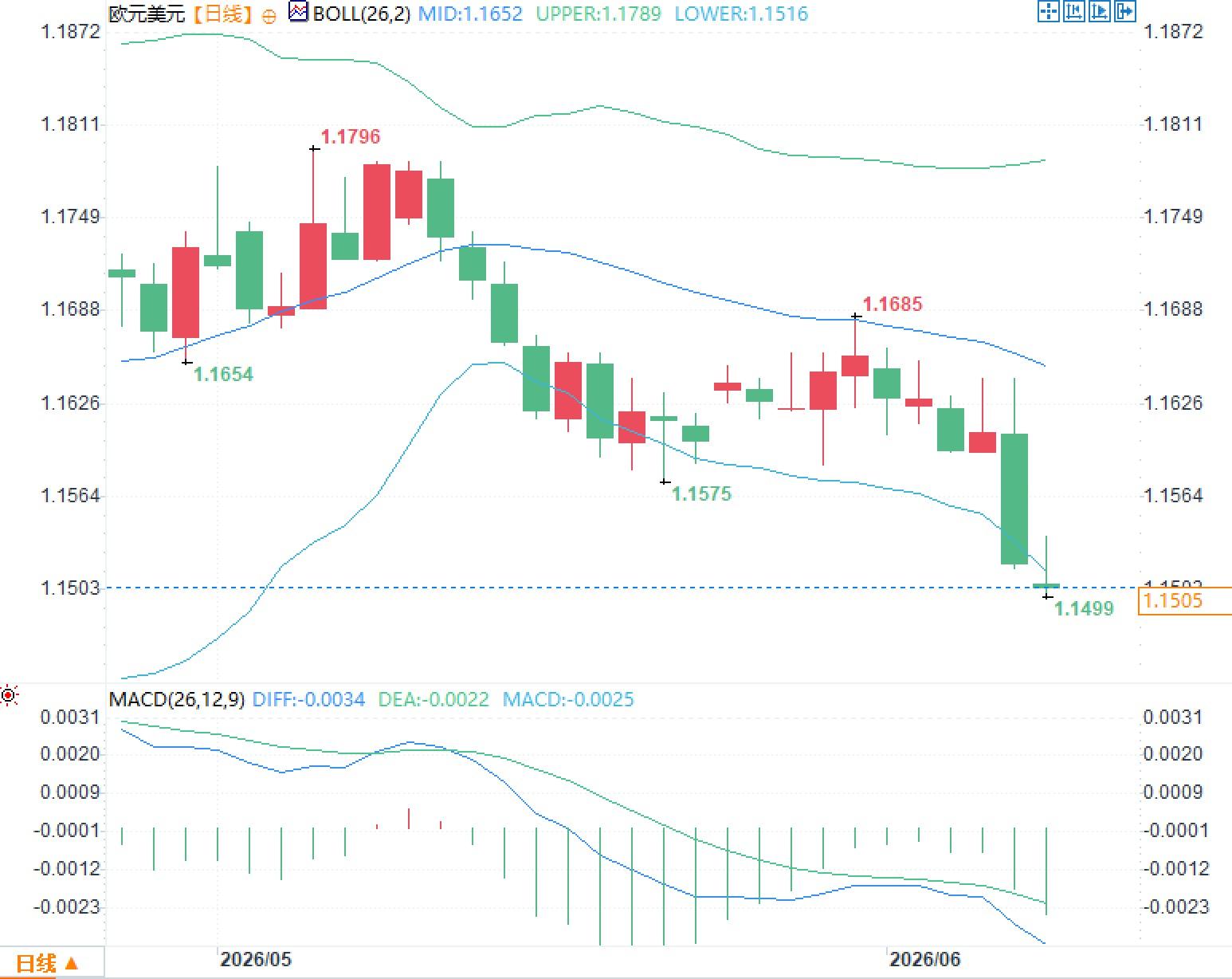
Meanwhile, the revised first-quarter GDP figure for the Eurozone, released on June 5, showed a quarter-on-quarter decline of 0.2%, contrasting with previous readings of slight growth. The yield on German 10-year bonds rose to approximately 3.05%, the euro fluctuated around 1.150 against the dollar, and Eurozone blue-chip futures fell back to around 6000 points. Traders are not simply facing a question of interest rate hikes, but rather a triangular pricing between the energy shock, downward revisions to growth, and central bank credibility.
The current market focus is on the European Central Bank's 25 basis point rate hike this week, with a potential cumulative increase of approximately 75 basis points this year. There are two underlying reasons for this pricing: First, inflation in May has consistently exceeded the 2% target, with the energy component making a significant contribution to overall inflation; second, the oil and gas price shocks from the Middle East conflict have caused the inflation expectation curve to rise again, forcing monetary authorities to suppress the risk of a second wave of transmission through rate hikes.
However, some large asset management institutions have not fully followed this consensus. Luca Paolini, a strategist at Pictet Asset Management, recently stated that the market expects three actions, while the European Central Bank may only act once to show it is still monitoring inflation data. His core judgment is that the European economy has not truly accelerated. JPMorgan analyst Zara Nokes's view leans more towards a "wait and see" approach, meaning that if growth continues to be weak, the central bank will find it difficult to continue tightening beyond this week. Guillaume Rigeade, an analyst at Camignac, also emphasized that the economy can withstand an additional 25 basis points, but the nature of the tightening would be significantly different if a continuous rate hike cycle were to begin.
This divergence is particularly important for bond traders. If central bank statements emphasize "data dependence" rather than "continuous action," short-term interest rates may be priced into subsequent rate hikes this year, and the yield curve will reflect growth risks more than tail risks of inflation.
The revised Q1 GDP figure of -0.2% quarter-on-quarter was the most easily underestimated variable before this round of interest rate decisions. On the surface, Ireland's -12.1% quarterly contraction had a significant impact on the Eurozone's overall figures, indicating statistical noise from fluctuations in multinational corporate activity; however, removing this noise does not necessarily mean a solid growth foundation. In Q1, the Eurozone's private and government consumption contributions were both +0.1 percentage points, fixed capital formation contributed -0.1 percentage points, inventories were negative, and net exports contributed -0.3 percentage points, suggesting a lack of sufficient buffer on the demand side.
More importantly, the job market has not deteriorated to the point of forcing rapid easing. The Eurozone unemployment rate in April was 6.3%, still near a low level, meaning the ECB cannot simply use contracting growth as a reason to pause its policy. This creates a policy dilemma: growth data sets a ceiling for consecutive rate hikes, while the resilience of the job market reduces the room for an immediate dovish shift. For the market, the real variable is not whether there will be a rate hike this week, but whether the central bank defines this action as a "precautionary one-off adjustment" or the start of a new policy cycle.
The 3.2% inflation reading in May was not solely driven by rising energy prices. While energy inflation at 10.9% year-on-year was indeed the biggest disruptor, services inflation rose to 3.5%, and the core figure excluding energy, food, alcohol, and tobacco was 2.5%, indicating that price pressures are no longer entirely confined to the energy chain. The Purchasing Managers' Survey also showed that input cost growth in May reached a three-and-a-half-year high, and business spending growth hit a 38-month high, meaning that the transmission of upstream costs to end-user prices is still ongoing.
This is why the ECB cannot completely ignore the market's hawkish pricing. Historically, the ECB raised interest rates in 2008 and 2011 during periods of economic weakness, which subsequently proved to be ill-timed. Therefore, the communication at this meeting will place greater emphasis on balanced wording. If the statement overemphasizes inflation risks, the market will continue to raise its terminal interest rate assumptions; if it overemphasizes the downside in growth, it will weaken its ability to manage inflation expectations. The more likely statement will be an acknowledgment that upside risks to inflation still need to be monitored, while avoiding a commitment to continuous interest rate hikes.
German 10-year bond yields are near multi-year highs, reflecting not only short-term policy rate expectations but also energy uncertainty, fiscal supply pressures, and inflation risk premiums. If the ECB raises rates this week but doesn't signal a strong, sustained tightening, the bond market reaction may focus on a decline in front-end rates and a cooling of medium- to long-term term premiums; if the statement is hawkish, yields may continue to test high levels, and credit spreads and equity valuations will face further discount rate pressure.
In the foreign exchange market, the euro is trading around 1.150 against the US dollar, indicating that interest rate differentials and growth concerns are offsetting each other. A single expectation of an interest rate hike does not necessarily lead to a one-sided exchange rate revaluation unless the central bank releases a clearer signal of a move towards higher terminal interest rates. In the equity market, Eurozone blue-chip futures are fluctuating around 6000 points. The market is not only worried about financing costs, but also about profit margins being squeezed by energy costs and slowing demand. The logic that bank stocks will benefit from rising interest rates still exists, but if growth expectations continue to be revised downwards, credit costs and loan demand will weaken the net interest margin advantage.
The OECD's latest forecast projects Eurozone growth at 0.8% in 2026, rising to 1.2% in 2027, consistent with market pricing in "high inflation, low growth, and limited policy space." The biggest focus of this week's meeting is not the 25 basis points themselves, but how the ECB defines the nature of those 25 basis points.
Meanwhile, the revised first-quarter GDP figure for the Eurozone, released on June 5, showed a quarter-on-quarter decline of 0.2%, contrasting with previous readings of slight growth. The yield on German 10-year bonds rose to approximately 3.05%, the euro fluctuated around 1.150 against the dollar, and Eurozone blue-chip futures fell back to around 6000 points. Traders are not simply facing a question of interest rate hikes, but rather a triangular pricing between the energy shock, downward revisions to growth, and central bank credibility.
The current market focus is on the European Central Bank's 25 basis point rate hike this week, with a potential cumulative increase of approximately 75 basis points this year. There are two underlying reasons for this pricing: First, inflation in May has consistently exceeded the 2% target, with the energy component making a significant contribution to overall inflation; second, the oil and gas price shocks from the Middle East conflict have caused the inflation expectation curve to rise again, forcing monetary authorities to suppress the risk of a second wave of transmission through rate hikes.
However, some large asset management institutions have not fully followed this consensus. Luca Paolini, a strategist at Pictet Asset Management, recently stated that the market expects three actions, while the European Central Bank may only act once to show it is still monitoring inflation data. His core judgment is that the European economy has not truly accelerated. JPMorgan analyst Zara Nokes's view leans more towards a "wait and see" approach, meaning that if growth continues to be weak, the central bank will find it difficult to continue tightening beyond this week. Guillaume Rigeade, an analyst at Camignac, also emphasized that the economy can withstand an additional 25 basis points, but the nature of the tightening would be significantly different if a continuous rate hike cycle were to begin.
This divergence is particularly important for bond traders. If central bank statements emphasize "data dependence" rather than "continuous action," short-term interest rates may be priced into subsequent rate hikes this year, and the yield curve will reflect growth risks more than tail risks of inflation.
The revised Q1 GDP figure of -0.2% quarter-on-quarter was the most easily underestimated variable before this round of interest rate decisions. On the surface, Ireland's -12.1% quarterly contraction had a significant impact on the Eurozone's overall figures, indicating statistical noise from fluctuations in multinational corporate activity; however, removing this noise does not necessarily mean a solid growth foundation. In Q1, the Eurozone's private and government consumption contributions were both +0.1 percentage points, fixed capital formation contributed -0.1 percentage points, inventories were negative, and net exports contributed -0.3 percentage points, suggesting a lack of sufficient buffer on the demand side.
More importantly, the job market has not deteriorated to the point of forcing rapid easing. The Eurozone unemployment rate in April was 6.3%, still near a low level, meaning the ECB cannot simply use contracting growth as a reason to pause its policy. This creates a policy dilemma: growth data sets a ceiling for consecutive rate hikes, while the resilience of the job market reduces the room for an immediate dovish shift. For the market, the real variable is not whether there will be a rate hike this week, but whether the central bank defines this action as a "precautionary one-off adjustment" or the start of a new policy cycle.
The 3.2% inflation reading in May was not solely driven by rising energy prices. While energy inflation at 10.9% year-on-year was indeed the biggest disruptor, services inflation rose to 3.5%, and the core figure excluding energy, food, alcohol, and tobacco was 2.5%, indicating that price pressures are no longer entirely confined to the energy chain. The Purchasing Managers' Survey also showed that input cost growth in May reached a three-and-a-half-year high, and business spending growth hit a 38-month high, meaning that the transmission of upstream costs to end-user prices is still ongoing.
This is why the ECB cannot completely ignore the market's hawkish pricing. Historically, the ECB raised interest rates in 2008 and 2011 during periods of economic weakness, which subsequently proved to be ill-timed. Therefore, the communication at this meeting will place greater emphasis on balanced wording. If the statement overemphasizes inflation risks, the market will continue to raise its terminal interest rate assumptions; if it overemphasizes the downside in growth, it will weaken its ability to manage inflation expectations. The more likely statement will be an acknowledgment that upside risks to inflation still need to be monitored, while avoiding a commitment to continuous interest rate hikes.
German 10-year bond yields are near multi-year highs, reflecting not only short-term policy rate expectations but also energy uncertainty, fiscal supply pressures, and inflation risk premiums. If the ECB raises rates this week but doesn't signal a strong, sustained tightening, the bond market reaction may focus on a decline in front-end rates and a cooling of medium- to long-term term premiums; if the statement is hawkish, yields may continue to test high levels, and credit spreads and equity valuations will face further discount rate pressure.
In the foreign exchange market, the euro is trading around 1.150 against the US dollar, indicating that interest rate differentials and growth concerns are offsetting each other. A single expectation of an interest rate hike does not necessarily lead to a one-sided exchange rate revaluation unless the central bank releases a clearer signal of a move towards higher terminal interest rates. In the equity market, Eurozone blue-chip futures are fluctuating around 6000 points. The market is not only worried about financing costs, but also about profit margins being squeezed by energy costs and slowing demand. The logic that bank stocks will benefit from rising interest rates still exists, but if growth expectations continue to be revised downwards, credit costs and loan demand will weaken the net interest margin advantage.
The OECD's latest forecast projects Eurozone growth at 0.8% in 2026, rising to 1.2% in 2027, consistent with market pricing in "high inflation, low growth, and limited policy space." The biggest focus of this week's meeting is not the 25 basis points themselves, but how the ECB defines the nature of those 25 basis points.
- Risk Warning and Disclaimer
- The market involves risk, and trading may not be suitable for all investors. This article is for reference only and does not constitute personal investment advice, nor does it take into account certain users’ specific investment objectives, financial situation, or other needs. Any investment decisions made based on this information are at your own risk.