The White House again warned the Federal Reserve that retail investors should flee while institutional investors are buying gold at rock-bottom prices.
2026-06-08 17:45:14
Trump's push for the Federal Reserve to cut interest rates stands in sharp contrast to the bets on rate hikes triggered by better-than-expected non-farm payroll data, pushing the Fed's monetary policy path into the spotlight. This interest rate game is profoundly influencing the logic behind the global gold market's price movement.
US President Donald Trump has explicitly advocated that the Federal Reserve should prioritize cutting interest rates rather than tightening policy in line with market expectations.
Previously released US non-farm payroll data for May showed an increase of 172,000 jobs, significantly exceeding market expectations. The data for the previous two months were also revised upwards, and the unemployment rate remained stable at a low level of 4.3%. The strong resilience of the labor market has fueled market expectations for a Fed rate hike.
In response, Trump publicly opposed the Federal Reserve's interest rate hike in an interview, saying, "Now that the economic data is good, the market is actually weakening. The core reason is that investors are anticipating that the Federal Reserve will raise interest rates. From the current macroeconomic environment and policy logic, there are absolutely no conditions for raising interest rates."
He further emphasized that raising the benchmark interest rate would be a directional mistake, as the economy is in a critical stage of expansion and should not suppress growth momentum through interest rate hikes.

These remarks come at a crucial time window – Kevin Warsh, Trump’s nominee for Federal Reserve Chairman, is set to chair his first Federal Open Market Committee (FOMC) meeting on June 16-17.
Although Trump has expressed support for the Federal Reserve Chairman's independent decision-making, he has deeply linked the demand for interest rate cuts with government fiscal planning, stating that the high level of US debt and the need for low-cost funding to support many core agendas and increased defense spending undoubtedly bring potential political pressure to the new chairman.
The market is currently betting that the Federal Reserve will raise interest rates by 25 basis points before the end of the year. US Treasury prices have already come under downward pressure, and the federal funds rate futures market has fully priced in this expectation. Meanwhile, US core inflation is still higher than the Fed's 2% policy target, further exacerbating the decision-making dilemma for policymakers.
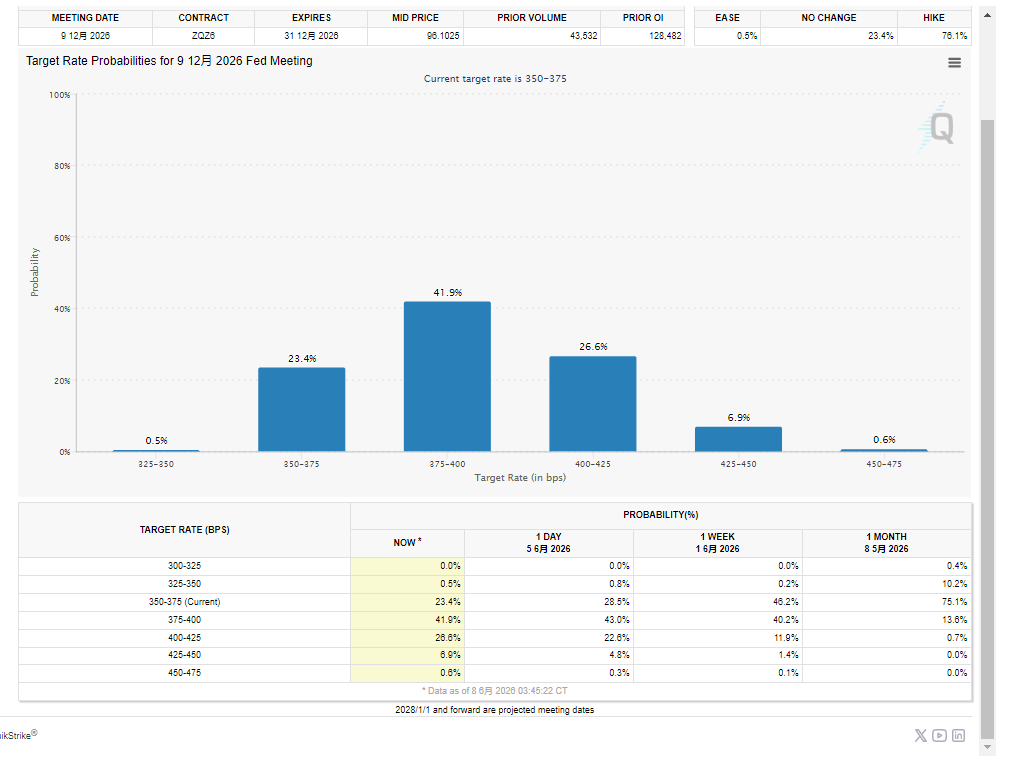
(The market expects a 73% probability of a 25 basis point rate hike by the end of the year. Source: CME Group)
At the institutional level, adjustments have also been made. Goldman Sachs officially announced on Friday that it was withdrawing its forecast of a Federal Reserve rate cut in 2026, and instead expecting a 25 basis point rate cut in June and December 2027, based on the continued strength of the labor market.
For global forex and interest rate traders, the core disagreement between the White House and financial markets on the path of monetary policy will inevitably exacerbate market volatility in the short term, and gold, as a safe-haven asset that is highly sensitive to interest rates, is becoming a key beneficiary in this game.
From a market perspective, gold prices and real interest rates have a typical negative correlation.
Current market concerns about sticky inflation, international oil price volatility, and the US-Iran conflict have not yet dissipated, and Trump's view that "economic prosperity itself can curb inflation" has not yet gained widespread acceptance.
If the Federal Reserve is pressured by economic data to raise interest rates, it may put downward pressure on gold prices in the short term, but continued geopolitical risks and potential concerns about economic growth will provide support for gold prices.
Conversely, if the Federal Reserve adopts the demand for interest rate cuts or slows down the pace of interest rate hikes, the expectation of a decline in real interest rates will directly boost the allocation value of gold.
Furthermore, the fluctuations in the US dollar exchange rate caused by interest rate games and the rising risk aversion in global financial markets will further strengthen gold's safe-haven attributes and asset hedging function.
The latest weekly COT gold futures positions data shows a divergence between institutional and retail investor activity in the market:
Managed money has clearly turned bullish: institutional long positions have increased slightly, while short positions have decreased significantly by 35.9%, resulting in a significant increase in net long positions, reflecting a strengthening of institutional bullish sentiment towards gold.
Retail investor funds (Non-Reportable) exited the market: Retail investors' long positions decreased by 7.4%, while short positions also decreased by 14.8%, but the reduction in long positions was greater, showing an overall outflow of long funds and a contraction in bullish positions.
Overall market open interest declined: Total open interest (OI) fell from 353,000 lots to 326,000 lots, indicating a decrease in market activity. Retail investors leaving the market was one of the main drags.
Overall, there is a clear divergence in the operational directions of institutional investors and retail investors: institutions are actively increasing their short positions, while retail investors are choosing to stay out of the market and observe the situation in the long positions.
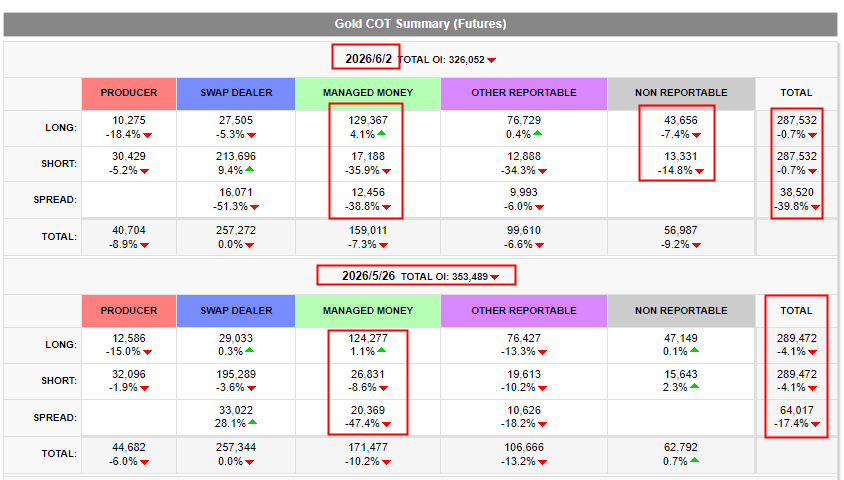
(CFTC releases weekly Commitment of Traders report, source: CME Group)
US President Donald Trump has explicitly advocated that the Federal Reserve should prioritize cutting interest rates rather than tightening policy in line with market expectations.
Previously released US non-farm payroll data for May showed an increase of 172,000 jobs, significantly exceeding market expectations. The data for the previous two months were also revised upwards, and the unemployment rate remained stable at a low level of 4.3%. The strong resilience of the labor market has fueled market expectations for a Fed rate hike.
In response, Trump publicly opposed the Federal Reserve's interest rate hike in an interview, saying, "Now that the economic data is good, the market is actually weakening. The core reason is that investors are anticipating that the Federal Reserve will raise interest rates. From the current macroeconomic environment and policy logic, there are absolutely no conditions for raising interest rates."
He further emphasized that raising the benchmark interest rate would be a directional mistake, as the economy is in a critical stage of expansion and should not suppress growth momentum through interest rate hikes.
Key Window: New Fed Chair Faces Dual Pressure
These remarks come at a crucial time window – Kevin Warsh, Trump’s nominee for Federal Reserve Chairman, is set to chair his first Federal Open Market Committee (FOMC) meeting on June 16-17.
Although Trump has expressed support for the Federal Reserve Chairman's independent decision-making, he has deeply linked the demand for interest rate cuts with government fiscal planning, stating that the high level of US debt and the need for low-cost funding to support many core agendas and increased defense spending undoubtedly bring potential political pressure to the new chairman.
The market is currently betting that the Federal Reserve will raise interest rates by 25 basis points before the end of the year. US Treasury prices have already come under downward pressure, and the federal funds rate futures market has fully priced in this expectation. Meanwhile, US core inflation is still higher than the Fed's 2% policy target, further exacerbating the decision-making dilemma for policymakers.
(The market expects a 73% probability of a 25 basis point rate hike by the end of the year. Source: CME Group)
Institutional Adjustments: Goldman Sachs Revises Rate Cut Expectations, Market Volatility Rises
At the institutional level, adjustments have also been made. Goldman Sachs officially announced on Friday that it was withdrawing its forecast of a Federal Reserve rate cut in 2026, and instead expecting a 25 basis point rate cut in June and December 2027, based on the continued strength of the labor market.
For global forex and interest rate traders, the core disagreement between the White House and financial markets on the path of monetary policy will inevitably exacerbate market volatility in the short term, and gold, as a safe-haven asset that is highly sensitive to interest rates, is becoming a key beneficiary in this game.
Market Opportunity: Expectation-Based Trading Driven by White House Intervention
From a market perspective, gold prices and real interest rates have a typical negative correlation.
Current market concerns about sticky inflation, international oil price volatility, and the US-Iran conflict have not yet dissipated, and Trump's view that "economic prosperity itself can curb inflation" has not yet gained widespread acceptance.
If the Federal Reserve is pressured by economic data to raise interest rates, it may put downward pressure on gold prices in the short term, but continued geopolitical risks and potential concerns about economic growth will provide support for gold prices.
Conversely, if the Federal Reserve adopts the demand for interest rate cuts or slows down the pace of interest rate hikes, the expectation of a decline in real interest rates will directly boost the allocation value of gold.
Furthermore, the fluctuations in the US dollar exchange rate caused by interest rate games and the rising risk aversion in global financial markets will further strengthen gold's safe-haven attributes and asset hedging function.
Market validation suggests that the divergence between institutional and retail investors is widening.
The latest weekly COT gold futures positions data shows a divergence between institutional and retail investor activity in the market:
Managed money has clearly turned bullish: institutional long positions have increased slightly, while short positions have decreased significantly by 35.9%, resulting in a significant increase in net long positions, reflecting a strengthening of institutional bullish sentiment towards gold.
Retail investor funds (Non-Reportable) exited the market: Retail investors' long positions decreased by 7.4%, while short positions also decreased by 14.8%, but the reduction in long positions was greater, showing an overall outflow of long funds and a contraction in bullish positions.
Overall market open interest declined: Total open interest (OI) fell from 353,000 lots to 326,000 lots, indicating a decrease in market activity. Retail investors leaving the market was one of the main drags.
Overall, there is a clear divergence in the operational directions of institutional investors and retail investors: institutions are actively increasing their short positions, while retail investors are choosing to stay out of the market and observe the situation in the long positions.
(CFTC releases weekly Commitment of Traders report, source: CME Group)
- Risk Warning and Disclaimer
- The market involves risk, and trading may not be suitable for all investors. This article is for reference only and does not constitute personal investment advice, nor does it take into account certain users’ specific investment objectives, financial situation, or other needs. Any investment decisions made based on this information are at your own risk.