Euro/Dollar Analysis: Geopolitical Risks and Fed Expectations Suppress the Conflict; Can the ECB's Rate Hike Break the Deadlock?
2026-06-10 09:07:21
On Wednesday (June 10) during the Asian session, the euro traded in a narrow range against the US dollar, currently around 1.1540.
The sudden escalation of geopolitical tensions caused safe-haven funds to flow back to the US dollar, and the euro fell slightly against the dollar after rising for two consecutive days.
U.S. officials said Wednesday that a second round of strikes against Iran is underway, targeting air defense and radar systems. This comes after Washington launched retaliatory strikes against Iran on Tuesday, calling it a “reciprocal response” to Iran shooting down a U.S. armed helicopter near the Strait of Hormuz the previous day.
Signs of escalating tensions between the US and Iran could boost demand for the US dollar as a safe haven, thus putting downward pressure on the euro against the dollar in the short term. When geopolitical risks escalate, funds tend to flow into traditional safe-haven assets such as the US dollar, making the euro a direct target of pressure.
Besides geopolitical factors, traders are also making final preparations for the release of the U.S. May Consumer Price Index (CPI) data later on Wednesday. This inflation data is considered the most important catalyst on the global macroeconomic front this week, directly impacting market expectations for the Federal Reserve's policy path and thus driving the short-term movements of the dollar and major non-U.S. currencies.
The market currently expects the US May CPI year-on-year growth rate to accelerate from 3.8% to 4.2%, which would be the first time the inflation reading has climbed back above 4% since May 2023. If the actual figure meets or exceeds expectations, it will further confirm that US inflation has resumed its accelerating trajectory after hitting a low point at the beginning of the year. Last week's May non-farm payroll report showed an increase of 172,000 jobs, exceeding market expectations and already signaling a still tight labor market. The resilience of employment means that wage growth and consumer demand are unlikely to cool significantly in the short term, providing a sustained source of momentum for inflationary pressures.
If the CPI exceeds expectations again, it will serve as a double warning sign regarding both employment and inflation. The market may further bet on the Federal Reserve adopting a more aggressive tightening policy, even anticipating an interest rate hike this year. In this scenario, US Treasury yields will receive upward support, and the US dollar is expected to strengthen further, thus putting direct pressure on the euro.
Conversely, if the CPI data shows an unexpected decline, especially a significant slowdown in core inflation, market expectations for a Fed rate hike will cool rapidly. The dollar may therefore enter a period of consolidation or even a pullback, giving the euro some breathing room. Coupled with expectations of an ECB rate hike on Thursday, the euro/dollar exchange rate is likely to gain upward momentum. Therefore, tonight's CPI data is not only a short-term indicator for the dollar's direction but will also provide crucial clues as to whether the euro can stabilize above the 1.15 level. Traders should remain cautious before the data release and wait for this macroeconomic variable to materialize before making directional judgments.
While the dollar is currently supported by both geopolitical tensions and rising US inflation expectations, the European Central Bank's (ECB) upcoming policy meeting on Thursday may provide some downside cushion for the euro. The market widely expects the ECB to announce a 25 basis point rate hike at its June meeting, consistent with the bank's recent hawkish communications. Since the last meeting, several ECB officials have publicly stated that inflationary pressures remain stubborn, particularly with no significant signs of slowing growth in service sector prices and wages, thus necessitating further tightening of monetary policy to push inflation back to the 2% target level.
According to Martin Wahlberg, senior economist at Generali Investments, a rate hike by the ECB at this meeting is almost certain. This expectation has already been largely priced into the market, so the rate hike itself is unlikely to trigger significant volatility in the euro. The key to limiting further euro declines and even driving a rebound lies in ECB President Lagarde's wording at the post-meeting press conference—especially her statements regarding the policy path in September and beyond.
If Lagarde hints that this rate hike is not a one-off event but the start of a new tightening cycle, and clearly states that further action is possible in September, then the euro is likely to receive more sustained support. Conversely, if she emphasizes downside risks to the economy and suggests a return to a data-dependent wait-and-see approach, the market may interpret this as a dovish signal, and the euro may face renewed selling pressure. Therefore, the key focus of Thursday's meeting is not the rate hike itself, but how Lagarde guides market expectations for the future.
Morgan Stanley's G10 FX strategist, David Adams, is explicitly bearish on the US dollar, believing the Federal Reserve will keep interest rates unchanged this year, lower than market expectations, putting downward pressure on the dollar. Conversely, the European Central Bank (ECB) is expected to raise rates twice this year. Based on this policy divergence, Morgan Stanley predicts the euro will rise to 1.23 against the dollar in the third quarter. However, Adams also cautions that the ECB has "limited tolerance" for continued euro appreciation, and the French election may bring eurozone fiscal issues to the forefront, potentially leading to a weaker euro later in the year that could revive the dollar.
BNP Paribas predicts that Eurozone GDP growth will slow from 1.5% in 2025 to 1.0% in 2026 due to the spillover effects of the Middle East conflict, but investment in defense, artificial intelligence, and electrification will continue to support economic activity. Inflation is expected to rebound to 3.0% in 2026. The European Central Bank is likely to begin raising interest rates in June 2026, with a total increase of 50 basis points throughout the year. In the baseline scenario, global asset allocation will continue to diversify away from the US dollar, with the euro/dollar exchange rate rising to 1.21 in the fourth quarter of 2026 and further to 1.25 in 2027.
The current short-term trend for the EUR/USD pair on the daily chart is weak, with significant downward pressure. The exchange rate has broken below the 20-day, 50-day, and 100-day moving averages, and has also tested the previous support level of 1.1499, only slightly above the historical low of 1.1410. Overall, it remains below the moving average system, confirming a short-term bearish pattern. Resistance is seen around 1.1679, where the moving averages and previous support levels converge. Support is seen at 1.1499 and the previous low of 1.1410.
In terms of indicators, the MACD's DIFF and DEA are running below the zero axis, and the green bars continue to expand, indicating that the bearish momentum is still ongoing; the RSI has fallen back to 36.41, which is in the weak zone. Although it is close to oversold, there is still no clear signal of stabilization and reversal.
Overall, the exchange rate rebounded weakly after breaking through key support, with moving averages turning downwards and technical indicators showing weakness. In the short term, it is highly likely to continue its weak and volatile trend. A break below the support levels of 1.1499 and 1.1410 would open up further downside potential; conversely, failure to break through the resistance level of 1.1679 would likely perpetuate the weak trend.
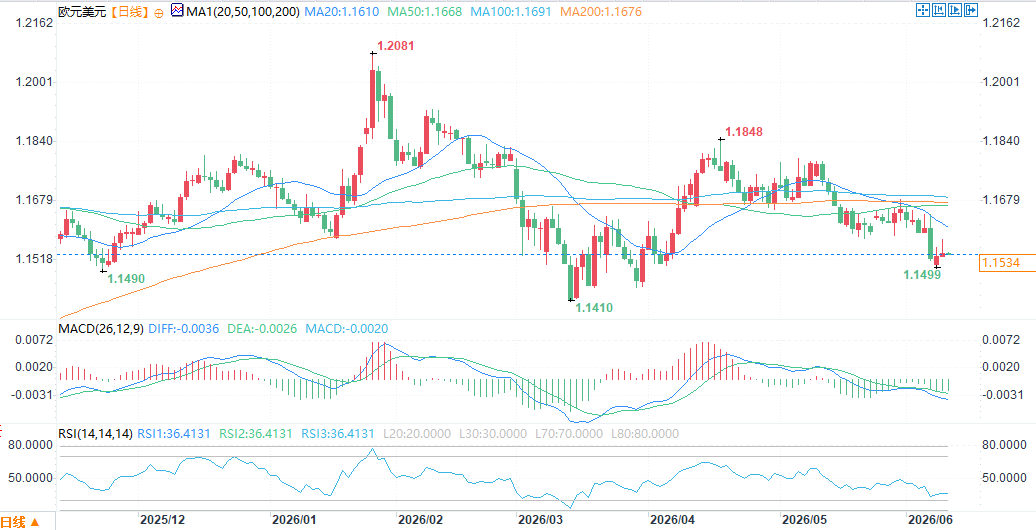
(Euro/USD daily chart, source: FX678)
At 9:07 AM Beijing time on June 10, the euro was trading at 1.1540/41 against the US dollar.
The sudden escalation of geopolitical tensions caused safe-haven funds to flow back to the US dollar, and the euro fell slightly against the dollar after rising for two consecutive days.
U.S. officials said Wednesday that a second round of strikes against Iran is underway, targeting air defense and radar systems. This comes after Washington launched retaliatory strikes against Iran on Tuesday, calling it a “reciprocal response” to Iran shooting down a U.S. armed helicopter near the Strait of Hormuz the previous day.
Signs of escalating tensions between the US and Iran could boost demand for the US dollar as a safe haven, thus putting downward pressure on the euro against the dollar in the short term. When geopolitical risks escalate, funds tend to flow into traditional safe-haven assets such as the US dollar, making the euro a direct target of pressure.
Market Focus: US CPI Data to be Released Soon
Besides geopolitical factors, traders are also making final preparations for the release of the U.S. May Consumer Price Index (CPI) data later on Wednesday. This inflation data is considered the most important catalyst on the global macroeconomic front this week, directly impacting market expectations for the Federal Reserve's policy path and thus driving the short-term movements of the dollar and major non-U.S. currencies.
The market currently expects the US May CPI year-on-year growth rate to accelerate from 3.8% to 4.2%, which would be the first time the inflation reading has climbed back above 4% since May 2023. If the actual figure meets or exceeds expectations, it will further confirm that US inflation has resumed its accelerating trajectory after hitting a low point at the beginning of the year. Last week's May non-farm payroll report showed an increase of 172,000 jobs, exceeding market expectations and already signaling a still tight labor market. The resilience of employment means that wage growth and consumer demand are unlikely to cool significantly in the short term, providing a sustained source of momentum for inflationary pressures.
If the CPI exceeds expectations again, it will serve as a double warning sign regarding both employment and inflation. The market may further bet on the Federal Reserve adopting a more aggressive tightening policy, even anticipating an interest rate hike this year. In this scenario, US Treasury yields will receive upward support, and the US dollar is expected to strengthen further, thus putting direct pressure on the euro.
Conversely, if the CPI data shows an unexpected decline, especially a significant slowdown in core inflation, market expectations for a Fed rate hike will cool rapidly. The dollar may therefore enter a period of consolidation or even a pullback, giving the euro some breathing room. Coupled with expectations of an ECB rate hike on Thursday, the euro/dollar exchange rate is likely to gain upward momentum. Therefore, tonight's CPI data is not only a short-term indicator for the dollar's direction but will also provide crucial clues as to whether the euro can stabilize above the 1.15 level. Traders should remain cautious before the data release and wait for this macroeconomic variable to materialize before making directional judgments.
ECB: Expectations of a rate hike on Thursday may provide support for the euro.
While the dollar is currently supported by both geopolitical tensions and rising US inflation expectations, the European Central Bank's (ECB) upcoming policy meeting on Thursday may provide some downside cushion for the euro. The market widely expects the ECB to announce a 25 basis point rate hike at its June meeting, consistent with the bank's recent hawkish communications. Since the last meeting, several ECB officials have publicly stated that inflationary pressures remain stubborn, particularly with no significant signs of slowing growth in service sector prices and wages, thus necessitating further tightening of monetary policy to push inflation back to the 2% target level.
According to Martin Wahlberg, senior economist at Generali Investments, a rate hike by the ECB at this meeting is almost certain. This expectation has already been largely priced into the market, so the rate hike itself is unlikely to trigger significant volatility in the euro. The key to limiting further euro declines and even driving a rebound lies in ECB President Lagarde's wording at the post-meeting press conference—especially her statements regarding the policy path in September and beyond.
If Lagarde hints that this rate hike is not a one-off event but the start of a new tightening cycle, and clearly states that further action is possible in September, then the euro is likely to receive more sustained support. Conversely, if she emphasizes downside risks to the economy and suggests a return to a data-dependent wait-and-see approach, the market may interpret this as a dovish signal, and the euro may face renewed selling pressure. Therefore, the key focus of Thursday's meeting is not the rate hike itself, but how Lagarde guides market expectations for the future.
Institutional Views
Morgan Stanley's G10 FX strategist, David Adams, is explicitly bearish on the US dollar, believing the Federal Reserve will keep interest rates unchanged this year, lower than market expectations, putting downward pressure on the dollar. Conversely, the European Central Bank (ECB) is expected to raise rates twice this year. Based on this policy divergence, Morgan Stanley predicts the euro will rise to 1.23 against the dollar in the third quarter. However, Adams also cautions that the ECB has "limited tolerance" for continued euro appreciation, and the French election may bring eurozone fiscal issues to the forefront, potentially leading to a weaker euro later in the year that could revive the dollar.
BNP Paribas predicts that Eurozone GDP growth will slow from 1.5% in 2025 to 1.0% in 2026 due to the spillover effects of the Middle East conflict, but investment in defense, artificial intelligence, and electrification will continue to support economic activity. Inflation is expected to rebound to 3.0% in 2026. The European Central Bank is likely to begin raising interest rates in June 2026, with a total increase of 50 basis points throughout the year. In the baseline scenario, global asset allocation will continue to diversify away from the US dollar, with the euro/dollar exchange rate rising to 1.21 in the fourth quarter of 2026 and further to 1.25 in 2027.
Technical Analysis
The current short-term trend for the EUR/USD pair on the daily chart is weak, with significant downward pressure. The exchange rate has broken below the 20-day, 50-day, and 100-day moving averages, and has also tested the previous support level of 1.1499, only slightly above the historical low of 1.1410. Overall, it remains below the moving average system, confirming a short-term bearish pattern. Resistance is seen around 1.1679, where the moving averages and previous support levels converge. Support is seen at 1.1499 and the previous low of 1.1410.
In terms of indicators, the MACD's DIFF and DEA are running below the zero axis, and the green bars continue to expand, indicating that the bearish momentum is still ongoing; the RSI has fallen back to 36.41, which is in the weak zone. Although it is close to oversold, there is still no clear signal of stabilization and reversal.
Overall, the exchange rate rebounded weakly after breaking through key support, with moving averages turning downwards and technical indicators showing weakness. In the short term, it is highly likely to continue its weak and volatile trend. A break below the support levels of 1.1499 and 1.1410 would open up further downside potential; conversely, failure to break through the resistance level of 1.1679 would likely perpetuate the weak trend.
(Euro/USD daily chart, source: FX678)
At 9:07 AM Beijing time on June 10, the euro was trading at 1.1540/41 against the US dollar.
- Risk Warning and Disclaimer
- The market involves risk, and trading may not be suitable for all investors. This article is for reference only and does not constitute personal investment advice, nor does it take into account certain users’ specific investment objectives, financial situation, or other needs. Any investment decisions made based on this information are at your own risk.