Gold prices accelerated their decline as expectations of rising US inflation and increased bets on a Federal Reserve rate hike fueled a decline in gold prices.
2026-06-10 10:31:01
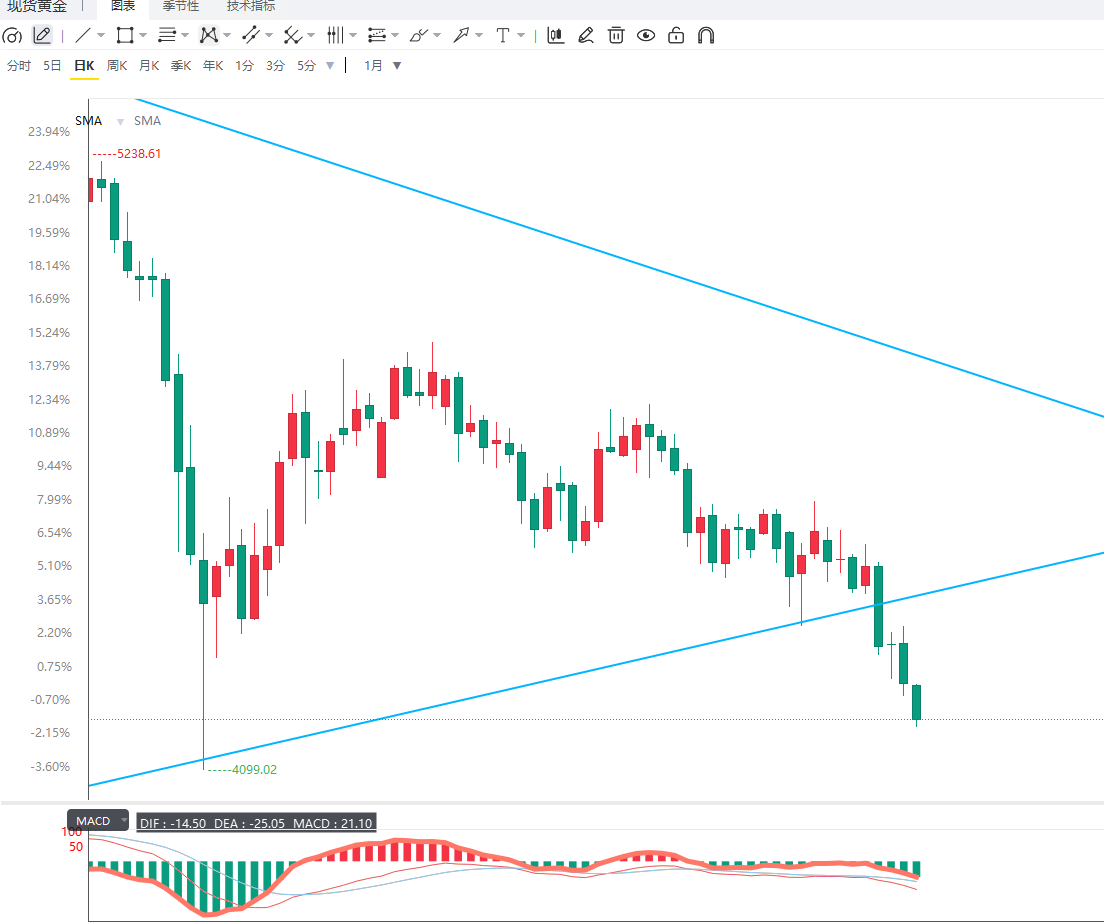
On Wednesday during Asian trading hours, the international gold market continued its previous decline, with spot gold (XAU/USD) briefly dipping to around $4,180 per ounce, its lowest level in nearly three months. Gold prices had been under selling pressure for several consecutive trading days, with market sentiment clearly leaning towards caution. Faced with ongoing geopolitical risks and the outlook for US monetary policy, investors were more inclined to focus on the long-term impact of the latter, which prevented gold's safe-haven appeal from fully materializing in the short term.

Recent tensions in the Middle East have increased market concerns about energy supply disruptions and a resurgence of global inflation. Tensions between the US and Iran have fluctuated, with the US previously launching military action against Iranian targets, and negotiations on a peace agreement remaining limited. While geopolitical conflicts typically spur increased allocations to safe-haven assets, thus supporting gold, the market is currently more focused on the potential for rising energy prices and renewed inflationary pressures resulting from the conflict.
Since gold itself does not generate interest income, the opportunity cost of holding gold increases significantly when the market anticipates that major central banks will maintain high interest rates for an extended period, or even further tighten monetary policy. Therefore, a clear conflict exists between safe-haven buying driven by the Middle East situation and expectations of potential interest rate hikes by the Federal Reserve. Currently, high interest rate expectations dominate, putting continued downward pressure on gold prices.
Previously released US employment data was stronger than market expectations, indicating that the US labor market remains resilient and further strengthening market expectations that the Federal Reserve may raise interest rates again this year. With economic data remaining stable, investors are beginning to readjust their assessments of the future path of monetary policy, thus supporting the US dollar index and US Treasury yields, and putting additional pressure on dollar-denominated gold.
The market's focus has now shifted to the upcoming release of the US May Consumer Price Index (CPI) data. The market expects the overall US CPI annual rate to rise to 4.2% from the previous 3.8%, while the core CPI annual rate is projected to rise to 2.9% from 2.8%. If the actual inflation data exceeds market expectations, it will further increase the likelihood of the Federal Reserve adopting a hawkish policy, pushing the dollar stronger and potentially triggering a new round of selling in the gold market. Conversely, if the inflation data is lower than expected, market bets on interest rate hikes may cool, thus providing a potential opportunity for a short-term rebound in gold prices.
Ryan McKay, senior commodities strategist at TD Securities, said that factors such as renewed concerns about inflation, continued strong US economic data, increased probability of further interest rate hikes by the Federal Reserve, and gold falling below its 200-day moving average have collectively driven a clear shift in short-term market sentiment toward a bearish one.
From a capital flow perspective, the gold market is undergoing a shift from a safe-haven logic to an interest rate logic. While geopolitical risks remain, investors are paying closer attention to changes in US real interest rates. When dollar yields rise, funds tend to flow to higher-yielding dollar assets, weakening gold's appeal as a store of value. Therefore, US inflation data, speeches by Federal Reserve officials, and changes in interest rate expectations will remain key factors influencing gold's price movements in the near future.
From a technical perspective, the daily gold chart shows that after breaking below the key 200-day moving average, the medium- to long-term technical structure has deteriorated significantly, with bearish forces gradually gaining dominance. The current area around $4100/oz is a crucial short-term support zone. A further break below this level could lead to further testing of lower support levels. On the upside, gold first needs to re-establish itself above the psychological level of $4250/oz to alleviate current downward pressure. Daily momentum indicators suggest that the downtrend continues, and the market may continue to decline in the short term.
From a 4-hour chart perspective, gold prices remain within a downtrend channel, with short-term moving averages showing a bearish alignment, indicating that sellers still control the market. If US inflation data is stronger than expected, the dollar and US Treasury yields may rise further, and gold may continue to seek new support levels. However, if inflationary pressures are lower than market expectations, the market may reassess the Fed's interest rate hike prospects, potentially driving a technical rebound in gold prices.
Editor's Summary : The current gold market is in a phase of intense struggle between geopolitical safe-haven demand and high interest rate pressures. While uncertainty in the Middle East continues to provide some support for gold, the resilience of the US economy, the potential for renewed inflation, and expectations of further interest rate hikes by the Federal Reserve are increasing the attractiveness of dollar assets, becoming the main factor suppressing gold prices. In the short term, the $4100 support level and the $4250 resistance level will be important references for the market to observe the next direction of gold, while US CPI data and its impact on the Federal Reserve's policy path are expected to determine the future direction of gold price fluctuations.
Recent tensions in the Middle East have increased market concerns about energy supply disruptions and a resurgence of global inflation. Tensions between the US and Iran have fluctuated, with the US previously launching military action against Iranian targets, and negotiations on a peace agreement remaining limited. While geopolitical conflicts typically spur increased allocations to safe-haven assets, thus supporting gold, the market is currently more focused on the potential for rising energy prices and renewed inflationary pressures resulting from the conflict.
Since gold itself does not generate interest income, the opportunity cost of holding gold increases significantly when the market anticipates that major central banks will maintain high interest rates for an extended period, or even further tighten monetary policy. Therefore, a clear conflict exists between safe-haven buying driven by the Middle East situation and expectations of potential interest rate hikes by the Federal Reserve. Currently, high interest rate expectations dominate, putting continued downward pressure on gold prices.
Previously released US employment data was stronger than market expectations, indicating that the US labor market remains resilient and further strengthening market expectations that the Federal Reserve may raise interest rates again this year. With economic data remaining stable, investors are beginning to readjust their assessments of the future path of monetary policy, thus supporting the US dollar index and US Treasury yields, and putting additional pressure on dollar-denominated gold.
The market's focus has now shifted to the upcoming release of the US May Consumer Price Index (CPI) data. The market expects the overall US CPI annual rate to rise to 4.2% from the previous 3.8%, while the core CPI annual rate is projected to rise to 2.9% from 2.8%. If the actual inflation data exceeds market expectations, it will further increase the likelihood of the Federal Reserve adopting a hawkish policy, pushing the dollar stronger and potentially triggering a new round of selling in the gold market. Conversely, if the inflation data is lower than expected, market bets on interest rate hikes may cool, thus providing a potential opportunity for a short-term rebound in gold prices.
Ryan McKay, senior commodities strategist at TD Securities, said that factors such as renewed concerns about inflation, continued strong US economic data, increased probability of further interest rate hikes by the Federal Reserve, and gold falling below its 200-day moving average have collectively driven a clear shift in short-term market sentiment toward a bearish one.
From a capital flow perspective, the gold market is undergoing a shift from a safe-haven logic to an interest rate logic. While geopolitical risks remain, investors are paying closer attention to changes in US real interest rates. When dollar yields rise, funds tend to flow to higher-yielding dollar assets, weakening gold's appeal as a store of value. Therefore, US inflation data, speeches by Federal Reserve officials, and changes in interest rate expectations will remain key factors influencing gold's price movements in the near future.
From a technical perspective, the daily gold chart shows that after breaking below the key 200-day moving average, the medium- to long-term technical structure has deteriorated significantly, with bearish forces gradually gaining dominance. The current area around $4100/oz is a crucial short-term support zone. A further break below this level could lead to further testing of lower support levels. On the upside, gold first needs to re-establish itself above the psychological level of $4250/oz to alleviate current downward pressure. Daily momentum indicators suggest that the downtrend continues, and the market may continue to decline in the short term.
From a 4-hour chart perspective, gold prices remain within a downtrend channel, with short-term moving averages showing a bearish alignment, indicating that sellers still control the market. If US inflation data is stronger than expected, the dollar and US Treasury yields may rise further, and gold may continue to seek new support levels. However, if inflationary pressures are lower than market expectations, the market may reassess the Fed's interest rate hike prospects, potentially driving a technical rebound in gold prices.
Editor's Summary : The current gold market is in a phase of intense struggle between geopolitical safe-haven demand and high interest rate pressures. While uncertainty in the Middle East continues to provide some support for gold, the resilience of the US economy, the potential for renewed inflation, and expectations of further interest rate hikes by the Federal Reserve are increasing the attractiveness of dollar assets, becoming the main factor suppressing gold prices. In the short term, the $4100 support level and the $4250 resistance level will be important references for the market to observe the next direction of gold, while US CPI data and its impact on the Federal Reserve's policy path are expected to determine the future direction of gold price fluctuations.
- Risk Warning and Disclaimer
- The market involves risk, and trading may not be suitable for all investors. This article is for reference only and does not constitute personal investment advice, nor does it take into account certain users’ specific investment objectives, financial situation, or other needs. Any investment decisions made based on this information are at your own risk.