Kazuo Ueda was suddenly hospitalized and missed the interest rate meeting. The USD/JPY exchange rate is approaching the last line of defense of 160.5. Is there going to be an unexpected event in the countdown to the "nuclear button" of interest rate hike?
2026-06-10 18:10:05
On Wednesday (June 10), news of Bank of Japan Governor Kazuo Ueda's hospitalization became the focus of the market. Ueda is expected to receive treatment in the hospital for about two weeks and will miss the June 15-16 monetary policy meeting, which will be chaired by Deputy Governor Ryozo Himino, with Deputy Governor Shinichi Uchida handling the post-meeting press conference. This unexpected situation adds uncertainty to the upcoming interest rate decision and highlights the sensitivity of the current policy path.
Despite the governor's absence, the prevailing market view still expects the Bank of Japan to raise its policy rate from 0.75% to 1.0%, a 31-year high. Continued pressure on energy prices due to the Middle East situation is pushing up inflation risks, and the Bank of Japan is increasingly concerned about the upside risks to prices. The Japanese government bond market initially weakened before stabilizing today. The 10-year yield briefly touched 2.695%, while the 30-year auction saw a widening at the end, but the longer-term end showed resilience, with futures prices recovering to around 128.77 at the close. This performance of Japanese government bonds is directly linked to expectations of interest rate hikes, significantly impacting the yen's exchange rate.
The USD/JPY exchange rate hovered around 160.4, continuing its high-level consolidation pattern. News regarding the central bank governor's health, coupled with the probability of an interest rate hike, has significantly increased market attention in the short term.
Bank of Japan Governor Kazuo Ueda's hospitalization directly impacted the June meeting proceedings. According to Bank of Japan regulations, the minimum quorum requirement for the Policy Committee is relatively low, and the meeting can still proceed as scheduled, with voting based on a majority of attending members. The governor's absence, as a representative of the cautious faction, may slightly shift the voting balance, but the overall impact is moderate and not a decisive factor. With the deputy governor acting as chairman, the meeting's direction will still rely on the existing consensus-building mechanism.
A report from a well-known institution indicates that the Bank of Japan plans to raise its policy rate to 1.0% at its meeting next week, prioritizing inflation risks over economic downside risks despite lingering uncertainties in the Middle East. Previously, the head of Ueda emphasized in a public speech the need for a thorough discussion of the pros and cons of raising interest rates and maintained greater vigilance regarding the significant upside risks to inflation. Poll data shows that 94% of economists expect a rate hike in June, a significant increase from last month's survey; a further increase to 1.25% by the end of the year is also widely anticipated.
The April meeting saw a 6-3 vote to keep interest rates unchanged, with three hawkish members advocating for a rate hike. In mid-May, council member Kazuyuki Masuda shifted his stance, supporting early action before a significant economic downturn, reflecting a strengthening hawkish atmosphere within the policy committee. Economy Minister Kiuchi pointed to a moderate economic recovery and a rebound in capital spending, while stating that specific monetary policy decisions would be made by the Bank of Japan, and that the government hoped both sides would maintain communication on the goal of combating deflation.
In the Japanese bond market, long-term interest rates are driven by multiple factors, including supply and demand. Today, the 10-year yield fluctuated between 2.665% and 2.695%, while the 30-year yield consolidated around 3.84% to 3.89%. If the central bank's plan to gradually reduce bond purchases is confirmed at its meeting, it will provide upward support for the yield curve. The stabilization of long-term bonds at the close is partly due to cautious adjustments ahead of tomorrow's central bank bond-buying operations, and also reflects the market's adaptation to expectations of policy normalization.
The fundamental logic chain is as follows: the governor's absence increases variables → inflation risk dominates decision-making → the probability of interest rate hikes remains high → the central level of Japanese government bond yields may rise → the environment for yen financing and capital flows improves. This chain provides neutral to positive support for the yen, but structural weakness still needs to be observed in tandem with the US dollar index.
The 240-minute chart shows that the USD/JPY pair has rebounded from its mid-May low of 156.753, accumulating a gain of over 370 pips. Currently trading at 160.439, it's in a consolidation phase at the high end of its uptrend. The Bollinger Bands have a middle band at 160.237, an upper band at 160.529, and a lower band at 159.945. The price is biased towards the upper band, and the narrowing band suggests potential for further expansion.
The MACD indicator's fast line is above the slow line, the histogram shows a slightly positive value, and a golden cross is emerging, indicating that bullish momentum is recovering but its strength is limited. The candlesticks mostly trade within the upper Bollinger Bands, reflecting a strong upward trend.
Referring to the USD/JPY main continuous contract, the key resistance zone is 160.529-160.900; a decisive break above this level could open up further upside potential. The key support zone is 160.237-159.945; a breach of the middle band would likely test the lower band. Key points to watch during the session include: the latest statements regarding the governor's absence, real-time fluctuations in Japanese government bond yields, the correlation between the US dollar index and the US market, and the dynamic performance of options gamma in the 160.50-161.00 range.
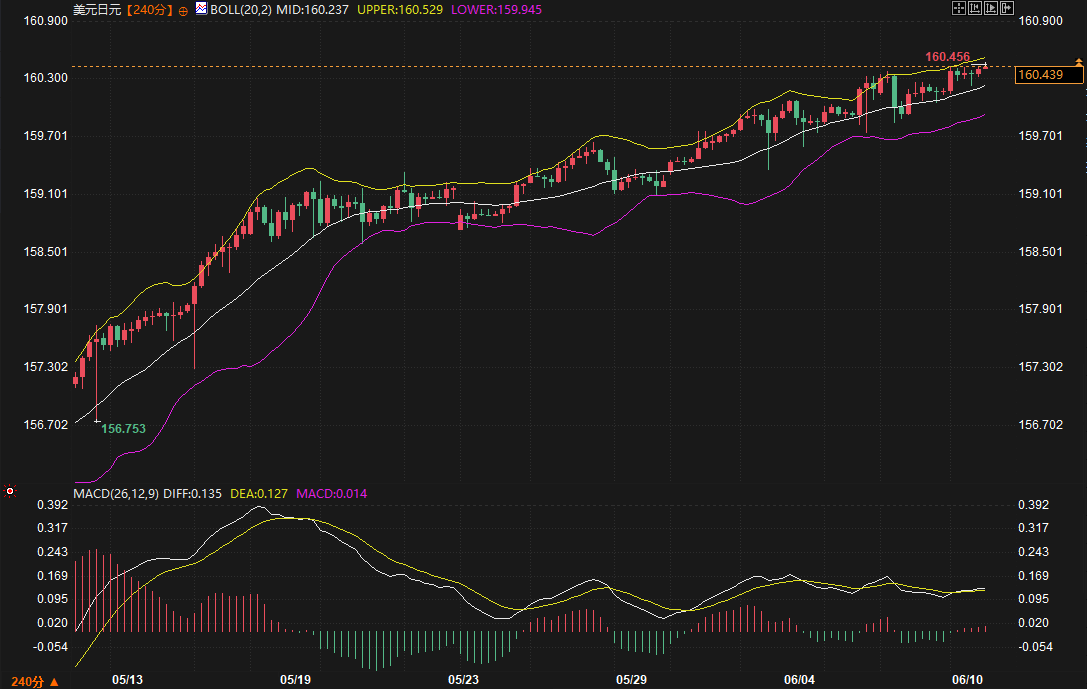
Japanese bond yields are closely linked to exchange rates. A moderate rise in yields usually alleviates short-term pressure on the yen, but a rapid increase could trigger volatility. Current technical patterns suggest a high probability of the trend continuing, but a pullback should be anticipated as it approaches the previous high of 160.456.
In the short term, the outcome of the June meeting remains the core driving factor. While the governor's absence introduces a variable, the probability of a rate hike remains high under mainstream expectations, potentially providing some support for the yen, while the USD/JPY pair faces some downward pressure. In the medium term, if the normalization process continues in the second half of the year, the slow upward shift in the central level of Japanese government bond yields will gradually narrow the yield spread, benefiting the yen's fundamentals.
The market needs to continue monitoring inflation data, economic indicators, and global risk appetite. The yen's exchange rate ultimately depends on policy continuity and external balance. The overall path of policy normalization provides support for the yen, but a trend reversal still requires multiple conditions to materialize. Investors should pay close attention to the guidance in the meeting statement and subsequent developments from the July meeting.
What direct impact will Governor Kazuo Ueda's hospitalization have on the June monetary policy meeting?
The governor will be absent from the meeting, which will be chaired by a vice governor. However, the required number of participants is easily met, and voting will proceed by majority vote. While this increases the variable of the outcome, the policy committee emphasizes prior communication and anticipates no dramatic changes that deviate significantly from mainstream expectations; the impact is expected to be moderate. The market has largely priced in a rate hike to 1.0%.
Will the governor's absence weaken the hawkish tendency to raise interest rates?
Governor Ueda is a data-dependent and cautious figure, and his absence could influence the balance of the vote by affecting the acting speaker's stance. However, recently, committee members such as Kazuyuki Masuda have shifted their support to early action, strengthening the overall hawkish atmosphere. If the data supports this, the probability of a rate hike remains high; variables exist but are not decisive.
How do recent trends in Japanese bond yields reflect expectations of interest rate hikes?
The 10-year yield rose to 2.695% before stabilizing, while the long-term yield showed resilience after the 30-year auction, reflecting the market's digestion of signals of policy normalization. Expectations of adjustments to the central bank's bond-buying program further supported the rise in the yield center, forming a positive correlation with the interest rate hike path and providing transmission support for the yen exchange rate.
How should we define the key range for USD/JPY from a technical perspective?
Key resistance levels to watch are the upper Bollinger Band at 160.529 and 160.900; a break above these levels could amplify volatility. Support levels are at 160.237-159.945. The 160.50-161.00 range is worth noting for options trading; a break above this range could alter the gamma structure and amplify short-term price movements. The MACD shows initial bullish signals, but momentum is weak; further observation of volume is needed.
What is the market's outlook on the Bank of Japan's interest rate hike path in the second half of the year?
A poll by a well-known institution shows that the prevailing expectation is for inflation to rise to 1.25% by the end of the year, with a forecast of 1.50% for the second quarter of next year also appearing earlier. This depends on the persistence of inflation and the resilience of the economy. After the governor's return in July, policy continuity will be a key focus, with the pace of normalization expected to continue but remaining data-dependent.
Despite the governor's absence, the prevailing market view still expects the Bank of Japan to raise its policy rate from 0.75% to 1.0%, a 31-year high. Continued pressure on energy prices due to the Middle East situation is pushing up inflation risks, and the Bank of Japan is increasingly concerned about the upside risks to prices. The Japanese government bond market initially weakened before stabilizing today. The 10-year yield briefly touched 2.695%, while the 30-year auction saw a widening at the end, but the longer-term end showed resilience, with futures prices recovering to around 128.77 at the close. This performance of Japanese government bonds is directly linked to expectations of interest rate hikes, significantly impacting the yen's exchange rate.
The USD/JPY exchange rate hovered around 160.4, continuing its high-level consolidation pattern. News regarding the central bank governor's health, coupled with the probability of an interest rate hike, has significantly increased market attention in the short term.
Fundamental Analysis: Interest Rate Hike Path and Japanese Bond Price Movements in the Absence of the Governor
Bank of Japan Governor Kazuo Ueda's hospitalization directly impacted the June meeting proceedings. According to Bank of Japan regulations, the minimum quorum requirement for the Policy Committee is relatively low, and the meeting can still proceed as scheduled, with voting based on a majority of attending members. The governor's absence, as a representative of the cautious faction, may slightly shift the voting balance, but the overall impact is moderate and not a decisive factor. With the deputy governor acting as chairman, the meeting's direction will still rely on the existing consensus-building mechanism.
A report from a well-known institution indicates that the Bank of Japan plans to raise its policy rate to 1.0% at its meeting next week, prioritizing inflation risks over economic downside risks despite lingering uncertainties in the Middle East. Previously, the head of Ueda emphasized in a public speech the need for a thorough discussion of the pros and cons of raising interest rates and maintained greater vigilance regarding the significant upside risks to inflation. Poll data shows that 94% of economists expect a rate hike in June, a significant increase from last month's survey; a further increase to 1.25% by the end of the year is also widely anticipated.
The April meeting saw a 6-3 vote to keep interest rates unchanged, with three hawkish members advocating for a rate hike. In mid-May, council member Kazuyuki Masuda shifted his stance, supporting early action before a significant economic downturn, reflecting a strengthening hawkish atmosphere within the policy committee. Economy Minister Kiuchi pointed to a moderate economic recovery and a rebound in capital spending, while stating that specific monetary policy decisions would be made by the Bank of Japan, and that the government hoped both sides would maintain communication on the goal of combating deflation.
In the Japanese bond market, long-term interest rates are driven by multiple factors, including supply and demand. Today, the 10-year yield fluctuated between 2.665% and 2.695%, while the 30-year yield consolidated around 3.84% to 3.89%. If the central bank's plan to gradually reduce bond purchases is confirmed at its meeting, it will provide upward support for the yield curve. The stabilization of long-term bonds at the close is partly due to cautious adjustments ahead of tomorrow's central bank bond-buying operations, and also reflects the market's adaptation to expectations of policy normalization.
The fundamental logic chain is as follows: the governor's absence increases variables → inflation risk dominates decision-making → the probability of interest rate hikes remains high → the central level of Japanese government bond yields may rise → the environment for yen financing and capital flows improves. This chain provides neutral to positive support for the yen, but structural weakness still needs to be observed in tandem with the US dollar index.
Technical Analysis: Key Range and Intraday Focus for USD/JPY
The 240-minute chart shows that the USD/JPY pair has rebounded from its mid-May low of 156.753, accumulating a gain of over 370 pips. Currently trading at 160.439, it's in a consolidation phase at the high end of its uptrend. The Bollinger Bands have a middle band at 160.237, an upper band at 160.529, and a lower band at 159.945. The price is biased towards the upper band, and the narrowing band suggests potential for further expansion.
The MACD indicator's fast line is above the slow line, the histogram shows a slightly positive value, and a golden cross is emerging, indicating that bullish momentum is recovering but its strength is limited. The candlesticks mostly trade within the upper Bollinger Bands, reflecting a strong upward trend.
Referring to the USD/JPY main continuous contract, the key resistance zone is 160.529-160.900; a decisive break above this level could open up further upside potential. The key support zone is 160.237-159.945; a breach of the middle band would likely test the lower band. Key points to watch during the session include: the latest statements regarding the governor's absence, real-time fluctuations in Japanese government bond yields, the correlation between the US dollar index and the US market, and the dynamic performance of options gamma in the 160.50-161.00 range.
Japanese bond yields are closely linked to exchange rates. A moderate rise in yields usually alleviates short-term pressure on the yen, but a rapid increase could trigger volatility. Current technical patterns suggest a high probability of the trend continuing, but a pullback should be anticipated as it approaches the previous high of 160.456.
Future Trend Outlook
In the short term, the outcome of the June meeting remains the core driving factor. While the governor's absence introduces a variable, the probability of a rate hike remains high under mainstream expectations, potentially providing some support for the yen, while the USD/JPY pair faces some downward pressure. In the medium term, if the normalization process continues in the second half of the year, the slow upward shift in the central level of Japanese government bond yields will gradually narrow the yield spread, benefiting the yen's fundamentals.
The market needs to continue monitoring inflation data, economic indicators, and global risk appetite. The yen's exchange rate ultimately depends on policy continuity and external balance. The overall path of policy normalization provides support for the yen, but a trend reversal still requires multiple conditions to materialize. Investors should pay close attention to the guidance in the meeting statement and subsequent developments from the July meeting.
Frequently Asked Questions
What direct impact will Governor Kazuo Ueda's hospitalization have on the June monetary policy meeting?
The governor will be absent from the meeting, which will be chaired by a vice governor. However, the required number of participants is easily met, and voting will proceed by majority vote. While this increases the variable of the outcome, the policy committee emphasizes prior communication and anticipates no dramatic changes that deviate significantly from mainstream expectations; the impact is expected to be moderate. The market has largely priced in a rate hike to 1.0%.
Will the governor's absence weaken the hawkish tendency to raise interest rates?
Governor Ueda is a data-dependent and cautious figure, and his absence could influence the balance of the vote by affecting the acting speaker's stance. However, recently, committee members such as Kazuyuki Masuda have shifted their support to early action, strengthening the overall hawkish atmosphere. If the data supports this, the probability of a rate hike remains high; variables exist but are not decisive.
How do recent trends in Japanese bond yields reflect expectations of interest rate hikes?
The 10-year yield rose to 2.695% before stabilizing, while the long-term yield showed resilience after the 30-year auction, reflecting the market's digestion of signals of policy normalization. Expectations of adjustments to the central bank's bond-buying program further supported the rise in the yield center, forming a positive correlation with the interest rate hike path and providing transmission support for the yen exchange rate.
How should we define the key range for USD/JPY from a technical perspective?
Key resistance levels to watch are the upper Bollinger Band at 160.529 and 160.900; a break above these levels could amplify volatility. Support levels are at 160.237-159.945. The 160.50-161.00 range is worth noting for options trading; a break above this range could alter the gamma structure and amplify short-term price movements. The MACD shows initial bullish signals, but momentum is weak; further observation of volume is needed.
What is the market's outlook on the Bank of Japan's interest rate hike path in the second half of the year?
A poll by a well-known institution shows that the prevailing expectation is for inflation to rise to 1.25% by the end of the year, with a forecast of 1.50% for the second quarter of next year also appearing earlier. This depends on the persistence of inflation and the resilience of the economy. After the governor's return in July, policy continuity will be a key focus, with the pace of normalization expected to continue but remaining data-dependent.
- Risk Warning and Disclaimer
- The market involves risk, and trading may not be suitable for all investors. This article is for reference only and does not constitute personal investment advice, nor does it take into account certain users’ specific investment objectives, financial situation, or other needs. Any investment decisions made based on this information are at your own risk.