













$90 becomes a watershed for the oil market; why are macro funds unwilling to chase higher prices?
2026-06-10 19:40:01
On Wednesday, June 10th, the crude oil market presented an unusual signal: supply risks remained, but US crude oil did not significantly expand its risk premium. In pre-market trading, US crude oil futures were trading around $90.0 per barrel; Brent crude was around $93 per barrel. On the surface, the Strait of Hormuz and US-Iran relations remain price-sensitive points, but deeper pricing variables have shifted to demand erosion and the Federal Reserve's policy path.

The core issue in the current crude oil market is not whether there is supply risk, but whether the supply risk can outweigh the downward revision of demand. US President Trump recently stated that an agreement could be reached within two or three days, while simultaneously issuing a tough stance, saying that prolonged negotiations would come at a cost to the other side. For traders, this kind of information doesn't simply push up oil prices, but rather creates two offsetting expectations: short-term supply disruptions increase risk premiums, while the negotiation window lowers the probability of extreme shortages.
This explains why US crude oil has struggled to break out of its trading range despite repeated conflict news. If the market is convinced the supply gap will continue to widen, prices typically undergo a rapid risk reassessment; however, the current price action around $90/barrel suggests that funds have not fully priced in the Strait of Hormuz risk as an irreversible event. More importantly, rising oil prices themselves increase inflationary pressures, which in turn compress demand-side affordability, shifting crude oil from a "supply shock asset" to a "macroeconomic stress asset."
The May non-farm payrolls report, released last Friday, showed an increase of 172,000 jobs, with the unemployment rate remaining at 4.3%, indicating stronger job resilience than the market had previously expected a slowdown. Meanwhile, the minutes of the Federal Reserve's April meeting showed that the target range for the federal funds rate remained at 3.50% to 3.75%. This data is not simply bearish for crude oil, but rather affects pricing through three aspects.
First, persistently high interest rates will increase financing costs for the real economy, raising the cost of holding inventory for refineries, traders, and end-users, making them more cautious about replenishing their stocks. Second, high oil prices and inflation expectations reinforce each other, making it more difficult for the Federal Reserve to quickly shift to an easing stance, thus increasing the discount rate for long-term demand. Third, when the market begins to discuss the risks of interest rate hikes, the financial attributes of crude oil will be suppressed, especially in a highly volatile environment, where macroeconomic funds will have less tolerance for commodity risk exposure.
Therefore, a drop in oil prices does not necessarily mean the market is ignoring supply shocks, but may indicate that the market is beginning to anticipate a disruption in demand. If interest rate expectations remain tight, the upside potential for crude oil will be constrained by a triple factor: consumer elasticity, industrial profits, and shipping costs.
The U.S. Energy Information Administration's June outlook projects that, under its assumptions, global commercial inventories are expected to decline by an average of 6.3 million barrels per day in the second quarter of 2026 and by 7.6 million barrels per day in the third quarter, with OECD inventories potentially falling to their lowest level since 2003. Meanwhile, the average Brent crude oil price for June and July is projected to be around $105 per barrel. At first glance, this appears to be a typical tight supply narrative, but the same report also lowered its 2026 global oil demand forecast to a decrease of 1.1 million barrels per day, indicating that high prices, declining supply availability, and energy-saving policy measures are beginning to negatively impact demand.
The International Energy Agency's May report also gave a similar assessment, predicting that global oil demand will decrease by 420,000 barrels per day year-on-year in 2026, falling to approximately 104 million barrels per day, 1.3 million barrels per day lower than pre-conflict forecasts. The coexistence of supply and demand contraction is currently the most difficult aspect of trading crude oil. It does not support a simple one-sided narrative: declining inventories imply a supply risk buffer below, while downward revisions to demand suggest insufficient upward momentum.
In other words, the market is repricing crude oil: it's not a matter of "prices rising due to oil shortages," but rather "to what extent oil shortages would cause prices to rise before destroying demand." The lower this threshold, the weaker the marginal reaction of oil prices to conflict news.
From a daily chart perspective, the highs for US crude oil have successively shifted from $110.93/barrel and $106.00/barrel to $97.00/barrel, indicating a significant decline in the price center. The Bollinger Band middle line is at $95.42/barrel, the upper line at $106.17/barrel, and the lower line at $84.67/barrel. The current price is below the middle line and close to the lower line area, suggesting that the rebound has not yet changed the weak channel.
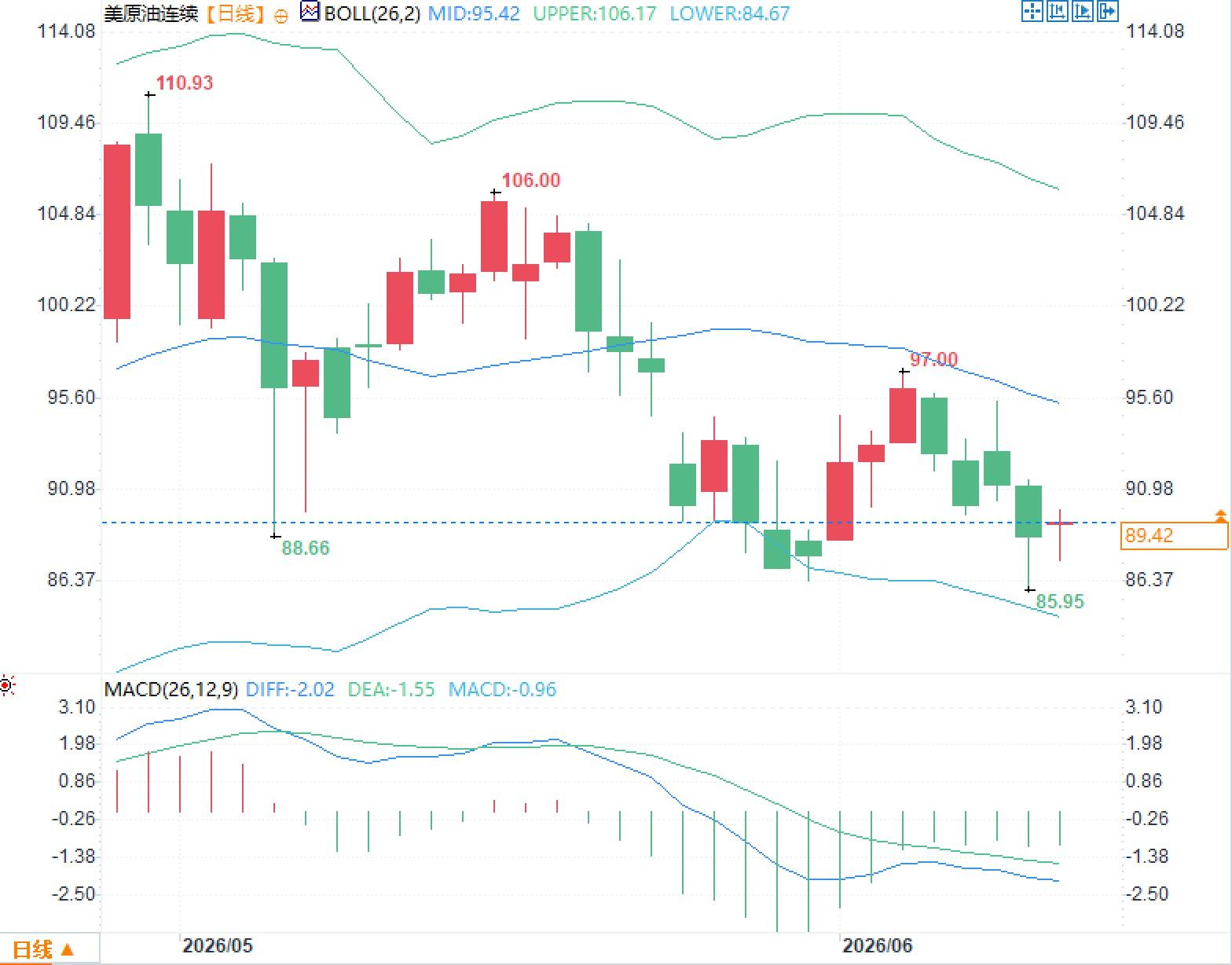
In terms of MACD, the DIFF is -2.02, the DEA is -1.55, and the histogram is -0.96, still below the zero line, indicating insufficient momentum recovery. The recent low of $85.95/barrel and the lower Bollinger Band at $84.67/barrel form a market observation zone, while the middle Bollinger Band around $95.42/barrel is a crucial reference for judging whether the risk premium can expand again. If the price fails to regain the middle Bollinger Band, the market is more like a supply-driven pulse fluctuation rather than a trend revaluation.
The more important task now is not predicting the next conflict news, but assessing the strength of its transmission to the term structure, inventory reduction, and demand erosion. As long as the Fed's policy expectations remain tight, high oil prices themselves will become a variable that inhibits further increases in oil prices.
Oil prices are no longer solely driven by supply shocks.
The core issue in the current crude oil market is not whether there is supply risk, but whether the supply risk can outweigh the downward revision of demand. US President Trump recently stated that an agreement could be reached within two or three days, while simultaneously issuing a tough stance, saying that prolonged negotiations would come at a cost to the other side. For traders, this kind of information doesn't simply push up oil prices, but rather creates two offsetting expectations: short-term supply disruptions increase risk premiums, while the negotiation window lowers the probability of extreme shortages.
This explains why US crude oil has struggled to break out of its trading range despite repeated conflict news. If the market is convinced the supply gap will continue to widen, prices typically undergo a rapid risk reassessment; however, the current price action around $90/barrel suggests that funds have not fully priced in the Strait of Hormuz risk as an irreversible event. More importantly, rising oil prices themselves increase inflationary pressures, which in turn compress demand-side affordability, shifting crude oil from a "supply shock asset" to a "macroeconomic stress asset."
Federal Reserve variables are depressing crude oil futures valuations.
The May non-farm payrolls report, released last Friday, showed an increase of 172,000 jobs, with the unemployment rate remaining at 4.3%, indicating stronger job resilience than the market had previously expected a slowdown. Meanwhile, the minutes of the Federal Reserve's April meeting showed that the target range for the federal funds rate remained at 3.50% to 3.75%. This data is not simply bearish for crude oil, but rather affects pricing through three aspects.
First, persistently high interest rates will increase financing costs for the real economy, raising the cost of holding inventory for refineries, traders, and end-users, making them more cautious about replenishing their stocks. Second, high oil prices and inflation expectations reinforce each other, making it more difficult for the Federal Reserve to quickly shift to an easing stance, thus increasing the discount rate for long-term demand. Third, when the market begins to discuss the risks of interest rate hikes, the financial attributes of crude oil will be suppressed, especially in a highly volatile environment, where macroeconomic funds will have less tolerance for commodity risk exposure.
Therefore, a drop in oil prices does not necessarily mean the market is ignoring supply shocks, but may indicate that the market is beginning to anticipate a disruption in demand. If interest rate expectations remain tight, the upside potential for crude oil will be constrained by a triple factor: consumer elasticity, industrial profits, and shipping costs.
Tight inventory and demand destruction coexist.
The U.S. Energy Information Administration's June outlook projects that, under its assumptions, global commercial inventories are expected to decline by an average of 6.3 million barrels per day in the second quarter of 2026 and by 7.6 million barrels per day in the third quarter, with OECD inventories potentially falling to their lowest level since 2003. Meanwhile, the average Brent crude oil price for June and July is projected to be around $105 per barrel. At first glance, this appears to be a typical tight supply narrative, but the same report also lowered its 2026 global oil demand forecast to a decrease of 1.1 million barrels per day, indicating that high prices, declining supply availability, and energy-saving policy measures are beginning to negatively impact demand.
The International Energy Agency's May report also gave a similar assessment, predicting that global oil demand will decrease by 420,000 barrels per day year-on-year in 2026, falling to approximately 104 million barrels per day, 1.3 million barrels per day lower than pre-conflict forecasts. The coexistence of supply and demand contraction is currently the most difficult aspect of trading crude oil. It does not support a simple one-sided narrative: declining inventories imply a supply risk buffer below, while downward revisions to demand suggest insufficient upward momentum.
In other words, the market is repricing crude oil: it's not a matter of "prices rising due to oil shortages," but rather "to what extent oil shortages would cause prices to rise before destroying demand." The lower this threshold, the weaker the marginal reaction of oil prices to conflict news.
Technical analysis suggests a weak rebound.
From a daily chart perspective, the highs for US crude oil have successively shifted from $110.93/barrel and $106.00/barrel to $97.00/barrel, indicating a significant decline in the price center. The Bollinger Band middle line is at $95.42/barrel, the upper line at $106.17/barrel, and the lower line at $84.67/barrel. The current price is below the middle line and close to the lower line area, suggesting that the rebound has not yet changed the weak channel.
In terms of MACD, the DIFF is -2.02, the DEA is -1.55, and the histogram is -0.96, still below the zero line, indicating insufficient momentum recovery. The recent low of $85.95/barrel and the lower Bollinger Band at $84.67/barrel form a market observation zone, while the middle Bollinger Band around $95.42/barrel is a crucial reference for judging whether the risk premium can expand again. If the price fails to regain the middle Bollinger Band, the market is more like a supply-driven pulse fluctuation rather than a trend revaluation.
The more important task now is not predicting the next conflict news, but assessing the strength of its transmission to the term structure, inventory reduction, and demand erosion. As long as the Fed's policy expectations remain tight, high oil prices themselves will become a variable that inhibits further increases in oil prices.
- Risk Warning and Disclaimer
- The market involves risk, and trading may not be suitable for all investors. This article is for reference only and does not constitute personal investment advice, nor does it take into account certain users’ specific investment objectives, financial situation, or other needs. Any investment decisions made based on this information are at your own risk.

