Is a 25 basis point rate hike a foregone conclusion? The euro awaits guidance from the ECB's decision against the dollar.
2026-06-11 09:05:30
The euro edged higher against the dollar during Asian trading hours on Thursday (June 11), currently trading around 1.1540. The euro has found support recently as the market has gradually priced in expectations of an interest rate hike this week, leading to a modest rise in the exchange rate.
The European Central Bank is widely expected to raise interest rates by 25 basis points this week, which would be another decisive move in this tightening cycle.
Despite a clear slowdown in the eurozone’s economic growth momentum, with manufacturing continuing to contract and the pace of expansion in the service sector also narrowing, policymakers are increasingly concerned about the inflation risks posed by rising energy prices.
The recent escalation of tensions in Iran has driven crude oil prices higher, directly impacting energy costs and transportation prices in the Eurozone.
At the same time, food prices and service inflation remain sticky, and core inflation is falling more slowly than previously expected.
Several ECB Governing Council members have recently emphasized in public speeches that prematurely halting interest rate hikes could cause inflation expectations to become unanchored, rendering previous policy efforts futile. This backdrop has increased the likelihood of further tightening policies.
It is worth noting that there has been increased disagreement within the ECB regarding the degree of tightening.
The mainstream opinion, represented by President Lagarde, is that interest rates should continue to be raised to ensure that inflation returns to the 2% target; however, some dovish members are concerned that excessive interest rate hikes may exacerbate the risk of economic downturn.
However, judging from the recently released minutes of the April meeting and subsequent statements from officials, the voices supporting continued interest rate hikes still dominate.
The market has fully priced in the expectation of a 25 basis point rate hike in June, and investors' focus has now shifted to how the ECB will guide the subsequent interest rate path.
Most institutions expect the ECB to raise interest rates by another 25 basis points in July, followed by a period of observation. If energy prices rise further or inflation expectations worsen again, further action in September cannot be ruled out.
ABN AMRO points out that ECB President Christine Lagarde had previously signaled that June would be "the right time to assess the impact of the Iranian conflict and update economic forecasts."
The agency stated, "Both the policy communications at the April meeting and the subsequent public statements by several officials indicate that the likelihood of an interest rate hike at the upcoming meeting is very high."
ING expects the ECB to raise its inflation forecast and hint at further monetary tightening, with a possible 25 basis point rate hike in July. The bank believes, "The policy committee will signal that further interest rate increases are likely to be needed."
Despite the slowdown in eurozone economic growth, the institution believes that policymakers are currently more concerned about inflation than economic activity, stating that "the policy committee is more anxious about inflation than about growth."
The euro/dollar pair is currently in a weak downward trend on the daily chart, with the overall bearish pattern dominating. The price is trading below all major moving averages; the 20-day, 50-day, 100-day, and 200-day moving averages have formed a bearish alignment, with short-term moving averages continuing to suppress the price, and the 200-day moving average flattening out, indicating a significant weakening of long-term upward momentum.
Recently, prices broke below the previous trading range, hitting a low of 1.1499, a new low for the period, indicating strong bearish momentum. Currently, prices are stabilizing slightly around 1.1540, with key support levels in the 1.1499-1.1410 range. Failure to hold this area could open up further downside potential. Short-term resistance is concentrated around the moving average near 1.1600, where rebounds have encountered significant resistance.
From a short-term candlestick chart perspective, while the pace of decline has slowed, there are no clear reversal signals yet, and the overall downtrend remains intact. It's crucial to watch whether the price can find effective support around 1.1500. If it rebounds and breaks through the 20-day moving average (MA20), a period of recovery may occur; otherwise, the weak trend is likely to continue.
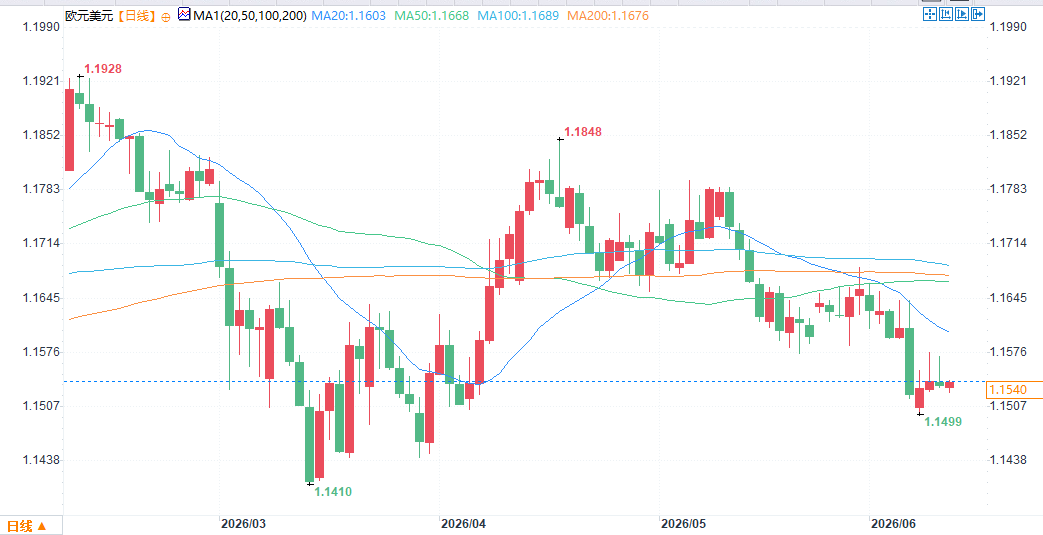
(Euro/USD daily chart, source: FX678)
At 9:05 AM Beijing time on June 11, the euro was trading at 1.1542/43 against the US dollar.
A rate hike this week is virtually certain; inflation concerns drive policy tightening.
The European Central Bank is widely expected to raise interest rates by 25 basis points this week, which would be another decisive move in this tightening cycle.
Despite a clear slowdown in the eurozone’s economic growth momentum, with manufacturing continuing to contract and the pace of expansion in the service sector also narrowing, policymakers are increasingly concerned about the inflation risks posed by rising energy prices.
The recent escalation of tensions in Iran has driven crude oil prices higher, directly impacting energy costs and transportation prices in the Eurozone.
At the same time, food prices and service inflation remain sticky, and core inflation is falling more slowly than previously expected.
Several ECB Governing Council members have recently emphasized in public speeches that prematurely halting interest rate hikes could cause inflation expectations to become unanchored, rendering previous policy efforts futile. This backdrop has increased the likelihood of further tightening policies.
Internal disagreements have emerged, and the market is focusing on the future path of interest rates.
It is worth noting that there has been increased disagreement within the ECB regarding the degree of tightening.
The mainstream opinion, represented by President Lagarde, is that interest rates should continue to be raised to ensure that inflation returns to the 2% target; however, some dovish members are concerned that excessive interest rate hikes may exacerbate the risk of economic downturn.
However, judging from the recently released minutes of the April meeting and subsequent statements from officials, the voices supporting continued interest rate hikes still dominate.
The market has fully priced in the expectation of a 25 basis point rate hike in June, and investors' focus has now shifted to how the ECB will guide the subsequent interest rate path.
Most institutions expect the ECB to raise interest rates by another 25 basis points in July, followed by a period of observation. If energy prices rise further or inflation expectations worsen again, further action in September cannot be ruled out.
Institutional Views
ABN AMRO points out that ECB President Christine Lagarde had previously signaled that June would be "the right time to assess the impact of the Iranian conflict and update economic forecasts."
The agency stated, "Both the policy communications at the April meeting and the subsequent public statements by several officials indicate that the likelihood of an interest rate hike at the upcoming meeting is very high."
ING expects the ECB to raise its inflation forecast and hint at further monetary tightening, with a possible 25 basis point rate hike in July. The bank believes, "The policy committee will signal that further interest rate increases are likely to be needed."
Despite the slowdown in eurozone economic growth, the institution believes that policymakers are currently more concerned about inflation than economic activity, stating that "the policy committee is more anxious about inflation than about growth."
Technical Analysis
The euro/dollar pair is currently in a weak downward trend on the daily chart, with the overall bearish pattern dominating. The price is trading below all major moving averages; the 20-day, 50-day, 100-day, and 200-day moving averages have formed a bearish alignment, with short-term moving averages continuing to suppress the price, and the 200-day moving average flattening out, indicating a significant weakening of long-term upward momentum.
Recently, prices broke below the previous trading range, hitting a low of 1.1499, a new low for the period, indicating strong bearish momentum. Currently, prices are stabilizing slightly around 1.1540, with key support levels in the 1.1499-1.1410 range. Failure to hold this area could open up further downside potential. Short-term resistance is concentrated around the moving average near 1.1600, where rebounds have encountered significant resistance.
From a short-term candlestick chart perspective, while the pace of decline has slowed, there are no clear reversal signals yet, and the overall downtrend remains intact. It's crucial to watch whether the price can find effective support around 1.1500. If it rebounds and breaks through the 20-day moving average (MA20), a period of recovery may occur; otherwise, the weak trend is likely to continue.
(Euro/USD daily chart, source: FX678)
At 9:05 AM Beijing time on June 11, the euro was trading at 1.1542/43 against the US dollar.
- Risk Warning and Disclaimer
- The market involves risk, and trading may not be suitable for all investors. This article is for reference only and does not constitute personal investment advice, nor does it take into account certain users’ specific investment objectives, financial situation, or other needs. Any investment decisions made based on this information are at your own risk.