Why did gold prices plummet even though real interest rates haven't risen? The US dollar is rewriting the game.
2026-06-11 11:04:35
On Thursday (June 11) during the Asian session, spot gold fluctuated widely, with prices falling to $4,023.85 per ounce at one point, and is currently trading around $4,070 per ounce.
Recently, the gold market has undergone a brutal test. For a long time, the negative correlation between real yields and gold prices has been almost regarded as a "physical law" of the macro market—when real interest rates fall, gold prices rise.
However, despite little fluctuation in the 10-year real interest rate this week, spot gold prices plummeted, briefly touching below $4,030 per ounce. This divergence is not statistical noise, but rather indicates a fundamental shift in the forces driving gold prices.
Traditional logic dictates that declining real interest rates will drive up gold prices, but this logic has been completely overturned by the strong US dollar. The USD/JPY pair broke through 160.50, continuing its unstoppable upward momentum. This isn't a story of collapsing inflation expectations or easing growth concerns, but rather a reflection of liquidity preference overriding the conventional logic of asset classes.
Looking at cross-asset performance, WTI crude oil rose nearly 2% to around $91.50 per barrel. Commodities generally saw buying interest due to supply-side concerns, except for gold, which was sold off. This divergence is typical of dollar-denominated settlement—when the dollar strengthens, dollar-denominated gold becomes more expensive for non-dollar buyers, forcing leveraged long positions to be liquidated.
The rise of the US dollar to 160.54 against the Japanese yen is particularly indicative. The yen has fallen to levels historically triggering intervention warnings, yet carry trades remain active. This has two implications for gold: first, it drains liquidity from yen-denominated gold buying; second, it reinforces the dollar's status as the "cleanest of the dirty laundry." In a world where the yen is collapsing and the euro is stagnant at 1.1545, the dollar becomes the preferred destination for safe-haven funds—even if these funds would otherwise flow into gold.
The euro remained largely unchanged at 1.1545 against the dollar, offering no relief. Caught between the European Central Bank's cautious stance and concerns about energy prices, the euro is powerless to challenge the dollar's dominance. Gold's traditional hedging function—protecting against currency devaluation—is being replaced by a more primal instinct for safe haven: hoarding global reserve currencies.
To understand the depth of this divergence, consider the expected level of real interest rates. If gold were still following its historical correlation with the yield on 10-year Treasury Inflation-Protected Securities (TIPS), the recent drop in gold prices should correspond to a surge in real interest rates of about 15 to 20 basis points. However, this has not happened. Real interest rates have remained largely range-bound, suppressed by market expectations that the Federal Reserve will cut rates before inflation is fully under control.
We are witnessing a "decoupling event." Gold is no longer reacting to real interest rates, but rather trading on the interest rate differential of the US dollar and the opportunity cost of holding a non-yielding asset in an environment of high nominal interest rates. The yields of over 5% offered by short-term US Treasury bonds are siphoning away funds that might otherwise flow into gold exchange-traded funds. While central bank physical demand provides some support, it is insufficient to offset speculative selling.
With gold prices falling below the psychologically key level of $4,100, the recent support zone is located at $4,050-$4,020, corresponding to the 50-day moving average and the consolidation range of late May. A close below $4,020 would open up space towards $3,980. $3,920 is the last line of defense before testing the $3,800 area.
On the upside, resistance levels have piled up. $4100 has now turned from support into resistance. A break above $4120 would indicate this decline was a false breakout, but momentum suggests this is unlikely. The next major resistance level is at $4150, followed by the recent high of $4220.
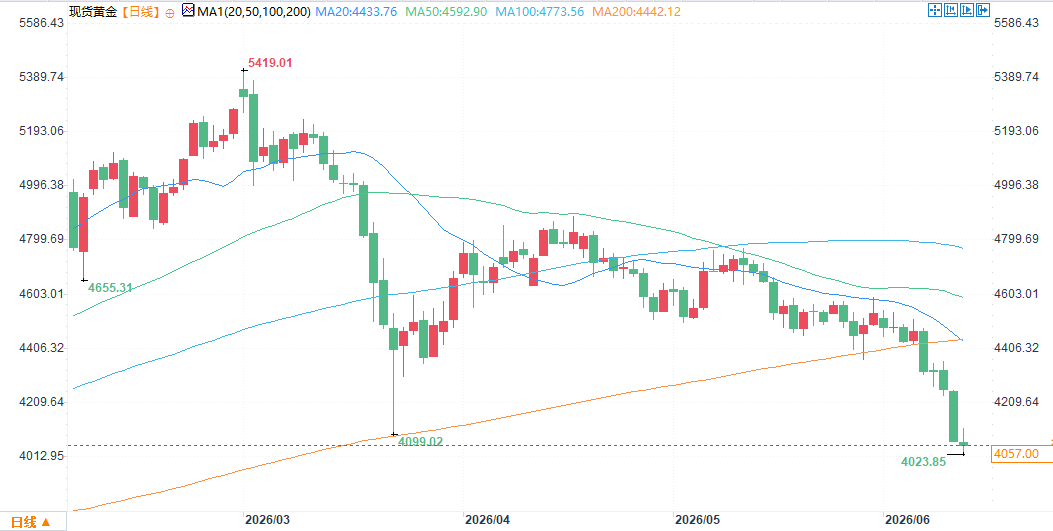
(Spot gold daily chart, source: FX678)
Scenario 1: Dollar Dominance Continues. If the USD/JPY pair continues its advance towards 162 and the EUR/USD pair falls below 1.15, gold prices could test $3980 this week. This is the baseline scenario. The dollar's momentum is self-reinforcing, and gold's decoupling from real interest rates has rendered it without a fundamental anchor.
Scenario 2: Real interest rates eventually follow suit and fall. If the Federal Reserve signals more aggressive easing or inflation data unexpectedly declines, real interest rates could plummet, re-establishing the traditional correlation. This would require gold to rebound from current levels, but the trigger is not imminent.
Scenario 3: Geopolitical risk premium reappears. Escalation of tensions in Eastern Europe or the Middle East could drive safe-haven funds to bypass the US dollar and flow directly into gold. This is an "uncertainty factor." Currently, the market is underpricing geopolitical risks, but the situation could change rapidly.
At 11:03 AM Beijing time on June 11, spot gold was trading at $4,074.67 per ounce.
Recently, the gold market has undergone a brutal test. For a long time, the negative correlation between real yields and gold prices has been almost regarded as a "physical law" of the macro market—when real interest rates fall, gold prices rise.
However, despite little fluctuation in the 10-year real interest rate this week, spot gold prices plummeted, briefly touching below $4,030 per ounce. This divergence is not statistical noise, but rather indicates a fundamental shift in the forces driving gold prices.
The US dollar's "gravitational field" draws in safe-haven funds.
Traditional logic dictates that declining real interest rates will drive up gold prices, but this logic has been completely overturned by the strong US dollar. The USD/JPY pair broke through 160.50, continuing its unstoppable upward momentum. This isn't a story of collapsing inflation expectations or easing growth concerns, but rather a reflection of liquidity preference overriding the conventional logic of asset classes.
Looking at cross-asset performance, WTI crude oil rose nearly 2% to around $91.50 per barrel. Commodities generally saw buying interest due to supply-side concerns, except for gold, which was sold off. This divergence is typical of dollar-denominated settlement—when the dollar strengthens, dollar-denominated gold becomes more expensive for non-dollar buyers, forcing leveraged long positions to be liquidated.
The rise of the US dollar to 160.54 against the Japanese yen is particularly indicative. The yen has fallen to levels historically triggering intervention warnings, yet carry trades remain active. This has two implications for gold: first, it drains liquidity from yen-denominated gold buying; second, it reinforces the dollar's status as the "cleanest of the dirty laundry." In a world where the yen is collapsing and the euro is stagnant at 1.1545, the dollar becomes the preferred destination for safe-haven funds—even if these funds would otherwise flow into gold.
The euro remained largely unchanged at 1.1545 against the dollar, offering no relief. Caught between the European Central Bank's cautious stance and concerns about energy prices, the euro is powerless to challenge the dollar's dominance. Gold's traditional hedging function—protecting against currency devaluation—is being replaced by a more primal instinct for safe haven: hoarding global reserve currencies.
Real Interest Rates: A Malfunctioning Compass
To understand the depth of this divergence, consider the expected level of real interest rates. If gold were still following its historical correlation with the yield on 10-year Treasury Inflation-Protected Securities (TIPS), the recent drop in gold prices should correspond to a surge in real interest rates of about 15 to 20 basis points. However, this has not happened. Real interest rates have remained largely range-bound, suppressed by market expectations that the Federal Reserve will cut rates before inflation is fully under control.
We are witnessing a "decoupling event." Gold is no longer reacting to real interest rates, but rather trading on the interest rate differential of the US dollar and the opportunity cost of holding a non-yielding asset in an environment of high nominal interest rates. The yields of over 5% offered by short-term US Treasury bonds are siphoning away funds that might otherwise flow into gold exchange-traded funds. While central bank physical demand provides some support, it is insufficient to offset speculative selling.
Technical Analysis: Key Support Levels Face Testing
With gold prices falling below the psychologically key level of $4,100, the recent support zone is located at $4,050-$4,020, corresponding to the 50-day moving average and the consolidation range of late May. A close below $4,020 would open up space towards $3,980. $3,920 is the last line of defense before testing the $3,800 area.
On the upside, resistance levels have piled up. $4100 has now turned from support into resistance. A break above $4120 would indicate this decline was a false breakout, but momentum suggests this is unlikely. The next major resistance level is at $4150, followed by the recent high of $4220.
(Spot gold daily chart, source: FX678)
Three Scenarios and Position Analysis
Scenario 1: Dollar Dominance Continues. If the USD/JPY pair continues its advance towards 162 and the EUR/USD pair falls below 1.15, gold prices could test $3980 this week. This is the baseline scenario. The dollar's momentum is self-reinforcing, and gold's decoupling from real interest rates has rendered it without a fundamental anchor.
Scenario 2: Real interest rates eventually follow suit and fall. If the Federal Reserve signals more aggressive easing or inflation data unexpectedly declines, real interest rates could plummet, re-establishing the traditional correlation. This would require gold to rebound from current levels, but the trigger is not imminent.
Scenario 3: Geopolitical risk premium reappears. Escalation of tensions in Eastern Europe or the Middle East could drive safe-haven funds to bypass the US dollar and flow directly into gold. This is an "uncertainty factor." Currently, the market is underpricing geopolitical risks, but the situation could change rapidly.
At 11:03 AM Beijing time on June 11, spot gold was trading at $4,074.67 per ounce.
- Risk Warning and Disclaimer
- The market involves risk, and trading may not be suitable for all investors. This article is for reference only and does not constitute personal investment advice, nor does it take into account certain users’ specific investment objectives, financial situation, or other needs. Any investment decisions made based on this information are at your own risk.