Escalating tensions in the Middle East have fueled inflation concerns and raised expectations of a Federal Reserve rate hike, but the dollar index remains hovering around the 100 mark.
2026-06-11 13:32:42
On Thursday during Asian trading hours, the US Dollar Index (DXY), which measures the dollar's performance against six major currencies, came under renewed pressure after a slight rebound, generally fluctuating around 100.00. Investors are weighing the combined impact of escalating tensions in the Middle East, rising energy prices, and changes in the outlook for US monetary policy on the dollar's trajectory.

Military conflicts in the Middle East have escalated recently. Following an attack on a US military helicopter, the US launched a so-called "self-defense" military operation against Iran, which subsequently triggered retaliatory actions by Iran against US military facilities in Bahrain, Jordan, and Kuwait. US Central Command later confirmed that it had carried out airstrikes against Iranian targets on Wednesday. US President Trump stated that the US might take more severe military measures if a temporary peace agreement cannot be reached, while Iran emphasized that it would not yield to external pressure.
Meanwhile, Iran's Islamic Revolutionary Guard Corps announced an immediate halt to all commercial vessels and oil tankers passing through the Strait of Hormuz, warning that any ships attempting to pass through the strait could become targets. Since the Strait of Hormuz handles approximately 20% of global seaborne crude oil transport, market concerns about a severe disruption to energy supplies have driven international oil prices sharply higher and reignited global inflationary pressures.
Rising energy prices have altered investors' assessment of the Federal Reserve's policy path. The money market now anticipates a potential 25-basis-point rate hike by the end of the year, a significant shift from previous expectations of rate cuts. Higher interest rate expectations typically enhance the attractiveness of dollar assets, but current geopolitical volatility and investor concerns about global economic growth are limiting the dollar's upside potential.
On the economic data front, the latest US Consumer Price Index (CPI) for May rose 4.2% year-on-year, higher than April's 3.8%, in line with market expectations; core CPI rose 2.9% year-on-year, a slight increase from the previous value of 2.8%, indicating that underlying inflationary pressures remain resilient. The market will now focus on the US Producer Price Index (PPI) and initial jobless claims data for May to assess the US economic and inflation trends and seek further clues about the Federal Reserve's future policies.
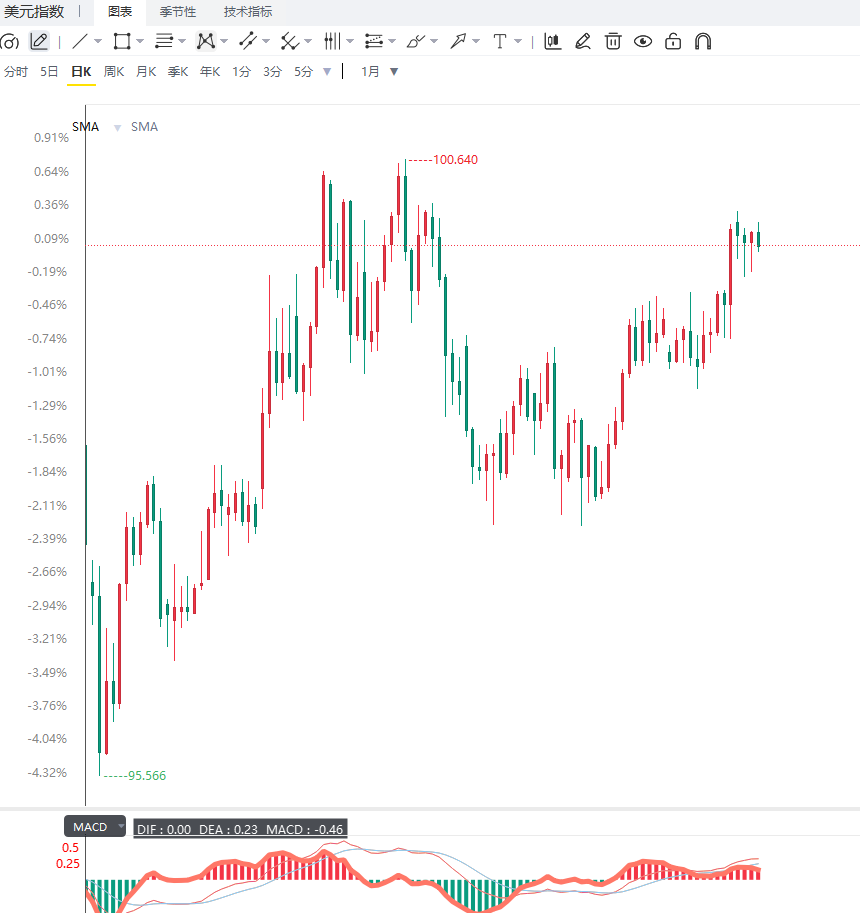
From a technical perspective, the daily chart shows that the US dollar index is still in a medium- to long-term consolidation phase, with the 100 level becoming a key battleground between bulls and bears. If market expectations for a Fed rate hike strengthen further, the dollar index could retest the 101.00 to 101.50 area; conversely, if safe-haven flows flow to other assets or economic data is weak, the dollar index may fall further to around 99.00 or even lower. Technically, the RSI is in neutral territory, and the MACD momentum is limited, indicating that the short-term direction still needs new fundamental catalysts.
From a 4-hour chart perspective, the US dollar index is showing short-term weakness, with prices still under pressure from short-term moving averages, but there is some technical support around the 100 level. If subsequent PPI data is stronger than expected, further reinforcing expectations that the Federal Reserve will maintain high interest rates or even raise rates, the US dollar index may rebound; conversely, if economic data weakens and the market re-bets on easing policies, the US dollar index may face further adjustment risks.
Editor's Summary : The current dollar trend is influenced by multiple factors, including Middle East geopolitical risks, rising energy prices, and expectations surrounding Federal Reserve policy. While high inflation and potential interest rate hikes provide support for the dollar, market risk aversion and economic uncertainty limit its rebound. Going forward, investors should focus on US PPI, employment data, and speeches by Federal Reserve officials, while also closely monitoring developments in the Middle East, as energy market volatility could become a significant variable affecting the dollar and global financial markets.
Military conflicts in the Middle East have escalated recently. Following an attack on a US military helicopter, the US launched a so-called "self-defense" military operation against Iran, which subsequently triggered retaliatory actions by Iran against US military facilities in Bahrain, Jordan, and Kuwait. US Central Command later confirmed that it had carried out airstrikes against Iranian targets on Wednesday. US President Trump stated that the US might take more severe military measures if a temporary peace agreement cannot be reached, while Iran emphasized that it would not yield to external pressure.
Meanwhile, Iran's Islamic Revolutionary Guard Corps announced an immediate halt to all commercial vessels and oil tankers passing through the Strait of Hormuz, warning that any ships attempting to pass through the strait could become targets. Since the Strait of Hormuz handles approximately 20% of global seaborne crude oil transport, market concerns about a severe disruption to energy supplies have driven international oil prices sharply higher and reignited global inflationary pressures.
Rising energy prices have altered investors' assessment of the Federal Reserve's policy path. The money market now anticipates a potential 25-basis-point rate hike by the end of the year, a significant shift from previous expectations of rate cuts. Higher interest rate expectations typically enhance the attractiveness of dollar assets, but current geopolitical volatility and investor concerns about global economic growth are limiting the dollar's upside potential.
On the economic data front, the latest US Consumer Price Index (CPI) for May rose 4.2% year-on-year, higher than April's 3.8%, in line with market expectations; core CPI rose 2.9% year-on-year, a slight increase from the previous value of 2.8%, indicating that underlying inflationary pressures remain resilient. The market will now focus on the US Producer Price Index (PPI) and initial jobless claims data for May to assess the US economic and inflation trends and seek further clues about the Federal Reserve's future policies.
From a technical perspective, the daily chart shows that the US dollar index is still in a medium- to long-term consolidation phase, with the 100 level becoming a key battleground between bulls and bears. If market expectations for a Fed rate hike strengthen further, the dollar index could retest the 101.00 to 101.50 area; conversely, if safe-haven flows flow to other assets or economic data is weak, the dollar index may fall further to around 99.00 or even lower. Technically, the RSI is in neutral territory, and the MACD momentum is limited, indicating that the short-term direction still needs new fundamental catalysts.
From a 4-hour chart perspective, the US dollar index is showing short-term weakness, with prices still under pressure from short-term moving averages, but there is some technical support around the 100 level. If subsequent PPI data is stronger than expected, further reinforcing expectations that the Federal Reserve will maintain high interest rates or even raise rates, the US dollar index may rebound; conversely, if economic data weakens and the market re-bets on easing policies, the US dollar index may face further adjustment risks.
Editor's Summary : The current dollar trend is influenced by multiple factors, including Middle East geopolitical risks, rising energy prices, and expectations surrounding Federal Reserve policy. While high inflation and potential interest rate hikes provide support for the dollar, market risk aversion and economic uncertainty limit its rebound. Going forward, investors should focus on US PPI, employment data, and speeches by Federal Reserve officials, while also closely monitoring developments in the Middle East, as energy market volatility could become a significant variable affecting the dollar and global financial markets.
- Risk Warning and Disclaimer
- The market involves risk, and trading may not be suitable for all investors. This article is for reference only and does not constitute personal investment advice, nor does it take into account certain users’ specific investment objectives, financial situation, or other needs. Any investment decisions made based on this information are at your own risk.