Interest rate hikes are no longer enough to satisfy our needs, and the 160.6 level remains unconquered: Who dares to be the first to waver before the Bank of Japan meeting?
2026-06-11 19:12:31
On Thursday (June 11), the Japanese government bond market experienced a volatile trading session, initially falling, then rising, and finally retreating, with the USD/JPY pair maintaining a strong consolidation above 160.50. Overnight, rising US Treasury yields put pressure on Japanese bond futures in the morning session, with the 10-year futures opening down 23 ticks to 128.46, forming the day's low. Subsequently, the US announced the completion of military strikes against Iranian targets, and President Trump told the media that the operation would soon end, partially easing geopolitical risk premiums, and futures rebounded from their lows. In the afternoon, a wave of buying emerged in the active 30-year government bond market, with market news suggesting that life insurance institutions may have been replacing low-coupon older bonds with newly issued bonds, pushing futures to an intraday high of 128.79. However, the recovery at the ultra-long term was short-lived. As the 40-year bond faced selling pressure, the 30-year yield rose again to a high of 3.87%, ultimately closing up 2 basis points. The 5-year yield fell 1 basis point to 1.925%, and the yield curve continued to steepen. In the foreign exchange market, the USD/JPY exchange rate was 160.53, close to the recent peak of 160.585, reflecting that the yen's weakness remains unchanged amid the interplay of interest rate differentials and central bank policy expectations.
Today's focus is on how the market will view next week's Bank of Japan (BOJ) meeting and the correlation between the Japanese bond and foreign exchange markets. During trading, news broke that BOJ Governor Kazuo Ueda will be absent from the policy meeting due to a two-week hospitalization for a liver cyst. Deputy Governor Ryozo Himino will chair the meeting, while another Deputy Governor, Shinichi Uchida, will handle the post-meeting press conference. Ueda can submit written opinions but has no voting rights. In the event of a 4-4 tie, Himino will have the final say. Overnight index swap data shows that the probability of a 25 basis point rate hike in June has slightly decreased to 96%, while the probability of a second rate hike in July is approximately 101.5%, indicating that the hospitalization news has only caused a minor disturbance, and the expectation of a rate hike remains solid. The prevailing market view is that, apart from Toichi Asada, who holds a reflationary stance, the remaining committee members are expected to support a rate hike.
What truly affects the yen is not whether or not there will be an interest rate hike, but rather the magnitude and subsequent path of such a hike. Currently, the USD/JPY exchange rate is firmly above 160. If the Bank of Japan only implements a 25 basis point rate hike, lacking a stronger hawkish signal, the huge interest rate differential between the US and Japan will be difficult to shake, and the yen's weakness is likely to continue. Japan is highly dependent on energy and commodity imports, and the continued depreciation of the exchange rate exacerbates imported inflation. The central bank itself has already considered accelerating inflation a major risk. Therefore, the market is closely watching whether any committee members will propose a 50 basis point rate hike at the meeting, and whether Shinichi Uchida will hint at further action in July at the press conference. These variables are directly reflected in the long-term Japanese government bond market: the rise in 30-year and 40-year yields reflects inflation compensation and term premium pressures. Meanwhile, dealer selling after this week's 30-year government bond auction has exacerbated the steepening of the yield curve.
The risk of currency intervention is also accumulating. The USD/JPY exchange rate has broken through the area that triggered market alarm in April, but there have been few explicit verbal warnings from officials so far. A survey by a well-known institution shows that strategists generally believe that the Ministry of Finance's tolerance for absolute levels may increase, but if the exchange rate unilaterally and rapidly surges towards the 161 level, or if implied volatility rises sharply, the probability of intervention will increase rapidly. In terms of fund flows, regional accounts bought 3-year bonds, pension funds sold short- and medium-term bonds, and short-term traders were forced to cover their short positions in futures in the morning, further confirming the uncertainty of market positioning before the key policy window.
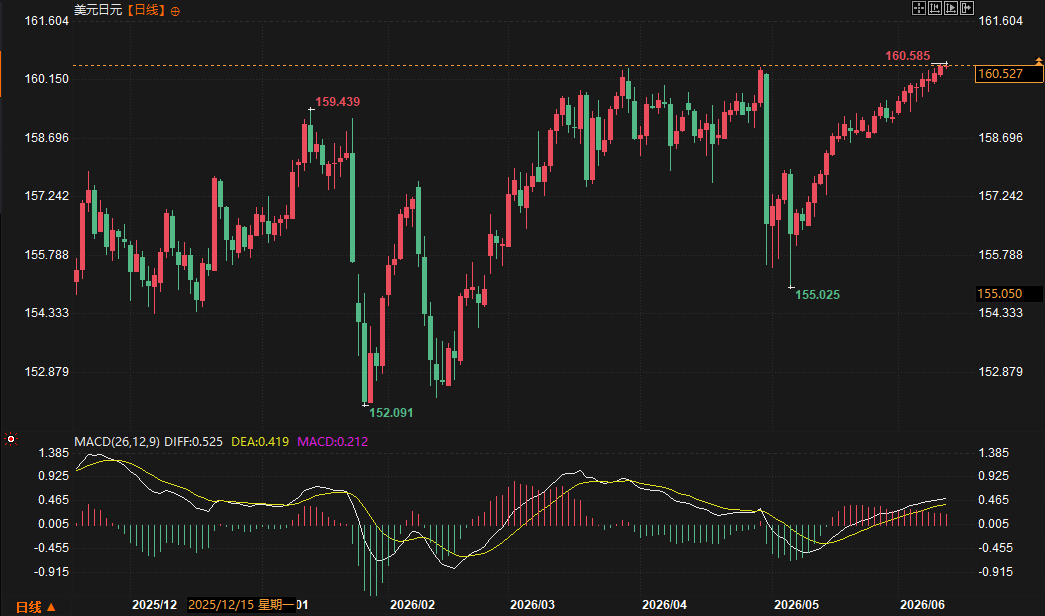
Technical analysis also provides important insights. The USD/JPY daily chart shows an upward continuation pattern of "rise – pullback – new high," breaking through the previous high of 159.439 after reaching a higher low of 155.025, and setting a new high of 160.585. In the MACD indicator, both the DIFF and DEA are positive and diverging upwards, with the red momentum bars expanding moderately and no signs of top divergence, indicating continued bullish momentum. Regarding resistance , initial resistance is concentrated in the 160.585-161.00 area, which coincides with recent peaks and psychological levels. A successful break above this level would target the 161.80 area. Support levels to watch are the psychological level of 160.00, the previous high of 159.44 (a former high that has now been converted into a support level), and the strong support around 157.50. During the session, attention should be paid to the possibility that a further rise in the yield on ultra-long-term Japanese government bonds could stimulate expectations of a Japan-US interest rate differential, thereby causing USD/JPY to test resistance. Also, monitor the distribution of exporter selling pressure and option barriers.
Ahead of next week's Bank of Japan meeting, the market will enter a sensitive period of policy silence and expectation-driven speculation. If the meeting only results in a 25 basis point rate hike, and the forward guidance fails to convey a continued tightening intention, a "buy the rumor, sell the fact" scenario may occur, putting short-term pressure on the yen and potentially testing 161.00 or even higher. However, if the meeting unexpectedly proposes a 50 basis point rate hike or explicitly hints at a July rate hike, the yen is expected to rebound quickly, returning to the support areas of 159.00 and 157.50. The risk of intervention hangs like a sword of Damocles; while it may not materialize immediately, it will compress the space for unilateral upward movement, resulting in a volatile market characterized by slow rises and rapid falls. Overall, the resonance between fundamentals, interest rate differentials, and central bank policy is entering a critical verification period, and volatility is expected to increase significantly.
Why did Kazuo Ueda's hospitalization fail to shake expectations of interest rate hikes?
Ueda had previously publicly emphasized the risk of accelerating inflation, making the policy direction clear. The meeting was chaired by Vice Governor Ryozo Himino, with Shinichi Uchida handling communication, and Ueda submitted written opinions, ensuring a robust decision-making mechanism. A majority of the eight voting committee members are expected to support an interest rate hike, with only one potentially opposing it. Even in a 4-4 tie, chairing Governor Himino could cast the decisive vote.
What does the rise in the 30-year Japanese government bond yield and the fall in the 5-year yield mean?
This contributes to a steepening of the yield curve. The short end, driven by expectations of interest rate hikes, has limited downside but remains relatively stable; the long end reflects market anxieties about future inflation compensation, fiscal supply, and the path of the Bank of Japan's policy normalization. Life insurance companies' bond-swapping activities amplified intraday volatility at the ultra-long end.
The USD/JPY exchange rate is above 160, so why hasn't there been any actual intervention?
Japanese authorities typically focus more on the speed of exchange rate fluctuations and the degree of one-sided speculation than on a fixed absolute level. Furthermore, geopolitical events can distract policy attention, but if the exchange rate quickly breaks through 161 and implied volatility jumps, the risk of verbal warnings or even actual intervention will escalate dramatically.
What are the key points to watch at next week's Bank of Japan meeting?
A 25-basis-point rate hike has already been largely priced in. The key lies in two points: first, whether any committee member will propose a 50-basis-point hike; and second, whether Shinichi Uchida will hint at further action in July at the press conference. These two variables will have a far greater impact on the Japanese bond yield curve and the direction of the yen than a single rate hike itself.
What are the technical signals confirming a valid breakout in USD/JPY?
For the daily closing price to hold above 160.60, the MACD histogram needs to continue expanding with no divergence. If a pullback occurs after a rally and breaks below the previous high support of 159.44, a short-term top may form, leading to a period of consolidation at higher levels.
The triple reflection of interest rate expectations, Japanese government bond volatility, and intervention risks.
Today's focus is on how the market will view next week's Bank of Japan (BOJ) meeting and the correlation between the Japanese bond and foreign exchange markets. During trading, news broke that BOJ Governor Kazuo Ueda will be absent from the policy meeting due to a two-week hospitalization for a liver cyst. Deputy Governor Ryozo Himino will chair the meeting, while another Deputy Governor, Shinichi Uchida, will handle the post-meeting press conference. Ueda can submit written opinions but has no voting rights. In the event of a 4-4 tie, Himino will have the final say. Overnight index swap data shows that the probability of a 25 basis point rate hike in June has slightly decreased to 96%, while the probability of a second rate hike in July is approximately 101.5%, indicating that the hospitalization news has only caused a minor disturbance, and the expectation of a rate hike remains solid. The prevailing market view is that, apart from Toichi Asada, who holds a reflationary stance, the remaining committee members are expected to support a rate hike.
What truly affects the yen is not whether or not there will be an interest rate hike, but rather the magnitude and subsequent path of such a hike. Currently, the USD/JPY exchange rate is firmly above 160. If the Bank of Japan only implements a 25 basis point rate hike, lacking a stronger hawkish signal, the huge interest rate differential between the US and Japan will be difficult to shake, and the yen's weakness is likely to continue. Japan is highly dependent on energy and commodity imports, and the continued depreciation of the exchange rate exacerbates imported inflation. The central bank itself has already considered accelerating inflation a major risk. Therefore, the market is closely watching whether any committee members will propose a 50 basis point rate hike at the meeting, and whether Shinichi Uchida will hint at further action in July at the press conference. These variables are directly reflected in the long-term Japanese government bond market: the rise in 30-year and 40-year yields reflects inflation compensation and term premium pressures. Meanwhile, dealer selling after this week's 30-year government bond auction has exacerbated the steepening of the yield curve.
The risk of currency intervention is also accumulating. The USD/JPY exchange rate has broken through the area that triggered market alarm in April, but there have been few explicit verbal warnings from officials so far. A survey by a well-known institution shows that strategists generally believe that the Ministry of Finance's tolerance for absolute levels may increase, but if the exchange rate unilaterally and rapidly surges towards the 161 level, or if implied volatility rises sharply, the probability of intervention will increase rapidly. In terms of fund flows, regional accounts bought 3-year bonds, pension funds sold short- and medium-term bonds, and short-term traders were forced to cover their short positions in futures in the morning, further confirming the uncertainty of market positioning before the key policy window.
Technical analysis also provides important insights. The USD/JPY daily chart shows an upward continuation pattern of "rise – pullback – new high," breaking through the previous high of 159.439 after reaching a higher low of 155.025, and setting a new high of 160.585. In the MACD indicator, both the DIFF and DEA are positive and diverging upwards, with the red momentum bars expanding moderately and no signs of top divergence, indicating continued bullish momentum. Regarding resistance , initial resistance is concentrated in the 160.585-161.00 area, which coincides with recent peaks and psychological levels. A successful break above this level would target the 161.80 area. Support levels to watch are the psychological level of 160.00, the previous high of 159.44 (a former high that has now been converted into a support level), and the strong support around 157.50. During the session, attention should be paid to the possibility that a further rise in the yield on ultra-long-term Japanese government bonds could stimulate expectations of a Japan-US interest rate differential, thereby causing USD/JPY to test resistance. Also, monitor the distribution of exporter selling pressure and option barriers.
Short-term outlook: Building momentum and volatility before the policy window
Ahead of next week's Bank of Japan meeting, the market will enter a sensitive period of policy silence and expectation-driven speculation. If the meeting only results in a 25 basis point rate hike, and the forward guidance fails to convey a continued tightening intention, a "buy the rumor, sell the fact" scenario may occur, putting short-term pressure on the yen and potentially testing 161.00 or even higher. However, if the meeting unexpectedly proposes a 50 basis point rate hike or explicitly hints at a July rate hike, the yen is expected to rebound quickly, returning to the support areas of 159.00 and 157.50. The risk of intervention hangs like a sword of Damocles; while it may not materialize immediately, it will compress the space for unilateral upward movement, resulting in a volatile market characterized by slow rises and rapid falls. Overall, the resonance between fundamentals, interest rate differentials, and central bank policy is entering a critical verification period, and volatility is expected to increase significantly.
Frequently Asked Questions
Why did Kazuo Ueda's hospitalization fail to shake expectations of interest rate hikes?
Ueda had previously publicly emphasized the risk of accelerating inflation, making the policy direction clear. The meeting was chaired by Vice Governor Ryozo Himino, with Shinichi Uchida handling communication, and Ueda submitted written opinions, ensuring a robust decision-making mechanism. A majority of the eight voting committee members are expected to support an interest rate hike, with only one potentially opposing it. Even in a 4-4 tie, chairing Governor Himino could cast the decisive vote.
What does the rise in the 30-year Japanese government bond yield and the fall in the 5-year yield mean?
This contributes to a steepening of the yield curve. The short end, driven by expectations of interest rate hikes, has limited downside but remains relatively stable; the long end reflects market anxieties about future inflation compensation, fiscal supply, and the path of the Bank of Japan's policy normalization. Life insurance companies' bond-swapping activities amplified intraday volatility at the ultra-long end.
The USD/JPY exchange rate is above 160, so why hasn't there been any actual intervention?
Japanese authorities typically focus more on the speed of exchange rate fluctuations and the degree of one-sided speculation than on a fixed absolute level. Furthermore, geopolitical events can distract policy attention, but if the exchange rate quickly breaks through 161 and implied volatility jumps, the risk of verbal warnings or even actual intervention will escalate dramatically.
What are the key points to watch at next week's Bank of Japan meeting?
A 25-basis-point rate hike has already been largely priced in. The key lies in two points: first, whether any committee member will propose a 50-basis-point hike; and second, whether Shinichi Uchida will hint at further action in July at the press conference. These two variables will have a far greater impact on the Japanese bond yield curve and the direction of the yen than a single rate hike itself.
What are the technical signals confirming a valid breakout in USD/JPY?
For the daily closing price to hold above 160.60, the MACD histogram needs to continue expanding with no divergence. If a pullback occurs after a rally and breaks below the previous high support of 159.44, a short-term top may form, leading to a period of consolidation at higher levels.
- Risk Warning and Disclaimer
- The market involves risk, and trading may not be suitable for all investors. This article is for reference only and does not constitute personal investment advice, nor does it take into account certain users’ specific investment objectives, financial situation, or other needs. Any investment decisions made based on this information are at your own risk.