Why is Japan holding back its military operations after breaching the 160 mark? Bank of New York Mellon reveals the reasons.
2026-06-12 08:53:55
On Friday (June 12) during the Asian session, the US dollar opened lower and then rose against the Japanese yen, currently trading around 160.15.
Geoff Yu, an analyst at BNY Mellon, pointed out that the dollar has broken through the 160.00 mark against the yen, while the Japanese authorities' response has been relatively muted.
Meanwhile, the momentum of cross-border capital inflows into Japanese assets continued to weaken. Although policymakers expressed concerns about disorderly volatility in the bond market and entrenched inflation expectations, they still believed that the benefits of a stronger yen were limited.
This means that even if the Bank of Japan further tightens its monetary policy, the appreciation potential of the yen will still be constrained.
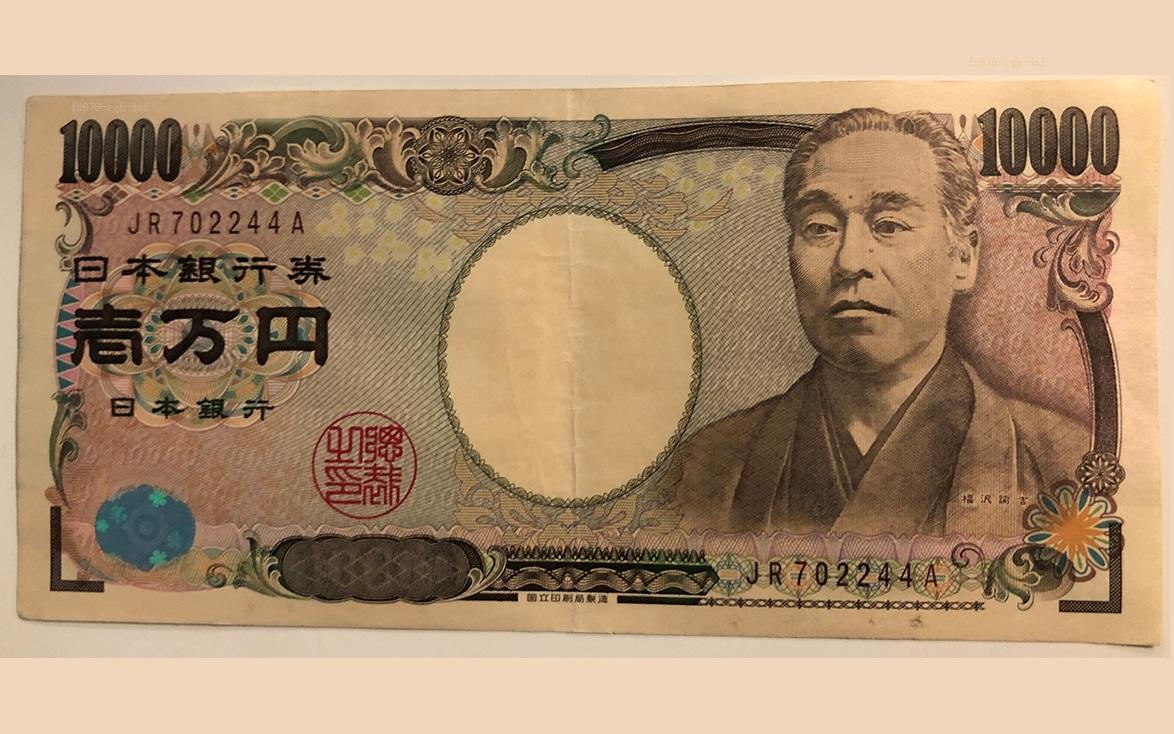
Six weeks after Japanese authorities issued their "final warning" to the foreign exchange market, the key 160.00 level for the USD/JPY pair has been breached without much ripple, and the Japanese authorities' reaction has been relatively muted. Moderate tightening by the Bank of Japan and a steady rise in nominal yields are currently considered sufficient to manage the situation.
From the perspective of the Japanese government, rather than spending a large amount of foreign exchange reserves on intervention, it would be better to allow the yen to fluctuate orderly within a relatively wide range, while simultaneously raising interest rates to narrow the interest rate differential with the United States and gradually alleviate depreciation pressure.
However, this assessment could change if the Fed's interest rate outlook is repriced—even a slightly hawkish Fed meeting outcome could offset the effects of the Bank of Japan's tightening policy. While market expectations for a Fed rate hike this year have somewhat subsided, they haven't completely disappeared. If next week's Fed meeting releases any hawkish signals, the dollar will gain new upward momentum, and USD/JPY could quickly challenge 162 or even higher.
At that point, Japanese authorities may be forced to shift from verbal warnings to substantive intervention; otherwise, depreciation expectations will become even more self-reinforcing. Therefore, the tone of the Federal Reserve's meeting next week will be a key variable in the short-term trend of the yen.
Meanwhile, data from Bank of New York Mellon shows that cross-border investor asset flows are continuing to deteriorate. Around mid-May, Japanese government bonds, the yen, and cash equivalents all recorded net selling for the first time this year, a "triple whammy" reflecting a rapidly cooling interest from overseas funds in Japanese assets. Looking at fund flows, foreign investors not only sold off Japanese bonds but also reduced their yen cash positions, indicating a lack of market confidence in the returns on assets in Japan's low-interest-rate environment.
Against the backdrop of widespread currency pressures facing Asian energy-importing countries, this trend is clearly not a reassuring sign for Japanese authorities attempting to stabilize the yen. While a weaker yen benefits export competitiveness, continued weakness will push up energy import costs, further worsening the trade balance. Furthermore, the continued outflow of cross-border funds means that Japanese authorities will face greater difficulties in intervening in the foreign exchange market—their actions of selling dollars and buying yen will be partially offset by outflowing domestic funds, weakening the intervention's effectiveness. If the capital outflow trend is not curbed, the Japanese authorities' efforts to stabilize the yen may be far less effective.
The absence of Bank of Japan Governor Kazuo Ueda from the upcoming meeting has further increased uncertainty surrounding the policy outcome. This marks Ueda's first absence from a policy meeting since taking office, fueling market speculation about his control over the meeting and the decision-making process.
However, analysts generally believe that this will not substantially change the policy direction. The Bank of Japan's policy framework and decision-making mechanism are relatively mature, and the deputy governor and relevant committee members can still proceed with discussions according to the established route. Ueda's absence is more of a procedural event than a signal of a policy shift.
It's worth noting that current market positioning appears to be preparing for a dovish surprise. Looking at the positioning structure in the interest rate futures and options markets, speculative short positions have increased recently, with some investors betting that the Bank of Japan might release a more dovish signal than expected.
Reports have indicated that the Bank of Japan may decide to end its tapering of purchases of Japanese government bonds, meaning that the previous plan to gradually reduce the scale of bond purchases will be suspended or even reversed. If this report is true, the Bank of Japan will expand its balance sheet again, injecting more liquidity into the market.
From a policy perspective, this move alone is sufficient to offset the tightening effect of any interest rate hike—interest rate hikes push up the yen, while quantitative easing suppresses it. With these two factors offsetting each other, it will be difficult for the yen to gain sustained upward momentum.
The Bank of Japan and the Ministry of Finance are clearly concerned about the potential for disorderly fluctuations in the government bond market and the risk of entrenched inflation expectations. The Japanese government bond market has long relied on strong intervention from the central bank to maintain stability. If monetary policy normalization proceeds too quickly, it could trigger a surge in yields, resulting in huge unrealized losses for financial institutions' holdings. At the same time, if inflation expectations become deeply ingrained in the minds of residents and businesses, it will increase the difficulty of subsequent governance, forcing the central bank to take more aggressive tightening measures.
However, authorities are far from convinced that a strong currency is an "asset" in dealing with such volatility—at least not in the context of supply shocks that are damaging Japan's balance of payments. The primary driver of the current yen depreciation is the worsening terms of trade due to soaring energy import costs, rather than a weakening of Japan's economic fundamentals. In this situation, forcibly pushing up the yen will not only fail to solve the supply-side problems but will also further compress corporate export profits and weaken the competitiveness of Japanese manufacturing.
Japanese authorities prefer to support economic recovery by maintaining loose monetary policy while tolerating the yen's fluctuations within a weaker range. Therefore, even when faced with a breach of the 160 level, the government opted for a restrained response rather than large-scale intervention. This stance indicates that the yen is unlikely to receive strong policy support in the short term.
Therefore, "taking a step forward in interest rates while retreating half a step in balance sheet operations" remains the Bank of Japan's preferred path. The core logic of this strategy is to send a signal of policy normalization to the market through small interest rate hikes, while simultaneously maintaining or even expanding bond purchases to curb the rapid rise in long-term interest rates, thereby protecting the value of bond assets held by financial institutions. This compromise between "raising interest rates and shrinking the balance sheet" reflects the Bank of Japan's difficult balance between inflationary pressures and debt risks.
However, such a policy mix is unlikely to leave much room for the yen to strengthen, especially given that intervention measures will be used cautiously. On the one hand, the narrowing effect of a small interest rate hike on the interest rate differential is limited and insufficient to reverse the huge yield gap between the US and Japan; on the other hand, continued balance sheet expansion means that the yen supply is still increasing, which fundamentally suppresses the upward momentum of the exchange rate.
As for foreign exchange intervention, the Japanese authorities clearly regard it as a "ballast" rather than a "conventional weapon." Large-scale interventions not only deplete precious foreign exchange reserves, but their effects often only last for a few weeks.
Against the backdrop of continued cross-border capital outflows and waning market interest in yen assets, the Bank of Japan is more inclined to address depreciation pressures through verbal warnings and gradual policy adjustments, rather than resorting to its scarce intervention tools. Therefore, the yen is unlikely to gain sustained upward momentum in the short term.
The USD/JPY pair is in an overall uptrend on the daily chart, currently trading around 160.15, approaching the previous high of 160.59. The moving average system shows a typical bullish alignment: the price is trading above the 20-day, 50-day, 100-day, and 200-day moving averages, with the medium- and long-term moving averages diverging upwards, indicating a clear bullish trend.
The MACD indicator shows that the DIFF (0.445) has crossed below the DEA (0.658), and the histogram is green (-0.426), indicating that the short-term upward momentum has weakened and there may be a need for a pullback. The RSI is 49.85, which is in the neutral range and there is no overbought signal, indicating that the bullish trend has not been overexerted and may continue.
Support levels to watch are 158.96 and the previous low of 155.03, while resistance is around 160.59. A breakout above the previous high with significant volume would open up further upside potential; however, a pullback after encountering resistance could lead to a correction towards the 20-day moving average (MA20) at 156.03.
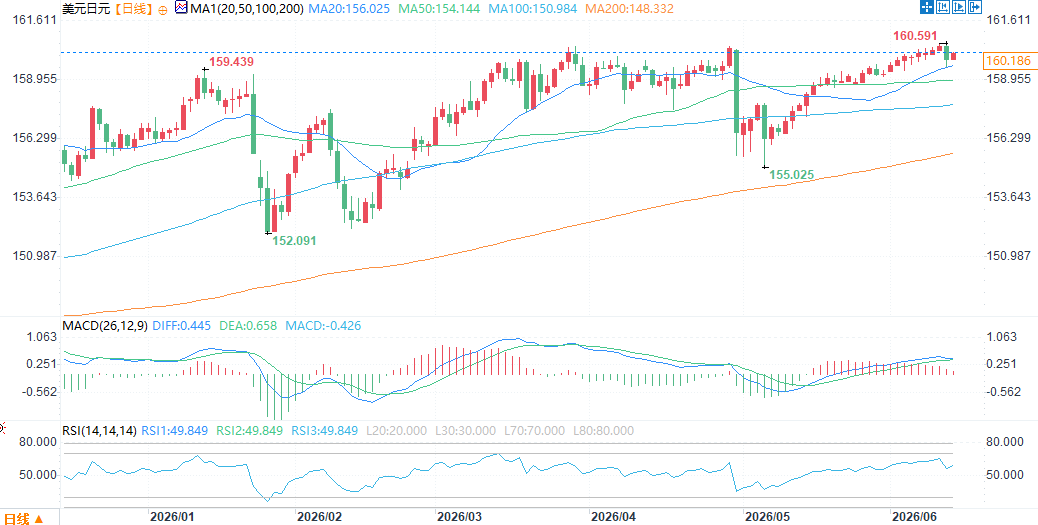
(USD/JPY daily chart, source: FX678)
At 8:53 AM Beijing time on June 12, the USD/JPY exchange rate was 160.17/18.
Geoff Yu, an analyst at BNY Mellon, pointed out that the dollar has broken through the 160.00 mark against the yen, while the Japanese authorities' response has been relatively muted.
Meanwhile, the momentum of cross-border capital inflows into Japanese assets continued to weaken. Although policymakers expressed concerns about disorderly volatility in the bond market and entrenched inflation expectations, they still believed that the benefits of a stronger yen were limited.
This means that even if the Bank of Japan further tightens its monetary policy, the appreciation potential of the yen will still be constrained.
The authorities' reaction to the breakout above the 160 mark was muted; the Federal Reserve is the key variable.
Six weeks after Japanese authorities issued their "final warning" to the foreign exchange market, the key 160.00 level for the USD/JPY pair has been breached without much ripple, and the Japanese authorities' reaction has been relatively muted. Moderate tightening by the Bank of Japan and a steady rise in nominal yields are currently considered sufficient to manage the situation.
From the perspective of the Japanese government, rather than spending a large amount of foreign exchange reserves on intervention, it would be better to allow the yen to fluctuate orderly within a relatively wide range, while simultaneously raising interest rates to narrow the interest rate differential with the United States and gradually alleviate depreciation pressure.
However, this assessment could change if the Fed's interest rate outlook is repriced—even a slightly hawkish Fed meeting outcome could offset the effects of the Bank of Japan's tightening policy. While market expectations for a Fed rate hike this year have somewhat subsided, they haven't completely disappeared. If next week's Fed meeting releases any hawkish signals, the dollar will gain new upward momentum, and USD/JPY could quickly challenge 162 or even higher.
At that point, Japanese authorities may be forced to shift from verbal warnings to substantive intervention; otherwise, depreciation expectations will become even more self-reinforcing. Therefore, the tone of the Federal Reserve's meeting next week will be a key variable in the short-term trend of the yen.
Cross-border capital flows continue to deteriorate, posing a challenge to stabilizing the yen.
Meanwhile, data from Bank of New York Mellon shows that cross-border investor asset flows are continuing to deteriorate. Around mid-May, Japanese government bonds, the yen, and cash equivalents all recorded net selling for the first time this year, a "triple whammy" reflecting a rapidly cooling interest from overseas funds in Japanese assets. Looking at fund flows, foreign investors not only sold off Japanese bonds but also reduced their yen cash positions, indicating a lack of market confidence in the returns on assets in Japan's low-interest-rate environment.
Against the backdrop of widespread currency pressures facing Asian energy-importing countries, this trend is clearly not a reassuring sign for Japanese authorities attempting to stabilize the yen. While a weaker yen benefits export competitiveness, continued weakness will push up energy import costs, further worsening the trade balance. Furthermore, the continued outflow of cross-border funds means that Japanese authorities will face greater difficulties in intervening in the foreign exchange market—their actions of selling dollars and buying yen will be partially offset by outflowing domestic funds, weakening the intervention's effectiveness. If the capital outflow trend is not curbed, the Japanese authorities' efforts to stabilize the yen may be far less effective.
Ueda's absence from the meeting increased uncertainty, and the market bet on a dovish surprise.
The absence of Bank of Japan Governor Kazuo Ueda from the upcoming meeting has further increased uncertainty surrounding the policy outcome. This marks Ueda's first absence from a policy meeting since taking office, fueling market speculation about his control over the meeting and the decision-making process.
However, analysts generally believe that this will not substantially change the policy direction. The Bank of Japan's policy framework and decision-making mechanism are relatively mature, and the deputy governor and relevant committee members can still proceed with discussions according to the established route. Ueda's absence is more of a procedural event than a signal of a policy shift.
It's worth noting that current market positioning appears to be preparing for a dovish surprise. Looking at the positioning structure in the interest rate futures and options markets, speculative short positions have increased recently, with some investors betting that the Bank of Japan might release a more dovish signal than expected.
Reports have indicated that the Bank of Japan may decide to end its tapering of purchases of Japanese government bonds, meaning that the previous plan to gradually reduce the scale of bond purchases will be suspended or even reversed. If this report is true, the Bank of Japan will expand its balance sheet again, injecting more liquidity into the market.
From a policy perspective, this move alone is sufficient to offset the tightening effect of any interest rate hike—interest rate hikes push up the yen, while quantitative easing suppresses it. With these two factors offsetting each other, it will be difficult for the yen to gain sustained upward momentum.
Authorities are concerned about risks in the bond market, but a strong yen is not considered an "asset".
The Bank of Japan and the Ministry of Finance are clearly concerned about the potential for disorderly fluctuations in the government bond market and the risk of entrenched inflation expectations. The Japanese government bond market has long relied on strong intervention from the central bank to maintain stability. If monetary policy normalization proceeds too quickly, it could trigger a surge in yields, resulting in huge unrealized losses for financial institutions' holdings. At the same time, if inflation expectations become deeply ingrained in the minds of residents and businesses, it will increase the difficulty of subsequent governance, forcing the central bank to take more aggressive tightening measures.
However, authorities are far from convinced that a strong currency is an "asset" in dealing with such volatility—at least not in the context of supply shocks that are damaging Japan's balance of payments. The primary driver of the current yen depreciation is the worsening terms of trade due to soaring energy import costs, rather than a weakening of Japan's economic fundamentals. In this situation, forcibly pushing up the yen will not only fail to solve the supply-side problems but will also further compress corporate export profits and weaken the competitiveness of Japanese manufacturing.
Japanese authorities prefer to support economic recovery by maintaining loose monetary policy while tolerating the yen's fluctuations within a weaker range. Therefore, even when faced with a breach of the 160 level, the government opted for a restrained response rather than large-scale intervention. This stance indicates that the yen is unlikely to receive strong policy support in the short term.
Policy path: Interest rates to "further increase," balance sheet reduction to "take a half-step back."
Therefore, "taking a step forward in interest rates while retreating half a step in balance sheet operations" remains the Bank of Japan's preferred path. The core logic of this strategy is to send a signal of policy normalization to the market through small interest rate hikes, while simultaneously maintaining or even expanding bond purchases to curb the rapid rise in long-term interest rates, thereby protecting the value of bond assets held by financial institutions. This compromise between "raising interest rates and shrinking the balance sheet" reflects the Bank of Japan's difficult balance between inflationary pressures and debt risks.
However, such a policy mix is unlikely to leave much room for the yen to strengthen, especially given that intervention measures will be used cautiously. On the one hand, the narrowing effect of a small interest rate hike on the interest rate differential is limited and insufficient to reverse the huge yield gap between the US and Japan; on the other hand, continued balance sheet expansion means that the yen supply is still increasing, which fundamentally suppresses the upward momentum of the exchange rate.
As for foreign exchange intervention, the Japanese authorities clearly regard it as a "ballast" rather than a "conventional weapon." Large-scale interventions not only deplete precious foreign exchange reserves, but their effects often only last for a few weeks.
Against the backdrop of continued cross-border capital outflows and waning market interest in yen assets, the Bank of Japan is more inclined to address depreciation pressures through verbal warnings and gradual policy adjustments, rather than resorting to its scarce intervention tools. Therefore, the yen is unlikely to gain sustained upward momentum in the short term.
Technical Analysis
The USD/JPY pair is in an overall uptrend on the daily chart, currently trading around 160.15, approaching the previous high of 160.59. The moving average system shows a typical bullish alignment: the price is trading above the 20-day, 50-day, 100-day, and 200-day moving averages, with the medium- and long-term moving averages diverging upwards, indicating a clear bullish trend.
The MACD indicator shows that the DIFF (0.445) has crossed below the DEA (0.658), and the histogram is green (-0.426), indicating that the short-term upward momentum has weakened and there may be a need for a pullback. The RSI is 49.85, which is in the neutral range and there is no overbought signal, indicating that the bullish trend has not been overexerted and may continue.
Support levels to watch are 158.96 and the previous low of 155.03, while resistance is around 160.59. A breakout above the previous high with significant volume would open up further upside potential; however, a pullback after encountering resistance could lead to a correction towards the 20-day moving average (MA20) at 156.03.
(USD/JPY daily chart, source: FX678)
At 8:53 AM Beijing time on June 12, the USD/JPY exchange rate was 160.17/18.
- Risk Warning and Disclaimer
- The market involves risk, and trading may not be suitable for all investors. This article is for reference only and does not constitute personal investment advice, nor does it take into account certain users’ specific investment objectives, financial situation, or other needs. Any investment decisions made based on this information are at your own risk.