













There's no need to panic about gold price pullbacks; seasoned scholars say this presents a good opportunity for long-term investment.
2026-06-12 09:37:29
International gold prices have recently been under pressure due to a concentrated sell-off, but have remained above the key long-term support level of $4,000 per ounce.
Industry experts believe that this round of decline is merely a normal technical correction after a significant rise, not the start of a bear market. Even if gold prices briefly break below existing support, the foundation of the medium- to long-term bull market remains unshaken. The current range presents a prime window for investing in gold assets, as multiple macroeconomic factors will continue to provide strong support for gold prices.
Thorsten Polliet, Professor Emeritus of Economics at the University of Bayreuth and author of the "Boom and Recession Report," expressed his views in an interview, stating that even if gold prices continue to decline, the long-term upward trend in gold prices will not change. This recent pullback from its highs has caused concern among many investors, but considering the price action models, spot gold prices had already deviated significantly from the normal trend line when they reached nearly $5,600 per ounce, making a price correction quite reasonable.
Judging from the overall market environment, the downside potential of this round of adjustment is relatively limited. Pollitt stated that the global economy currently faces numerous challenges, including negative real interest rates, persistently high money supply, and continuously expanding government debt in various countries. These factors collectively define the long-term trading range for gold and determine that a deep decline in gold prices is unlikely.
After clearly identifying the trend, Pollitz also revealed his investment plan.
He stated that he is currently planning to increase his gold holdings and is choosing between physical gold and gold trading products at this stage. He believes that the current price level will not affect his determination to enter the market. In his view, focusing on capturing absolute lows is not very meaningful; for assets with long-term positive prospects, early positioning is far more important than precisely buying at the bottom.
He said that from a long-term perspective of five years or more, the current gold price is very attractive. Even if there is a slight decline in the short term, it will not change the long-term return expectations. He is very optimistic about the price performance of gold in a few years.
The core factor supporting the bullish trend in gold prices is the increasingly fragile global monetary and fiscal system.
Pollitz argues that the market has generally underestimated the impact of the "fiscal-led" phenomenon, and that central bank monetary policies will be constrained by government financing needs. With high debt levels in developed economies, policymakers are finding it difficult to maintain high real interest rates in the long term, resulting in persistently negative real returns for bonds and even some stocks. Meanwhile, gold, as a non-interest-bearing asset, will continue to demonstrate its advantages.
The recent rise in US Treasury yields has increased the opportunity cost of holding gold, putting downward pressure on gold prices in the short term. However, this impact is only temporary. The market will eventually realize that sustained and significant interest rate hikes will severely damage economic growth, exacerbate debt risks, and make it impossible to sustain tightening policies in the long run. Furthermore, current inflation is mainly driven by rising energy prices, constituting cost-push inflation, which cannot be addressed at its root by raising interest rates. Blindly tightening monetary policy will only lead highly indebted economies into recession, further amplifying gold's safe-haven and value-preserving attributes.
In summary, this round of correction in gold prices is merely a temporary fluctuation within a bull market. Although market hotspots shift and funds occasionally flow to other sectors, global investors' overall allocation to gold remains relatively low. Torsten Politt stated that the logic supporting gold's rise is now more solid than before, and in a complex macroeconomic environment, allocating to gold remains a sound long-term choice.
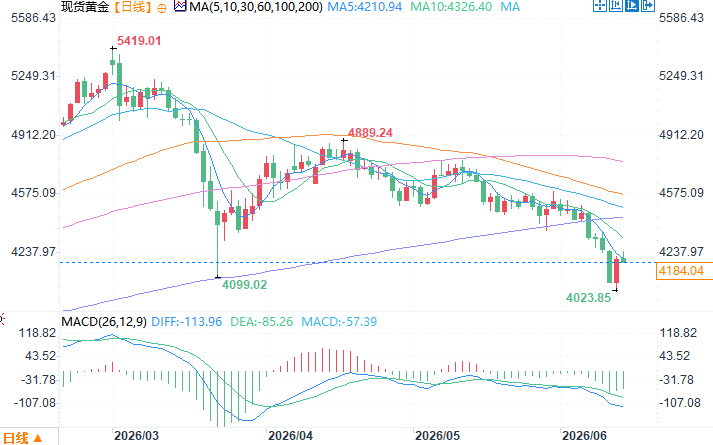
Spot gold daily chart source: EasyForex
At 9:37 AM Beijing time on June 12, spot gold was trading at $4172.04 per ounce.
Industry experts believe that this round of decline is merely a normal technical correction after a significant rise, not the start of a bear market. Even if gold prices briefly break below existing support, the foundation of the medium- to long-term bull market remains unshaken. The current range presents a prime window for investing in gold assets, as multiple macroeconomic factors will continue to provide strong support for gold prices.
The market is experiencing a normal correction, and the downside potential is limited.
Thorsten Polliet, Professor Emeritus of Economics at the University of Bayreuth and author of the "Boom and Recession Report," expressed his views in an interview, stating that even if gold prices continue to decline, the long-term upward trend in gold prices will not change. This recent pullback from its highs has caused concern among many investors, but considering the price action models, spot gold prices had already deviated significantly from the normal trend line when they reached nearly $5,600 per ounce, making a price correction quite reasonable.
Judging from the overall market environment, the downside potential of this round of adjustment is relatively limited. Pollitt stated that the global economy currently faces numerous challenges, including negative real interest rates, persistently high money supply, and continuously expanding government debt in various countries. These factors collectively define the long-term trading range for gold and determine that a deep decline in gold prices is unlikely.
Long-term investment value is becoming increasingly apparent; experts plan to increase holdings on dips.
After clearly identifying the trend, Pollitz also revealed his investment plan.
He stated that he is currently planning to increase his gold holdings and is choosing between physical gold and gold trading products at this stage. He believes that the current price level will not affect his determination to enter the market. In his view, focusing on capturing absolute lows is not very meaningful; for assets with long-term positive prospects, early positioning is far more important than precisely buying at the bottom.
He said that from a long-term perspective of five years or more, the current gold price is very attractive. Even if there is a slight decline in the short term, it will not change the long-term return expectations. He is very optimistic about the price performance of gold in a few years.
With a solid macroeconomic foundation, multiple factors support the rise in gold prices.
The core factor supporting the bullish trend in gold prices is the increasingly fragile global monetary and fiscal system.
Pollitz argues that the market has generally underestimated the impact of the "fiscal-led" phenomenon, and that central bank monetary policies will be constrained by government financing needs. With high debt levels in developed economies, policymakers are finding it difficult to maintain high real interest rates in the long term, resulting in persistently negative real returns for bonds and even some stocks. Meanwhile, gold, as a non-interest-bearing asset, will continue to demonstrate its advantages.
The recent rise in US Treasury yields has increased the opportunity cost of holding gold, putting downward pressure on gold prices in the short term. However, this impact is only temporary. The market will eventually realize that sustained and significant interest rate hikes will severely damage economic growth, exacerbate debt risks, and make it impossible to sustain tightening policies in the long run. Furthermore, current inflation is mainly driven by rising energy prices, constituting cost-push inflation, which cannot be addressed at its root by raising interest rates. Blindly tightening monetary policy will only lead highly indebted economies into recession, further amplifying gold's safe-haven and value-preserving attributes.
Summarize
In summary, this round of correction in gold prices is merely a temporary fluctuation within a bull market. Although market hotspots shift and funds occasionally flow to other sectors, global investors' overall allocation to gold remains relatively low. Torsten Politt stated that the logic supporting gold's rise is now more solid than before, and in a complex macroeconomic environment, allocating to gold remains a sound long-term choice.
Spot gold daily chart source: EasyForex
At 9:37 AM Beijing time on June 12, spot gold was trading at $4172.04 per ounce.
- Risk Warning and Disclaimer
- The market involves risk, and trading may not be suitable for all investors. This article is for reference only and does not constitute personal investment advice, nor does it take into account certain users’ specific investment objectives, financial situation, or other needs. Any investment decisions made based on this information are at your own risk.

