













Gold has rebounded after a sharp drop; be wary of another pullback.
2026-06-12 10:02:08
International gold prices saw a technical rebound after a period of continuous selling, as market risk aversion shifted with signs of easing tensions in the Middle East. Spot gold (XAU/USD) rose to around $4240 during Asian trading on Friday before falling back, after hitting a near six-month low. Some short sellers took profits, and a weaker dollar and US Treasury yields provided short-term support for gold prices.

US President Trump said on Thursday that planned military action against Iran had been canceled and that negotiations with Tehran had been submitted to and approved by Iran's top leadership. This news boosted market expectations that the US and Iran might be close to reaching a ceasefire agreement. However, Iran subsequently stated that no final agreement had been reached, meaning that uncertainty in the Middle East remains, and gold, as a traditional safe-haven asset, continues to receive some support.
As market optimism grew regarding a diplomatic solution to the conflict, investor risk appetite improved, leading to a decline in US Treasury yields and the US dollar index. Since gold is priced in US dollars, a weaker dollar reduces the cost of purchasing gold for holders of other currencies, thereby boosting demand. Market analysts believe that the previous sharp decline in gold prices has pushed technical indicators into oversold territory, and the short-term rebound could represent a bottoming out or simply a correction driven by short covering.
However, gold still faces significant pressure in the future. Recent high international oil prices and rising energy costs could further increase global inflationary pressures, reinforcing market expectations that major central banks will maintain high interest rate policies. Since gold itself does not generate interest income, the opportunity cost of holding gold increases in a high-interest-rate environment, which may limit the extent of any further rebound in gold prices.
Market focus has shifted to next week's Federal Reserve interest rate meeting, which will be the first policy meeting chaired by new Fed Chairman Kevin Warsh. The market widely expects the Fed to maintain current interest rates, but with inflation risks not yet fully subsided, the path of interest rates remains highly uncertain. According to the CME FedWatch tool, investors currently expect a 67% probability of a Fed rate hike in December, an expectation that continues to exert medium- to long-term pressure on gold, a non-yielding asset.
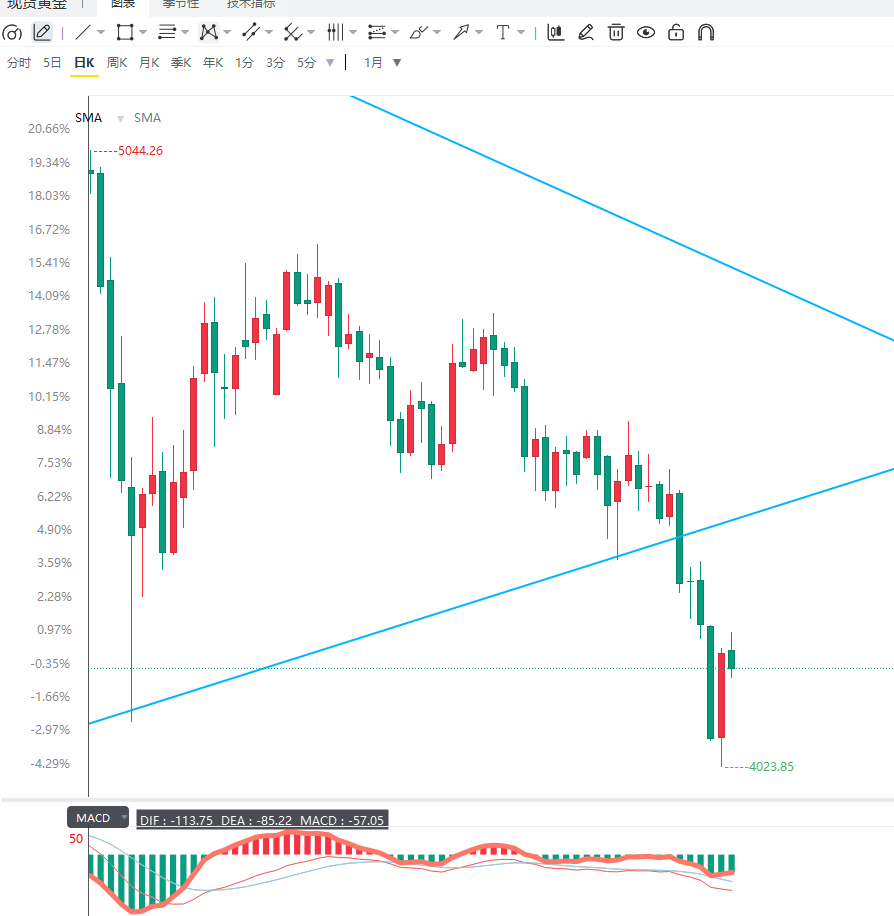
From a daily chart perspective, gold found support near $4100 after a continuous decline and began a corrective rebound from a six-month low. Currently, the price is still trading below major moving averages, indicating that the medium-term downtrend remains intact. While market momentum has improved, the strength of the rebound still needs further confirmation. In the short term, the first resistance level to watch is the $4260-$4300 area. A decisive break above this area could lead to a further rebound towards $4350. On the downside, support levels to watch are $4150 and $4100. A break below $4100 could see bears retest lower levels.
From a 4-hour chart perspective, gold has formed a short-term low-level rebound structure, with technical indicators gradually recovering from oversold territory, indicating that selling pressure has eased. However, the price is still within the previous downward channel, suggesting that a reversal signal has not yet fully formed. If the bulls can continue to hold above $4200, the short-term recovery may continue; if the rebound is blocked and falls back below $4150, it may reopen downside potential. The market still needs to pay attention to the dollar's performance, changes in US Treasury yields, and the latest developments in the Middle East.
Editor's Summary : Gold's recent price movements have been influenced by multiple factors, including easing geopolitical tensions, dollar volatility, and expectations regarding monetary policy. Trump's cancellation of the military action plan restored market risk appetite, pushing gold prices back from recent lows. However, the continued inflationary risks from high oil prices and the possibility of the Federal Reserve maintaining high interest rates or even further tightening policies have limited gold's upside potential. In the short term, gold may maintain a low-level consolidation and correction trend. Investors need to pay close attention to the progress of Middle East negotiations, the outcome of the Federal Reserve meeting, and changes in US inflation expectations to determine whether gold prices can break free from the current correction trend.
US President Trump said on Thursday that planned military action against Iran had been canceled and that negotiations with Tehran had been submitted to and approved by Iran's top leadership. This news boosted market expectations that the US and Iran might be close to reaching a ceasefire agreement. However, Iran subsequently stated that no final agreement had been reached, meaning that uncertainty in the Middle East remains, and gold, as a traditional safe-haven asset, continues to receive some support.
As market optimism grew regarding a diplomatic solution to the conflict, investor risk appetite improved, leading to a decline in US Treasury yields and the US dollar index. Since gold is priced in US dollars, a weaker dollar reduces the cost of purchasing gold for holders of other currencies, thereby boosting demand. Market analysts believe that the previous sharp decline in gold prices has pushed technical indicators into oversold territory, and the short-term rebound could represent a bottoming out or simply a correction driven by short covering.
However, gold still faces significant pressure in the future. Recent high international oil prices and rising energy costs could further increase global inflationary pressures, reinforcing market expectations that major central banks will maintain high interest rate policies. Since gold itself does not generate interest income, the opportunity cost of holding gold increases in a high-interest-rate environment, which may limit the extent of any further rebound in gold prices.
Market focus has shifted to next week's Federal Reserve interest rate meeting, which will be the first policy meeting chaired by new Fed Chairman Kevin Warsh. The market widely expects the Fed to maintain current interest rates, but with inflation risks not yet fully subsided, the path of interest rates remains highly uncertain. According to the CME FedWatch tool, investors currently expect a 67% probability of a Fed rate hike in December, an expectation that continues to exert medium- to long-term pressure on gold, a non-yielding asset.
From a daily chart perspective, gold found support near $4100 after a continuous decline and began a corrective rebound from a six-month low. Currently, the price is still trading below major moving averages, indicating that the medium-term downtrend remains intact. While market momentum has improved, the strength of the rebound still needs further confirmation. In the short term, the first resistance level to watch is the $4260-$4300 area. A decisive break above this area could lead to a further rebound towards $4350. On the downside, support levels to watch are $4150 and $4100. A break below $4100 could see bears retest lower levels.
From a 4-hour chart perspective, gold has formed a short-term low-level rebound structure, with technical indicators gradually recovering from oversold territory, indicating that selling pressure has eased. However, the price is still within the previous downward channel, suggesting that a reversal signal has not yet fully formed. If the bulls can continue to hold above $4200, the short-term recovery may continue; if the rebound is blocked and falls back below $4150, it may reopen downside potential. The market still needs to pay attention to the dollar's performance, changes in US Treasury yields, and the latest developments in the Middle East.
Editor's Summary : Gold's recent price movements have been influenced by multiple factors, including easing geopolitical tensions, dollar volatility, and expectations regarding monetary policy. Trump's cancellation of the military action plan restored market risk appetite, pushing gold prices back from recent lows. However, the continued inflationary risks from high oil prices and the possibility of the Federal Reserve maintaining high interest rates or even further tightening policies have limited gold's upside potential. In the short term, gold may maintain a low-level consolidation and correction trend. Investors need to pay close attention to the progress of Middle East negotiations, the outcome of the Federal Reserve meeting, and changes in US inflation expectations to determine whether gold prices can break free from the current correction trend.
- Risk Warning and Disclaimer
- The market involves risk, and trading may not be suitable for all investors. This article is for reference only and does not constitute personal investment advice, nor does it take into account certain users’ specific investment objectives, financial situation, or other needs. Any investment decisions made based on this information are at your own risk.

