













Crude oil trading alert: Expectations of a US-Iran peace agreement have dampened supply risk premiums, causing oil prices to break below support again. Be wary of a potential acceleration in the downward trend.
2026-06-12 09:23:15
International crude oil markets continued their weak consolidation in Asian trading on Friday, with WTI crude oil prices trading around $86.70 per barrel. The previous trading day saw oil prices fall by more than 5.5%, mainly due to positive signals from US President Trump suggesting a possible peace agreement between the US and Iran in the near future, which quickly reduced market concerns about a long-term impact on energy supplies in the Middle East.

Trump stated that the US and Iran could reach a peace agreement as early as this weekend, and revealed that previously planned military strikes have been postponed. According to his description, the future agreement could not only restore stable navigation in the Strait of Hormuz, but would also include a commitment from Iran to abandon its nuclear weapons program. As one of the world's most important energy transport routes, the Strait of Hormuz handles approximately 20% of global seaborne crude oil shipments; therefore, any sign of easing tensions would quickly diminish the geopolitical risk premium in the oil market.
Signals from Iran have further strengthened market expectations for the agreement to be implemented. Iran's Fars News Agency reported that Tehran is highly likely to approve the agreement, given that the United States has accepted its proposed terms. However, the market remains cautious, as the final text of the agreement has not yet been formally confirmed by both sides, meaning that the situation in the Middle East remains subject to change.
Furthermore, even if a peace agreement is ultimately reached, it will still take time for global energy supplies to return to normal levels. Market analysts believe that the restoration of shipping safety in the Strait of Hormuz still requires a thorough risk assessment of the area, including clearing potential maritime obstacles, restoring operations at affected oil and gas facilities, and repairing infrastructure damage caused by previous drone and missile attacks. Therefore, the global energy logistics system may still face periodic disruptions in the short term.
It is worth noting that there are still discrepancies in reports regarding the current security situation in the Strait of Hormuz. The US military states that commercial vessels can still pass safely through the strait and denies any claims that US warships have been attacked; while Iranian state media claims that US ships were attacked by missiles and drones. This information divergence indicates that although expectations of a diplomatic breakthrough are improving market sentiment, shipping risks have not completely disappeared.
Shipping data shows that some energy transport activities are gradually recovering. Data indicates that three LNG carriers have departed the Strait of Hormuz for Asia with their transponders switched off. However, maritime accidents continue to occur. Indian authorities reported an accident near the port of Shinas in Oman on Thursday, the third such incident this week. Indian refineries, however, stated that they have secured sufficient crude oil supplies to meet operational needs for at least the next few months, which has somewhat alleviated market concerns about short-term supply shortages.
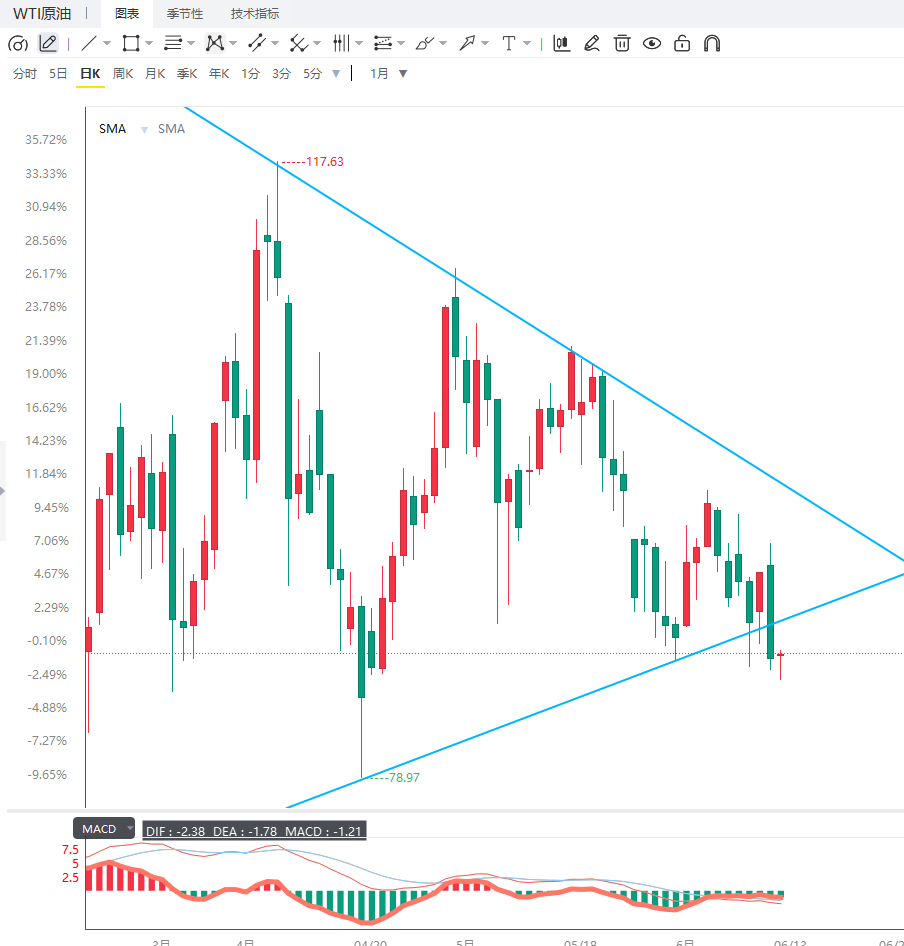
From a daily chart perspective, WTI crude oil experienced a rapid pullback after its significant rally driven by escalating tensions in the Middle East. Prices broke below key uptrend support, indicating a renewed shift in market dominance to the bears in the short term. Currently, prices are finding support around the $85 area, but the overall trend remains weak. If the bears continue to exert pressure, key support levels to watch are $83 and the psychological level of $80. A break below $80 could lead to further testing of the area near the April lows. On the upside, the initial resistance level to watch is the $88-$89 area. A sustained recovery above this range would allow for a more significant technical correction.
From a 4-hour chart perspective, although there is a short-term need for stabilization after the continuous sharp decline in oil prices, the overall price is still trading below the resistance of major moving averages, and the short-term downtrend has not fundamentally changed. Technical indicators show that market momentum remains bearish, and any rebound may encounter profit-taking and new selling pressure. If WTI fails to effectively break through the resistance above $88, oil prices still face the risk of further declines to $83 or even $80. If new uncertainties arise in the geopolitical situation, or if supply recovery is slower than market expectations, oil prices may retest the $90 mark.
Editor's Summary : The anticipated US-Iran peace agreement is currently the most crucial factor influencing the crude oil market, with the rapid fading of geopolitical risk premiums causing WTI to fall significantly from its previous highs. However, the final signing of the agreement, the full restoration of normal shipping in the Strait of Hormuz, and the repair of damaged energy facilities will still take time; therefore, global supply risks have not been completely eliminated. In the short term, oil prices may maintain a weak and volatile pattern. The market will focus on the final outcome of the US-Iran negotiations, shipping conditions in the Strait of Hormuz, and changes in global inventory and demand. These factors will determine whether WTI falls further towards the $80 area or rebounds when supply concerns resurface.
Trump stated that the US and Iran could reach a peace agreement as early as this weekend, and revealed that previously planned military strikes have been postponed. According to his description, the future agreement could not only restore stable navigation in the Strait of Hormuz, but would also include a commitment from Iran to abandon its nuclear weapons program. As one of the world's most important energy transport routes, the Strait of Hormuz handles approximately 20% of global seaborne crude oil shipments; therefore, any sign of easing tensions would quickly diminish the geopolitical risk premium in the oil market.
Signals from Iran have further strengthened market expectations for the agreement to be implemented. Iran's Fars News Agency reported that Tehran is highly likely to approve the agreement, given that the United States has accepted its proposed terms. However, the market remains cautious, as the final text of the agreement has not yet been formally confirmed by both sides, meaning that the situation in the Middle East remains subject to change.
Furthermore, even if a peace agreement is ultimately reached, it will still take time for global energy supplies to return to normal levels. Market analysts believe that the restoration of shipping safety in the Strait of Hormuz still requires a thorough risk assessment of the area, including clearing potential maritime obstacles, restoring operations at affected oil and gas facilities, and repairing infrastructure damage caused by previous drone and missile attacks. Therefore, the global energy logistics system may still face periodic disruptions in the short term.
It is worth noting that there are still discrepancies in reports regarding the current security situation in the Strait of Hormuz. The US military states that commercial vessels can still pass safely through the strait and denies any claims that US warships have been attacked; while Iranian state media claims that US ships were attacked by missiles and drones. This information divergence indicates that although expectations of a diplomatic breakthrough are improving market sentiment, shipping risks have not completely disappeared.
Shipping data shows that some energy transport activities are gradually recovering. Data indicates that three LNG carriers have departed the Strait of Hormuz for Asia with their transponders switched off. However, maritime accidents continue to occur. Indian authorities reported an accident near the port of Shinas in Oman on Thursday, the third such incident this week. Indian refineries, however, stated that they have secured sufficient crude oil supplies to meet operational needs for at least the next few months, which has somewhat alleviated market concerns about short-term supply shortages.
From a daily chart perspective, WTI crude oil experienced a rapid pullback after its significant rally driven by escalating tensions in the Middle East. Prices broke below key uptrend support, indicating a renewed shift in market dominance to the bears in the short term. Currently, prices are finding support around the $85 area, but the overall trend remains weak. If the bears continue to exert pressure, key support levels to watch are $83 and the psychological level of $80. A break below $80 could lead to further testing of the area near the April lows. On the upside, the initial resistance level to watch is the $88-$89 area. A sustained recovery above this range would allow for a more significant technical correction.
From a 4-hour chart perspective, although there is a short-term need for stabilization after the continuous sharp decline in oil prices, the overall price is still trading below the resistance of major moving averages, and the short-term downtrend has not fundamentally changed. Technical indicators show that market momentum remains bearish, and any rebound may encounter profit-taking and new selling pressure. If WTI fails to effectively break through the resistance above $88, oil prices still face the risk of further declines to $83 or even $80. If new uncertainties arise in the geopolitical situation, or if supply recovery is slower than market expectations, oil prices may retest the $90 mark.
Editor's Summary : The anticipated US-Iran peace agreement is currently the most crucial factor influencing the crude oil market, with the rapid fading of geopolitical risk premiums causing WTI to fall significantly from its previous highs. However, the final signing of the agreement, the full restoration of normal shipping in the Strait of Hormuz, and the repair of damaged energy facilities will still take time; therefore, global supply risks have not been completely eliminated. In the short term, oil prices may maintain a weak and volatile pattern. The market will focus on the final outcome of the US-Iran negotiations, shipping conditions in the Strait of Hormuz, and changes in global inventory and demand. These factors will determine whether WTI falls further towards the $80 area or rebounds when supply concerns resurface.
- Risk Warning and Disclaimer
- The market involves risk, and trading may not be suitable for all investors. This article is for reference only and does not constitute personal investment advice, nor does it take into account certain users’ specific investment objectives, financial situation, or other needs. Any investment decisions made based on this information are at your own risk.

