Better-than-expected US PPI strengthens expectations of interest rate hikes; USD/JPY breaks through 160, but intervention risks limit gains.
2026-06-12 10:57:57
The dollar continued its strength against the yen in Asian trading on Friday, rising to around 160.25. The latest US inflation data showed that upstream price pressures remain significant, prompting the market to reassess the Federal Reserve's future monetary policy path. This supported the dollar, while the yen continued to face pressure from the low-interest-rate environment.

Data released by the U.S. Bureau of Labor Statistics showed that the Producer Price Index (PPI) rose 6.5% year-on-year in May, higher than April's 5.7% and exceeding market expectations of 6.4%, reaching its highest level since November 2022. On a month-on-month basis, the PPI rose 1.1% in May, also significantly higher than the market expectation of 0.7%. The strong inflation data indicates that price pressures in the U.S. have not eased significantly, strengthening market expectations that the Federal Reserve will maintain its high-interest-rate policy for an extended period.
Market analysts believe that the main challenge facing the Federal Reserve remains balancing its inflation target with economic growth. As inflation data continues to exceed the target level, voices within the Fed supporting further policy tightening may strengthen, which could keep the dollar relatively strong in the short term and further widen the policy divergence with Japan's low-interest-rate environment.
However, further appreciation of the USD/JPY exchange rate still faces the risk of potential intervention from the Japanese government. With the exchange rate hovering around the key psychological level of 160, the market is closely watching whether the Japanese government will take action to stabilize the yen. Japanese Finance Minister Satsuki Katayama previously stated that the government is closely monitoring speculative trading and is prepared to take decisive measures to address excessive yen depreciation if necessary.
Meanwhile, the Bank of Japan will hold its monetary policy meeting on June 15-16. Due to Bank of Japan Governor Kazuo Ueda's hospitalization, Deputy Governor Ryozo Himino will chair the meeting, marking the first time since 1998 that a Bank of Japan governor has been absent from a policy meeting. The market will focus on the Bank of Japan's latest statements regarding the economy, inflation, and future policy normalization; any hawkish signals could provide support for the yen.
From a daily chart perspective, the USD/JPY pair maintains a strong upward trend, with the price regaining the important psychological level of 160, indicating that bulls still control the market. However, the area above 160 is now a sensitive zone closely watched by the Japanese authorities, significantly increasing the risk of chasing the price higher in the short term. If the exchange rate breaks through the 160.50 area effectively, it may further test 161.00 or even higher. On the downside, the first support levels to watch are 159.50 and 158.80; a break below these levels could trigger a deeper correction.
From a 4-hour chart perspective, the USD/JPY pair is maintaining a high-level upward trend, with short-term moving averages remaining in a bullish alignment, indicating continued strong market momentum. However, the Relative Strength Index (RSI) is approaching overbought territory, suggesting that upward momentum may gradually slow. If the price continues to stabilize above the 160 level, the bulls still have a chance to extend their upward trend; if the Japanese government releases stronger intervention signals, the exchange rate may experience a rapid pullback, with key support around 159.00 to watch.
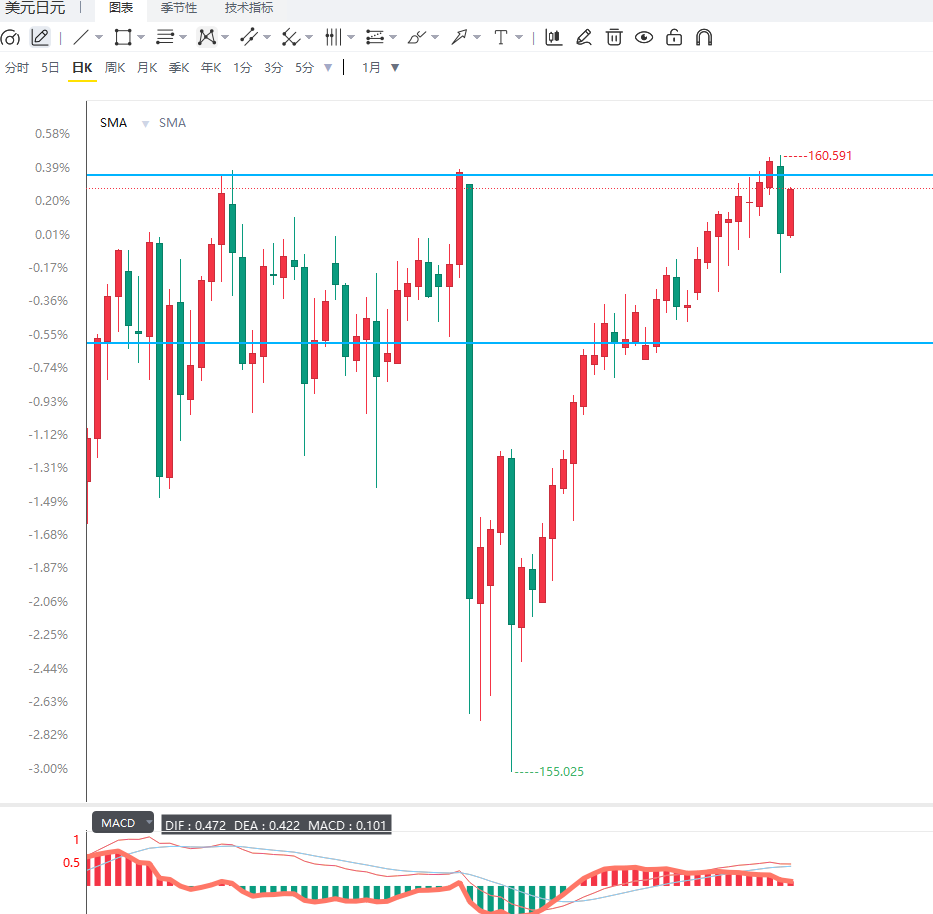
Editor's Summary : The unexpectedly strong US PPI data reinforced market expectations that the Federal Reserve will maintain high interest rates for a longer period, providing fundamental support for the USD/JPY exchange rate. However, as the exchange rate approaches or even breaks through the key level of 160, the risk of Japanese government intervention in the foreign exchange market has increased significantly, creating considerable policy uncertainty for bulls. In the short term, the USD/JPY exchange rate is still biased towards high-level fluctuations with a slight upward bias, but investors need to pay close attention to US consumer confidence data, the results of the Bank of Japan's meeting, and the latest official stance of the Japanese government on exchange rate fluctuations.
Data released by the U.S. Bureau of Labor Statistics showed that the Producer Price Index (PPI) rose 6.5% year-on-year in May, higher than April's 5.7% and exceeding market expectations of 6.4%, reaching its highest level since November 2022. On a month-on-month basis, the PPI rose 1.1% in May, also significantly higher than the market expectation of 0.7%. The strong inflation data indicates that price pressures in the U.S. have not eased significantly, strengthening market expectations that the Federal Reserve will maintain its high-interest-rate policy for an extended period.
Market analysts believe that the main challenge facing the Federal Reserve remains balancing its inflation target with economic growth. As inflation data continues to exceed the target level, voices within the Fed supporting further policy tightening may strengthen, which could keep the dollar relatively strong in the short term and further widen the policy divergence with Japan's low-interest-rate environment.
However, further appreciation of the USD/JPY exchange rate still faces the risk of potential intervention from the Japanese government. With the exchange rate hovering around the key psychological level of 160, the market is closely watching whether the Japanese government will take action to stabilize the yen. Japanese Finance Minister Satsuki Katayama previously stated that the government is closely monitoring speculative trading and is prepared to take decisive measures to address excessive yen depreciation if necessary.
Meanwhile, the Bank of Japan will hold its monetary policy meeting on June 15-16. Due to Bank of Japan Governor Kazuo Ueda's hospitalization, Deputy Governor Ryozo Himino will chair the meeting, marking the first time since 1998 that a Bank of Japan governor has been absent from a policy meeting. The market will focus on the Bank of Japan's latest statements regarding the economy, inflation, and future policy normalization; any hawkish signals could provide support for the yen.
From a daily chart perspective, the USD/JPY pair maintains a strong upward trend, with the price regaining the important psychological level of 160, indicating that bulls still control the market. However, the area above 160 is now a sensitive zone closely watched by the Japanese authorities, significantly increasing the risk of chasing the price higher in the short term. If the exchange rate breaks through the 160.50 area effectively, it may further test 161.00 or even higher. On the downside, the first support levels to watch are 159.50 and 158.80; a break below these levels could trigger a deeper correction.
From a 4-hour chart perspective, the USD/JPY pair is maintaining a high-level upward trend, with short-term moving averages remaining in a bullish alignment, indicating continued strong market momentum. However, the Relative Strength Index (RSI) is approaching overbought territory, suggesting that upward momentum may gradually slow. If the price continues to stabilize above the 160 level, the bulls still have a chance to extend their upward trend; if the Japanese government releases stronger intervention signals, the exchange rate may experience a rapid pullback, with key support around 159.00 to watch.
Editor's Summary : The unexpectedly strong US PPI data reinforced market expectations that the Federal Reserve will maintain high interest rates for a longer period, providing fundamental support for the USD/JPY exchange rate. However, as the exchange rate approaches or even breaks through the key level of 160, the risk of Japanese government intervention in the foreign exchange market has increased significantly, creating considerable policy uncertainty for bulls. In the short term, the USD/JPY exchange rate is still biased towards high-level fluctuations with a slight upward bias, but investors need to pay close attention to US consumer confidence data, the results of the Bank of Japan's meeting, and the latest official stance of the Japanese government on exchange rate fluctuations.
- Risk Warning and Disclaimer
- The market involves risk, and trading may not be suitable for all investors. This article is for reference only and does not constitute personal investment advice, nor does it take into account certain users’ specific investment objectives, financial situation, or other needs. Any investment decisions made based on this information are at your own risk.