Even raising interest rates to 1% couldn't save the yen? USD/JPY holds steady above 160.
2026-06-12 10:56:56
On Friday (June 12) during the Asian session, the US dollar rose against the Japanese yen, currently trading above 160.25.
The Bank of Japan is almost certain to raise interest rates next week, but the dollar/yen exchange rate remains firmly above the 160 mark, indicating that the market remains cautious about the yen's prospects.
The Bank of Japan is expected to raise its policy rate from 0.75% to 1% next week, the highest level since 1995, or 31 years, and may signal a continued push up borrowing costs.
Even though Governor Kazuo Ueda will be absent from the meeting due to medical treatment, the Bank of Japan will remain focused on addressing the inflation risks posed by the Middle East war. This move will align the Bank of Japan with other central banks, such as the European Central Bank, which are shifting towards tighter policies.
Bank President Kazuo Ueda will miss the two-day meeting, which concludes on June 16, as he is currently hospitalized for two weeks due to an infected liver cyst. Most of the remaining eight policymakers had previously warned of rising price pressures.
Investinglive analyst Justin Low said he believes Ueda's absence will not have any impact on the Bank of Japan's interest rate decision, with the market generally expecting the central bank to still raise the policy rate by 25 basis points to 1%.
This rate hike will be the first since last December, and it also symbolizes a shift in the Bank of Japan's policy focus—from cautiously exiting the massive easing measures left by the previous governor to focusing on the traditional role of a central bank in curbing inflation.
With the market having fully priced in the possibility of a rate hike next week, attention is now turning to the timing and pace of future rate increases.
One major challenge for investors is how to interpret the tone of Ueda's previous remarks and Uchida's upcoming post-meeting comments. Vice Governor Uchida will chair the briefing in place of the Governor, and the market will closely watch his wording to determine whether rising inflation will force the central bank to accelerate interest rate hikes.
The Bank of Japan may reiterate its commitment to continue raising interest rates due to energy shocks, rising import costs caused by the depreciation of the yen, and increased inflation risks due to a tight labor market.
Bank of America points out that since the market has already priced in a June rate hike, the true "hawkish" or "dovish" stance will be reflected in future guidance. If the Bank of Japan's signals raise the market's pricing probability of an October rate hike to over 60%, it will be considered hawkish.
If Shinichi Uchida's remarks at the press conference lean towards this path, it could reverse previous expectations of easing and support a stronger yen.
If interest rates rise to 1%, the Bank of Japan's policy rate will be close to the lower end of its projected nominal interest rate range of 1.1%-2.5%, a range considered neutral for the economy—the ideal range that neither stimulates nor inhibits economic growth. Once this level is reached, the central bank will need to be more cautious in its subsequent interest rate decisions, as further increases could dampen economic activity, especially given already weak domestic demand.
According to sources within the Bank of Japan, the central bank currently sees no need to accelerate or continuously raise interest rates, mainly because the impact of the Middle East war on the economy remains unclear, and policymakers want more time to observe the trends in inflation and growth.
However, the Bank of Japan's slow pace of interest rate hikes is also considered a significant reason for the yen's continued weakness. Since its first rate hike last December, the Bank of Japan has only increased rates by a cumulative 25 basis points, while the Federal Reserve and the European Central Bank have maintained policy rates above 5% and 2% respectively, keeping the US-Japan interest rate differential at a historically high level.
The huge interest rate differential makes the yen the preferred funding currency for carry trades—investors borrow low-interest yen and then invest in high-interest currency assets, and continuous selling pressure pushes the dollar/yen exchange rate up to around 160.
The yen is currently hovering around the 160 level against the dollar, which is widely considered by the market to be close to the "limit of tolerance" set by the Japanese Ministry of Finance. While there has been no large-scale official intervention in the foreign exchange market since the end of April, the 160 level is seen as a potential trigger. If the yen depreciates further, Japanese authorities may be forced to intervene in the market to curb the further expansion of imported inflationary pressures.
At next week's meeting, the Bank of Japan will also review its current tapering program, which runs until March next year, and formulate a new plan for fiscal year 2027 and beyond. This is a crucial step in the central bank's exit from its massive easing policy.
Since initiating balance sheet reduction last year, the Bank of Japan has gradually reduced its purchases of long-term government bonds, but the pace of reduction has been relatively cautious.
As the Middle East wars have fueled inflation expectations and caused continued volatility in the bond market, the Bank of Japan is reportedly considering maintaining its current pace of bond purchases and may extend this rhythm into the next fiscal year to stabilize market sentiment.
This means that despite rising interest rates, central banks may slow down or even pause the process of shrinking their balance sheets to avoid the excessive impact of soaring yields on the balance sheets of financial institutions.
Japan's wholesale prices rose 6.3% year-on-year in May, the fastest pace in three years, as businesses continued to pass on the increased energy costs caused by the war to consumers. The continued rise in the producer price index typically translates into higher consumer prices in the coming months.
Analysts say this inflationary pressure could push core consumer inflation well above 2% later this year, at which point central banks may face greater pressure to raise interest rates.
It is worth noting that whether wage growth can keep pace with price increases will be a key factor in determining whether inflation can be sustained.
In summary, a market consensus is that the Bank of Japan will raise interest rates to 1% next week; the focus is now on signals regarding its subsequent policy path. While Deputy Governor Shinichi Uchida is considered a dovish member, given the continued weakening of the yen and rising inflationary pressures, his statements at the press conference may lean towards a hawkish stance to prevent further yen depreciation.
Meanwhile, the central bank is likely to maintain its current pace in tapering its bond purchases to stabilize the volatile bond market. While the slow pace of interest rate hikes is one reason for the yen's weakness, the central bank is clearly more concerned about the economic impact of acting too quickly.
The market will look for clues about the pace of future interest rate hikes in Uchida's remarks, and any hawkish signals could trigger a short-term rebound in the yen.
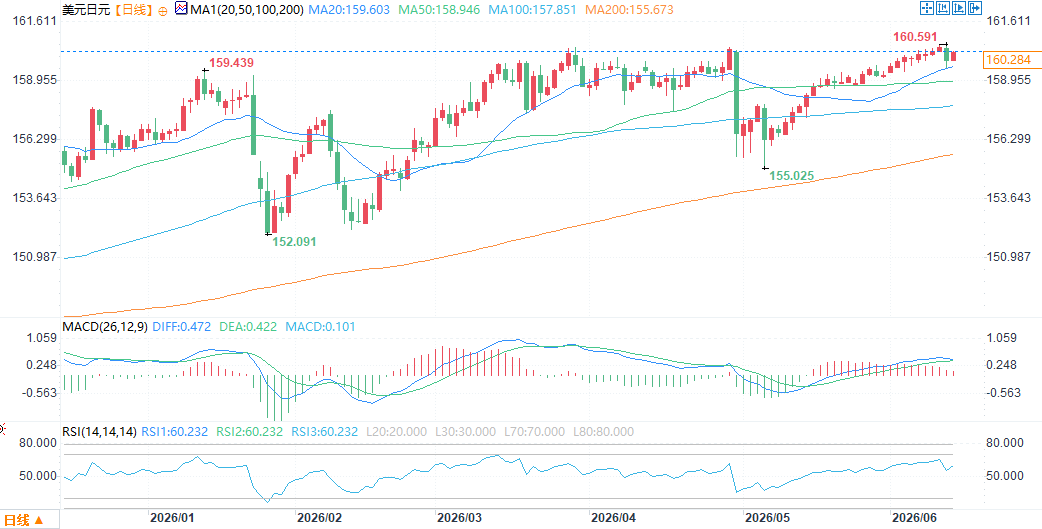
(USD/JPY daily chart, source: FX678)
Technically, the USD/JPY pair is in an overall uptrend on the daily chart, currently trading around 160.25, approaching the previous high of 160.59. Support levels to watch are 158.96 and the previous low of 155.03, while resistance is around 160.59. A breakout above the previous high with significant volume would open up further upside potential; however, a pullback could present a risk of a correction towards the 20-day moving average (MA20) at 156.03.
At 10:56 AM Beijing time on June 12, the USD/JPY exchange rate was 160.28/29.
The Bank of Japan is almost certain to raise interest rates next week, but the dollar/yen exchange rate remains firmly above the 160 mark, indicating that the market remains cautious about the yen's prospects.
The Bank of Japan is expected to raise its policy rate from 0.75% to 1% next week, the highest level since 1995, or 31 years, and may signal a continued push up borrowing costs.
Even though Governor Kazuo Ueda will be absent from the meeting due to medical treatment, the Bank of Japan will remain focused on addressing the inflation risks posed by the Middle East war. This move will align the Bank of Japan with other central banks, such as the European Central Bank, which are shifting towards tighter policies.
Ueda's absence will not affect policy decisions; interest rate hikes will address inflation risks.
Bank President Kazuo Ueda will miss the two-day meeting, which concludes on June 16, as he is currently hospitalized for two weeks due to an infected liver cyst. Most of the remaining eight policymakers had previously warned of rising price pressures.
Investinglive analyst Justin Low said he believes Ueda's absence will not have any impact on the Bank of Japan's interest rate decision, with the market generally expecting the central bank to still raise the policy rate by 25 basis points to 1%.
This rate hike will be the first since last December, and it also symbolizes a shift in the Bank of Japan's policy focus—from cautiously exiting the massive easing measures left by the previous governor to focusing on the traditional role of a central bank in curbing inflation.
Pay attention to Vice President Shinichi Uchida's remarks, as they may signal a hawkish stance.
With the market having fully priced in the possibility of a rate hike next week, attention is now turning to the timing and pace of future rate increases.
One major challenge for investors is how to interpret the tone of Ueda's previous remarks and Uchida's upcoming post-meeting comments. Vice Governor Uchida will chair the briefing in place of the Governor, and the market will closely watch his wording to determine whether rising inflation will force the central bank to accelerate interest rate hikes.
The Bank of Japan may reiterate its commitment to continue raising interest rates due to energy shocks, rising import costs caused by the depreciation of the yen, and increased inflation risks due to a tight labor market.
Bank of America points out that since the market has already priced in a June rate hike, the true "hawkish" or "dovish" stance will be reflected in future guidance. If the Bank of Japan's signals raise the market's pricing probability of an October rate hike to over 60%, it will be considered hawkish.
If Shinichi Uchida's remarks at the press conference lean towards this path, it could reverse previous expectations of easing and support a stronger yen.
Interest rates rose to the lower end of the neutral range, and the slow pace of rate hikes weighed on the yen.
If interest rates rise to 1%, the Bank of Japan's policy rate will be close to the lower end of its projected nominal interest rate range of 1.1%-2.5%, a range considered neutral for the economy—the ideal range that neither stimulates nor inhibits economic growth. Once this level is reached, the central bank will need to be more cautious in its subsequent interest rate decisions, as further increases could dampen economic activity, especially given already weak domestic demand.
According to sources within the Bank of Japan, the central bank currently sees no need to accelerate or continuously raise interest rates, mainly because the impact of the Middle East war on the economy remains unclear, and policymakers want more time to observe the trends in inflation and growth.
However, the Bank of Japan's slow pace of interest rate hikes is also considered a significant reason for the yen's continued weakness. Since its first rate hike last December, the Bank of Japan has only increased rates by a cumulative 25 basis points, while the Federal Reserve and the European Central Bank have maintained policy rates above 5% and 2% respectively, keeping the US-Japan interest rate differential at a historically high level.
The huge interest rate differential makes the yen the preferred funding currency for carry trades—investors borrow low-interest yen and then invest in high-interest currency assets, and continuous selling pressure pushes the dollar/yen exchange rate up to around 160.
The yen is currently hovering around the 160 level against the dollar, which is widely considered by the market to be close to the "limit of tolerance" set by the Japanese Ministry of Finance. While there has been no large-scale official intervention in the foreign exchange market since the end of April, the 160 level is seen as a potential trigger. If the yen depreciates further, Japanese authorities may be forced to intervene in the market to curb the further expansion of imported inflationary pressures.
Attention should be paid to whether the pace of bond purchases will be reduced, or whether the current pace will be maintained to stabilize the bond market.
At next week's meeting, the Bank of Japan will also review its current tapering program, which runs until March next year, and formulate a new plan for fiscal year 2027 and beyond. This is a crucial step in the central bank's exit from its massive easing policy.
Since initiating balance sheet reduction last year, the Bank of Japan has gradually reduced its purchases of long-term government bonds, but the pace of reduction has been relatively cautious.
As the Middle East wars have fueled inflation expectations and caused continued volatility in the bond market, the Bank of Japan is reportedly considering maintaining its current pace of bond purchases and may extend this rhythm into the next fiscal year to stabilize market sentiment.
This means that despite rising interest rates, central banks may slow down or even pause the process of shrinking their balance sheets to avoid the excessive impact of soaring yields on the balance sheets of financial institutions.
Japan's wholesale prices rose 6.3% year-on-year in May, the fastest pace in three years, as businesses continued to pass on the increased energy costs caused by the war to consumers. The continued rise in the producer price index typically translates into higher consumer prices in the coming months.
Analysts say this inflationary pressure could push core consumer inflation well above 2% later this year, at which point central banks may face greater pressure to raise interest rates.
It is worth noting that whether wage growth can keep pace with price increases will be a key factor in determining whether inflation can be sustained.
Conclusion: Interest rate hike is a foregone conclusion; striking a balance between hawks and doves is key.
In summary, a market consensus is that the Bank of Japan will raise interest rates to 1% next week; the focus is now on signals regarding its subsequent policy path. While Deputy Governor Shinichi Uchida is considered a dovish member, given the continued weakening of the yen and rising inflationary pressures, his statements at the press conference may lean towards a hawkish stance to prevent further yen depreciation.
Meanwhile, the central bank is likely to maintain its current pace in tapering its bond purchases to stabilize the volatile bond market. While the slow pace of interest rate hikes is one reason for the yen's weakness, the central bank is clearly more concerned about the economic impact of acting too quickly.
The market will look for clues about the pace of future interest rate hikes in Uchida's remarks, and any hawkish signals could trigger a short-term rebound in the yen.
(USD/JPY daily chart, source: FX678)
Technically, the USD/JPY pair is in an overall uptrend on the daily chart, currently trading around 160.25, approaching the previous high of 160.59. Support levels to watch are 158.96 and the previous low of 155.03, while resistance is around 160.59. A breakout above the previous high with significant volume would open up further upside potential; however, a pullback could present a risk of a correction towards the 20-day moving average (MA20) at 156.03.
At 10:56 AM Beijing time on June 12, the USD/JPY exchange rate was 160.28/29.
- Risk Warning and Disclaimer
- The market involves risk, and trading may not be suitable for all investors. This article is for reference only and does not constitute personal investment advice, nor does it take into account certain users’ specific investment objectives, financial situation, or other needs. Any investment decisions made based on this information are at your own risk.