The USD/JPY pair experienced significant volatility ahead of the Bank of Japan's interest rate hike, with the battle between bulls and bears reaching a fever pitch.
2026-06-12 13:22:43
The USD/JPY exchange rate has been fluctuating recently. Under the influence of multiple domestic and international news, the exchange rate has rebounded after a short-term correction. Ahead of the Bank of Japan's important interest rate meeting, the market is generally in a cautious and speculative state.
During Friday's Asian trading session, the USD/JPY pair saw increased buying interest, successfully recovering from the one-week low hit in the previous session. The exchange rate stabilized and rebounded, indicating a subtle shift in market sentiment. Overall, geopolitical tensions, expectations regarding US and Japanese monetary policy, and anticipated market intervention have collectively driven this round of exchange rate fluctuations. While the short-term upward trend has not yet ended, the upward momentum has shown signs of weakening.

After the Asian session opened on Friday, the USD/JPY pair saw a new wave of bullish buying, completely shaking off the one-week low reached the previous day and initiating a slight rebound. As of the latest intraday update, the exchange rate is trading steadily between 160.25 and 160.30, with a cumulative daily gain of nearly 0.25%.
From a short-term perspective, the current exchange rate is only slightly away from the high reached in late April this year, and it is still within the core range of strong upward movement. The foundation of the short-term bullish trend has not yet been broken.
The geopolitical situation in the Middle East is one of the core factors contributing to the recent weakening of the yen.
The market signals released by the United States and Iran regarding the regional peace agreement were mixed and contradictory, failing to provide clear safe-haven benefits to the market and completely dispelling the market's optimism for the time being.
The ongoing turmoil in the Middle East has created economic uncertainty, continuously suppressing the yen's safe-haven appeal and causing it to weaken. Meanwhile, escalating global geopolitical risks, coupled with strong market expectations that the Federal Reserve will maintain a hawkish monetary policy, have reignited demand for the US dollar, providing solid upward support for the USD/JPY exchange rate and further widening the gap between the two currencies.
Despite the bulls having the upper hand, two key factors constrained a significant rise in the exchange rate, effectively curbing the upward momentum of the USD/JPY exchange rate.
On the one hand, the market generally anticipates that Japanese financial regulators may intervene in the foreign exchange market again to stabilize the yen's exchange rate through policy measures. This expectation has deterred yen short sellers from aggressively increasing their positions, significantly reducing their short-selling efforts. On the other hand, the market is highly focused on the Bank of Japan's important two-day monetary policy meeting to be held from June 15th to 16th. This meeting will finalize several core policies, including interest rate hikes and debt reduction. Before the results are announced, most investment institutions and traders are choosing to wait and see, leading to cautious market sentiment and making it difficult for the current exchange rate rally to continue.
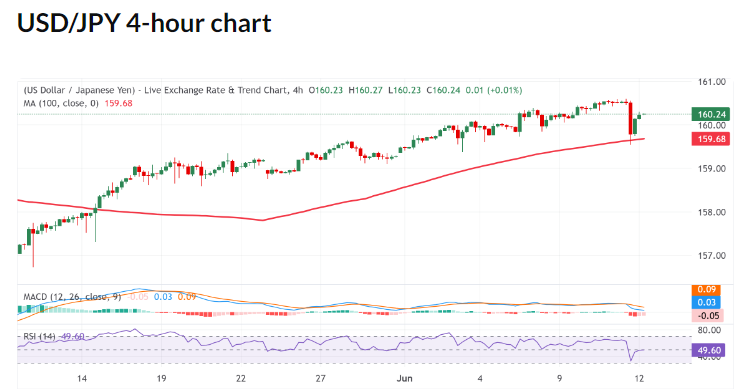
From the four-hour chart, the previous day's pullback showed strong support near the 100-period simple moving average, without a deep breakdown. The subsequent rebound also confirmed the bulls' dominance, meaning that the overall upward trend of the exchange rate has not reversed and there is still room for further upward movement.
However, various technical momentum indicators have shown signs of weakness, and the overall trend is clearly divergent between bullish and bearish sentiment. Among them, the Relative Strength Index (RSI) is hovering around the neutral threshold of 50, with unclear signals for either upward or downward movement; the Moving Average Convergence Divergence (MACD) is running slightly in the negative range, indicating that the upward momentum in the market is gradually waning, and is not a signal of continued strong bullishness.
In summary , the key short-term support level for USD/JPY is firmly established around the 100-period moving average at 159.68. As long as this crucial support level holds, each pullback will attract bargain hunters, allowing the bullish trend to continue. Conversely, if the exchange rate falls sharply and breaks below this support level, the nearly month-long upward trend will come to a complete end.
Before the Bank of Japan's policy is implemented, the exchange rate is likely to maintain a structural trend of fluctuating strength with alternating rises and falls.
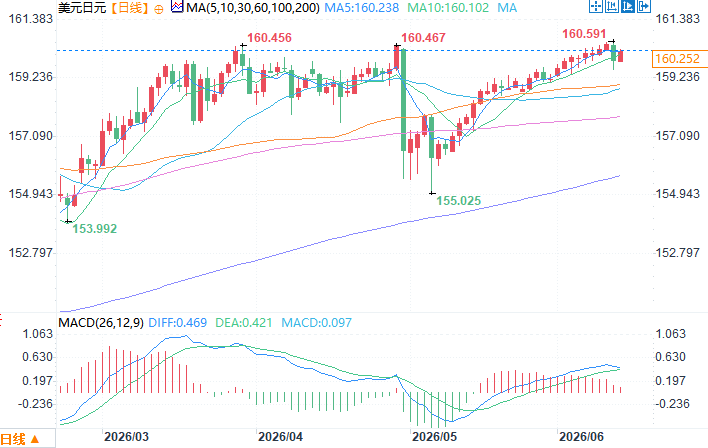
USD/JPY Daily Chart Source: EasyForex
At 13:22 Beijing time on June 12, the USD/JPY exchange rate was 160.25/26.
During Friday's Asian trading session, the USD/JPY pair saw increased buying interest, successfully recovering from the one-week low hit in the previous session. The exchange rate stabilized and rebounded, indicating a subtle shift in market sentiment. Overall, geopolitical tensions, expectations regarding US and Japanese monetary policy, and anticipated market intervention have collectively driven this round of exchange rate fluctuations. While the short-term upward trend has not yet ended, the upward momentum has shown signs of weakening.
The exchange rate rebounded strongly during the Asian session, continuing its high-level range pattern.
After the Asian session opened on Friday, the USD/JPY pair saw a new wave of bullish buying, completely shaking off the one-week low reached the previous day and initiating a slight rebound. As of the latest intraday update, the exchange rate is trading steadily between 160.25 and 160.30, with a cumulative daily gain of nearly 0.25%.
From a short-term perspective, the current exchange rate is only slightly away from the high reached in late April this year, and it is still within the core range of strong upward movement. The foundation of the short-term bullish trend has not yet been broken.
With the combined support of geopolitical and monetary policies, the US dollar continues to exert downward pressure on the Japanese yen.
The geopolitical situation in the Middle East is one of the core factors contributing to the recent weakening of the yen.
The market signals released by the United States and Iran regarding the regional peace agreement were mixed and contradictory, failing to provide clear safe-haven benefits to the market and completely dispelling the market's optimism for the time being.
The ongoing turmoil in the Middle East has created economic uncertainty, continuously suppressing the yen's safe-haven appeal and causing it to weaken. Meanwhile, escalating global geopolitical risks, coupled with strong market expectations that the Federal Reserve will maintain a hawkish monetary policy, have reignited demand for the US dollar, providing solid upward support for the USD/JPY exchange rate and further widening the gap between the two currencies.
Market trading became more cautious due to expectations of intervention and the upcoming interest rate decision.
Despite the bulls having the upper hand, two key factors constrained a significant rise in the exchange rate, effectively curbing the upward momentum of the USD/JPY exchange rate.
On the one hand, the market generally anticipates that Japanese financial regulators may intervene in the foreign exchange market again to stabilize the yen's exchange rate through policy measures. This expectation has deterred yen short sellers from aggressively increasing their positions, significantly reducing their short-selling efforts. On the other hand, the market is highly focused on the Bank of Japan's important two-day monetary policy meeting to be held from June 15th to 16th. This meeting will finalize several core policies, including interest rate hikes and debt reduction. Before the results are announced, most investment institutions and traders are choosing to wait and see, leading to cautious market sentiment and making it difficult for the current exchange rate rally to continue.
Technical indicators show a divergence between bullish and bearish signals, with short-term upward momentum gradually weakening.
From the four-hour chart, the previous day's pullback showed strong support near the 100-period simple moving average, without a deep breakdown. The subsequent rebound also confirmed the bulls' dominance, meaning that the overall upward trend of the exchange rate has not reversed and there is still room for further upward movement.
However, various technical momentum indicators have shown signs of weakness, and the overall trend is clearly divergent between bullish and bearish sentiment. Among them, the Relative Strength Index (RSI) is hovering around the neutral threshold of 50, with unclear signals for either upward or downward movement; the Moving Average Convergence Divergence (MACD) is running slightly in the negative range, indicating that the upward momentum in the market is gradually waning, and is not a signal of continued strong bullishness.
In summary , the key short-term support level for USD/JPY is firmly established around the 100-period moving average at 159.68. As long as this crucial support level holds, each pullback will attract bargain hunters, allowing the bullish trend to continue. Conversely, if the exchange rate falls sharply and breaks below this support level, the nearly month-long upward trend will come to a complete end.
Before the Bank of Japan's policy is implemented, the exchange rate is likely to maintain a structural trend of fluctuating strength with alternating rises and falls.
USD/JPY Daily Chart Source: EasyForex
At 13:22 Beijing time on June 12, the USD/JPY exchange rate was 160.25/26.
- Risk Warning and Disclaimer
- The market involves risk, and trading may not be suitable for all investors. This article is for reference only and does not constitute personal investment advice, nor does it take into account certain users’ specific investment objectives, financial situation, or other needs. Any investment decisions made based on this information are at your own risk.