Crude oil trading alert: With the US and Iran reaching a peace agreement, risk premiums have fallen sharply, and oil prices may be entering a downtrend?
2026-06-15 09:18:38
International oil prices experienced a significant sell-off at the beginning of the week, with West Texas Intermediate (WTI) crude oil falling to around $80 per barrel during Asian trading hours, hitting its lowest level in nearly two months. Significant signs of easing in the months-long military conflict in the Middle East quickly cooled market concerns about disruptions to global energy transportation, prompting a rapid erosion of previously accumulated risk premiums.

Pakistani Prime Minister Shebaz Sharif announced that the United States and Iran had reached a peace agreement, with both sides declaring an immediate and permanent cessation of all military operations, including in the Lebanon region. Subsequently, US President Donald Trump confirmed the agreement's completion and announced the resumption of normal shipping in the Strait of Hormuz, while also lifting the previous maritime blockade against Iran.
Previously, the Strait of Hormuz was severely affected after the US and Israel launched airstrikes against Iran in late February. As one of the world's most important energy transport routes, the Strait of Hormuz handles approximately 20% of global seaborne crude oil shipments, and the risk of its closure had kept international oil prices high for several months. Now, with increased expectations of shipping resumption, the market is reassessing global crude oil supply risks, and safe-haven funds are gradually withdrawing from the energy market.
However, market concerns about the Middle East situation have not completely disappeared. Trump emphasized that if Iran fails to reach a final nuclear agreement with the United States in the future, the US may still take military action again. This means that the current peace agreement is more of a temporary easing, and future geopolitical risks may still be included in market pricing. Once supply in the Middle East is disrupted again, the risk premium for crude oil may rise again, providing support for WTI prices.
Besides geopolitical factors, investors will also be watching the latest weekly crude oil inventory data released by the American Petroleum Institute (API) this week. If the data shows a larger-than-expected decline in U.S. commercial crude oil inventories, it could indicate improved refinery demand or increased consumption, thus providing upward momentum for oil prices. Conversely, if inventories unexpectedly increase, it could reinforce market concerns about ample supply and slowing demand, further limiting the upside potential of WTI crude oil.
From a daily chart perspective, the upward trend in WTI crude oil, previously driven by the Middle East situation, has clearly reversed. Prices have quickly broken through multiple key moving averages, indicating that market sentiment has shifted from supply concerns to a renewed focus on fundamental supply and demand. The $80 level is currently a significant short-term psychological support area; a break below this level could lead to further tests of $77.00 and $75. On the upside, the $82 and $84 levels will act as key resistance areas for any short-term rebound. Only a retest of these levels could alleviate the current bearish pressure.
From a 4-hour chart perspective, WTI crude oil remains in a clear downward channel, with short-term moving averages maintaining a bearish alignment. Momentum indicators suggest that while selling pressure has eased somewhat, there are no clear signs of a trend reversal. If oil prices stabilize around $80, a technical correction and rebound are possible. However, if the rebound fails to break through the $82 area, the overall trend will likely remain weak and range-bound or continue its downward trajectory.
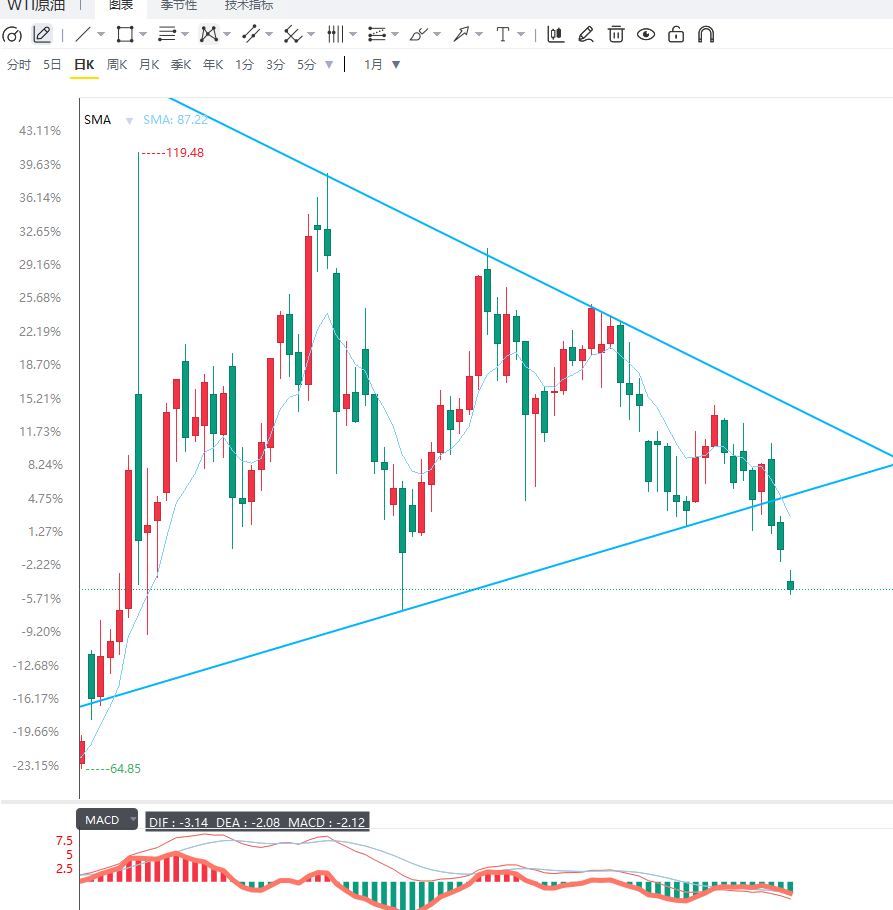
Editor's Summary : The US-Iran peace agreement significantly eased market concerns about disruptions to Middle Eastern oil supplies, causing WTI oil prices to quickly shed their previous geopolitical risk premium and fall to near a two-month low. In the short term, the reopening of the Strait of Hormuz and improved supply expectations will continue to limit the upside potential for oil prices. However, as the final nuclear agreement is not yet fully confirmed, the situation in the Middle East remains prone to relapses. Meanwhile, US API inventory data and subsequent EIA inventory data will be important indicators of actual demand. If inventories continue to decline, they may provide temporary support for oil prices. The future trend of WTI is expected to find a new balance between easing geopolitical risks and changes in global supply and demand.
Pakistani Prime Minister Shebaz Sharif announced that the United States and Iran had reached a peace agreement, with both sides declaring an immediate and permanent cessation of all military operations, including in the Lebanon region. Subsequently, US President Donald Trump confirmed the agreement's completion and announced the resumption of normal shipping in the Strait of Hormuz, while also lifting the previous maritime blockade against Iran.
Previously, the Strait of Hormuz was severely affected after the US and Israel launched airstrikes against Iran in late February. As one of the world's most important energy transport routes, the Strait of Hormuz handles approximately 20% of global seaborne crude oil shipments, and the risk of its closure had kept international oil prices high for several months. Now, with increased expectations of shipping resumption, the market is reassessing global crude oil supply risks, and safe-haven funds are gradually withdrawing from the energy market.
However, market concerns about the Middle East situation have not completely disappeared. Trump emphasized that if Iran fails to reach a final nuclear agreement with the United States in the future, the US may still take military action again. This means that the current peace agreement is more of a temporary easing, and future geopolitical risks may still be included in market pricing. Once supply in the Middle East is disrupted again, the risk premium for crude oil may rise again, providing support for WTI prices.
Besides geopolitical factors, investors will also be watching the latest weekly crude oil inventory data released by the American Petroleum Institute (API) this week. If the data shows a larger-than-expected decline in U.S. commercial crude oil inventories, it could indicate improved refinery demand or increased consumption, thus providing upward momentum for oil prices. Conversely, if inventories unexpectedly increase, it could reinforce market concerns about ample supply and slowing demand, further limiting the upside potential of WTI crude oil.
From a daily chart perspective, the upward trend in WTI crude oil, previously driven by the Middle East situation, has clearly reversed. Prices have quickly broken through multiple key moving averages, indicating that market sentiment has shifted from supply concerns to a renewed focus on fundamental supply and demand. The $80 level is currently a significant short-term psychological support area; a break below this level could lead to further tests of $77.00 and $75. On the upside, the $82 and $84 levels will act as key resistance areas for any short-term rebound. Only a retest of these levels could alleviate the current bearish pressure.
From a 4-hour chart perspective, WTI crude oil remains in a clear downward channel, with short-term moving averages maintaining a bearish alignment. Momentum indicators suggest that while selling pressure has eased somewhat, there are no clear signs of a trend reversal. If oil prices stabilize around $80, a technical correction and rebound are possible. However, if the rebound fails to break through the $82 area, the overall trend will likely remain weak and range-bound or continue its downward trajectory.
Editor's Summary : The US-Iran peace agreement significantly eased market concerns about disruptions to Middle Eastern oil supplies, causing WTI oil prices to quickly shed their previous geopolitical risk premium and fall to near a two-month low. In the short term, the reopening of the Strait of Hormuz and improved supply expectations will continue to limit the upside potential for oil prices. However, as the final nuclear agreement is not yet fully confirmed, the situation in the Middle East remains prone to relapses. Meanwhile, US API inventory data and subsequent EIA inventory data will be important indicators of actual demand. If inventories continue to decline, they may provide temporary support for oil prices. The future trend of WTI is expected to find a new balance between easing geopolitical risks and changes in global supply and demand.
- Risk Warning and Disclaimer
- The market involves risk, and trading may not be suitable for all investors. This article is for reference only and does not constitute personal investment advice, nor does it take into account certain users’ specific investment objectives, financial situation, or other needs. Any investment decisions made based on this information are at your own risk.