Warsh's "Hellish Start": Inflation Exceeds 4%, Bond Market Pricing Rate Hikes, Trump Pressures for Rate Cuts
2026-06-15 12:16:13
The US dollar index fluctuated lower on Monday (June 15), currently down 0.3% to around 99.50.
As the week begins, the bigger market focus has shifted to the early morning of June 18th, Beijing time—when Kevin Warsh, the newly appointed chairman of the Federal Reserve, who has only been in office for three weeks, will chair his first FOMC meeting since taking office. This is arguably the most dramatic and riskiest debut of his career, and perhaps even in the history of modern central banks.
The market widely expects the federal funds rate target range to remain unchanged at 3.50% to 3.75% at this meeting. However, amid multiple pressures including inflation returning above 4%, the market beginning to price in a rate hike at the end of the year, Trump continuing to pressure for rate cuts, and the most serious division within the FOMC in nearly 34 years, the decision to "hold rates steady" is far less important than the signals that Warsh will send.
Market participants will scrutinize every word of the FOMC statement and analyze Warsh's every word at the press conference. These details will be key clues in determining where this former hawkish governor, now a proponent of "pragmatic monetarism," will steer US monetary policy—whether to continue the hardline stance against inflation or to succumb to political pressure.
Data released on June 10th local time precisely foreshadowed this crucial test. The US CPI rose 4.2% year-on-year in May, the highest level since April 2023, marking the third consecutive month of increase and breaking the 4% mark for the first time. Month-on-month, it rose 0.5%, slightly lower than April's 0.6%; core CPI rose 2.9% year-on-year and 0.2% month-on-month, lower than the market expectation of 0.3%.
US inflation in May was characterized by "overall high inflation, but core inflation was relatively weak." Energy contributed 1.55 percentage points to the year-on-year CPI increase, making it the absolute main driver of overall inflation. Gasoline prices rose by more than 40% year-on-year at one point and surged 7% month-on-month. Behind the soaring energy prices was the continued escalation of geopolitical conflicts in the Middle East, with Brent crude oil fluctuating significantly between $95 and $110 per barrel in May.
It is worth noting that, after excluding supply-side shocks, the upward momentum of US endogenous CPI has not significantly strengthened, and energy prices have not yet been transmitted to other sectors on a large scale. The relatively moderate core inflation provides the Federal Reserve with room to "wait and see."
Furthermore, the PCE inflation rate, which the Federal Reserve pays closer attention to, rose 3.3% year-on-year in April and only 0.2% month-on-month, a moderate pace. The main driver of inflation is external supply shocks rather than overheated domestic demand, meaning that raising interest rates may not be the right solution, giving the Federal Reserve greater policy flexibility.
Warsh's inauguration as Federal Reserve Chairman was a politically charged start. On May 22, Trump presided over Warsh's swearing-in ceremony in the East Room of the White House—the first time in nearly 40 years that a Federal Reserve Chairman had been sworn in from the White House.
Trump's remarks at the inauguration ceremony were quite nuanced. On one hand, he said, "I'm serious, I want Kevin to be completely independent. Don't look at me, don't look at anyone, just do your own thing and get the job done." On the other hand, he emphasized, "We also want to curb inflation, but we don't want to hinder economic prosperity." At the same time, he also clearly expressed his desire for lower interest rates.
On June 8th—just one week before the FOMC meeting—Trump made another public statement. He bluntly stated that if the Federal Reserve chose to raise interest rates, it would be a "wrong decision," adding, "We should actually lower interest rates." "When a country's economy is performing well, it shouldn't be punished immediately by raising interest rates."
Furthermore, Trump's previous threats to remove Powell from the board and the criminal investigation launched against board member Lisa Cook have further exacerbated tensions between the White House and the Federal Reserve.
Johns Hopkins University political science professor Nicholas Yabko points out that if Warsh ultimately chooses to cut interest rates, the market will pay close attention to this move, as it could be interpreted as a dangerous signal that the Fed's independence is being substantially eroded.
Yabko's warning directly addresses the core contradiction of Warsh's debut. Since the Volcker era, the Federal Reserve has consistently upheld its credibility based on its decision-making ability independent of political pressure. However, Trump's continued public pronouncements on interest rate cuts have cracked this foundation. As the new chairman, the outcome of Warsh's first policy meeting will be seen by the market as a litmus test: if he withstands pressure, maintains interest rates, or even releases hawkish signals, it will demonstrate that the Fed remains data-driven rather than politically driven; conversely, if he chooses to comply with the White House's demands and cut rates against a backdrop of inflation returning to 4%, the market's trust in the Fed's independence will suffer an irreversible blow.
Yabko further analyzed that once the Fed's independence is questioned, the effectiveness of future policy communication will be greatly reduced. Investors will no longer rely solely on economic data to predict policy direction, but will also consider the interference of political factors in decision-making, which will lead to increased market volatility and higher risk premiums. For Warsh, this debut is not only about an interest rate decision, but also about the foundation of the Fed's policy credibility for years to come. He must prove to the market through his actions that inflation data is the only indicator, not the White House's pronouncements.
Meanwhile, divisions within the Federal Reserve are intensifying. The minutes of the April meeting revealed that a large number of policymakers warned that if inflation remains high, they hope to completely abandon their previous stance favoring rate cuts and are even prepared to restart rate hikes before the end of the year. In a recent vote, three Fed officials directly voted against the policy because the wording was not hawkish enough.
The rate-cutting expectations that preceded Warsh's appointment have been completely shattered in the past month. The latest survey shows that the timing of Fed rate cuts has been significantly postponed to mid-2027, with most respondents expecting the first rate cut to occur in June 2027. Even more concerning is the market's repricing of the rate hike path: the CME Group's FedWatch tool shows that the probability of a cumulative 25 basis point rate hike by the Fed by July has reached 7.4%. Data previously released by Goldman Sachs also shows that the probability of a Fed rate hike in 2026 has surged from about 12% before the outbreak of war to 45%.
The bond market is sending a clearer signal: the yield on two-year U.S. Treasury bonds has surged to over 4%, significantly higher than the Federal Reserve's policy rate; the yield on 30-year Treasury bonds touched 5.19% last month, just a step away from its 2007 high. The mainstream view on Wall Street is that these two indicators are sending the same signal to the market—interest rates need to continue rising.
Even so, Warsh's decision on whether to raise interest rates still faces numerous constraints: core inflation is moderate month-on-month; the better-than-expected May non-farm payrolls report is largely due to a short-term surge rather than a comprehensive economic overheating; rising oil prices are a supply-side shock, and raising interest rates could potentially trigger stagflation; the US and Iran have reached an agreement on a memorandum of understanding, and international oil prices have already fallen accordingly. Furthermore, the European Central Bank raised interest rates last week, and the Bank of Japan is expected to follow suit, further widening the divergence in monetary policy among global central banks.
The yield on 2-year US Treasury bonds has remained above the upper limit of the Federal Reserve's policy rate since March of this year, currently trading at a premium of about 40 to 50 basis points. This is the market's way of indicating that policy is no longer restrictive and may even be too loose.
Investors and analysts are beginning to refocus on the Federal Reserve's long-term "neutral interest rate" benchmark. The FOMC projected in March that the long-term neutral interest rate would be around 3.1%.
Analysis indicates that the ongoing AI capital expenditure boom is pushing the neutral interest rate higher by increasing capital demand. Market trading prices currently imply an inflation-adjusted neutral interest rate of approximately 1.8%, significantly higher than the Federal Reserve's median inflation-adjusted estimate of 1.1%.
This is a potential pitfall that Warsh must carefully manage in his first press conference. If he believes the neutral interest rate is higher than the committee's estimate, then maintaining the current rate would mean that policy is no longer restrictive, and a rate hike might be inevitable; if he prefers to maintain the committee's current lower estimate, he would have to face the risk of a continued rise in the bond market and soaring inflation expectations.
JPMorgan Chase stated that assessing the neutral interest rate will be one of Warsh's core challenges in formulating monetary policy. He pointed out that with the AI capital expenditure boom continuing to drive up capital demand, the neutral interest rate for the US economy may already be significantly higher than the Fed's current estimates. If Warsh acknowledges at this meeting that the neutral interest rate needs to be raised, it would mean that the current policy rate of 3.50% to 3.75% is no longer effectively restrictive, and a rate hike may be inevitable; however, if he maintains the committee's current low estimate of the neutral interest rate, he will have to face the dual pressures of a continuously rising bond market and soaring inflation expectations.
Warsh's first FOMC meeting can be described as a "hellish start." He was not facing a simple data judgment, but a multi-dimensional extreme game: inflation was generally hot but the core was soft, Trump was "verbally independent" but continued to pressure for interest rate cuts, the bond market was pricing in interest rate hikes in advance, the FOMC was experiencing its most serious division in 34 years, and the neutral interest rate guidance was in a dilemma.
It's almost certain that interest rates will remain unchanged at this meeting, but the market's real focus is on how Warsh will convey signals through the wording of the statement and the press conference. Wall Street is hoping to see the same Kevin Warsh who was once a staunch opponent of inflation—if he shows any sign of compromise with the White House, the credit assets the Fed has accumulated over decades could face a severe test.
Technically, according to the daily chart of the US Dollar Index, the index is currently trading around 99.50, exhibiting a generally bullish consolidation pattern. The price previously broke through and stabilized above all moving averages, with the 20/50/100/200 MAs forming a bullish alignment, indicating a continuation of the medium-term upward trend. After recently rising to 100.31, it has slightly retreated and is currently supported by the 20 MA, with the 100.31-100.64 range acting as strong resistance. In terms of indicators, the MACD is running above the zero line, with the DIFF and DEA maintaining a golden cross, although the red bars are slightly contracting, indicating a slowdown in upward momentum. The RSI is in a neutral-to-strong range, without overbought signals, suggesting a clear short-term consolidation phase.
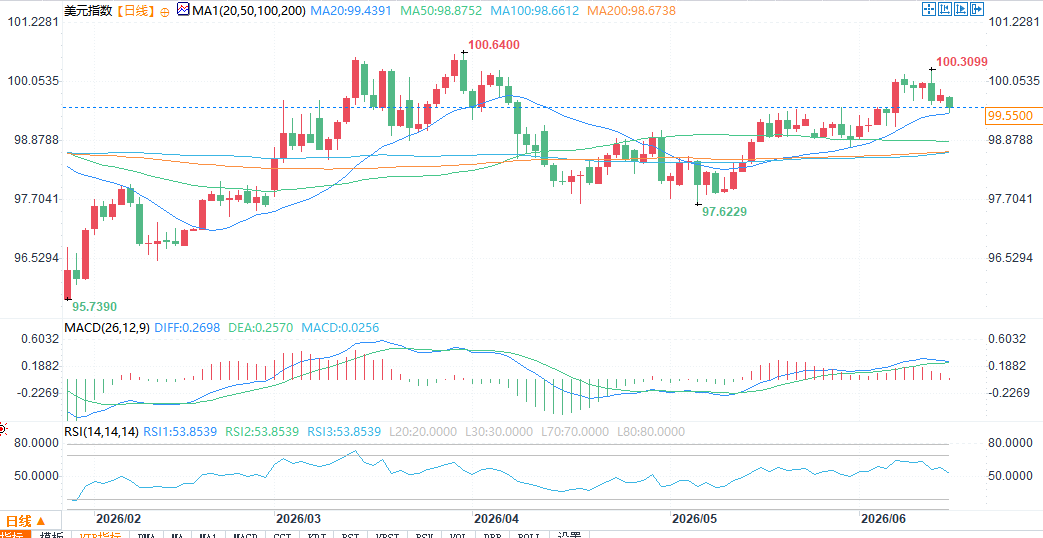
(US Dollar Index Daily Chart, Source: FX678)
At 15:15 Beijing time on June 15, the US dollar index was at 99.50.
As the week begins, the bigger market focus has shifted to the early morning of June 18th, Beijing time—when Kevin Warsh, the newly appointed chairman of the Federal Reserve, who has only been in office for three weeks, will chair his first FOMC meeting since taking office. This is arguably the most dramatic and riskiest debut of his career, and perhaps even in the history of modern central banks.
The market widely expects the federal funds rate target range to remain unchanged at 3.50% to 3.75% at this meeting. However, amid multiple pressures including inflation returning above 4%, the market beginning to price in a rate hike at the end of the year, Trump continuing to pressure for rate cuts, and the most serious division within the FOMC in nearly 34 years, the decision to "hold rates steady" is far less important than the signals that Warsh will send.
Market participants will scrutinize every word of the FOMC statement and analyze Warsh's every word at the press conference. These details will be key clues in determining where this former hawkish governor, now a proponent of "pragmatic monetarism," will steer US monetary policy—whether to continue the hardline stance against inflation or to succumb to political pressure.
Divergent Inflation Signals: Overall Inflation is Hot, Core Inflation is Weak
Data released on June 10th local time precisely foreshadowed this crucial test. The US CPI rose 4.2% year-on-year in May, the highest level since April 2023, marking the third consecutive month of increase and breaking the 4% mark for the first time. Month-on-month, it rose 0.5%, slightly lower than April's 0.6%; core CPI rose 2.9% year-on-year and 0.2% month-on-month, lower than the market expectation of 0.3%.
US inflation in May was characterized by "overall high inflation, but core inflation was relatively weak." Energy contributed 1.55 percentage points to the year-on-year CPI increase, making it the absolute main driver of overall inflation. Gasoline prices rose by more than 40% year-on-year at one point and surged 7% month-on-month. Behind the soaring energy prices was the continued escalation of geopolitical conflicts in the Middle East, with Brent crude oil fluctuating significantly between $95 and $110 per barrel in May.
It is worth noting that, after excluding supply-side shocks, the upward momentum of US endogenous CPI has not significantly strengthened, and energy prices have not yet been transmitted to other sectors on a large scale. The relatively moderate core inflation provides the Federal Reserve with room to "wait and see."
Furthermore, the PCE inflation rate, which the Federal Reserve pays closer attention to, rose 3.3% year-on-year in April and only 0.2% month-on-month, a moderate pace. The main driver of inflation is external supply shocks rather than overheated domestic demand, meaning that raising interest rates may not be the right solution, giving the Federal Reserve greater policy flexibility.
Political Eye of the Storm: Trump's "Independence" Rhetoric and the Tug-of-War with Continued Pressure
Warsh's inauguration as Federal Reserve Chairman was a politically charged start. On May 22, Trump presided over Warsh's swearing-in ceremony in the East Room of the White House—the first time in nearly 40 years that a Federal Reserve Chairman had been sworn in from the White House.
Trump's remarks at the inauguration ceremony were quite nuanced. On one hand, he said, "I'm serious, I want Kevin to be completely independent. Don't look at me, don't look at anyone, just do your own thing and get the job done." On the other hand, he emphasized, "We also want to curb inflation, but we don't want to hinder economic prosperity." At the same time, he also clearly expressed his desire for lower interest rates.
On June 8th—just one week before the FOMC meeting—Trump made another public statement. He bluntly stated that if the Federal Reserve chose to raise interest rates, it would be a "wrong decision," adding, "We should actually lower interest rates." "When a country's economy is performing well, it shouldn't be punished immediately by raising interest rates."
Furthermore, Trump's previous threats to remove Powell from the board and the criminal investigation launched against board member Lisa Cook have further exacerbated tensions between the White House and the Federal Reserve.
Johns Hopkins University political science professor Nicholas Yabko points out that if Warsh ultimately chooses to cut interest rates, the market will pay close attention to this move, as it could be interpreted as a dangerous signal that the Fed's independence is being substantially eroded.
Yabko's warning directly addresses the core contradiction of Warsh's debut. Since the Volcker era, the Federal Reserve has consistently upheld its credibility based on its decision-making ability independent of political pressure. However, Trump's continued public pronouncements on interest rate cuts have cracked this foundation. As the new chairman, the outcome of Warsh's first policy meeting will be seen by the market as a litmus test: if he withstands pressure, maintains interest rates, or even releases hawkish signals, it will demonstrate that the Fed remains data-driven rather than politically driven; conversely, if he chooses to comply with the White House's demands and cut rates against a backdrop of inflation returning to 4%, the market's trust in the Fed's independence will suffer an irreversible blow.
Yabko further analyzed that once the Fed's independence is questioned, the effectiveness of future policy communication will be greatly reduced. Investors will no longer rely solely on economic data to predict policy direction, but will also consider the interference of political factors in decision-making, which will lead to increased market volatility and higher risk premiums. For Warsh, this debut is not only about an interest rate decision, but also about the foundation of the Fed's policy credibility for years to come. He must prove to the market through his actions that inflation data is the only indicator, not the White House's pronouncements.
Meanwhile, divisions within the Federal Reserve are intensifying. The minutes of the April meeting revealed that a large number of policymakers warned that if inflation remains high, they hope to completely abandon their previous stance favoring rate cuts and are even prepared to restart rate hikes before the end of the year. In a recent vote, three Fed officials directly voted against the policy because the wording was not hawkish enough.
The bond market has completely turned against it: the inverted yield curve is forcing interest rate hikes.
The rate-cutting expectations that preceded Warsh's appointment have been completely shattered in the past month. The latest survey shows that the timing of Fed rate cuts has been significantly postponed to mid-2027, with most respondents expecting the first rate cut to occur in June 2027. Even more concerning is the market's repricing of the rate hike path: the CME Group's FedWatch tool shows that the probability of a cumulative 25 basis point rate hike by the Fed by July has reached 7.4%. Data previously released by Goldman Sachs also shows that the probability of a Fed rate hike in 2026 has surged from about 12% before the outbreak of war to 45%.
The bond market is sending a clearer signal: the yield on two-year U.S. Treasury bonds has surged to over 4%, significantly higher than the Federal Reserve's policy rate; the yield on 30-year Treasury bonds touched 5.19% last month, just a step away from its 2007 high. The mainstream view on Wall Street is that these two indicators are sending the same signal to the market—interest rates need to continue rising.
Even so, Warsh's decision on whether to raise interest rates still faces numerous constraints: core inflation is moderate month-on-month; the better-than-expected May non-farm payrolls report is largely due to a short-term surge rather than a comprehensive economic overheating; rising oil prices are a supply-side shock, and raising interest rates could potentially trigger stagflation; the US and Iran have reached an agreement on a memorandum of understanding, and international oil prices have already fallen accordingly. Furthermore, the European Central Bank raised interest rates last week, and the Bank of Japan is expected to follow suit, further widening the divergence in monetary policy among global central banks.
Divergence between short-term yields and policy rates: The difficulty of providing guidance on the neutral interest rate
The yield on 2-year US Treasury bonds has remained above the upper limit of the Federal Reserve's policy rate since March of this year, currently trading at a premium of about 40 to 50 basis points. This is the market's way of indicating that policy is no longer restrictive and may even be too loose.
Investors and analysts are beginning to refocus on the Federal Reserve's long-term "neutral interest rate" benchmark. The FOMC projected in March that the long-term neutral interest rate would be around 3.1%.
Analysis indicates that the ongoing AI capital expenditure boom is pushing the neutral interest rate higher by increasing capital demand. Market trading prices currently imply an inflation-adjusted neutral interest rate of approximately 1.8%, significantly higher than the Federal Reserve's median inflation-adjusted estimate of 1.1%.
This is a potential pitfall that Warsh must carefully manage in his first press conference. If he believes the neutral interest rate is higher than the committee's estimate, then maintaining the current rate would mean that policy is no longer restrictive, and a rate hike might be inevitable; if he prefers to maintain the committee's current lower estimate, he would have to face the risk of a continued rise in the bond market and soaring inflation expectations.
JPMorgan Chase stated that assessing the neutral interest rate will be one of Warsh's core challenges in formulating monetary policy. He pointed out that with the AI capital expenditure boom continuing to drive up capital demand, the neutral interest rate for the US economy may already be significantly higher than the Fed's current estimates. If Warsh acknowledges at this meeting that the neutral interest rate needs to be raised, it would mean that the current policy rate of 3.50% to 3.75% is no longer effectively restrictive, and a rate hike may be inevitable; however, if he maintains the committee's current low estimate of the neutral interest rate, he will have to face the dual pressures of a continuously rising bond market and soaring inflation expectations.
Summary and Outlook
Warsh's first FOMC meeting can be described as a "hellish start." He was not facing a simple data judgment, but a multi-dimensional extreme game: inflation was generally hot but the core was soft, Trump was "verbally independent" but continued to pressure for interest rate cuts, the bond market was pricing in interest rate hikes in advance, the FOMC was experiencing its most serious division in 34 years, and the neutral interest rate guidance was in a dilemma.
It's almost certain that interest rates will remain unchanged at this meeting, but the market's real focus is on how Warsh will convey signals through the wording of the statement and the press conference. Wall Street is hoping to see the same Kevin Warsh who was once a staunch opponent of inflation—if he shows any sign of compromise with the White House, the credit assets the Fed has accumulated over decades could face a severe test.
Technically, according to the daily chart of the US Dollar Index, the index is currently trading around 99.50, exhibiting a generally bullish consolidation pattern. The price previously broke through and stabilized above all moving averages, with the 20/50/100/200 MAs forming a bullish alignment, indicating a continuation of the medium-term upward trend. After recently rising to 100.31, it has slightly retreated and is currently supported by the 20 MA, with the 100.31-100.64 range acting as strong resistance. In terms of indicators, the MACD is running above the zero line, with the DIFF and DEA maintaining a golden cross, although the red bars are slightly contracting, indicating a slowdown in upward momentum. The RSI is in a neutral-to-strong range, without overbought signals, suggesting a clear short-term consolidation phase.
(US Dollar Index Daily Chart, Source: FX678)
At 15:15 Beijing time on June 15, the US dollar index was at 99.50.
- Risk Warning and Disclaimer
- The market involves risk, and trading may not be suitable for all investors. This article is for reference only and does not constitute personal investment advice, nor does it take into account certain users’ specific investment objectives, financial situation, or other needs. Any investment decisions made based on this information are at your own risk.