US oil hits $80 mark: Gulf crude oil continues to flow out secretly, supply gap far smaller than initially estimated.
2026-06-15 12:20:14
On Monday (June 15) during the Asian session, US crude oil futures fell by more than 5% to the $80 mark due to the negative impact of the peace agreement reached between the US and Iran and the imminent reopening of the Strait of Hormuz. It is currently trading around $80.60 per barrel.
However, if we turn back the clock to the beginning of the conflict, the situation was quite different. Since the outbreak of the war with Iran and Tehran's announcement of the "closure" of the Strait of Hormuz, the market has been struggling to estimate the oil supply gap and try to predict oil price trends.
The initial calculations were relatively simple: adding up all non-Iranian Gulf crude oil exports, approximately 12 to 15 million barrels per day—a disruption of this scale could easily be considered the largest energy crisis in history.
However, the latest evidence suggests that the actual supply gap may be much lower than that figure.
Following the outbreak of the Iran-Iraq War, the market made extremely aggressive predictions about a potential supply disaster caused by the closure of the Strait of Hormuz. Driven by expectations of extreme disruption, Brent crude futures surged to nearly $120 per barrel in early March. At that time, analysts warned that this was just the beginning, and predictions that oil prices could rise to $200 quickly made headlines, triggering widespread concerns about inflation among consumers and businesses.
Under the military threat from Iran, oil tankers have anchored and stopped sailing due to the high risk of navigation. At the same time, the United States restricts satellite imagery of the Gulf region, and ships frequently spoof their location signals, making it almost impossible for outsiders to track any oil tankers attempting to venture through. The information black box and the panic have combined to further amplify market fears of a supply collapse.
However, as time went on and more data was released, the market began to realize that the actual scale of the disruptions was far lower than expected. Oil prices subsequently fell from their frenzied highs, dropping below $90 per barrel, and the previously extremely bullish expectations were gradually corrected by reality.
Despite the ongoing war with Iran and the nominal "closure" of the Strait of Hormuz, a large number of oil tankers have successfully sailed away—some detected by shipping tracking companies, others unnoticed. As evidence gradually emerges, the market is beginning to re-examine its previous expectations of extreme disruption and to reflect on why oil prices have fallen below $90 per barrel amid the ongoing conflict, catching previously bullish market participants off guard.
US President Trump said last Wednesday that more than 100 million barrels of crude oil have passed through the Strait of Hormuz as part of what he called a secret US operation to support tanker shipments. This statement was the first public acknowledgment of the US's behind-the-scenes role in maintaining the outflow of Gulf oil.
According to Trump, the U.S. has ensured that oil tankers can still pass through highly dangerous waters through military escorts, intelligence support, and coordination with regional allies. Despite repeated threats from Iran to completely blockade the strait, U.S. intervention has effectively provided some ship owners with "invisible protection," lowering the psychological barrier to risky voyages.
Shipping industry insiders point out that while this "unannounced escort operation" has not been officially confirmed, its existence is an open secret in the market. It is this behind-the-scenes intervention that allows Gulf crude oil to continue flowing out despite the nominal blockade, becoming one of the key factors suppressing oil prices. Trump's recent public statement, to some extent, validates previous market speculation and further undermines the logic behind extremely bullish oil prices.
The International Energy Agency (IEA) estimated in its latest report that crude oil supplies in the Gulf region have decreased by 14 million barrels per day, representing approximately 14% of global supply. If accurate, this figure would undoubtedly constitute one of the most severe supply shocks in modern energy history. However, data from several major trading companies and independent shipping tracking agencies suggest that this figure may significantly exaggerate the actual scale of the disruption.
The crux of the issue is that the IEA's estimates may be largely based on the assumption that the Strait of Hormuz is nominally "closed," meaning that all oil tankers transiting the strait are assumed to have ceased operations. However, the reality is far more complex than this assumption suggests. Countries like Iraq, Kuwait, and the UAE have successfully maintained substantial crude oil exports by shutting down satellite signals, coordinating with Iran, or using alternative ports. Saudi Arabia, meanwhile, continues to export crude oil through the port of Yanbu on the Red Sea coast, with daily exports reaching 4 to 5 million barrels.
According to sources, internal calculations by oil-producing countries to maintain crude oil transportation suggest the actual supply gap may be closer to 5 to 6 million barrels per day. Iraq's exports are down by 2.5 to 3 million barrels per day, Kuwait by about 1.5 million barrels per day, and Saudi Arabia and the UAE by about 500,000 barrels per day each. This means that the actual export resilience of Gulf oil-producing countries far exceeds market expectations. The IEA's estimate of 14 million barrels per day may equate the nominal "Strait closure" with an actual "zero supply," thus overestimating the true scale of the disruption. This discrepancy in understanding is one of the core reasons why oil prices have not surged further as predicted.
Regarding US crude oil exports, thanks to the continued growth in shale oil production and the improvement of export infrastructure, the US is supplying crude oil to the global market on an unprecedented scale. This not only fills some of the supply gap in the Gulf region but also, to some extent, suppresses further increases in oil prices.
Data from the U.S. Energy Information Administration (EIA) shows that U.S. crude oil exports have recently hit record highs, making it an important force that cannot be ignored in the global crude oil supply system.
Analysts point out that the continued surge in US exports has effectively alleviated market panic over supply disruptions in the Middle East, providing additional downward pressure on oil prices.
Member countries of the International Energy Agency (IEA) coordinated an action, announcing a record release of 400 million barrels of emergency oil reserves to address the supply shock caused by the war with Iran. This is the largest strategic reserve release in history, far exceeding any previous intervention. The release of these reserves injected significant liquidity into the market in a short period, effectively mitigating price spikes caused by the supply-demand imbalance.
Although the release of strategic reserves was a temporary measure, its scale and speed of coordination sent a clear signal to the market: major consuming countries would not stand idly by and allow oil prices to spiral out of control. This move exerted significant downward pressure on oil prices both psychologically and in terms of actual supply and demand.
Affected by multiple factors such as slowing economic growth, weakening industrial activity, and energy structure adjustments, Asia's recent crude oil import demand has declined significantly. A source stated that, taking into account the decline in Asian demand, the actual supply gap in the market may only be close to 2 million barrels per day, far lower than the initial estimate of 12 million to 15 million barrels per day. This means that the "unexpected contraction" on the demand side has largely offset the impact of supply disruptions, becoming one of the key variables in the cooling oil market.
In summary, the combined effect of three major factors—surging US exports, the release of strategic reserves, and weak demand in Asia—has allowed oil prices, which could have spiraled out of control, to gradually fall back below $90.
From a technical perspective, according to the daily chart, US crude oil futures are currently in a downward channel, with prices breaking through the support of multiple moving averages. The 20-day and 50-day moving averages have turned downwards, indicating significant short-term weakness.
The MACD indicator is running below the zero axis, with the two lines forming a death cross and the green bars continuing to expand, indicating strong bearish momentum; the RSI is around 35, close to the oversold zone, and there may be a short-term technical rebound demand, but the overall bias is bearish.
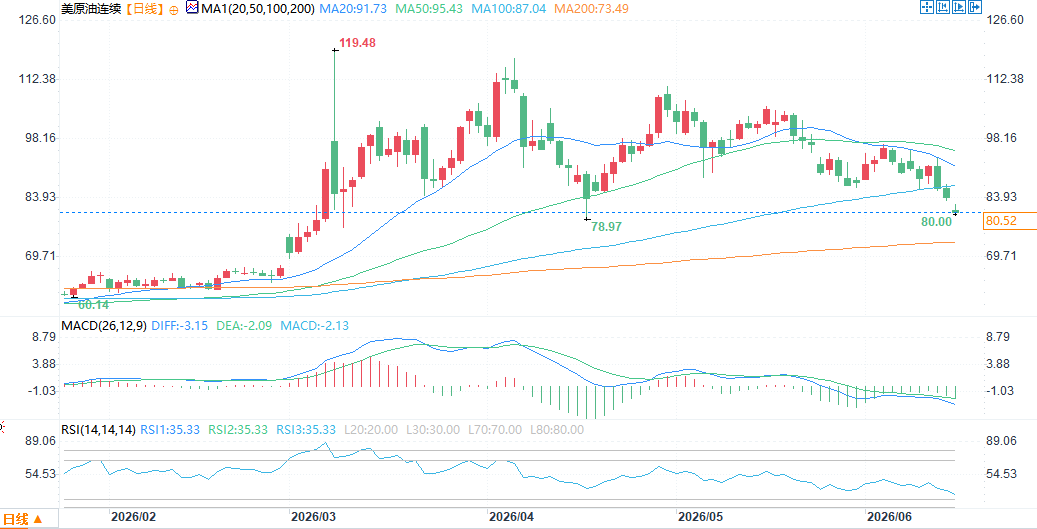
(US crude oil futures daily chart, source: FX678)
At 12:19 Beijing time on June 15, US crude oil futures were trading at $80.59 per barrel.
However, if we turn back the clock to the beginning of the conflict, the situation was quite different. Since the outbreak of the war with Iran and Tehran's announcement of the "closure" of the Strait of Hormuz, the market has been struggling to estimate the oil supply gap and try to predict oil price trends.
The initial calculations were relatively simple: adding up all non-Iranian Gulf crude oil exports, approximately 12 to 15 million barrels per day—a disruption of this scale could easily be considered the largest energy crisis in history.
However, the latest evidence suggests that the actual supply gap may be much lower than that figure.
Oil prices return to reality from frenzy
Following the outbreak of the Iran-Iraq War, the market made extremely aggressive predictions about a potential supply disaster caused by the closure of the Strait of Hormuz. Driven by expectations of extreme disruption, Brent crude futures surged to nearly $120 per barrel in early March. At that time, analysts warned that this was just the beginning, and predictions that oil prices could rise to $200 quickly made headlines, triggering widespread concerns about inflation among consumers and businesses.
Under the military threat from Iran, oil tankers have anchored and stopped sailing due to the high risk of navigation. At the same time, the United States restricts satellite imagery of the Gulf region, and ships frequently spoof their location signals, making it almost impossible for outsiders to track any oil tankers attempting to venture through. The information black box and the panic have combined to further amplify market fears of a supply collapse.
However, as time went on and more data was released, the market began to realize that the actual scale of the disruptions was far lower than expected. Oil prices subsequently fell from their frenzied highs, dropping below $90 per barrel, and the previously extremely bullish expectations were gradually corrected by reality.
Millions of barrels of crude oil are still secretly flowing out.
Despite the ongoing war with Iran and the nominal "closure" of the Strait of Hormuz, a large number of oil tankers have successfully sailed away—some detected by shipping tracking companies, others unnoticed. As evidence gradually emerges, the market is beginning to re-examine its previous expectations of extreme disruption and to reflect on why oil prices have fallen below $90 per barrel amid the ongoing conflict, catching previously bullish market participants off guard.
US President Trump said last Wednesday that more than 100 million barrels of crude oil have passed through the Strait of Hormuz as part of what he called a secret US operation to support tanker shipments. This statement was the first public acknowledgment of the US's behind-the-scenes role in maintaining the outflow of Gulf oil.
According to Trump, the U.S. has ensured that oil tankers can still pass through highly dangerous waters through military escorts, intelligence support, and coordination with regional allies. Despite repeated threats from Iran to completely blockade the strait, U.S. intervention has effectively provided some ship owners with "invisible protection," lowering the psychological barrier to risky voyages.
Shipping industry insiders point out that while this "unannounced escort operation" has not been officially confirmed, its existence is an open secret in the market. It is this behind-the-scenes intervention that allows Gulf crude oil to continue flowing out despite the nominal blockade, becoming one of the key factors suppressing oil prices. Trump's recent public statement, to some extent, validates previous market speculation and further undermines the logic behind extremely bullish oil prices.
The supply gap is far smaller than initially estimated.
The International Energy Agency (IEA) estimated in its latest report that crude oil supplies in the Gulf region have decreased by 14 million barrels per day, representing approximately 14% of global supply. If accurate, this figure would undoubtedly constitute one of the most severe supply shocks in modern energy history. However, data from several major trading companies and independent shipping tracking agencies suggest that this figure may significantly exaggerate the actual scale of the disruption.
The crux of the issue is that the IEA's estimates may be largely based on the assumption that the Strait of Hormuz is nominally "closed," meaning that all oil tankers transiting the strait are assumed to have ceased operations. However, the reality is far more complex than this assumption suggests. Countries like Iraq, Kuwait, and the UAE have successfully maintained substantial crude oil exports by shutting down satellite signals, coordinating with Iran, or using alternative ports. Saudi Arabia, meanwhile, continues to export crude oil through the port of Yanbu on the Red Sea coast, with daily exports reaching 4 to 5 million barrels.
According to sources, internal calculations by oil-producing countries to maintain crude oil transportation suggest the actual supply gap may be closer to 5 to 6 million barrels per day. Iraq's exports are down by 2.5 to 3 million barrels per day, Kuwait by about 1.5 million barrels per day, and Saudi Arabia and the UAE by about 500,000 barrels per day each. This means that the actual export resilience of Gulf oil-producing countries far exceeds market expectations. The IEA's estimate of 14 million barrels per day may equate the nominal "Strait closure" with an actual "zero supply," thus overestimating the true scale of the disruption. This discrepancy in understanding is one of the core reasons why oil prices have not surged further as predicted.
Multiple factors combined to alleviate market pressure
Regarding US crude oil exports, thanks to the continued growth in shale oil production and the improvement of export infrastructure, the US is supplying crude oil to the global market on an unprecedented scale. This not only fills some of the supply gap in the Gulf region but also, to some extent, suppresses further increases in oil prices.
Data from the U.S. Energy Information Administration (EIA) shows that U.S. crude oil exports have recently hit record highs, making it an important force that cannot be ignored in the global crude oil supply system.
Analysts point out that the continued surge in US exports has effectively alleviated market panic over supply disruptions in the Middle East, providing additional downward pressure on oil prices.
Member countries of the International Energy Agency (IEA) coordinated an action, announcing a record release of 400 million barrels of emergency oil reserves to address the supply shock caused by the war with Iran. This is the largest strategic reserve release in history, far exceeding any previous intervention. The release of these reserves injected significant liquidity into the market in a short period, effectively mitigating price spikes caused by the supply-demand imbalance.
Although the release of strategic reserves was a temporary measure, its scale and speed of coordination sent a clear signal to the market: major consuming countries would not stand idly by and allow oil prices to spiral out of control. This move exerted significant downward pressure on oil prices both psychologically and in terms of actual supply and demand.
Affected by multiple factors such as slowing economic growth, weakening industrial activity, and energy structure adjustments, Asia's recent crude oil import demand has declined significantly. A source stated that, taking into account the decline in Asian demand, the actual supply gap in the market may only be close to 2 million barrels per day, far lower than the initial estimate of 12 million to 15 million barrels per day. This means that the "unexpected contraction" on the demand side has largely offset the impact of supply disruptions, becoming one of the key variables in the cooling oil market.
In summary, the combined effect of three major factors—surging US exports, the release of strategic reserves, and weak demand in Asia—has allowed oil prices, which could have spiraled out of control, to gradually fall back below $90.
From a technical perspective, according to the daily chart, US crude oil futures are currently in a downward channel, with prices breaking through the support of multiple moving averages. The 20-day and 50-day moving averages have turned downwards, indicating significant short-term weakness.
The MACD indicator is running below the zero axis, with the two lines forming a death cross and the green bars continuing to expand, indicating strong bearish momentum; the RSI is around 35, close to the oversold zone, and there may be a short-term technical rebound demand, but the overall bias is bearish.
(US crude oil futures daily chart, source: FX678)
At 12:19 Beijing time on June 15, US crude oil futures were trading at $80.59 per barrel.
- Risk Warning and Disclaimer
- The market involves risk, and trading may not be suitable for all investors. This article is for reference only and does not constitute personal investment advice, nor does it take into account certain users’ specific investment objectives, financial situation, or other needs. Any investment decisions made based on this information are at your own risk.