The pound rose on risk appetite as the "super week" of central bank meetings in the UK and the US approaches.
2026-06-15 14:22:23
On Monday (June 15) during Asian trading hours, the pound rose approximately 0.3% against the dollar to around 1.3445. News of a deal between the US and Iran significantly improved market risk sentiment, pushing up risk-sensitive currencies such as the pound. Meanwhile, the market is closely watching the upcoming monetary policy decisions from the Federal Reserve and the Bank of England this week.
Market sentiment improved significantly following news of a US-Iran agreement. Tensions, previously high due to escalating tensions in the Middle East, eased considerably, with investors shifting from safe-haven assets to riskier ones. Asian stock markets generally rose, with major markets such as Japan, South Korea, and Australia recording substantial gains, reflecting strong investor risk appetite.
Meanwhile, the US dollar index fell 0.4% to around 99.40, continuing its recent downward trend pressured by declining US inflation data and rising expectations of a Federal Reserve rate cut. The weakening dollar further provided upward support for higher-risk currencies such as the British pound and the Australian dollar.
The improved market sentiment was also reflected in the sharp drop in crude oil prices. As a bellwether for geopolitical risks, Brent crude and WTI crude futures both fell more than 4% in early Asian trading on Monday, indicating that the market is rapidly shedding the risk premium previously priced into oil prices. Analysts pointed out that the reopening of the Strait of Hormuz will release millions of barrels of crude oil supply per day, effectively easing tensions in the global energy market.
Pakistani Prime Minister Sheikh Sharif announced on the X platform that the memorandum of understanding between the US and Iran will be formally signed in Switzerland on June 19. This clear timeline further bolsters market confidence in the peace process. Sharif's statement, as a key mediator, adds credibility to the agreement.
The market is currently closely watching the specific arrangements for the signing ceremony, as well as the progress of discussions on core issues such as Iran's nuclear program and the lifting of sanctions during the subsequent 60-day negotiations. Analysts believe that if the subsequent negotiations proceed smoothly, the global geopolitical risk premium is expected to decline further, providing sustained support for risk assets.
Meanwhile, investors are bracing for a week of heightened volatility, particularly for the British pound. The UK will be the focus of global foreign exchange markets this week, with a flurry of key economic data and central bank decisions scheduled.
First, the UK will release its three-month labor market report to April. The market is closely watching changes in wage growth and the unemployment rate – these two indicators are key factors for the Bank of England in assessing domestic inflationary pressures. If wage growth remains high, it will strengthen market expectations that the Bank of England will maintain a hawkish stance, thus supporting the pound; conversely, if there are clear signs of a cooling labor market, it could weaken the pound's upward momentum.
Secondly, the May Consumer Price Index (CPI) data is also closely watched. Although global energy prices have recently declined due to easing tensions in the Middle East, inflation in the UK services sector remains sticky. The market expects the May CPI year-on-year increase to likely remain above the Bank of England's 2% target. Stronger-than-expected inflation data would increase pressure on the Bank of England to continue tightening policy.
The most crucial event will be the Bank of England's monetary policy statement. The market widely expects the Bank of England to keep interest rates unchanged, but investors will be closely watching Governor Bailey's remarks and the voting outcome. Any hints about the timing of future rate cuts or further rate hikes could trigger significant volatility in the pound.
In the US, investors will focus on the Federal Reserve's monetary policy decision on Wednesday. While the market widely expects the Fed to hold rates steady, with inflation returning above 4% and the bond market already pricing in a rate hike, Fed Chairman Warsh's remarks at his first press conference will be a key variable for global markets. The market will analyze the statement's wording carefully, looking for any clues about the future path of interest rates.
Analysts point out that if the Federal Reserve sends hawkish signals, the dollar may find support, thus putting pressure on the pound; conversely, if Warsh shows signs of compromising with the White House's demands for rate cuts, the dollar may weaken further, providing room for the pound to rise. The policy signals from the central banks of the UK and the US will have a cross-influence this week, and the pound-dollar exchange rate faces the risk of two-way volatility.
Brown Brothers Harriman's research team holds a clear bearish stance on the pound against the dollar, predicting the exchange rate will fall to 1.3100, with a potential drop of more than 1%. The core logic behind this prediction is that the US economic growth outlook is significantly better than that of the UK.
BBH analyst Elias Haddad pointed out that UK GDP fell 0.1% month-on-month in April, the first monthly contraction since August 2025, mainly dragged down by a decline in service sector output. PMI data suggests that UK Q2 real GDP may have contracted by 0.2% quarter-on-quarter, lower than the Bank of England's baseline forecast of +0.1%. Meanwhile, the swap curve has significantly lowered its 12-month Bank of England interest rate hike expectations from 60 basis points to 40 basis points.
Furthermore, BBH warned that political risks in the UK could exacerbate downward pressure on the pound. The Mekfield by-election on June 18th (Mekfield is a parliamentary constituency in Greater Manchester, northwest England, between Manchester and Liverpool. It has been held by the Labour Party since its establishment in 1983 and is a traditional Labour stronghold) is attracting significant attention. Polls show Labour candidate Andy Burnham leading Reform Britain by 10 percentage points, and his return to Parliament could pose a leadership challenge to Prime Minister Starmer. A Labour government led by Burnham could increase spending and borrowing, worsening the UK's fiscal credibility. Technically, 1.3100 is a key support level; a break below this level could open a path to the 1.3000 mark.
Scotiabank strategists Shaun Osborne and Eric Theoret hold a neutral-to-bearish stance on the pound against the dollar, believing the pair is consolidating its recent gains around 1.3400, awaiting guidance from key data releases and the Bank of England's decision this week.
Scotiabank noted that UK April GDP met expectations, while industrial production and trade data were slightly disappointing. Domestic risks remain high this week: CPI data will be released on Wednesday, employment data on Thursday, and the Bank of England's interest rate decision and Labour by-election will both take place on the same day. The market widely expects the Bank of England to keep interest rates unchanged, but the risk lies in the Monetary Policy Committee's statement and guidance on the interest rate outlook – the market is currently pricing in a tightening of approximately 35 basis points by the end of the year. Political risks have increased due to the by-election results.
According to the daily chart of GBP/USD, the exchange rate is currently in a range-bound trading pattern. The price is fluctuating repeatedly within the 1.3302-1.3657 range, and is currently near the medium-term moving average, indicating a stalemate between bulls and bears.
On the moving average system, the price is almost flat with the MA20, MA50, MA100, and MA200, forming a converging pattern, indicating an unclear market direction and a lack of a clear trend. Resistance is concentrated in the 1.3450-1.3470 range, with further resistance at the previous high of 1.3657. Support is around 1.3300-1.3302, with a key defensive level at the low of 1.3159.
In terms of indicators, the MACD lines are converging near the zero axis, and the histogram is close to the zero axis, indicating that the momentum of both bulls and bears is not strong; the RSI is in the neutral range near 52, with no overbought or oversold signals, further confirming the current oscillating characteristics.
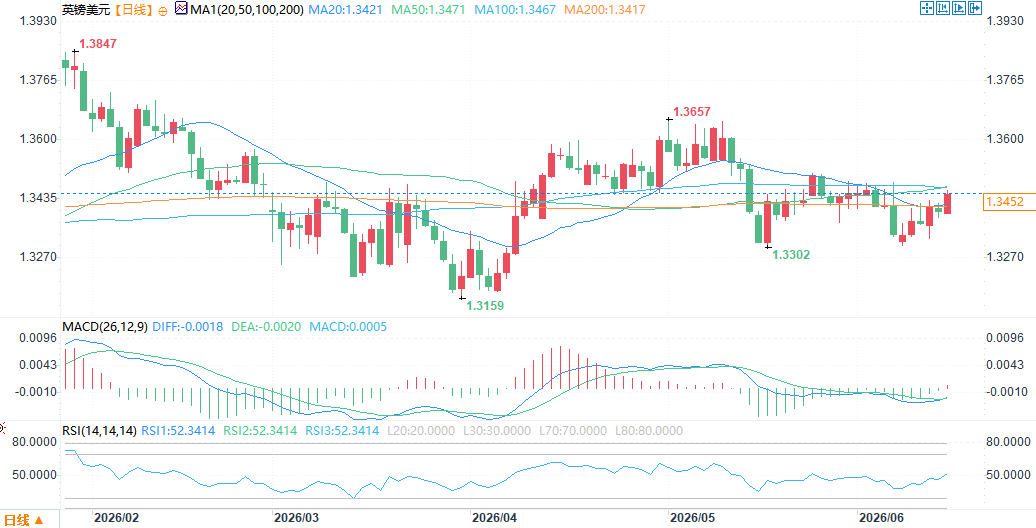
(GBP/USD daily chart, source: FX678)
At 14:22 Beijing time on June 15, the British pound was trading at 1.3446/47 against the US dollar.
Improved risk sentiment drove the pound higher.
Market sentiment improved significantly following news of a US-Iran agreement. Tensions, previously high due to escalating tensions in the Middle East, eased considerably, with investors shifting from safe-haven assets to riskier ones. Asian stock markets generally rose, with major markets such as Japan, South Korea, and Australia recording substantial gains, reflecting strong investor risk appetite.
Meanwhile, the US dollar index fell 0.4% to around 99.40, continuing its recent downward trend pressured by declining US inflation data and rising expectations of a Federal Reserve rate cut. The weakening dollar further provided upward support for higher-risk currencies such as the British pound and the Australian dollar.
The improved market sentiment was also reflected in the sharp drop in crude oil prices. As a bellwether for geopolitical risks, Brent crude and WTI crude futures both fell more than 4% in early Asian trading on Monday, indicating that the market is rapidly shedding the risk premium previously priced into oil prices. Analysts pointed out that the reopening of the Strait of Hormuz will release millions of barrels of crude oil supply per day, effectively easing tensions in the global energy market.
Pakistani Prime Minister Sheikh Sharif announced on the X platform that the memorandum of understanding between the US and Iran will be formally signed in Switzerland on June 19. This clear timeline further bolsters market confidence in the peace process. Sharif's statement, as a key mediator, adds credibility to the agreement.
The market is currently closely watching the specific arrangements for the signing ceremony, as well as the progress of discussions on core issues such as Iran's nuclear program and the lifting of sanctions during the subsequent 60-day negotiations. Analysts believe that if the subsequent negotiations proceed smoothly, the global geopolitical risk premium is expected to decline further, providing sustained support for risk assets.
This week is packed with key events.
Meanwhile, investors are bracing for a week of heightened volatility, particularly for the British pound. The UK will be the focus of global foreign exchange markets this week, with a flurry of key economic data and central bank decisions scheduled.
First, the UK will release its three-month labor market report to April. The market is closely watching changes in wage growth and the unemployment rate – these two indicators are key factors for the Bank of England in assessing domestic inflationary pressures. If wage growth remains high, it will strengthen market expectations that the Bank of England will maintain a hawkish stance, thus supporting the pound; conversely, if there are clear signs of a cooling labor market, it could weaken the pound's upward momentum.
Secondly, the May Consumer Price Index (CPI) data is also closely watched. Although global energy prices have recently declined due to easing tensions in the Middle East, inflation in the UK services sector remains sticky. The market expects the May CPI year-on-year increase to likely remain above the Bank of England's 2% target. Stronger-than-expected inflation data would increase pressure on the Bank of England to continue tightening policy.
The most crucial event will be the Bank of England's monetary policy statement. The market widely expects the Bank of England to keep interest rates unchanged, but investors will be closely watching Governor Bailey's remarks and the voting outcome. Any hints about the timing of future rate cuts or further rate hikes could trigger significant volatility in the pound.
In the US, investors will focus on the Federal Reserve's monetary policy decision on Wednesday. While the market widely expects the Fed to hold rates steady, with inflation returning above 4% and the bond market already pricing in a rate hike, Fed Chairman Warsh's remarks at his first press conference will be a key variable for global markets. The market will analyze the statement's wording carefully, looking for any clues about the future path of interest rates.
Analysts point out that if the Federal Reserve sends hawkish signals, the dollar may find support, thus putting pressure on the pound; conversely, if Warsh shows signs of compromising with the White House's demands for rate cuts, the dollar may weaken further, providing room for the pound to rise. The policy signals from the central banks of the UK and the US will have a cross-influence this week, and the pound-dollar exchange rate faces the risk of two-way volatility.
Institutional Views
Brown Brothers Harriman's research team holds a clear bearish stance on the pound against the dollar, predicting the exchange rate will fall to 1.3100, with a potential drop of more than 1%. The core logic behind this prediction is that the US economic growth outlook is significantly better than that of the UK.
BBH analyst Elias Haddad pointed out that UK GDP fell 0.1% month-on-month in April, the first monthly contraction since August 2025, mainly dragged down by a decline in service sector output. PMI data suggests that UK Q2 real GDP may have contracted by 0.2% quarter-on-quarter, lower than the Bank of England's baseline forecast of +0.1%. Meanwhile, the swap curve has significantly lowered its 12-month Bank of England interest rate hike expectations from 60 basis points to 40 basis points.
Furthermore, BBH warned that political risks in the UK could exacerbate downward pressure on the pound. The Mekfield by-election on June 18th (Mekfield is a parliamentary constituency in Greater Manchester, northwest England, between Manchester and Liverpool. It has been held by the Labour Party since its establishment in 1983 and is a traditional Labour stronghold) is attracting significant attention. Polls show Labour candidate Andy Burnham leading Reform Britain by 10 percentage points, and his return to Parliament could pose a leadership challenge to Prime Minister Starmer. A Labour government led by Burnham could increase spending and borrowing, worsening the UK's fiscal credibility. Technically, 1.3100 is a key support level; a break below this level could open a path to the 1.3000 mark.
Scotiabank strategists Shaun Osborne and Eric Theoret hold a neutral-to-bearish stance on the pound against the dollar, believing the pair is consolidating its recent gains around 1.3400, awaiting guidance from key data releases and the Bank of England's decision this week.
Scotiabank noted that UK April GDP met expectations, while industrial production and trade data were slightly disappointing. Domestic risks remain high this week: CPI data will be released on Wednesday, employment data on Thursday, and the Bank of England's interest rate decision and Labour by-election will both take place on the same day. The market widely expects the Bank of England to keep interest rates unchanged, but the risk lies in the Monetary Policy Committee's statement and guidance on the interest rate outlook – the market is currently pricing in a tightening of approximately 35 basis points by the end of the year. Political risks have increased due to the by-election results.
Technical Analysis
According to the daily chart of GBP/USD, the exchange rate is currently in a range-bound trading pattern. The price is fluctuating repeatedly within the 1.3302-1.3657 range, and is currently near the medium-term moving average, indicating a stalemate between bulls and bears.
On the moving average system, the price is almost flat with the MA20, MA50, MA100, and MA200, forming a converging pattern, indicating an unclear market direction and a lack of a clear trend. Resistance is concentrated in the 1.3450-1.3470 range, with further resistance at the previous high of 1.3657. Support is around 1.3300-1.3302, with a key defensive level at the low of 1.3159.
In terms of indicators, the MACD lines are converging near the zero axis, and the histogram is close to the zero axis, indicating that the momentum of both bulls and bears is not strong; the RSI is in the neutral range near 52, with no overbought or oversold signals, further confirming the current oscillating characteristics.
(GBP/USD daily chart, source: FX678)
At 14:22 Beijing time on June 15, the British pound was trading at 1.3446/47 against the US dollar.
- Risk Warning and Disclaimer
- The market involves risk, and trading may not be suitable for all investors. This article is for reference only and does not constitute personal investment advice, nor does it take into account certain users’ specific investment objectives, financial situation, or other needs. Any investment decisions made based on this information are at your own risk.