A decline in risk aversion pressured the dollar lower, and it is expected to remain in a high-level consolidation phase in the short term.
2026-06-15 14:31:33
The US dollar index (DXY) continued its pullback during Asian trading hours on Monday, trading around 99.50. This followed the announcement by the US and Iran of a peace agreement ending nearly four months of military conflict, increased expectations of reopening the Strait of Hormuz, and a significant improvement in global market risk appetite. Investors reduced their allocation to safe-haven assets such as the US dollar, pushing the dollar index down from its recent highs.

US President Donald Trump stated that the US will lift the maritime blockade against Iranian ports and push for the reopening of the Strait of Hormuz after the agreement is signed. The UK, France, Germany, and Italy have also indicated they will consider lifting sanctions if Iran takes appropriate measures on its nuclear program. The easing of tensions in the Middle East means reduced risks to global energy supplies, and market concerns about inflation caused by continued oil price increases have lessened.
Meanwhile, Iran's National Security Council confirmed a ceasefire agreement with the United States, but emphasized that final negotiations would only begin after relevant commitments were fulfilled. This means that the current peace framework remains somewhat uncertain. If subsequent negotiations encounter setbacks, market risk aversion may resurface, providing temporary support for the US dollar.
As energy prices have fallen, investors have readjusted their expectations for U.S. monetary policy. Data from the CME Group's FedWatch tool shows that following the U.S.-Iran peace agreement, the market expects the probability of another Fed rate hike in December to fall to about 27%, down from about 40% a week earlier. This cooling of rate hike expectations has reduced the interest rate advantage of dollar assets, a significant reason for the recent weakening of the dollar index.
However, the market still expects the Federal Reserve to maintain current interest rates at its upcoming policy meeting and continue to monitor inflation and economic data. If US inflation rebounds or the economy performs strongly in the future, the possibility of the Fed maintaining high interest rates or even further tightening policy remains, which will limit further downside for the dollar index.
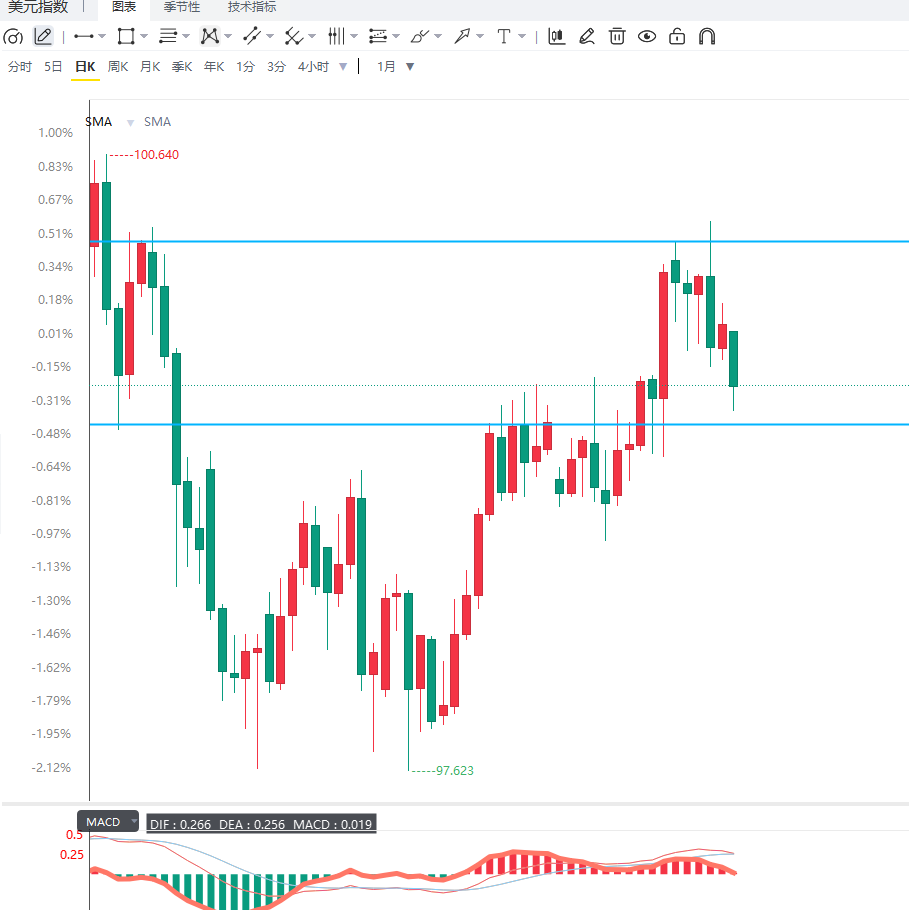
From a daily chart perspective, the US dollar index has faced resistance multiple times near the 100 level and has currently retreated to the 99.50 area, indicating a weakening of short-term upward momentum. With the price breaking below short-term moving average support, the market has entered a technical correction phase, but remains within a medium-term consolidation structure. Key support levels to watch are 99.00 and 98.30; a break below these levels could open up further downside potential. On the upside, the 100.00 and 100.80 areas remain significant short-term resistance levels. Only a firm hold above the 100 level could allow the dollar to regain further upward momentum.
From a 4-hour chart perspective, the US dollar index is showing a short-term downward trend, with the moving average system beginning to weaken and technical indicators suggesting that bearish momentum has eased somewhat, indicating a short-term bias towards a downward consolidation. However, considering the strong support around the 99 level, if the US dollar index can stabilize and break through the 100 level again, there is still a chance for a technical rebound; if it continues to trade below the 100 level, the downward trend may continue further.
Editor's Summary : The US-Iran peace agreement reduced market concerns about escalating tensions in the Middle East and energy supply disruptions, boosting market risk appetite and significantly weakening demand for the US dollar as a safe haven. Meanwhile, falling oil prices reduced market expectations for inflation and further Fed rate hikes, further pressuring the dollar index. However, the Fed remains in a wait-and-see phase, and US economic and inflation data will continue to dominate future policy paths. In the short term, the dollar index may maintain a weak and volatile trend, with support around 99.00 and the 100 level being crucial indicators for determining its next direction.
US President Donald Trump stated that the US will lift the maritime blockade against Iranian ports and push for the reopening of the Strait of Hormuz after the agreement is signed. The UK, France, Germany, and Italy have also indicated they will consider lifting sanctions if Iran takes appropriate measures on its nuclear program. The easing of tensions in the Middle East means reduced risks to global energy supplies, and market concerns about inflation caused by continued oil price increases have lessened.
Meanwhile, Iran's National Security Council confirmed a ceasefire agreement with the United States, but emphasized that final negotiations would only begin after relevant commitments were fulfilled. This means that the current peace framework remains somewhat uncertain. If subsequent negotiations encounter setbacks, market risk aversion may resurface, providing temporary support for the US dollar.
As energy prices have fallen, investors have readjusted their expectations for U.S. monetary policy. Data from the CME Group's FedWatch tool shows that following the U.S.-Iran peace agreement, the market expects the probability of another Fed rate hike in December to fall to about 27%, down from about 40% a week earlier. This cooling of rate hike expectations has reduced the interest rate advantage of dollar assets, a significant reason for the recent weakening of the dollar index.
However, the market still expects the Federal Reserve to maintain current interest rates at its upcoming policy meeting and continue to monitor inflation and economic data. If US inflation rebounds or the economy performs strongly in the future, the possibility of the Fed maintaining high interest rates or even further tightening policy remains, which will limit further downside for the dollar index.
From a daily chart perspective, the US dollar index has faced resistance multiple times near the 100 level and has currently retreated to the 99.50 area, indicating a weakening of short-term upward momentum. With the price breaking below short-term moving average support, the market has entered a technical correction phase, but remains within a medium-term consolidation structure. Key support levels to watch are 99.00 and 98.30; a break below these levels could open up further downside potential. On the upside, the 100.00 and 100.80 areas remain significant short-term resistance levels. Only a firm hold above the 100 level could allow the dollar to regain further upward momentum.
From a 4-hour chart perspective, the US dollar index is showing a short-term downward trend, with the moving average system beginning to weaken and technical indicators suggesting that bearish momentum has eased somewhat, indicating a short-term bias towards a downward consolidation. However, considering the strong support around the 99 level, if the US dollar index can stabilize and break through the 100 level again, there is still a chance for a technical rebound; if it continues to trade below the 100 level, the downward trend may continue further.
Editor's Summary : The US-Iran peace agreement reduced market concerns about escalating tensions in the Middle East and energy supply disruptions, boosting market risk appetite and significantly weakening demand for the US dollar as a safe haven. Meanwhile, falling oil prices reduced market expectations for inflation and further Fed rate hikes, further pressuring the dollar index. However, the Fed remains in a wait-and-see phase, and US economic and inflation data will continue to dominate future policy paths. In the short term, the dollar index may maintain a weak and volatile trend, with support around 99.00 and the 100 level being crucial indicators for determining its next direction.
- Risk Warning and Disclaimer
- The market involves risk, and trading may not be suitable for all investors. This article is for reference only and does not constitute personal investment advice, nor does it take into account certain users’ specific investment objectives, financial situation, or other needs. Any investment decisions made based on this information are at your own risk.