Crude oil analysis: After the risk premium recedes, will the $80-$85 range become the new battleground?
2026-06-15 15:02:43
On Monday, June 15, the core pricing strategy in the crude oil market quickly shifted from "supply being locked down" to "the possibility of a reopening of the Strait of Hormuz." The main trading themes focused on the interim agreement reached between the US and Iran, the potential reopening of the Strait of Hormuz, and the uncertainty surrounding the subsequent 60-day negotiations.

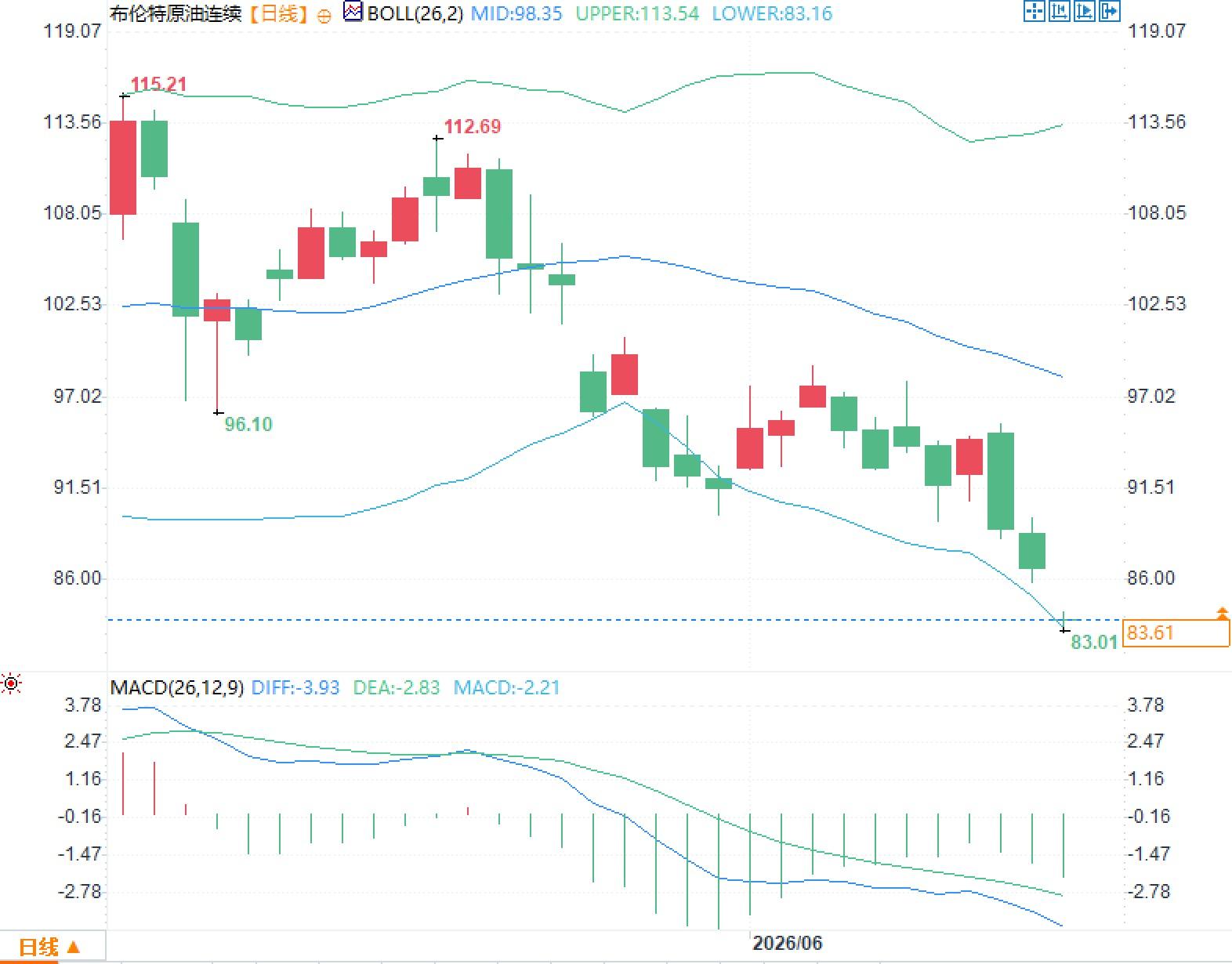
Brent crude futures are currently down to around $83.6 per barrel, compared to $87.33 per barrel in the previous trading session. The daily chart also shows that the lower Bollinger Band is around $83.16, and the MACD remains in negative territory, indicating that the price decline is not just a single day's news shock, but rather a result of a receding risk premium and weakening trend.
The immediate trigger for this round of decline was the expectation of reopening the Strait of Hormuz following the interim agreement between the US and Iran. In the preceding months, the market had factored in a portion of the premium in crude oil prices to compensate for risks such as transportation disruptions, rising insurance rates, shipping delays, and regional supply disruptions. After the agreement was announced, this premium was first compressed, with Brent crude falling by approximately 4% in a single day and dropping below $84 per barrel, reflecting that traders were reducing the weighting of "extreme disruption scenarios."
However, this does not equate to the disappearance of supply pressure. The Strait of Hormuz normally handles approximately 20 million barrels per day of oil and related liquids, equivalent to about 20% of global oil and liquids consumption, and is also a crucial route for liquefied natural gas (LNG) transportation. The price decline reflects a "mitigation of marginal risk," not a "full recovery of physical supply." If any aspect—channel clearing, insurance underwriting, port scheduling, or oil field resumption—slows down as expected, the spot market may still correct financial market pricing through narrowing discounts, strengthening crack spreads, or a renewed widening of spreads.
More noteworthy than price movements is the term structure. The Brent near-month spread has narrowed to a cash premium of less than $1/barrel, compared to over $12/barrel in April. While the near-month spread remains higher than the far-month spread, indicating the market hasn't fully shifted to a looser structure, the significant compression of the premium suggests that immediate delivery tightness is decreasing.
There are three layers of logic behind this change. First, the expectation of the resumption of shipping lanes has weakened panic buying in the near term. Second, the release of emergency inventories and the depletion of commercial inventories buffered the supply disruption in the early stages, reducing the necessity for buyers to compete for supplies in near-month contracts. Third, the high oil price phase has already suppressed some demand, and refineries and end-users have become more conservative in their purchasing pace. The International Energy Agency's May report predicted that, assuming that strait traffic gradually recovers from June, global oil supply could still decline by an average of 3.9 million barrels per day in 2026; refinery crude oil processing volumes are also constrained by feedstock availability and infrastructure issues. This means that the narrowing of the contract spread is more like a "correction of an extreme shortage" rather than a "formation of a supply glut."
The market tends to underestimate the technical challenges of resuming production. The restart of oil fields forced to shut down involves wellhead pressure management, pipeline integrity checks, storage tank scheduling, port berth arrangements, and the restoration of loading schedules. If some facilities have experienced damage or prolonged periods of reduced capacity operation, the resumption period may be measured in weeks or even months, rather than in the number of days following the announcement.
The same applies to the shipping sector. Even after the agreement is signed, shipowners, insurers, and cargo owners still need to confirm channel safety, insurance terms, toll arrangements, and liability boundaries. Some analysts believe the market still needs to understand the specific meaning of the agreement; even if the strait is planned to open, there may still be mine risks, and insurance institutions may maintain high rates. This statement doesn't necessarily imply bullish or bearish sentiment, but rather suggests the market needs to distinguish between the three stages: "political commitment," "shipping recovery," and "physical cargo flow recovery." Oil prices have already traded the first stage; if the latter two stages are not fully realized, volatility may rise again.
If oil prices stabilize in the $80-$85 range, it will reduce cost pressures on refined oil products, jet fuel, and chemical raw materials, and mitigate tail risks of inflation in major economies. As the Federal Reserve reviews interest rates this week, falling energy prices will prompt the market to reassess the inflation path. However, a decline in the price of a single commodity is not enough to directly change the path of monetary policy; it is also necessary to observe inflation, employment, and wage data.
Inventory is another constraint. Strategic and commercial inventories were rapidly utilized previously, and once shipping routes resume, restocking demand will re-enter the spot market. In other words, the return of supply will depress risk premiums, but inventory replenishment will lead to physical absorption at lower prices. If Brent crude remains below $84/barrel, refineries and traders may be more inclined to reduce inventory days, thus slowing the rate of further price declines. The core issue in the market has shifted from "whether there will be supply disruptions" to "whether the recovery speed is sufficient to cover restocking and summer demand."
Brent crude futures are currently down to around $83.6 per barrel, compared to $87.33 per barrel in the previous trading session. The daily chart also shows that the lower Bollinger Band is around $83.16, and the MACD remains in negative territory, indicating that the price decline is not just a single day's news shock, but rather a result of a receding risk premium and weakening trend.
Geopolitical premiums cleared quickly, oil price repricing and supply risks.
The immediate trigger for this round of decline was the expectation of reopening the Strait of Hormuz following the interim agreement between the US and Iran. In the preceding months, the market had factored in a portion of the premium in crude oil prices to compensate for risks such as transportation disruptions, rising insurance rates, shipping delays, and regional supply disruptions. After the agreement was announced, this premium was first compressed, with Brent crude falling by approximately 4% in a single day and dropping below $84 per barrel, reflecting that traders were reducing the weighting of "extreme disruption scenarios."
However, this does not equate to the disappearance of supply pressure. The Strait of Hormuz normally handles approximately 20 million barrels per day of oil and related liquids, equivalent to about 20% of global oil and liquids consumption, and is also a crucial route for liquefied natural gas (LNG) transportation. The price decline reflects a "mitigation of marginal risk," not a "full recovery of physical supply." If any aspect—channel clearing, insurance underwriting, port scheduling, or oil field resumption—slows down as expected, the spot market may still correct financial market pricing through narrowing discounts, strengthening crack spreads, or a renewed widening of spreads.
The narrowing spread between monthly contracts sends a key signal, indicating a marginal decrease in spot market tightness.
More noteworthy than price movements is the term structure. The Brent near-month spread has narrowed to a cash premium of less than $1/barrel, compared to over $12/barrel in April. While the near-month spread remains higher than the far-month spread, indicating the market hasn't fully shifted to a looser structure, the significant compression of the premium suggests that immediate delivery tightness is decreasing.
There are three layers of logic behind this change. First, the expectation of the resumption of shipping lanes has weakened panic buying in the near term. Second, the release of emergency inventories and the depletion of commercial inventories buffered the supply disruption in the early stages, reducing the necessity for buyers to compete for supplies in near-month contracts. Third, the high oil price phase has already suppressed some demand, and refineries and end-users have become more conservative in their purchasing pace. The International Energy Agency's May report predicted that, assuming that strait traffic gradually recovers from June, global oil supply could still decline by an average of 3.9 million barrels per day in 2026; refinery crude oil processing volumes are also constrained by feedstock availability and infrastructure issues. This means that the narrowing of the contract spread is more like a "correction of an extreme shortage" rather than a "formation of a supply glut."
Resuming production is not the same as opening the floodgates; there is a time lag between oil fields and shipping.
The market tends to underestimate the technical challenges of resuming production. The restart of oil fields forced to shut down involves wellhead pressure management, pipeline integrity checks, storage tank scheduling, port berth arrangements, and the restoration of loading schedules. If some facilities have experienced damage or prolonged periods of reduced capacity operation, the resumption period may be measured in weeks or even months, rather than in the number of days following the announcement.
The same applies to the shipping sector. Even after the agreement is signed, shipowners, insurers, and cargo owners still need to confirm channel safety, insurance terms, toll arrangements, and liability boundaries. Some analysts believe the market still needs to understand the specific meaning of the agreement; even if the strait is planned to open, there may still be mine risks, and insurance institutions may maintain high rates. This statement doesn't necessarily imply bullish or bearish sentiment, but rather suggests the market needs to distinguish between the three stages: "political commitment," "shipping recovery," and "physical cargo flow recovery." Oil prices have already traded the first stage; if the latter two stages are not fully realized, volatility may rise again.
Macroeconomic factors: Cooling oil prices ease inflationary pressures, but inventory replenishment limits downside potential.
If oil prices stabilize in the $80-$85 range, it will reduce cost pressures on refined oil products, jet fuel, and chemical raw materials, and mitigate tail risks of inflation in major economies. As the Federal Reserve reviews interest rates this week, falling energy prices will prompt the market to reassess the inflation path. However, a decline in the price of a single commodity is not enough to directly change the path of monetary policy; it is also necessary to observe inflation, employment, and wage data.
Inventory is another constraint. Strategic and commercial inventories were rapidly utilized previously, and once shipping routes resume, restocking demand will re-enter the spot market. In other words, the return of supply will depress risk premiums, but inventory replenishment will lead to physical absorption at lower prices. If Brent crude remains below $84/barrel, refineries and traders may be more inclined to reduce inventory days, thus slowing the rate of further price declines. The core issue in the market has shifted from "whether there will be supply disruptions" to "whether the recovery speed is sufficient to cover restocking and summer demand."
- Risk Warning and Disclaimer
- The market involves risk, and trading may not be suitable for all investors. This article is for reference only and does not constitute personal investment advice, nor does it take into account certain users’ specific investment objectives, financial situation, or other needs. Any investment decisions made based on this information are at your own risk.