The euro rose on risk appetite, with the Fed's decision and Warsh's debut drawing attention, and the ECB hinting at another rate hike in July.
2026-06-15 14:55:38
On Monday (June 15) during the Asian session, the euro rose against the US dollar, gaining nearly 0.35%, and is currently trading around 1.1605.
The announcement of a peace framework agreement between the United States and Iran significantly improved market risk sentiment, providing support for the euro. Meanwhile, market focus is shifting to Wednesday's Federal Reserve interest rate decision and the latest statements from European Central Bank officials.
Washington and Tehran announced a framework agreement for peace, to be formally signed in Switzerland on Friday. This breakthrough marks the imminent arrival of a substantial ceasefire in the nearly four-month-long war with Iran, and tensions in the Middle East are expected to ease significantly. US President Trump stated that the US will lift the naval blockade on Iranian ports, and the Strait of Hormuz will reopen after the agreement is signed. As the world's most important oil shipping chokepoint, the Strait of Hormuz handles approximately 20% of global oil shipments daily; its reopening significantly reduces the risk of oil supply disruptions.
This news significantly improved risk appetite in global markets. Funds that had previously flowed into safe-haven assets such as the US dollar and gold due to escalating war began to flow back into risk assets, leading to widespread gains in stock markets in Europe, the US, and Asia. International oil prices, a bellwether for geopolitical risks, fell in response, with Brent crude and WTI crude futures both dropping more than 4% in early Asian trading on Monday, indicating that the market is rapidly removing the risk premium previously priced into oil prices.
Analysts point out that the peace agreement will effectively alleviate tensions in the global energy market and create conditions for a decline in inflationary pressures.
Meanwhile, Trump's statements regarding lifting the blockade and opening the Straits further solidified market confidence in the peace process. Pakistani Prime Minister Shebaz Sharif, as a mediator, confirmed on the X platform that the memorandum of understanding would be formally signed on June 19th, adding credibility to the agreement. The market is currently closely watching Friday's signing ceremony and the progress of discussions on key issues such as Iran's nuclear program and the lifting of sanctions during the subsequent 60 days of negotiations.
Boosted by this, risk-sensitive currencies such as the euro gained upward momentum, with the euro rising to around 1.1610 against the dollar, while the dollar index came under pressure and fell to around 99.40.
Analysts believe that if subsequent negotiations proceed smoothly, the global geopolitical risk premium is expected to decline further, providing sustained support for risk assets.
The market widely expects the Federal Reserve to keep its benchmark interest rate unchanged at 3.50% to 3.75% at its policy meeting on Wednesday. However, with inflation returning above 4%, the bond market beginning to price in a year-end rate hike, and Trump continuing to pressure for rate cuts, the decision to "keep it unchanged" is far less important than the signals that new Chairman Warsh will send.
Investors will be closely watching the subsequent press conference, Warsh's first public policy communication since taking office. Market participants will scrutinize any changes in the FOMC statement's wording and analyze every word Warsh utters at the press conference. These details will be key clues in determining where this former hawkish governor, now advocating "pragmatic monetarism," will steer US monetary policy—whether he will maintain a hardline stance against inflation or succumb to political pressure.
Analysts point out that any hawkish comments from Federal Reserve officials, including hints at a rise in the neutral interest rate, maintaining the option of a rate hike at the end of the year, or expressing concerns about upside risks to inflation, could push up the dollar. The dollar index is currently trading around 99.50, near a one-month low, and is quite sensitive to hawkish signals. If the dollar finds support, the euro will face downward pressure against the dollar, potentially giving back recent gains from the US-Iran agreement. Conversely, if Warsh shows signs of compromising with the White House's demands for rate cuts and releases dovish signals, the dollar may weaken further, providing upside potential for the euro.
The market is currently paying close attention to this meeting, and any unexpected changes in wording could trigger significant volatility in the currency market. Investors will be looking for clues about the Fed's future interest rate path in Warsh's debut to adjust their euro/dollar positions.
Last week, the European Central Bank (ECB) announced a 25 basis point increase in its key interest rate to 2.75%, the first rate hike since September 2023, ending a seven-day streak of holding rates steady. The ECB stated that the decision was based on "inflationary pressures arising from the Middle East conflict"—the war with Iran leading to the closure of the Strait of Hormuz has driven up energy prices, significantly impacting inflation in the Eurozone.
European Central Bank Governing Council member Joachim Nagel further signaled a hawkish stance last Friday, stating that the central bank is prepared to raise interest rates for a second consecutive meeting in July should the impact of the Middle East conflict necessitate it. He warned that rising energy prices could have a second-round effect that spreads to broader sectors of the economy.
This hawkish statement provided additional support for the euro, reflecting the potential divergence in policy paths between the European Central Bank (ECB) and the Federal Reserve—the ECB hinted at further rate hikes in July, while the Fed is expected to hold rates steady this week. This divergence in monetary policy is expected to provide upward momentum for the euro against the dollar in the short term.
Nordea's chief analyst, Jan von Gerich, holds a medium-term bullish view on the euro against the dollar. He noted that despite recent strong US data and the continued favorable interest rate differential between the US and Europe for the dollar, the euro has remained trapped in the 1.15-1.16 range and has not fallen further.
von Gerich's core argument is that the recent performance of the US dollar has actually fallen short of historical patterns. Given its interest rate advantage, economic lead, and escalating geopolitical tensions, the dollar should historically have performed stronger, but its actual performance has been relatively mild. He believes this reflects a weakening of market confidence in the dollar's underlying potential.
Based on this assessment, Nordea maintains its medium-term expectation of a stronger euro against the US dollar.
Rabobank senior foreign exchange strategist Jane Foley expects the euro to remain largely range-bound against the dollar in the short term, as the market awaits progress on the US-Iran agreement and US economic data that could alter expectations for Federal Reserve policy.
She pointed out that, considering the risks to economic growth in the Eurozone, reaching 1.20 against the dollar this year will remain a "challenging target." While the Fed's October rate cut should allow the euro to trend upward in the second half of the year, the market has already priced in two ECB rate hikes, and Eurozone growth headwinds may limit the euro's upside potential.
According to the EUR/USD daily chart, the exchange rate is currently in a technical correction phase above a key support zone. After previously testing a low of 1.1499, the price rebounded and is currently fluctuating within the 1.1500-1.1650 range, with a stalemate between bulls and bears.
On the moving average system, the short-term price has risen above the MA20, but is still suppressed by the MA50 and MA100. The medium-term moving averages are flat, lacking clear trend guidance. The area around 1.1650 is a strong resistance formed by the MA100 and the previous densely traded area; a break above this level is needed to open up room for a rebound. On the downside, 1.1500 is a key support level; a break below this level would likely restart the downward trend.
In terms of indicators, the MACD lines are converging below the zero line, and the momentum bars are close to the zero line, indicating that the rebound momentum is weak; the RSI is in the neutral range with no overbought or oversold signals, confirming the current oscillating characteristics.
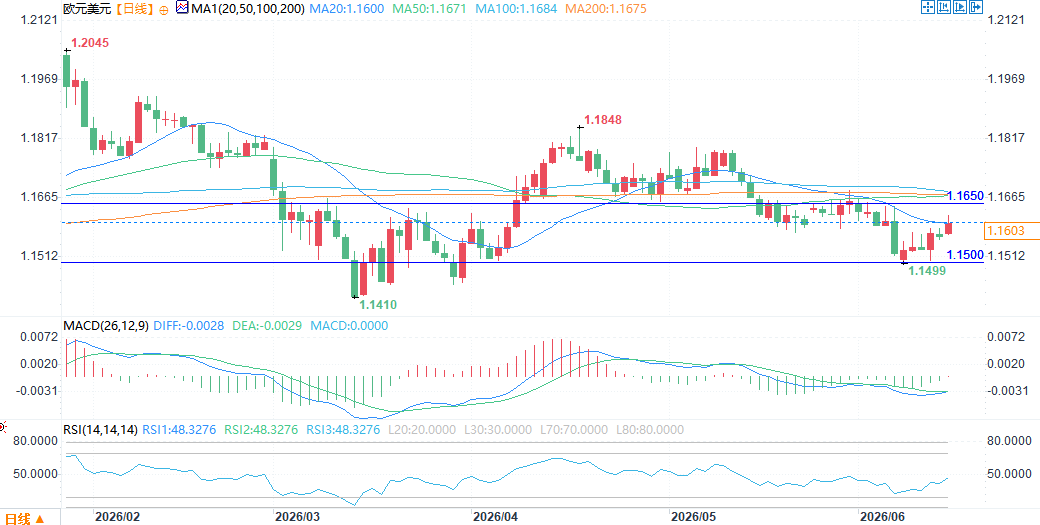
(Euro/USD daily chart, source: FX678)
At 14:55 Beijing time on June 15, the euro was trading at 1.1605/06 against the US dollar.
The announcement of a peace framework agreement between the United States and Iran significantly improved market risk sentiment, providing support for the euro. Meanwhile, market focus is shifting to Wednesday's Federal Reserve interest rate decision and the latest statements from European Central Bank officials.
The US and Iran reached a peace framework agreement, improving risk sentiment.
Washington and Tehran announced a framework agreement for peace, to be formally signed in Switzerland on Friday. This breakthrough marks the imminent arrival of a substantial ceasefire in the nearly four-month-long war with Iran, and tensions in the Middle East are expected to ease significantly. US President Trump stated that the US will lift the naval blockade on Iranian ports, and the Strait of Hormuz will reopen after the agreement is signed. As the world's most important oil shipping chokepoint, the Strait of Hormuz handles approximately 20% of global oil shipments daily; its reopening significantly reduces the risk of oil supply disruptions.
This news significantly improved risk appetite in global markets. Funds that had previously flowed into safe-haven assets such as the US dollar and gold due to escalating war began to flow back into risk assets, leading to widespread gains in stock markets in Europe, the US, and Asia. International oil prices, a bellwether for geopolitical risks, fell in response, with Brent crude and WTI crude futures both dropping more than 4% in early Asian trading on Monday, indicating that the market is rapidly removing the risk premium previously priced into oil prices.
Analysts point out that the peace agreement will effectively alleviate tensions in the global energy market and create conditions for a decline in inflationary pressures.
Meanwhile, Trump's statements regarding lifting the blockade and opening the Straits further solidified market confidence in the peace process. Pakistani Prime Minister Shebaz Sharif, as a mediator, confirmed on the X platform that the memorandum of understanding would be formally signed on June 19th, adding credibility to the agreement. The market is currently closely watching Friday's signing ceremony and the progress of discussions on key issues such as Iran's nuclear program and the lifting of sanctions during the subsequent 60 days of negotiations.
Boosted by this, risk-sensitive currencies such as the euro gained upward momentum, with the euro rising to around 1.1610 against the dollar, while the dollar index came under pressure and fell to around 99.40.
Analysts believe that if subsequent negotiations proceed smoothly, the global geopolitical risk premium is expected to decline further, providing sustained support for risk assets.
The Federal Reserve's decision is under close scrutiny.
The market widely expects the Federal Reserve to keep its benchmark interest rate unchanged at 3.50% to 3.75% at its policy meeting on Wednesday. However, with inflation returning above 4%, the bond market beginning to price in a year-end rate hike, and Trump continuing to pressure for rate cuts, the decision to "keep it unchanged" is far less important than the signals that new Chairman Warsh will send.
Investors will be closely watching the subsequent press conference, Warsh's first public policy communication since taking office. Market participants will scrutinize any changes in the FOMC statement's wording and analyze every word Warsh utters at the press conference. These details will be key clues in determining where this former hawkish governor, now advocating "pragmatic monetarism," will steer US monetary policy—whether he will maintain a hardline stance against inflation or succumb to political pressure.
Analysts point out that any hawkish comments from Federal Reserve officials, including hints at a rise in the neutral interest rate, maintaining the option of a rate hike at the end of the year, or expressing concerns about upside risks to inflation, could push up the dollar. The dollar index is currently trading around 99.50, near a one-month low, and is quite sensitive to hawkish signals. If the dollar finds support, the euro will face downward pressure against the dollar, potentially giving back recent gains from the US-Iran agreement. Conversely, if Warsh shows signs of compromising with the White House's demands for rate cuts and releases dovish signals, the dollar may weaken further, providing upside potential for the euro.
The market is currently paying close attention to this meeting, and any unexpected changes in wording could trigger significant volatility in the currency market. Investors will be looking for clues about the Fed's future interest rate path in Warsh's debut to adjust their euro/dollar positions.
ECB sends hawkish signals
Last week, the European Central Bank (ECB) announced a 25 basis point increase in its key interest rate to 2.75%, the first rate hike since September 2023, ending a seven-day streak of holding rates steady. The ECB stated that the decision was based on "inflationary pressures arising from the Middle East conflict"—the war with Iran leading to the closure of the Strait of Hormuz has driven up energy prices, significantly impacting inflation in the Eurozone.
European Central Bank Governing Council member Joachim Nagel further signaled a hawkish stance last Friday, stating that the central bank is prepared to raise interest rates for a second consecutive meeting in July should the impact of the Middle East conflict necessitate it. He warned that rising energy prices could have a second-round effect that spreads to broader sectors of the economy.
This hawkish statement provided additional support for the euro, reflecting the potential divergence in policy paths between the European Central Bank (ECB) and the Federal Reserve—the ECB hinted at further rate hikes in July, while the Fed is expected to hold rates steady this week. This divergence in monetary policy is expected to provide upward momentum for the euro against the dollar in the short term.
Institutional Views
Nordea's chief analyst, Jan von Gerich, holds a medium-term bullish view on the euro against the dollar. He noted that despite recent strong US data and the continued favorable interest rate differential between the US and Europe for the dollar, the euro has remained trapped in the 1.15-1.16 range and has not fallen further.
von Gerich's core argument is that the recent performance of the US dollar has actually fallen short of historical patterns. Given its interest rate advantage, economic lead, and escalating geopolitical tensions, the dollar should historically have performed stronger, but its actual performance has been relatively mild. He believes this reflects a weakening of market confidence in the dollar's underlying potential.
Based on this assessment, Nordea maintains its medium-term expectation of a stronger euro against the US dollar.
Rabobank senior foreign exchange strategist Jane Foley expects the euro to remain largely range-bound against the dollar in the short term, as the market awaits progress on the US-Iran agreement and US economic data that could alter expectations for Federal Reserve policy.
She pointed out that, considering the risks to economic growth in the Eurozone, reaching 1.20 against the dollar this year will remain a "challenging target." While the Fed's October rate cut should allow the euro to trend upward in the second half of the year, the market has already priced in two ECB rate hikes, and Eurozone growth headwinds may limit the euro's upside potential.
Technical Analysis
According to the EUR/USD daily chart, the exchange rate is currently in a technical correction phase above a key support zone. After previously testing a low of 1.1499, the price rebounded and is currently fluctuating within the 1.1500-1.1650 range, with a stalemate between bulls and bears.
On the moving average system, the short-term price has risen above the MA20, but is still suppressed by the MA50 and MA100. The medium-term moving averages are flat, lacking clear trend guidance. The area around 1.1650 is a strong resistance formed by the MA100 and the previous densely traded area; a break above this level is needed to open up room for a rebound. On the downside, 1.1500 is a key support level; a break below this level would likely restart the downward trend.
In terms of indicators, the MACD lines are converging below the zero line, and the momentum bars are close to the zero line, indicating that the rebound momentum is weak; the RSI is in the neutral range with no overbought or oversold signals, confirming the current oscillating characteristics.
(Euro/USD daily chart, source: FX678)
At 14:55 Beijing time on June 15, the euro was trading at 1.1605/06 against the US dollar.
- Risk Warning and Disclaimer
- The market involves risk, and trading may not be suitable for all investors. This article is for reference only and does not constitute personal investment advice, nor does it take into account certain users’ specific investment objectives, financial situation, or other needs. Any investment decisions made based on this information are at your own risk.