What will happen to the dollar when the Walsh black box is lifted?
2026-06-15 21:19:58
On Monday (June 15), the US dollar index continued its weakness, hovering around a low of 99.49, with the downtrend remaining unchanged. Market trading volume was relatively light, with attention entirely focused on the upcoming June Federal Reserve interest rate meeting. This will be the first press conference since the new chairman, Warsh, took office, and his statements on the inflation outlook and interest rate path will directly fill the "black box" of his policy framework.
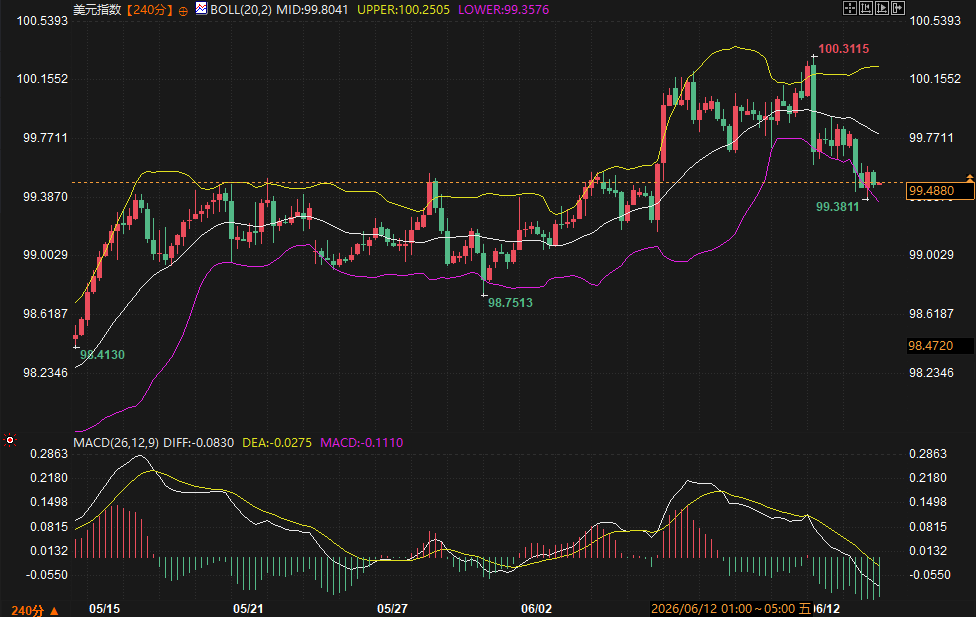
Looking at the charts, the US dollar index exhibits a typical three-stage structure on the 240-minute chart: a breakout from a high level followed by a downward move and then a weak consolidation at a low level. The Bollinger Bands are widening downwards, with the price closely following the lower band. The MACD has formed a death cross below the zero line, and the green bars are expanding. The technical indicators have already allowed for potential volatility, and any slight change in the fundamentals could trigger a trend acceleration or a sharp correction. The changes in the policy statement's wording at this meeting, as well as Warsh's interpretation of the economic "crosscurrents," are key variables in breaking the current dollar stalemate.
The market's focus at this policy meeting has completely shifted from "whether to cut interest rates" to "when to raise interest rates" and Warsh's personal style. Currently, the federal funds rate is in the 3.50%-3.75% range, and the mainstream market expectation is that the rate will remain unchanged at this meeting. The key points to watch are twofold: the shift in the wording of the policy statement and Warsh's description of inflation .
From a fundamental perspective, rising energy prices triggered by tariff rhetoric and geopolitical factors are showing signs of solidifying into persistent inflation, turning what was initially seen as a temporary price shock. Meanwhile, the job market is nearing full employment, and regional Federal Reserve reports mention rising wage pressures. Against this backdrop, market observers believe Warsh will have to break his silence. A well-known institution quoted a fixed-income portfolio manager as saying that Warsh has previously focused more on balance sheets and communication strategies, and the inflation transmission mechanism and monetary policy stance remain an unexplored "black box."
However, existing information suggests that Warsh is not inclined to provide overly strong "forward guidance." If he combines his assessment of upside risks to inflation with phrases like "data-dependent" and "not in a hurry to act," the market might interpret this as a willingness to tolerate inflation overshooting, thus putting pressure on the dollar. Conversely, if the policy statement abandons the phrase "the next step may be a rate cut" and adopts a neutral stance, coupled with a subsequent dot plot showing more members expecting a rate hike this year, it could temporarily boost the dollar. However, the chief US economist at one institution believes that Warsh will "pass the buck" on the inflation issue; he will not completely rule out a rate cut, but only if the data proves that the energy shock has passed.
Extending the above policy logic to the technical analysis, the current market has already priced in some of the uncertainty. The 4-hour chart for the US Dollar Index shows that the Bollinger Band middle line at 99.80 is the lifeline for the bulls and also the first hurdle for trend reversal; the upper line at 100.25 constitutes strong medium-term resistance. On the downside, the lower line at 99.35 is a fragile short-term support. Once the policy tone is confirmed to be dovish, the price will quickly test the recent low of 98.75 , and may even slide towards the cycle's absolute low of 98.41 .
Technical indicators and price movements are trending downwards in tandem, with no bullish divergence signal, indicating that there is still room for further downward momentum. Close attention should be paid to the micro-structure within the 99.35-99.80 range during the trading session. The downtrend remains intact until any rebound can effectively close above the middle Bollinger Band.
In the short term, the direction of the US dollar index hinges entirely on how Warsh constructs his inflation narrative. If he acknowledges that inflation is stickier than expected and hints that the policy framework needs to be adjusted towards tightening, the dollar could use this opportunity to launch a corrective rebound towards the resistance zones around 99.80 and 100.25. A more probable scenario is that Warsh tends to maintain policy flexibility, emphasizing uncertainty and data dependence. This would lead the market to continue trading along its existing logic: weak policy expectations combined with a bearish technical outlook would cause the dollar to retest 98.75 or even lower.
The sustainability of this trend depends on the combined relationship between the median interest rate and inflation forecasts. If the Fed raises its median inflation forecast without correspondingly adjusting the interest rate path, it will exacerbate market doubts about its "out-of-the-curve" performance, which is detrimental to the dollar in the long term. The market outlook requires close monitoring of all signals from Warsh's preferences: the pace of balance sheet reduction, his views on AI's productivity-enhancing effects, and his questioning of inflation accounting methods—all of which could become new anchors for future dollar pricing.
Why is Warsh's first press conference more important than the interest rate decision itself?
The market has already fully priced in the decision to keep interest rates unchanged at this meeting. The real variable is Warsh. He has historically focused on structural issues such as balance sheets, rarely commenting on the traditional policy framework for inflation and employment, creating a "black box." His first statement will reveal his true views on current inflation stickiness and the transmission chain of energy shocks, which will reshape market expectations for future policy paths and directly impact the pricing of the dollar.
What wording changes in the policy statement would be most detrimental to dollar bulls?
The most unfavorable combination of wording for the dollar is: removing the phrase "the next step may be an interest rate cut," indicating a retreat of the dovish camp, but at the same time, Warsh tried to downplay the sustainability of inflation in the press conference, emphasizing the base effect and the unsustainability of energy prices, and even reiterating the claim that inflation is "overestimated." This "ostensibly neutral stance, but actually avoiding tightening" will be interpreted as a sign that interest rate hikes are still far off, and the dollar's bearish trend will be strengthened.
Have raster charts lost their guiding function?
Not entirely, but its reference value is being diluted by Warsh's communication preferences. Some believe Warsh dislikes the dot plot, but he's unlikely to abandon it outright at this meeting. The key is that if the dot plot indicates a rate hike this year, while Warsh's remarks downplay it, the conflict will create confusion. The market will ultimately price in Warsh's statements. Additionally, former official Mullen's extremely low interest rate expectations will disappear, potentially causing the median to shift upward, but this technical change needs to be considered in conjunction with Warsh's statement.
Technical analysis suggests that the US dollar has support around 98.41. Will this level be broken?
This level represents the cycle low reached in mid-June, providing some psychological support. Whether it breaks through depends entirely on the signals Warsh releases. If Warsh takes a completely open stance to tightening, this could constitute a temporary bottom. Conversely, if he adopts a laissez-faire or "temporary" approach to inflation, given the strong bearish momentum and the lack of a bullish divergence, the dollar index will likely break through 98.41, subsequently opening up a new round of downward movement.
What are the current market concerns about the Federal Reserve's long-term policy framework?
One institution, citing the views of a former head of the Federal Reserve's monetary affairs department, pointed out that it would be a "bad performance" for the Fed to say now that inflation is high but take no action because it excludes specific components or considers it temporary. The market is worried that Warsh will repeat the mistakes of his predecessor's early assessments, namely, remaining complacent about rising prices despite a strong labor market and fiscal shocks. This risk of runaway inflation expectations is a long-term sword hanging over the heads of dollar bulls.
Looking at the charts, the US dollar index exhibits a typical three-stage structure on the 240-minute chart: a breakout from a high level followed by a downward move and then a weak consolidation at a low level. The Bollinger Bands are widening downwards, with the price closely following the lower band. The MACD has formed a death cross below the zero line, and the green bars are expanding. The technical indicators have already allowed for potential volatility, and any slight change in the fundamentals could trigger a trend acceleration or a sharp correction. The changes in the policy statement's wording at this meeting, as well as Warsh's interpretation of the economic "crosscurrents," are key variables in breaking the current dollar stalemate.
The fundamental "black box" remains unsolved, while the technical weakness is already evident.
The market's focus at this policy meeting has completely shifted from "whether to cut interest rates" to "when to raise interest rates" and Warsh's personal style. Currently, the federal funds rate is in the 3.50%-3.75% range, and the mainstream market expectation is that the rate will remain unchanged at this meeting. The key points to watch are twofold: the shift in the wording of the policy statement and Warsh's description of inflation .
From a fundamental perspective, rising energy prices triggered by tariff rhetoric and geopolitical factors are showing signs of solidifying into persistent inflation, turning what was initially seen as a temporary price shock. Meanwhile, the job market is nearing full employment, and regional Federal Reserve reports mention rising wage pressures. Against this backdrop, market observers believe Warsh will have to break his silence. A well-known institution quoted a fixed-income portfolio manager as saying that Warsh has previously focused more on balance sheets and communication strategies, and the inflation transmission mechanism and monetary policy stance remain an unexplored "black box."
However, existing information suggests that Warsh is not inclined to provide overly strong "forward guidance." If he combines his assessment of upside risks to inflation with phrases like "data-dependent" and "not in a hurry to act," the market might interpret this as a willingness to tolerate inflation overshooting, thus putting pressure on the dollar. Conversely, if the policy statement abandons the phrase "the next step may be a rate cut" and adopts a neutral stance, coupled with a subsequent dot plot showing more members expecting a rate hike this year, it could temporarily boost the dollar. However, the chief US economist at one institution believes that Warsh will "pass the buck" on the inflation issue; he will not completely rule out a rate cut, but only if the data proves that the energy shock has passed.
Extending the above policy logic to the technical analysis, the current market has already priced in some of the uncertainty. The 4-hour chart for the US Dollar Index shows that the Bollinger Band middle line at 99.80 is the lifeline for the bulls and also the first hurdle for trend reversal; the upper line at 100.25 constitutes strong medium-term resistance. On the downside, the lower line at 99.35 is a fragile short-term support. Once the policy tone is confirmed to be dovish, the price will quickly test the recent low of 98.75 , and may even slide towards the cycle's absolute low of 98.41 .
Technical indicators and price movements are trending downwards in tandem, with no bullish divergence signal, indicating that there is still room for further downward momentum. Close attention should be paid to the micro-structure within the 99.35-99.80 range during the trading session. The downtrend remains intact until any rebound can effectively close above the middle Bollinger Band.
The US dollar is expected to experience significant fluctuations before and after the press conference.
In the short term, the direction of the US dollar index hinges entirely on how Warsh constructs his inflation narrative. If he acknowledges that inflation is stickier than expected and hints that the policy framework needs to be adjusted towards tightening, the dollar could use this opportunity to launch a corrective rebound towards the resistance zones around 99.80 and 100.25. A more probable scenario is that Warsh tends to maintain policy flexibility, emphasizing uncertainty and data dependence. This would lead the market to continue trading along its existing logic: weak policy expectations combined with a bearish technical outlook would cause the dollar to retest 98.75 or even lower.
The sustainability of this trend depends on the combined relationship between the median interest rate and inflation forecasts. If the Fed raises its median inflation forecast without correspondingly adjusting the interest rate path, it will exacerbate market doubts about its "out-of-the-curve" performance, which is detrimental to the dollar in the long term. The market outlook requires close monitoring of all signals from Warsh's preferences: the pace of balance sheet reduction, his views on AI's productivity-enhancing effects, and his questioning of inflation accounting methods—all of which could become new anchors for future dollar pricing.
Frequently Asked Questions
Why is Warsh's first press conference more important than the interest rate decision itself?
The market has already fully priced in the decision to keep interest rates unchanged at this meeting. The real variable is Warsh. He has historically focused on structural issues such as balance sheets, rarely commenting on the traditional policy framework for inflation and employment, creating a "black box." His first statement will reveal his true views on current inflation stickiness and the transmission chain of energy shocks, which will reshape market expectations for future policy paths and directly impact the pricing of the dollar.
What wording changes in the policy statement would be most detrimental to dollar bulls?
The most unfavorable combination of wording for the dollar is: removing the phrase "the next step may be an interest rate cut," indicating a retreat of the dovish camp, but at the same time, Warsh tried to downplay the sustainability of inflation in the press conference, emphasizing the base effect and the unsustainability of energy prices, and even reiterating the claim that inflation is "overestimated." This "ostensibly neutral stance, but actually avoiding tightening" will be interpreted as a sign that interest rate hikes are still far off, and the dollar's bearish trend will be strengthened.
Have raster charts lost their guiding function?
Not entirely, but its reference value is being diluted by Warsh's communication preferences. Some believe Warsh dislikes the dot plot, but he's unlikely to abandon it outright at this meeting. The key is that if the dot plot indicates a rate hike this year, while Warsh's remarks downplay it, the conflict will create confusion. The market will ultimately price in Warsh's statements. Additionally, former official Mullen's extremely low interest rate expectations will disappear, potentially causing the median to shift upward, but this technical change needs to be considered in conjunction with Warsh's statement.
Technical analysis suggests that the US dollar has support around 98.41. Will this level be broken?
This level represents the cycle low reached in mid-June, providing some psychological support. Whether it breaks through depends entirely on the signals Warsh releases. If Warsh takes a completely open stance to tightening, this could constitute a temporary bottom. Conversely, if he adopts a laissez-faire or "temporary" approach to inflation, given the strong bearish momentum and the lack of a bullish divergence, the dollar index will likely break through 98.41, subsequently opening up a new round of downward movement.
What are the current market concerns about the Federal Reserve's long-term policy framework?
One institution, citing the views of a former head of the Federal Reserve's monetary affairs department, pointed out that it would be a "bad performance" for the Fed to say now that inflation is high but take no action because it excludes specific components or considers it temporary. The market is worried that Warsh will repeat the mistakes of his predecessor's early assessments, namely, remaining complacent about rising prices despite a strong labor market and fiscal shocks. This risk of runaway inflation expectations is a long-term sword hanging over the heads of dollar bulls.
- Risk Warning and Disclaimer
- The market involves risk, and trading may not be suitable for all investors. This article is for reference only and does not constitute personal investment advice, nor does it take into account certain users’ specific investment objectives, financial situation, or other needs. Any investment decisions made based on this information are at your own risk.