Goldman Sachs has just lowered its oil price forecast—what does this mean for the global economy and oil-producing countries?
2026-06-16 13:44:39
Brent crude oil futures fluctuated and fell during Asian trading hours on Tuesday (June 16), currently down about 0.8% to around $82.80 per barrel. Oil prices had previously fallen for three consecutive trading days.
The decline in Brent crude oil futures prices was mainly driven by the continued easing of geopolitical tensions in the Middle East. With the progress of the US-Iran ceasefire memorandum of understanding and the gradual improvement in navigation conditions in the Strait of Hormuz, market concerns about tight crude oil supply have significantly subsided, putting downward pressure on oil prices.
On Tuesday, Goldman Sachs released its latest oil market forecast report, making significant adjustments to its outlook for global crude oil prices. The firm lowered its Brent crude oil price forecast for the fourth quarter of 2026 from $90 per barrel to $80 per barrel, while also reducing its full-year average Brent crude oil price forecast for 2027 from $80 to $75. This adjustment reflects a significant increase in market expectations regarding the easing of geopolitical risks in the Middle East.

Goldman Sachs' significant revision to its forecast reflects the institution's optimistic assessment of a rapid easing of tensions in the Middle East. The target price for Brent crude oil in the fourth quarter of 2026 was lowered by $10 to $80 per barrel, and the average price for the whole of 2027 was lowered by $5 to $75 per barrel.
Meanwhile, Goldman Sachs forecasts an average price of $75 per barrel for West Texas Intermediate (WTI) crude oil in the fourth quarter of 2026 and $70 per barrel in 2027. These figures are the latest updates released by Goldman Sachs on the morning of June 16th and are among the most authoritative institutional forecasts currently available.
The adjustment is made against the backdrop of progress in the US-Iran armistice memorandum of understanding. Navigation in the Strait of Hormuz is gradually resuming, which is expected to ease the global oil supply shortage. Goldman Sachs assumes that Persian Gulf exports will recover to pre-war levels by the end of July, about a month earlier than previously predicted by the end of August. This forward timeline is mainly due to the progress of the agreement announced by Trump, including the lifting of the maritime blockade and the restoration of freedom of navigation.
Previously, oil prices had soared due to conflicts disrupting approximately one-fifth of global oil shipments. Now, expectations of a supply recovery are directly reducing geopolitical risk premiums.
In addition, Goldman Sachs also considered global demand factors. Trends such as slower global economic growth and accelerated substitution of new energy sources in 2026-2027 also support the judgment that oil prices will shift downwards. Shipping companies have begun planning to resume normal routes, and energy traders are accelerating inventory adjustments.
The early recovery of Persian Gulf exports to pre-war levels will have multiple positive impacts on the global energy supply chain. As a crucial chokepoint for global crude oil transportation, the resumption of free navigation through the Strait of Hormuz has significantly reduced transportation costs, decreased detours, and improved logistics efficiency. It is expected that international tanker capacity will be rapidly released in the short term, facilitating inventory replenishment in major importing regions such as Asia and Europe, and helping to mitigate regional energy price disparities.
For oil-producing countries, the recovery in exports means a rebound in revenue, but declining oil prices also bring fiscal pressure. Gulf states such as Saudi Arabia and the UAE need to balance their production policies to maintain market stability. OPEC+ may face a new round of coordination challenges. For downstream industries, costs in chemicals, aviation, logistics, and manufacturing are expected to decrease, further easing global inflationary pressures and providing support for economic recovery.
However, uncertainties remain regarding the recovery process. Details of the agreement's implementation, potential localized frictions, and the positions of parties like Israel could all impact actual air traffic efficiency. Goldman Sachs emphasizes that the end-of-July recovery target is based on current optimistic assumptions; if delays occur after the formal signing ceremony between the US and Iran (expected to be held in Switzerland on June 19), oil price volatility could still intensify. Overall, this shift marks a transition in the energy market from crisis mode to normalcy.
Goldman Sachs' downward revision of its forecast signals medium- to long-term downward pressure on oil prices, but the market outlook still needs to consider multiple variables. In the short term, increased supply will dominate oil price movements, and Brent crude may fluctuate between $75 and $85. In the long term, the accelerated global energy transition, the widespread adoption of electric vehicles, and the development of renewable energy will continue to suppress crude oil demand growth, and an average price of around $75 may become the new normal.
On the positive side, lower oil prices are beneficial to economic growth in consuming countries, reduce operating costs for businesses, and provide a boost to the stock market, especially the non-energy sector. Investors can focus on aviation, chemical, and consumer assets that benefit from low oil prices. However, the profitability of oil-producing countries and related energy companies will be tested, and some high-cost oil fields may face pressure to reduce production.
Risk factors are also prominent: the stability of the US-Iran agreement remains questionable; if nuclear negotiations stall or new conflicts erupt, oil prices could rebound rapidly. Furthermore, global macroeconomic uncertainties, dollar exchange rate fluctuations, and unexpected OPEC+ policy adjustments could all alter the market trend. Goldman Sachs advises market participants to closely monitor the G7 summit outcomes, actual Iranian vessel traffic data, and subsequent institutional forecast updates, and to prepare for risk hedging.
Overall, this adjustment highlights the profound impact of geopolitical easing on the energy market.
Technically, Brent crude oil is trending downwards on the daily chart, having previously surged to 119.45 and 115.21 before falling back to its current low. Prices have broken below the 20-day, 50-day, and 100-day moving averages, with only the 200-day moving average at 78.08 providing long-term support, indicating a clear downtrend.
In terms of indicators, the MACD lines remain in a death cross, and the green bars continue to expand, indicating strong bearish momentum. The RSI value is 32.71, falling into the weak zone below the 50 midline, but has not yet reached the oversold zone of 30, suggesting further downside potential.
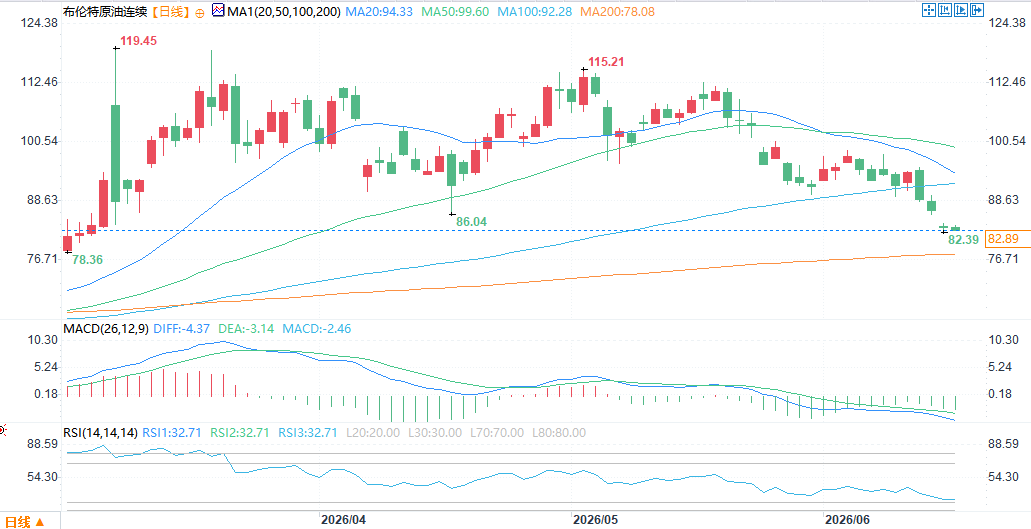
(Brent crude oil futures daily chart, source: FX678)
Goldman Sachs' latest report significantly lowered its price forecasts for Brent and WTI crude oil, primarily driven by the expectation that the US-Iran armistice agreement will bring Persian Gulf exports back to pre-war levels by the end of July. This adjustment reflects market expectations of a rapid recovery in global oil supply, with a significant decline in geopolitical risk premiums. Although uncertainties remain regarding the implementation of the agreement, the downward trend in oil prices is relatively clear, which will support global energy stability and economic recovery, while testing the fiscal resilience of oil-producing countries.
At 13:17 Beijing time on June 16, Brent crude oil futures were trading at $82.76 per barrel.
Q1: What are the key data points behind Goldman Sachs' latest oil price forecast adjustment?
Goldman Sachs lowered its Q4 2026 Brent crude oil forecast to $80/barrel from $90/barrel on June 16, 2026, and its full-year 2027 average price forecast to $75/barrel from $80/barrel. The corresponding adjustments for WTI crude oil are $75/barrel for Q4 2026 and $70/barrel for 2027. These are the latest institutional forecasts, reflecting optimistic expectations for supply recovery.
Q2: What does the earlier-than-expected resumption of exports from the Persian Gulf mean?
Goldman Sachs currently assumes that Persian Gulf exports will recover to pre-war levels by the end of July (previously the end of August). This is attributed to improved navigation in the Strait of Hormuz, which will accelerate the recovery of global crude oil supply, reduce transportation costs and energy price pressures, and ease supply chain tensions. However, the actual effect depends on the implementation of the US-Iran agreement.
Q3: What impact will the oil price reduction have on different market players?
Consumer countries and downstream industries (such as chemicals and aviation) will benefit from lower costs; oil-producing countries will face pressure on fiscal revenue; and energy companies will need to adjust their strategies. Overall, this is beneficial for controlling global inflation, but high-cost oil fields may reduce production, and the energy transition process may be further accelerated.
Q4: What are the main risks facing current oil price forecasts?
Key risks include poor implementation of the US-Iran agreement, stalled nuclear negotiations, recurring regional conflicts, and global macroeconomic volatility. Adjustments to OPEC+ policies and the dollar's performance could also trigger a rebound in oil prices; investors should remain vigilant.
Q5: How should investors respond to this change in forecasts?
We recommend monitoring the progress of the agreement's implementation, allocating a moderate amount to sectors that benefit from low oil prices, and hedging risks through futures contracts. In the long term, it is necessary to balance the energy transition trend with geopolitical variables and maintain a flexible investment portfolio.
The decline in Brent crude oil futures prices was mainly driven by the continued easing of geopolitical tensions in the Middle East. With the progress of the US-Iran ceasefire memorandum of understanding and the gradual improvement in navigation conditions in the Strait of Hormuz, market concerns about tight crude oil supply have significantly subsided, putting downward pressure on oil prices.
On Tuesday, Goldman Sachs released its latest oil market forecast report, making significant adjustments to its outlook for global crude oil prices. The firm lowered its Brent crude oil price forecast for the fourth quarter of 2026 from $90 per barrel to $80 per barrel, while also reducing its full-year average Brent crude oil price forecast for 2027 from $80 to $75. This adjustment reflects a significant increase in market expectations regarding the easing of geopolitical risks in the Middle East.
Key data and background for Goldman Sachs' oil price forecast adjustment
Goldman Sachs' significant revision to its forecast reflects the institution's optimistic assessment of a rapid easing of tensions in the Middle East. The target price for Brent crude oil in the fourth quarter of 2026 was lowered by $10 to $80 per barrel, and the average price for the whole of 2027 was lowered by $5 to $75 per barrel.
Meanwhile, Goldman Sachs forecasts an average price of $75 per barrel for West Texas Intermediate (WTI) crude oil in the fourth quarter of 2026 and $70 per barrel in 2027. These figures are the latest updates released by Goldman Sachs on the morning of June 16th and are among the most authoritative institutional forecasts currently available.
The adjustment is made against the backdrop of progress in the US-Iran armistice memorandum of understanding. Navigation in the Strait of Hormuz is gradually resuming, which is expected to ease the global oil supply shortage. Goldman Sachs assumes that Persian Gulf exports will recover to pre-war levels by the end of July, about a month earlier than previously predicted by the end of August. This forward timeline is mainly due to the progress of the agreement announced by Trump, including the lifting of the maritime blockade and the restoration of freedom of navigation.
Previously, oil prices had soared due to conflicts disrupting approximately one-fifth of global oil shipments. Now, expectations of a supply recovery are directly reducing geopolitical risk premiums.
In addition, Goldman Sachs also considered global demand factors. Trends such as slower global economic growth and accelerated substitution of new energy sources in 2026-2027 also support the judgment that oil prices will shift downwards. Shipping companies have begun planning to resume normal routes, and energy traders are accelerating inventory adjustments.
The impact of the recovery of Persian Gulf exports on the global energy supply chain
The early recovery of Persian Gulf exports to pre-war levels will have multiple positive impacts on the global energy supply chain. As a crucial chokepoint for global crude oil transportation, the resumption of free navigation through the Strait of Hormuz has significantly reduced transportation costs, decreased detours, and improved logistics efficiency. It is expected that international tanker capacity will be rapidly released in the short term, facilitating inventory replenishment in major importing regions such as Asia and Europe, and helping to mitigate regional energy price disparities.
For oil-producing countries, the recovery in exports means a rebound in revenue, but declining oil prices also bring fiscal pressure. Gulf states such as Saudi Arabia and the UAE need to balance their production policies to maintain market stability. OPEC+ may face a new round of coordination challenges. For downstream industries, costs in chemicals, aviation, logistics, and manufacturing are expected to decrease, further easing global inflationary pressures and providing support for economic recovery.
However, uncertainties remain regarding the recovery process. Details of the agreement's implementation, potential localized frictions, and the positions of parties like Israel could all impact actual air traffic efficiency. Goldman Sachs emphasizes that the end-of-July recovery target is based on current optimistic assumptions; if delays occur after the formal signing ceremony between the US and Iran (expected to be held in Switzerland on June 19), oil price volatility could still intensify. Overall, this shift marks a transition in the energy market from crisis mode to normalcy.
Market Prospects and Risk Considerations under the Downward Trend of Oil Prices
Goldman Sachs' downward revision of its forecast signals medium- to long-term downward pressure on oil prices, but the market outlook still needs to consider multiple variables. In the short term, increased supply will dominate oil price movements, and Brent crude may fluctuate between $75 and $85. In the long term, the accelerated global energy transition, the widespread adoption of electric vehicles, and the development of renewable energy will continue to suppress crude oil demand growth, and an average price of around $75 may become the new normal.
On the positive side, lower oil prices are beneficial to economic growth in consuming countries, reduce operating costs for businesses, and provide a boost to the stock market, especially the non-energy sector. Investors can focus on aviation, chemical, and consumer assets that benefit from low oil prices. However, the profitability of oil-producing countries and related energy companies will be tested, and some high-cost oil fields may face pressure to reduce production.
Risk factors are also prominent: the stability of the US-Iran agreement remains questionable; if nuclear negotiations stall or new conflicts erupt, oil prices could rebound rapidly. Furthermore, global macroeconomic uncertainties, dollar exchange rate fluctuations, and unexpected OPEC+ policy adjustments could all alter the market trend. Goldman Sachs advises market participants to closely monitor the G7 summit outcomes, actual Iranian vessel traffic data, and subsequent institutional forecast updates, and to prepare for risk hedging.
Overall, this adjustment highlights the profound impact of geopolitical easing on the energy market.
Technically, Brent crude oil is trending downwards on the daily chart, having previously surged to 119.45 and 115.21 before falling back to its current low. Prices have broken below the 20-day, 50-day, and 100-day moving averages, with only the 200-day moving average at 78.08 providing long-term support, indicating a clear downtrend.
In terms of indicators, the MACD lines remain in a death cross, and the green bars continue to expand, indicating strong bearish momentum. The RSI value is 32.71, falling into the weak zone below the 50 midline, but has not yet reached the oversold zone of 30, suggesting further downside potential.
(Brent crude oil futures daily chart, source: FX678)
Editor's Summary
Goldman Sachs' latest report significantly lowered its price forecasts for Brent and WTI crude oil, primarily driven by the expectation that the US-Iran armistice agreement will bring Persian Gulf exports back to pre-war levels by the end of July. This adjustment reflects market expectations of a rapid recovery in global oil supply, with a significant decline in geopolitical risk premiums. Although uncertainties remain regarding the implementation of the agreement, the downward trend in oil prices is relatively clear, which will support global energy stability and economic recovery, while testing the fiscal resilience of oil-producing countries.
At 13:17 Beijing time on June 16, Brent crude oil futures were trading at $82.76 per barrel.
Frequently Asked Questions
Q1: What are the key data points behind Goldman Sachs' latest oil price forecast adjustment?
Goldman Sachs lowered its Q4 2026 Brent crude oil forecast to $80/barrel from $90/barrel on June 16, 2026, and its full-year 2027 average price forecast to $75/barrel from $80/barrel. The corresponding adjustments for WTI crude oil are $75/barrel for Q4 2026 and $70/barrel for 2027. These are the latest institutional forecasts, reflecting optimistic expectations for supply recovery.
Q2: What does the earlier-than-expected resumption of exports from the Persian Gulf mean?
Goldman Sachs currently assumes that Persian Gulf exports will recover to pre-war levels by the end of July (previously the end of August). This is attributed to improved navigation in the Strait of Hormuz, which will accelerate the recovery of global crude oil supply, reduce transportation costs and energy price pressures, and ease supply chain tensions. However, the actual effect depends on the implementation of the US-Iran agreement.
Q3: What impact will the oil price reduction have on different market players?
Consumer countries and downstream industries (such as chemicals and aviation) will benefit from lower costs; oil-producing countries will face pressure on fiscal revenue; and energy companies will need to adjust their strategies. Overall, this is beneficial for controlling global inflation, but high-cost oil fields may reduce production, and the energy transition process may be further accelerated.
Q4: What are the main risks facing current oil price forecasts?
Key risks include poor implementation of the US-Iran agreement, stalled nuclear negotiations, recurring regional conflicts, and global macroeconomic volatility. Adjustments to OPEC+ policies and the dollar's performance could also trigger a rebound in oil prices; investors should remain vigilant.
Q5: How should investors respond to this change in forecasts?
We recommend monitoring the progress of the agreement's implementation, allocating a moderate amount to sectors that benefit from low oil prices, and hedging risks through futures contracts. In the long term, it is necessary to balance the energy transition trend with geopolitical variables and maintain a flexible investment portfolio.
- Risk Warning and Disclaimer
- The market involves risk, and trading may not be suitable for all investors. This article is for reference only and does not constitute personal investment advice, nor does it take into account certain users’ specific investment objectives, financial situation, or other needs. Any investment decisions made based on this information are at your own risk.