Why didn't the dollar/yen pair fall sharply after the Bank of Japan raised interest rates to 1%, a 30-year high?
2026-06-16 14:17:41
On Tuesday (June 16) during the Asian session, the USD/JPY pair rose after the Bank of Japan announced its interest rate decision, and is currently trading around 160.25.
The Bank of Japan raised its policy rate to 1% on Tuesday, the highest level in more than 30 years. This is the first rate hike by the Bank of Japan since it raised the rate to 0.75% last December, and the first time the rate has reached 1% since 1995.
Market sentiment was cautious ahead of further developments in the US-Iran peace talks, which provided some support for the US dollar.
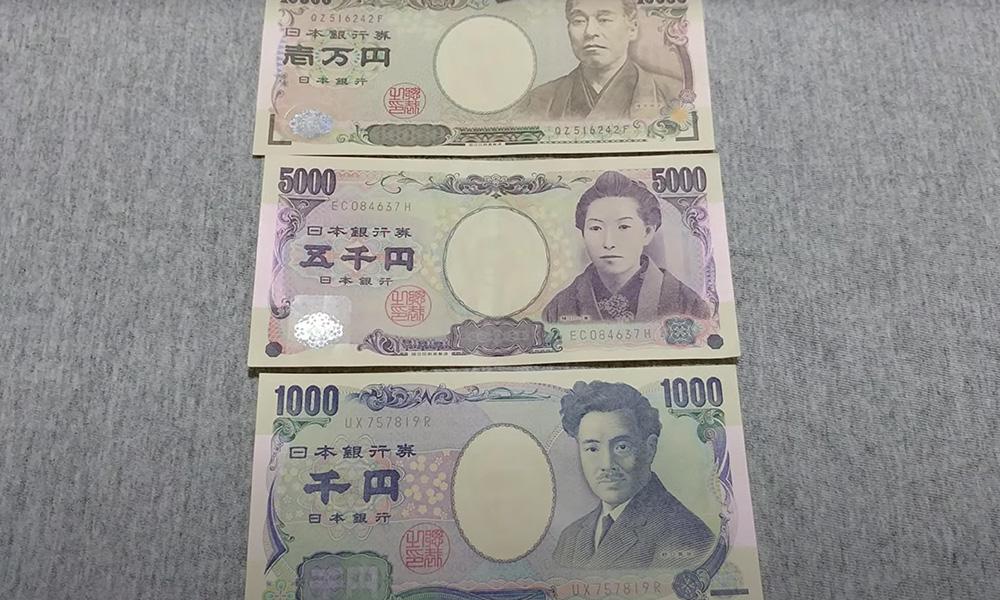
The Bank of Japan concluded its monthly monetary policy meeting on Tuesday and officially announced its interest rate adjustment decision, raising the short-term policy rate by 25 basis points to 1%. This rate hike is a key step in the Bank of Japan's continued efforts to normalize monetary policy. The overall pace and magnitude of the adjustment were in line with previous market expectations and did not exceed trading expectations.
Since exiting the era of negative interest rates, the Bank of Japan has continued to steadily tighten the loose monetary environment, and this latest interest rate hike continues the path of gradual interest rate increases.
Market analysts interpret the 25 basis point rate hike as relatively mild and unlikely to immediately reverse the pace of exchange rate fluctuations. However, the policy stance clearly signals a medium- to long-term tightening of liquidity, which will gradually correct the yen's valuation disadvantage from the perspective of interest rate differentials.
For some time, the interest rate differential resulting from the divergence in monetary policy between the US and Japan has consistently suppressed the yen's exchange rate. However, the Bank of Japan's continued interest rate hikes will gradually narrow this gap, weakening the incentive for short-selling speculation. From a medium- to long-term perspective, this round of continuous tightening will provide stable support for the yen's exchange rate, alleviating the pressure of continued yen depreciation. Going forward, the market will focus on the Bank of Japan's subsequent interest rate guidance and domestic inflation data to determine the extent of the tightening cycle and, consequently, the medium- to long-term direction of the USD/JPY exchange rate.
The Bank of Japan has decided to suspend the reduction of its government bond purchases starting in April 2027, maintaining its monthly purchases of Japanese government bonds at around 2 trillion yen. This will continue the current plan of reducing monthly purchases of Japanese government bonds by 200 billion yen per quarter until January to March 2027.
The bond reduction plan was passed by a vote of 7 to 1.
Despite Trump's official announcement of signing a memorandum of understanding, declaring that it would quell the conflict and lift the blockade of the Strait of Hormuz to ease geopolitical tensions in the Middle East, global commodity and shipping market participants are not blindly optimistic and maintain a highly cautious trading mentality.
Neither the US nor Iran has publicly disclosed the full text of the formal agreement. Core clauses and implementation details lack authoritative public disclosure, resulting in a severe lack of transparency. Major international shipping companies have clearly stated that they will not adjust their vessel detour plans and will continue to avoid the strait until details such as navigation rules and safety guarantees are fully finalized. Therefore, it will be difficult for stranded merchant ships in the Gulf to resume passage in the short term.
According to a draft agreement disclosed by Iranian news agency Merkel, the Strait of Hormuz must be gradually reopened to navigation within 30 days, in accordance with Iran's arrangements. This timeline differs significantly from previous statements by the United States, and the conflict between the two sides' statements further amplifies market disagreements and uncertainties.
The Strait of Hormuz handles a large volume of global crude oil shipments. The market had initially bet on a rapid decline in geopolitical risk premiums, but disagreements over terms have delayed expectations of supply chain recovery. The pace of decline in commodities such as crude oil and non-ferrous metals has slowed, and funds continue to wait and see, awaiting the implementation of a unified plan by both sides before repricing supply expectations.
Charu Chanana, chief investment strategist at Saxo Bank in Singapore, said the Bank of Japan's decision was in line with market expectations, but the overall policy tone was not hawkish enough to drive a revaluation of the yen. Although the central bank raised interest rates due to persistently high inflation, it maintained an accommodative monetary environment and adopted a conservative pace of rate hikes.
Charu Chanana points out that the interest rate differential between the US and Japan has not narrowed effectively at present, and coupled with internal voting divisions, it reflects management's concerns that tightening policies will drag down the economy and employment, further weakening the tightening signal. This policy environment is favorable for the Japanese stock market, and ample liquidity stabilizes corporate profits; in terms of foreign exchange, the USD/JPY is relatively vulnerable at the 160 level. If the exchange rate continues to hold above 160 after the interest rate hike, the risk of the Japanese government intervening in the exchange rate will rise accordingly.
SMBC's Chief Foreign Exchange Strategist in Tokyo, HIROFUMI SUZUKI, pointed out that while the number of dissenting votes in this decision slightly exceeded expectations, the dissenting members were long-standing dovish members and did not significantly impact the market. Previously, the market had speculated on a 50-basis-point rate hike by the central bank, which ultimately did not materialize, a result that is beneficial to various risk assets.
HIROFUMI SUZUKI stated that, considering policy direction, the Bank of Japan is highly likely to maintain a conservative pace, gradually raising interest rates every six months to a year, with no possibility of aggressive tightening in the short term. Only in exceptional circumstances such as rapidly rising inflation and a significant depreciation of the yen would the central bank consider initiating a new round of interest rate hikes ahead of schedule.
Market consensus indicates that the Federal Reserve will hold its monetary policy meeting on Wednesday and is highly likely to hold rates steady, maintaining the benchmark interest rate range at 3.50%-3.75%. Current inflation data shows signs of easing volatility, and the job market remains generally robust. These multiple factors support the Fed's decision to postpone interest rate adjustments, and maintaining stable monetary policy in the short term aligns with market expectations.
Compared to the interest rate decision itself, the core focus of this meeting is the post-meeting press conference. Market traders and institutional investors will pay close attention to the remarks of the new Federal Reserve Chairman, Warsh, seeking new insights into monetary policy and economic regulation. As the new head of the Fed, Warsh's hawkish or dovish leanings, his attitude towards inflation and employment, and his predictions regarding future interest rate cuts and hikes will directly determine the path of medium- to long-term interest rates.
Currently, the financial markets are gripped by a wait-and-see attitude, and the Federal Reserve's policy direction will profoundly influence the dollar's trajectory, precious metals, and non-US asset prices. Assuming interest rates remain unchanged, the Chairman's speech is likely to dominate market fluctuations and become a crucial indicator for the next round of price movements across various assets.
The details of the US-Iran armistice agreement have not yet been made public, and there are significant differences between the two sides regarding its implementation. The implementation progress is fraught with uncertainty, and geopolitical risks in the Middle East have not been completely eliminated. Market risk aversion has not completely dissipated, and funds are still maintaining risk hedging positions, allocating funds based on the traditional safe-haven attributes of the US dollar, indirectly providing support for the US dollar index and effectively limiting the downside potential of the USD/JPY pair.
Meanwhile, the market had already priced in the expectation that the Federal Reserve would keep its benchmark interest rate unchanged this week. The interest rate decision itself was unlikely to cause significant market volatility; the focus was on the speech given by the new Fed Chairman, Warsh. Currently, both bullish and bearish investors are adopting a wait-and-see approach, and future exchange rate movements will heavily depend on the Fed's policy statements.
If Warsh makes hawkish comments, signaling a tightening of interest rates, it could boost bullish sentiment towards the US dollar and drive a rebound in the USD/JPY exchange rate. Conversely, if his rhetoric is dovish, signaling expectations of further easing and rate cuts, the US dollar will come under pressure and fall. The Japanese yen may take this opportunity to strengthen, and in the short term, the USD/JPY pair will generally fluctuate within a range, revolving around the Fed's policy direction.
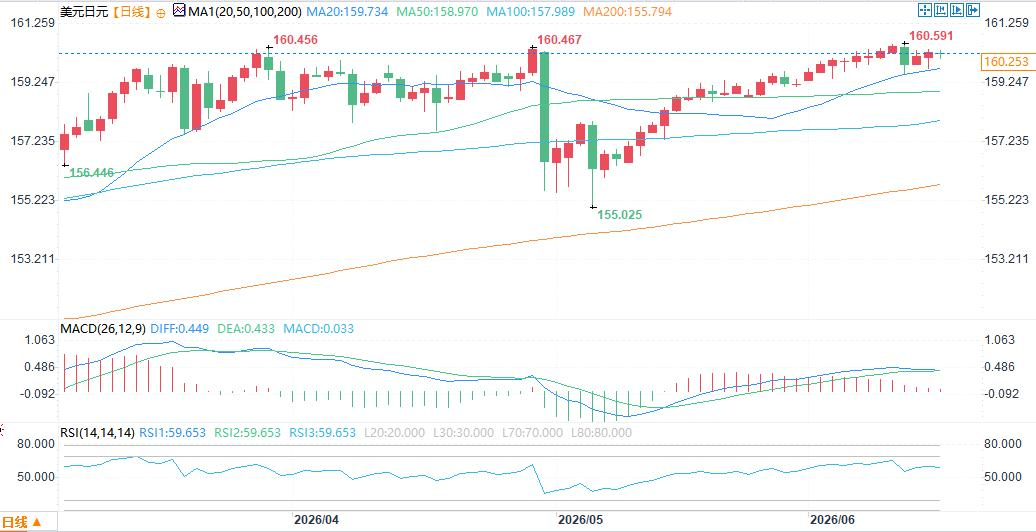
According to the daily chart, the USD/JPY pair rebounded after testing a low of 155.03, and is currently approaching its previous high of 160.59. The price is trading steadily above the 20-day, 50-day, 100-day, and 200-day moving averages, with both short-term and long-term moving averages in a bullish alignment. The medium- to long-term uptrend structure remains intact, and the moving averages continue to provide support.
In terms of indicators, the MACD maintains a golden cross, the DIFF line continues to be above the DEA line, the red bars maintain a moderate bullish momentum, and the bullish power is being released steadily; the RSI value is 59.65, which is in the bullish range above the 50 midline and has not yet reached the 70 overbought threshold, so the upside potential has not been fully exhausted.
The price is currently facing short-term pressure at the previous high of 160.59, with key support at the 20-day moving average (MA20) around 159.73. Recent gains have been followed by narrow-range consolidation, representing a period of consolidation within an uptrend, without clear signs of a top or reversal. Considering fundamentals, Middle East geopolitical risks are providing safe-haven support for the US dollar, coupled with market anticipation of the Fed's interest rate decision. Therefore, the exchange rate is likely to fluctuate within the moving average range in the short term. A decisive break above 160.59 would likely extend the bullish trend; a break below the short-term moving average support would indicate a period of correction and adjustment.
(USD/JPY daily chart, source: FX678)
At 14:17 Beijing time on June 16, the USD/JPY exchange rate was 160.26/27.
The Bank of Japan raised its policy rate to 1% on Tuesday, the highest level in more than 30 years. This is the first rate hike by the Bank of Japan since it raised the rate to 0.75% last December, and the first time the rate has reached 1% since 1995.
Market sentiment was cautious ahead of further developments in the US-Iran peace talks, which provided some support for the US dollar.
The Bank of Japan raised interest rates as expected.
The Bank of Japan concluded its monthly monetary policy meeting on Tuesday and officially announced its interest rate adjustment decision, raising the short-term policy rate by 25 basis points to 1%. This rate hike is a key step in the Bank of Japan's continued efforts to normalize monetary policy. The overall pace and magnitude of the adjustment were in line with previous market expectations and did not exceed trading expectations.
Since exiting the era of negative interest rates, the Bank of Japan has continued to steadily tighten the loose monetary environment, and this latest interest rate hike continues the path of gradual interest rate increases.
Market analysts interpret the 25 basis point rate hike as relatively mild and unlikely to immediately reverse the pace of exchange rate fluctuations. However, the policy stance clearly signals a medium- to long-term tightening of liquidity, which will gradually correct the yen's valuation disadvantage from the perspective of interest rate differentials.
For some time, the interest rate differential resulting from the divergence in monetary policy between the US and Japan has consistently suppressed the yen's exchange rate. However, the Bank of Japan's continued interest rate hikes will gradually narrow this gap, weakening the incentive for short-selling speculation. From a medium- to long-term perspective, this round of continuous tightening will provide stable support for the yen's exchange rate, alleviating the pressure of continued yen depreciation. Going forward, the market will focus on the Bank of Japan's subsequent interest rate guidance and domestic inflation data to determine the extent of the tightening cycle and, consequently, the medium- to long-term direction of the USD/JPY exchange rate.
The Bank of Japan has decided to suspend the reduction of its government bond purchases starting in April 2027, maintaining its monthly purchases of Japanese government bonds at around 2 trillion yen. This will continue the current plan of reducing monthly purchases of Japanese government bonds by 200 billion yen per quarter until January to March 2027.
The bond reduction plan was passed by a vote of 7 to 1.
The future of the US-Iran agreement remains uncertain, and the market remains cautious.
Despite Trump's official announcement of signing a memorandum of understanding, declaring that it would quell the conflict and lift the blockade of the Strait of Hormuz to ease geopolitical tensions in the Middle East, global commodity and shipping market participants are not blindly optimistic and maintain a highly cautious trading mentality.
Neither the US nor Iran has publicly disclosed the full text of the formal agreement. Core clauses and implementation details lack authoritative public disclosure, resulting in a severe lack of transparency. Major international shipping companies have clearly stated that they will not adjust their vessel detour plans and will continue to avoid the strait until details such as navigation rules and safety guarantees are fully finalized. Therefore, it will be difficult for stranded merchant ships in the Gulf to resume passage in the short term.
According to a draft agreement disclosed by Iranian news agency Merkel, the Strait of Hormuz must be gradually reopened to navigation within 30 days, in accordance with Iran's arrangements. This timeline differs significantly from previous statements by the United States, and the conflict between the two sides' statements further amplifies market disagreements and uncertainties.
The Strait of Hormuz handles a large volume of global crude oil shipments. The market had initially bet on a rapid decline in geopolitical risk premiums, but disagreements over terms have delayed expectations of supply chain recovery. The pace of decline in commodities such as crude oil and non-ferrous metals has slowed, and funds continue to wait and see, awaiting the implementation of a unified plan by both sides before repricing supply expectations.
Analyst Interpretation
Charu Chanana, chief investment strategist at Saxo Bank in Singapore, said the Bank of Japan's decision was in line with market expectations, but the overall policy tone was not hawkish enough to drive a revaluation of the yen. Although the central bank raised interest rates due to persistently high inflation, it maintained an accommodative monetary environment and adopted a conservative pace of rate hikes.
Charu Chanana points out that the interest rate differential between the US and Japan has not narrowed effectively at present, and coupled with internal voting divisions, it reflects management's concerns that tightening policies will drag down the economy and employment, further weakening the tightening signal. This policy environment is favorable for the Japanese stock market, and ample liquidity stabilizes corporate profits; in terms of foreign exchange, the USD/JPY is relatively vulnerable at the 160 level. If the exchange rate continues to hold above 160 after the interest rate hike, the risk of the Japanese government intervening in the exchange rate will rise accordingly.
SMBC's Chief Foreign Exchange Strategist in Tokyo, HIROFUMI SUZUKI, pointed out that while the number of dissenting votes in this decision slightly exceeded expectations, the dissenting members were long-standing dovish members and did not significantly impact the market. Previously, the market had speculated on a 50-basis-point rate hike by the central bank, which ultimately did not materialize, a result that is beneficial to various risk assets.
HIROFUMI SUZUKI stated that, considering policy direction, the Bank of Japan is highly likely to maintain a conservative pace, gradually raising interest rates every six months to a year, with no possibility of aggressive tightening in the short term. Only in exceptional circumstances such as rapidly rising inflation and a significant depreciation of the yen would the central bank consider initiating a new round of interest rate hikes ahead of schedule.
The Federal Reserve is expected to hold rates steady this week; the new chairman's remarks will be the focus.
Market consensus indicates that the Federal Reserve will hold its monetary policy meeting on Wednesday and is highly likely to hold rates steady, maintaining the benchmark interest rate range at 3.50%-3.75%. Current inflation data shows signs of easing volatility, and the job market remains generally robust. These multiple factors support the Fed's decision to postpone interest rate adjustments, and maintaining stable monetary policy in the short term aligns with market expectations.
Compared to the interest rate decision itself, the core focus of this meeting is the post-meeting press conference. Market traders and institutional investors will pay close attention to the remarks of the new Federal Reserve Chairman, Warsh, seeking new insights into monetary policy and economic regulation. As the new head of the Fed, Warsh's hawkish or dovish leanings, his attitude towards inflation and employment, and his predictions regarding future interest rate cuts and hikes will directly determine the path of medium- to long-term interest rates.
Currently, the financial markets are gripped by a wait-and-see attitude, and the Federal Reserve's policy direction will profoundly influence the dollar's trajectory, precious metals, and non-US asset prices. Assuming interest rates remain unchanged, the Chairman's speech is likely to dominate market fluctuations and become a crucial indicator for the next round of price movements across various assets.
The US dollar found short-term support.
The details of the US-Iran armistice agreement have not yet been made public, and there are significant differences between the two sides regarding its implementation. The implementation progress is fraught with uncertainty, and geopolitical risks in the Middle East have not been completely eliminated. Market risk aversion has not completely dissipated, and funds are still maintaining risk hedging positions, allocating funds based on the traditional safe-haven attributes of the US dollar, indirectly providing support for the US dollar index and effectively limiting the downside potential of the USD/JPY pair.
Meanwhile, the market had already priced in the expectation that the Federal Reserve would keep its benchmark interest rate unchanged this week. The interest rate decision itself was unlikely to cause significant market volatility; the focus was on the speech given by the new Fed Chairman, Warsh. Currently, both bullish and bearish investors are adopting a wait-and-see approach, and future exchange rate movements will heavily depend on the Fed's policy statements.
If Warsh makes hawkish comments, signaling a tightening of interest rates, it could boost bullish sentiment towards the US dollar and drive a rebound in the USD/JPY exchange rate. Conversely, if his rhetoric is dovish, signaling expectations of further easing and rate cuts, the US dollar will come under pressure and fall. The Japanese yen may take this opportunity to strengthen, and in the short term, the USD/JPY pair will generally fluctuate within a range, revolving around the Fed's policy direction.
Technical Analysis
According to the daily chart, the USD/JPY pair rebounded after testing a low of 155.03, and is currently approaching its previous high of 160.59. The price is trading steadily above the 20-day, 50-day, 100-day, and 200-day moving averages, with both short-term and long-term moving averages in a bullish alignment. The medium- to long-term uptrend structure remains intact, and the moving averages continue to provide support.
In terms of indicators, the MACD maintains a golden cross, the DIFF line continues to be above the DEA line, the red bars maintain a moderate bullish momentum, and the bullish power is being released steadily; the RSI value is 59.65, which is in the bullish range above the 50 midline and has not yet reached the 70 overbought threshold, so the upside potential has not been fully exhausted.
The price is currently facing short-term pressure at the previous high of 160.59, with key support at the 20-day moving average (MA20) around 159.73. Recent gains have been followed by narrow-range consolidation, representing a period of consolidation within an uptrend, without clear signs of a top or reversal. Considering fundamentals, Middle East geopolitical risks are providing safe-haven support for the US dollar, coupled with market anticipation of the Fed's interest rate decision. Therefore, the exchange rate is likely to fluctuate within the moving average range in the short term. A decisive break above 160.59 would likely extend the bullish trend; a break below the short-term moving average support would indicate a period of correction and adjustment.
(USD/JPY daily chart, source: FX678)
At 14:17 Beijing time on June 16, the USD/JPY exchange rate was 160.26/27.
- Risk Warning and Disclaimer
- The market involves risk, and trading may not be suitable for all investors. This article is for reference only and does not constitute personal investment advice, nor does it take into account certain users’ specific investment objectives, financial situation, or other needs. Any investment decisions made based on this information are at your own risk.