The US-Iran deal and the ECB's hawkish stance are both positive for the euro, but Warsh's debut will be the real deciding factor.
2026-06-17 14:55:21
On Wednesday (June 17) during the Asian session, the euro maintained a positive bias against the US dollar for the third consecutive trading day, currently trading above the 1.1600 level.
The interim peace agreement between the US and Iran continues to dampen demand for the US dollar as a safe haven, providing support for the euro; meanwhile, the hawkish signals released by the European Central Bank after its recent interest rate hike have further boosted the euro.
However, market sentiment remains cautious, with investors generally awaiting the Federal Reserve's policy decision and the press conference of new Chairman Warsh to determine the short-term direction. Despite some easing of tensions between the US and Iran, the market is still pricing in a 25-basis-point rate hike by the Fed in December, which limits further upside potential for the euro.
The euro has maintained a positive bias against the dollar for the third consecutive trading day, currently holding steady above the 1.1600 level. However, bulls appear cautious, generally choosing to await the results of the two-day FOMC policy meeting before deciding whether to further push the recent rebound from the 1.1500 level (the two-month low reached last week).
The market has recently been digesting the positive news of the interim peace agreement reached between the US and Iran. The optimism stemming from the easing of geopolitical tensions has been steadily rising, significantly weakening global demand for safe-haven assets. As a traditional safe-haven asset, the US dollar has continued to see reduced holdings, with bullish buying significantly cooling, putting pressure on the dollar index and causing it to fluctuate downwards. This indirectly provided strong support for the euro against the dollar.
With geopolitical risks easing, funds have flowed out of safe-haven assets like the US dollar and into non-US currencies with stronger risk profiles, such as the euro, effectively supporting the euro's exchange rate. However, the market also anticipates a Federal Reserve rate hike at the end of the year, limiting the euro's rebound. Therefore, the euro's recovery is only supported by geopolitical advantages and is unlikely to see a significant one-sided upward trend.
On the other hand, the eurozone's common currency received additional support from hawkish signals from the European Central Bank (ECB), which further reinforced its tightening stance after raising interest rates for the first time in nearly three years. The ECB has raised its 2026 inflation forecast to 3%, citing the ongoing energy shock and expanding price pressures across the eurozone.
It is worth noting that despite the easing of tensions in the Middle East, traders are still pricing in a further interest rate hike of about 40 basis points by the European Central Bank in 2026. While the US and Iran have reached a framework peace agreement aimed at ending the war that began in early 2026, with the initial memorandum of understanding establishing a 60-day ceasefire, reopening the Strait of Hormuz, and laying the groundwork for technical negotiations on Iran's nuclear program, other details of the agreement remain scarce.
Meanwhile, mainstream market expectations still lean towards a possible tightening by the Federal Reserve at the end of the year, with many funds betting on a potential 25 basis point rate hike in December. Hawkish long-term policy expectations continue to suppress large-scale short selling, and the solid support for the US dollar directly limits the upward rebound of the euro against the dollar, making it difficult for non-US currencies to achieve a sustained one-sided upward trend.
Against this backdrop, all investors are focused on the outcome of this Federal Reserve interest rate meeting, paying close attention to the interest rate decision, updated economic forecasts, and the dot plot to determine the pace of monetary easing and tightening throughout the year and into next year. Meanwhile, the post-meeting remarks by the new Chairman, Kevin Warsh, are crucial; investors will carefully interpret his wording to glean key signals regarding the Fed's future monetary policy path, inflation, and employment outlook, which will guide short-term exchange rate fluctuations.
The euro/dollar pair rebounded after testing a low of 1.1499 on the daily chart, currently trading around 1.1610. The price has rebounded above the 20-day moving average of 1.1599, indicating a slight short-term bullish advantage. The moving average system is intertwined, with the 50, 100, and 200-day moving averages closely clustered around 1.1670, forming a key resistance zone. The medium- to long-term trend remains unclear, and the pair is currently in a range-bound trading pattern.
In terms of indicators, the MACD is below the zero line, the DIFF is turning upward and approaching the DEA, the red bars are showing a slight increase in volume, the bearish momentum continues to weaken, and the short-term rebound momentum is being released moderately; the RSI has stabilized in the 49 range, moved away from the previous low oversold area, and the downward pressure has eased somewhat, but it has not broken through 60, so the rebound strength is limited.
In terms of price structure, strong resistance is concentrated around the 1.1670 moving average cluster, with the mid-term high of 1.1848 providing further resistance. On the downside, 1.1499 and 1.1410 form a double bottom support. In the short term, the price is consolidating around the 20-day moving average. If it holds above the 1.1670 resistance level, the upside potential will expand further; if it falls back under pressure, it will retest the 1.1500 support level. Overall, the Euro/USD pair is expected to maintain a wide range of fluctuations in the medium term, with a short-term oversold correction, but the converging moving averages above are limiting the rebound's potential.
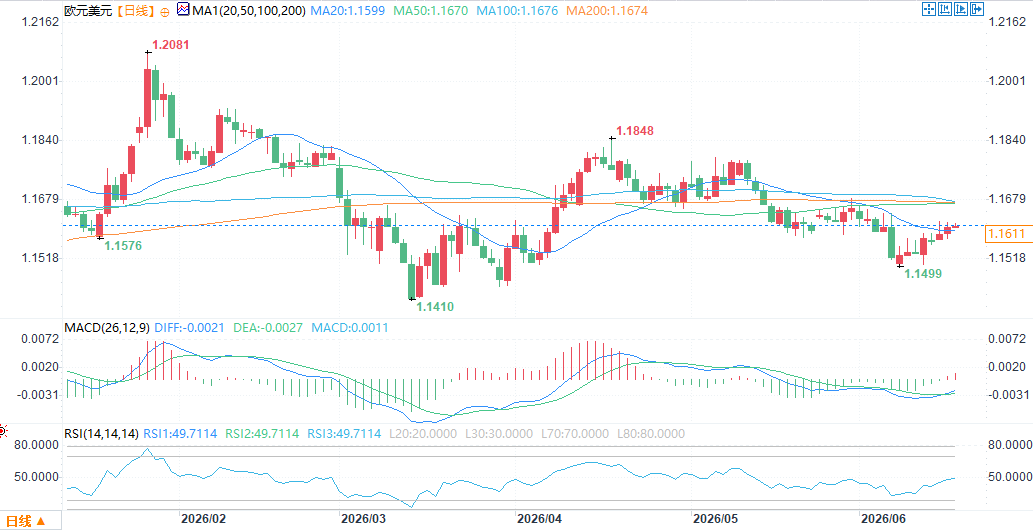
(Euro/USD daily chart, source: FX678)
At 14:54 Beijing time on June 17, the euro was trading at 1.1607/08 against the US dollar.
The interim peace agreement between the US and Iran continues to dampen demand for the US dollar as a safe haven, providing support for the euro; meanwhile, the hawkish signals released by the European Central Bank after its recent interest rate hike have further boosted the euro.
However, market sentiment remains cautious, with investors generally awaiting the Federal Reserve's policy decision and the press conference of new Chairman Warsh to determine the short-term direction. Despite some easing of tensions between the US and Iran, the market is still pricing in a 25-basis-point rate hike by the Fed in December, which limits further upside potential for the euro.
The US-Iran agreement put pressure on the dollar, while the euro received support.
The euro has maintained a positive bias against the dollar for the third consecutive trading day, currently holding steady above the 1.1600 level. However, bulls appear cautious, generally choosing to await the results of the two-day FOMC policy meeting before deciding whether to further push the recent rebound from the 1.1500 level (the two-month low reached last week).
The market has recently been digesting the positive news of the interim peace agreement reached between the US and Iran. The optimism stemming from the easing of geopolitical tensions has been steadily rising, significantly weakening global demand for safe-haven assets. As a traditional safe-haven asset, the US dollar has continued to see reduced holdings, with bullish buying significantly cooling, putting pressure on the dollar index and causing it to fluctuate downwards. This indirectly provided strong support for the euro against the dollar.
With geopolitical risks easing, funds have flowed out of safe-haven assets like the US dollar and into non-US currencies with stronger risk profiles, such as the euro, effectively supporting the euro's exchange rate. However, the market also anticipates a Federal Reserve rate hike at the end of the year, limiting the euro's rebound. Therefore, the euro's recovery is only supported by geopolitical advantages and is unlikely to see a significant one-sided upward trend.
Hawkish signals from the ECB provide additional support for the euro.
On the other hand, the eurozone's common currency received additional support from hawkish signals from the European Central Bank (ECB), which further reinforced its tightening stance after raising interest rates for the first time in nearly three years. The ECB has raised its 2026 inflation forecast to 3%, citing the ongoing energy shock and expanding price pressures across the eurozone.
It is worth noting that despite the easing of tensions in the Middle East, traders are still pricing in a further interest rate hike of about 40 basis points by the European Central Bank in 2026. While the US and Iran have reached a framework peace agreement aimed at ending the war that began in early 2026, with the initial memorandum of understanding establishing a 60-day ceasefire, reopening the Strait of Hormuz, and laying the groundwork for technical negotiations on Iran's nuclear program, other details of the agreement remain scarce.
Expectations of a Fed rate hike are limiting the euro's upside potential.
Meanwhile, mainstream market expectations still lean towards a possible tightening by the Federal Reserve at the end of the year, with many funds betting on a potential 25 basis point rate hike in December. Hawkish long-term policy expectations continue to suppress large-scale short selling, and the solid support for the US dollar directly limits the upward rebound of the euro against the dollar, making it difficult for non-US currencies to achieve a sustained one-sided upward trend.
Against this backdrop, all investors are focused on the outcome of this Federal Reserve interest rate meeting, paying close attention to the interest rate decision, updated economic forecasts, and the dot plot to determine the pace of monetary easing and tightening throughout the year and into next year. Meanwhile, the post-meeting remarks by the new Chairman, Kevin Warsh, are crucial; investors will carefully interpret his wording to glean key signals regarding the Fed's future monetary policy path, inflation, and employment outlook, which will guide short-term exchange rate fluctuations.
Technical Analysis
The euro/dollar pair rebounded after testing a low of 1.1499 on the daily chart, currently trading around 1.1610. The price has rebounded above the 20-day moving average of 1.1599, indicating a slight short-term bullish advantage. The moving average system is intertwined, with the 50, 100, and 200-day moving averages closely clustered around 1.1670, forming a key resistance zone. The medium- to long-term trend remains unclear, and the pair is currently in a range-bound trading pattern.
In terms of indicators, the MACD is below the zero line, the DIFF is turning upward and approaching the DEA, the red bars are showing a slight increase in volume, the bearish momentum continues to weaken, and the short-term rebound momentum is being released moderately; the RSI has stabilized in the 49 range, moved away from the previous low oversold area, and the downward pressure has eased somewhat, but it has not broken through 60, so the rebound strength is limited.
In terms of price structure, strong resistance is concentrated around the 1.1670 moving average cluster, with the mid-term high of 1.1848 providing further resistance. On the downside, 1.1499 and 1.1410 form a double bottom support. In the short term, the price is consolidating around the 20-day moving average. If it holds above the 1.1670 resistance level, the upside potential will expand further; if it falls back under pressure, it will retest the 1.1500 support level. Overall, the Euro/USD pair is expected to maintain a wide range of fluctuations in the medium term, with a short-term oversold correction, but the converging moving averages above are limiting the rebound's potential.
(Euro/USD daily chart, source: FX678)
At 14:54 Beijing time on June 17, the euro was trading at 1.1607/08 against the US dollar.
- Risk Warning and Disclaimer
- The market involves risk, and trading may not be suitable for all investors. This article is for reference only and does not constitute personal investment advice, nor does it take into account certain users’ specific investment objectives, financial situation, or other needs. Any investment decisions made based on this information are at your own risk.