Gold prices surged and then retreated as expectations of a Fed rate hike intensified, but the upward trend remains intact.
2026-06-18 09:54:02
International gold prices continued their pullback during Asian trading hours on Thursday, with spot gold briefly dipping to around $4,280. The safe-haven premium that had accumulated over the previous weeks is being rapidly eroded, and market trading logic is shifting back towards the Federal Reserve's interest rate outlook and the dollar's performance.

The Federal Reserve unanimously decided at its latest policy meeting to maintain the federal funds rate in the 3.50%-3.75% range. This was the first policy meeting since Kevin Warsh took over as chairman. While keeping the rate unchanged was in line with market expectations, the post-meeting statement and dot plot were clearly hawkish, with several officials hinting that the possibility of further policy tightening this year is increasing as inflation risks have not yet fully subsided.
Kevin Warsh emphasized that "price stability" will be a core objective of the Federal Reserve's future policy. As a result, US Treasury yields rose across the board, and the US dollar index rebounded in tandem. Since gold itself does not generate interest income, a higher interest rate environment will increase the opportunity cost of holding gold, thereby weakening its attractiveness as an investment.
According to the CME FedWatch tool, the market's expectation of a December rate hike has risen to 83.1%, up from 61% before the decision. This change indicates that investors are reassessing the monetary policy path in the coming months, with funds beginning to flow more towards higher-yielding dollar assets. On the geopolitical front, the market is also witnessing significant changes. Market surveys indicate that the United States and Iran are expected to formally sign a memorandum of understanding to end the conflict in Geneva this Friday. The agreement includes ensuring the safe passage of commercial vessels for the next 60 days and further consultations on subsequent management arrangements in the Strait of Hormuz.
The Strait of Hormuz handles approximately 20% of global seaborne crude oil transport, and the expectation of its resumption of normal navigation has significantly reduced market concerns about energy supply disruptions. As tensions in the Middle East ease, some safe-haven funds that had previously flowed into the gold market have begun to withdraw, further exacerbating downward pressure on gold prices.
However, analysts also point out that factors such as slowing global economic growth, widening fiscal deficits in major economies, and central banks' continued accumulation of gold reserves continue to provide medium- to long-term support for gold prices. The current market situation appears more like a temporary correction after the previous sharp rise, rather than a trend reversal.
Going forward, investors will focus on US initial jobless claims, subsequent inflation data, and speeches by Federal Reserve officials. If US economic data continues to show resilience, market pricing in interest rate hikes may be further strengthened; conversely, if employment or consumption data cools significantly, gold is expected to regain buying support at lower levels.
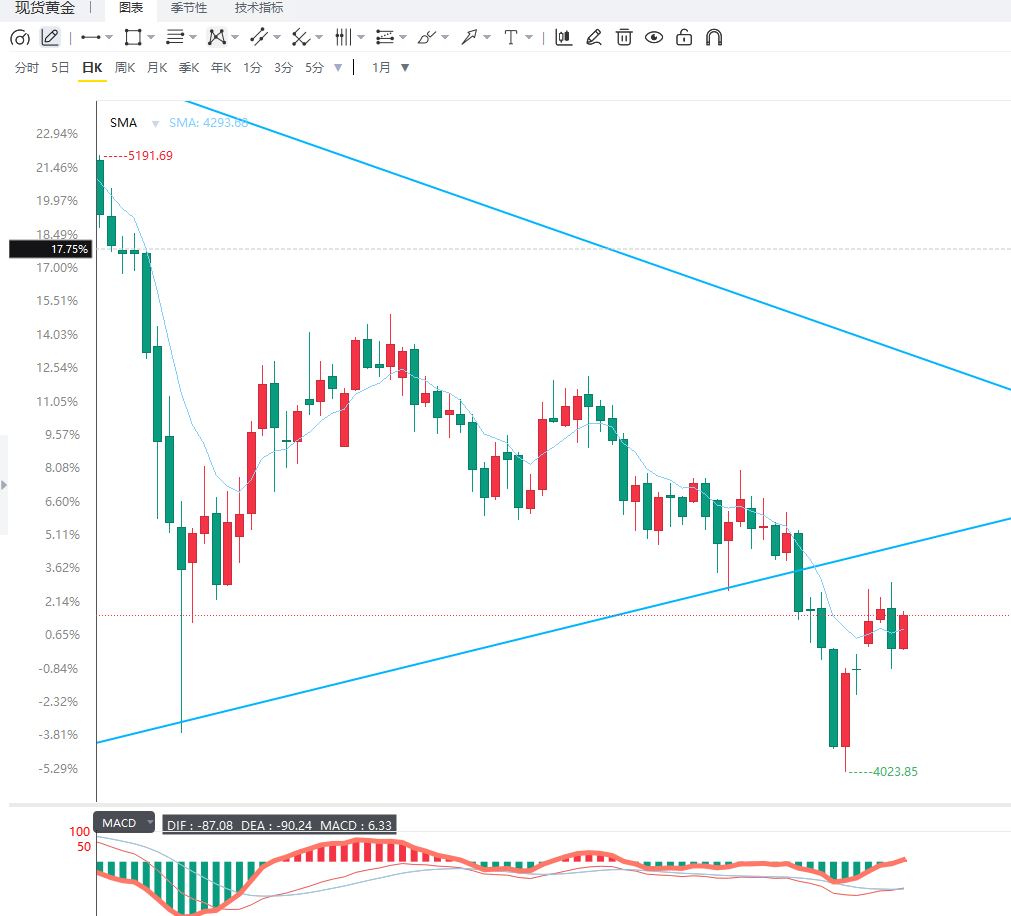
From a daily chart perspective, gold has entered a clear correction phase after reaching a historical high. The price has broken below the short-term uptrend line and is currently trading near the major moving average system. The $4280 level has become a key battleground between bulls and bears. If it cannot quickly recover above $4320, the market may continue its high-level consolidation with a bearish bias. The MACD indicator has been declining since its bearish crossover at a high level, indicating that bearish momentum still dominates in the medium term. Key resistance levels to watch are $4320, $4350, and $4400; key support levels are $4250, $4200, and $4150.
Observing the 4-hour chart, gold prices showed signs of being oversold in the short term after a continuous decline, but the rebound was weak. Although the MACD showed signs of convergence at a low level, it has not yet formed a valid golden cross, indicating that the bearish momentum has only weakened rather than completely reversed. The price is currently still trading within a descending channel, with the $4320-$4330 area forming a key short-term resistance. If it can effectively break through this area, gold prices are expected to rebound towards $4350; if it falls below $4250 again, it may further test the support areas of $4200 or even $4150.
Editor's Summary : The core issue in the current gold market has shifted from geopolitical safe-haven demand to the question of "how long can the high-interest-rate environment be sustained?" Following the Federal Reserve's signal of a rate hike this year, the dollar's yield advantage has widened again, while easing tensions in the Middle East have weakened safe-haven demand, both contributing to a temporary pullback in gold prices. In the short term, the $4250-$4320 range will be crucial for determining gold's direction. If US employment and inflation data remain strong, the market's pricing in a December rate hike still has room to rise, and gold may continue to face downward pressure. Conversely, if economic data shows a significant slowdown or Fed officials release more dovish signals, gold prices are expected to stabilize above $4200. In the medium to long term, global central bank gold purchases and macroeconomic uncertainty remain important supporting forces for gold, but short-term volatility is expected to increase significantly.
The Federal Reserve unanimously decided at its latest policy meeting to maintain the federal funds rate in the 3.50%-3.75% range. This was the first policy meeting since Kevin Warsh took over as chairman. While keeping the rate unchanged was in line with market expectations, the post-meeting statement and dot plot were clearly hawkish, with several officials hinting that the possibility of further policy tightening this year is increasing as inflation risks have not yet fully subsided.
Kevin Warsh emphasized that "price stability" will be a core objective of the Federal Reserve's future policy. As a result, US Treasury yields rose across the board, and the US dollar index rebounded in tandem. Since gold itself does not generate interest income, a higher interest rate environment will increase the opportunity cost of holding gold, thereby weakening its attractiveness as an investment.
According to the CME FedWatch tool, the market's expectation of a December rate hike has risen to 83.1%, up from 61% before the decision. This change indicates that investors are reassessing the monetary policy path in the coming months, with funds beginning to flow more towards higher-yielding dollar assets. On the geopolitical front, the market is also witnessing significant changes. Market surveys indicate that the United States and Iran are expected to formally sign a memorandum of understanding to end the conflict in Geneva this Friday. The agreement includes ensuring the safe passage of commercial vessels for the next 60 days and further consultations on subsequent management arrangements in the Strait of Hormuz.
The Strait of Hormuz handles approximately 20% of global seaborne crude oil transport, and the expectation of its resumption of normal navigation has significantly reduced market concerns about energy supply disruptions. As tensions in the Middle East ease, some safe-haven funds that had previously flowed into the gold market have begun to withdraw, further exacerbating downward pressure on gold prices.
However, analysts also point out that factors such as slowing global economic growth, widening fiscal deficits in major economies, and central banks' continued accumulation of gold reserves continue to provide medium- to long-term support for gold prices. The current market situation appears more like a temporary correction after the previous sharp rise, rather than a trend reversal.
Going forward, investors will focus on US initial jobless claims, subsequent inflation data, and speeches by Federal Reserve officials. If US economic data continues to show resilience, market pricing in interest rate hikes may be further strengthened; conversely, if employment or consumption data cools significantly, gold is expected to regain buying support at lower levels.
From a daily chart perspective, gold has entered a clear correction phase after reaching a historical high. The price has broken below the short-term uptrend line and is currently trading near the major moving average system. The $4280 level has become a key battleground between bulls and bears. If it cannot quickly recover above $4320, the market may continue its high-level consolidation with a bearish bias. The MACD indicator has been declining since its bearish crossover at a high level, indicating that bearish momentum still dominates in the medium term. Key resistance levels to watch are $4320, $4350, and $4400; key support levels are $4250, $4200, and $4150.
Observing the 4-hour chart, gold prices showed signs of being oversold in the short term after a continuous decline, but the rebound was weak. Although the MACD showed signs of convergence at a low level, it has not yet formed a valid golden cross, indicating that the bearish momentum has only weakened rather than completely reversed. The price is currently still trading within a descending channel, with the $4320-$4330 area forming a key short-term resistance. If it can effectively break through this area, gold prices are expected to rebound towards $4350; if it falls below $4250 again, it may further test the support areas of $4200 or even $4150.
Editor's Summary : The core issue in the current gold market has shifted from geopolitical safe-haven demand to the question of "how long can the high-interest-rate environment be sustained?" Following the Federal Reserve's signal of a rate hike this year, the dollar's yield advantage has widened again, while easing tensions in the Middle East have weakened safe-haven demand, both contributing to a temporary pullback in gold prices. In the short term, the $4250-$4320 range will be crucial for determining gold's direction. If US employment and inflation data remain strong, the market's pricing in a December rate hike still has room to rise, and gold may continue to face downward pressure. Conversely, if economic data shows a significant slowdown or Fed officials release more dovish signals, gold prices are expected to stabilize above $4200. In the medium to long term, global central bank gold purchases and macroeconomic uncertainty remain important supporting forces for gold, but short-term volatility is expected to increase significantly.
- Risk Warning and Disclaimer
- The market involves risk, and trading may not be suitable for all investors. This article is for reference only and does not constitute personal investment advice, nor does it take into account certain users’ specific investment objectives, financial situation, or other needs. Any investment decisions made based on this information are at your own risk.