Between the ceasefire agreement and the resumption of oil tanker voyages, there was a "time lag," and is the market prematurely celebrating US-Iran peace?
2026-06-18 12:43:33
Brent crude oil recently fell below $80 per barrel. The futures market saw optimism due to the possibility of a temporary agreement between the US and Iran. However, executives from major energy agencies and oil companies have collectively warned that there are long-term constraints on shipping, production capacity, insurance, and global inventories. The tight supply and demand situation in the spot market has not changed, and oil prices still have strong upward momentum.
Multiple institutions have predicted that even if navigation in the Strait of Hormuz resumes, the production capacity and export volume of crude oil in the Persian Gulf will be difficult to quickly return to pre-conflict levels.
Analysts at energy consulting firms said in early June that the ceasefire agreement did not equate to an immediate recovery in shipping; there would be a time lag in the recovery of tanker traffic, and at present, the world could only maintain supply and demand balance by depleting its inventory. Priyanka Sachdeva, an analyst at Philip Nova, stated that the negative impacts of the conflict are long-term, with not only physical damage to oil and gas infrastructure but also a long-term economic burden on oil-importing countries from high oil prices, which will be difficult to absorb in the short term.
Xavier Tang, a senior analyst at shipping data agency Vortexa, pointed out that shipping insurance is a key obstacle. Only when the agreement is implemented and insurance companies resume coverage can the resumption of empty tanker navigation, oil field production, and refinery restart proceed gradually. There is no possibility of a one-time stabilization and rebound in oil prices.
Executives at leading oil companies have issued warnings about an inventory crisis. Chevron CEO Mike Wirth stated in early June that the pressure from shrinking inventories would gradually be transmitted to the spot market, and upward pressure on oil prices would continue to intensify in June and July. ExxonMobil Senior Vice President Neil Chapman said that current crude oil inventories have fallen to historically low levels, and oil prices will surge rapidly once inventories reach a critical threshold.
Carlyle Group analyst Jeff Currie warned as early as May that during the conflict, countries released large amounts of commercial crude oil inventories to offset supply gaps, and by July, inventories in many parts of the world would reach the minimum operating threshold for storage.
U.S. crude oil inventories have decreased for nine consecutive weeks, accumulating a total reduction of 52 million barrels. Inventories at Cushing, Oklahoma, the core storage hub, are now only around 21 million barrels. If this figure falls below 20 million barrels, various operational failures will occur in storage facilities. Previously, in 2022, the release of massive amounts of strategic petroleum reserves by the U.S. to stabilize oil prices due to the Russia-Ukraine conflict already exposed the operational shortcomings of insufficient reserve levels.
As many countries around the world simultaneously deplete their reserves to ensure supply, the market will see a large-scale restocking demand, further boosting crude oil demand.
Apart from speculative funds in crude oil, insurance institutions and large shipowners are all maintaining a cautious wait-and-see attitude.
Insurance companies are choosing to continue observing the situation and are temporarily suspending the full resumption of coverage for the Persian Gulf routes. Anoop Singh, head of shipping research at an oil brokerage firm, said that major shipowners are maintaining their suspension of operations at this stage, as the industry has not yet fully grasped all the terms of the temporary agreement and is hesitant to resume shipping business.
The current crude oil market is exhibiting a polarized pattern. The futures market is simply speculating on the truce, ignoring various real obstacles to supply recovery; the spot market is experiencing a far greater supply-demand imbalance than the futures market, with spot prices significantly higher than benchmark futures prices. Coupled with countries continuing to deplete their inventories, once geopolitical tensions stabilize, crude oil-importing countries will engage in concentrated restocking, providing long-term support for stronger oil prices.
In summary , the short-term decline in Brent crude oil prices is merely a disturbance of sentiment in the futures market. The four core negative factors—lagging supply recovery, bottoming out of global inventories, concentrated release of restocking demand, and constraints from shipping insurance—have not been eliminated.
Short-term geopolitical easing cannot change the fundamentals of crude oil supply and demand. The market needs to be wary of a new round of sharp price increases once inventories hit their lower limit.
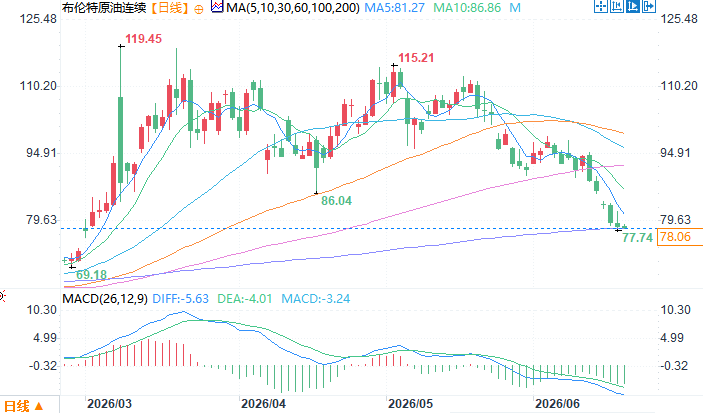
Brent crude oil daily chart source: EasyForex
At 12:15 Beijing time on June 18, Brent crude oil futures were trading at $78.06 per barrel.
The US-Iran agreement is unlikely to quickly restore crude oil supply, and multiple losses cannot be eliminated in the short term.
Multiple institutions have predicted that even if navigation in the Strait of Hormuz resumes, the production capacity and export volume of crude oil in the Persian Gulf will be difficult to quickly return to pre-conflict levels.
Analysts at energy consulting firms said in early June that the ceasefire agreement did not equate to an immediate recovery in shipping; there would be a time lag in the recovery of tanker traffic, and at present, the world could only maintain supply and demand balance by depleting its inventory. Priyanka Sachdeva, an analyst at Philip Nova, stated that the negative impacts of the conflict are long-term, with not only physical damage to oil and gas infrastructure but also a long-term economic burden on oil-importing countries from high oil prices, which will be difficult to absorb in the short term.
Xavier Tang, a senior analyst at shipping data agency Vortexa, pointed out that shipping insurance is a key obstacle. Only when the agreement is implemented and insurance companies resume coverage can the resumption of empty tanker navigation, oil field production, and refinery restart proceed gradually. There is no possibility of a one-time stabilization and rebound in oil prices.
Global crude oil inventories continue to decline significantly, and low inventory levels could easily trigger a surge in oil prices.
Executives at leading oil companies have issued warnings about an inventory crisis. Chevron CEO Mike Wirth stated in early June that the pressure from shrinking inventories would gradually be transmitted to the spot market, and upward pressure on oil prices would continue to intensify in June and July. ExxonMobil Senior Vice President Neil Chapman said that current crude oil inventories have fallen to historically low levels, and oil prices will surge rapidly once inventories reach a critical threshold.
Carlyle Group analyst Jeff Currie warned as early as May that during the conflict, countries released large amounts of commercial crude oil inventories to offset supply gaps, and by July, inventories in many parts of the world would reach the minimum operating threshold for storage.
U.S. crude oil inventories have decreased for nine consecutive weeks, accumulating a total reduction of 52 million barrels. Inventories at Cushing, Oklahoma, the core storage hub, are now only around 21 million barrels. If this figure falls below 20 million barrels, various operational failures will occur in storage facilities. Previously, in 2022, the release of massive amounts of strategic petroleum reserves by the U.S. to stabilize oil prices due to the Russia-Ukraine conflict already exposed the operational shortcomings of insufficient reserve levels.
As many countries around the world simultaneously deplete their reserves to ensure supply, the market will see a large-scale restocking demand, further boosting crude oil demand.
Shipping and insurance companies are adopting a wait-and-see attitude, resulting in a disconnect between futures and spot market conditions.
Apart from speculative funds in crude oil, insurance institutions and large shipowners are all maintaining a cautious wait-and-see attitude.
Insurance companies are choosing to continue observing the situation and are temporarily suspending the full resumption of coverage for the Persian Gulf routes. Anoop Singh, head of shipping research at an oil brokerage firm, said that major shipowners are maintaining their suspension of operations at this stage, as the industry has not yet fully grasped all the terms of the temporary agreement and is hesitant to resume shipping business.
The current crude oil market is exhibiting a polarized pattern. The futures market is simply speculating on the truce, ignoring various real obstacles to supply recovery; the spot market is experiencing a far greater supply-demand imbalance than the futures market, with spot prices significantly higher than benchmark futures prices. Coupled with countries continuing to deplete their inventories, once geopolitical tensions stabilize, crude oil-importing countries will engage in concentrated restocking, providing long-term support for stronger oil prices.
In summary , the short-term decline in Brent crude oil prices is merely a disturbance of sentiment in the futures market. The four core negative factors—lagging supply recovery, bottoming out of global inventories, concentrated release of restocking demand, and constraints from shipping insurance—have not been eliminated.
Short-term geopolitical easing cannot change the fundamentals of crude oil supply and demand. The market needs to be wary of a new round of sharp price increases once inventories hit their lower limit.
Brent crude oil daily chart source: EasyForex
At 12:15 Beijing time on June 18, Brent crude oil futures were trading at $78.06 per barrel.
- Risk Warning and Disclaimer
- The market involves risk, and trading may not be suitable for all investors. This article is for reference only and does not constitute personal investment advice, nor does it take into account certain users’ specific investment objectives, financial situation, or other needs. Any investment decisions made based on this information are at your own risk.