Japanese officials verbally warned them to be "on call 24/7," yet carry traders continued their frenzy: Is there no short-term solution to the yen's predicament?
2026-06-18 13:31:56
The USD/JPY pair saw a modest pullback during Asian trading hours on Thursday (June 18), currently trading around 160.60. This followed a four-day winning streak.
Although the dollar retreated after hitting a new high since the end of March, boosted by hawkish signals from the Federal Reserve, optimism surrounding the US-Iran peace agreement and market concerns about the risk of Japanese intervention limited the upside potential of the currency pair.
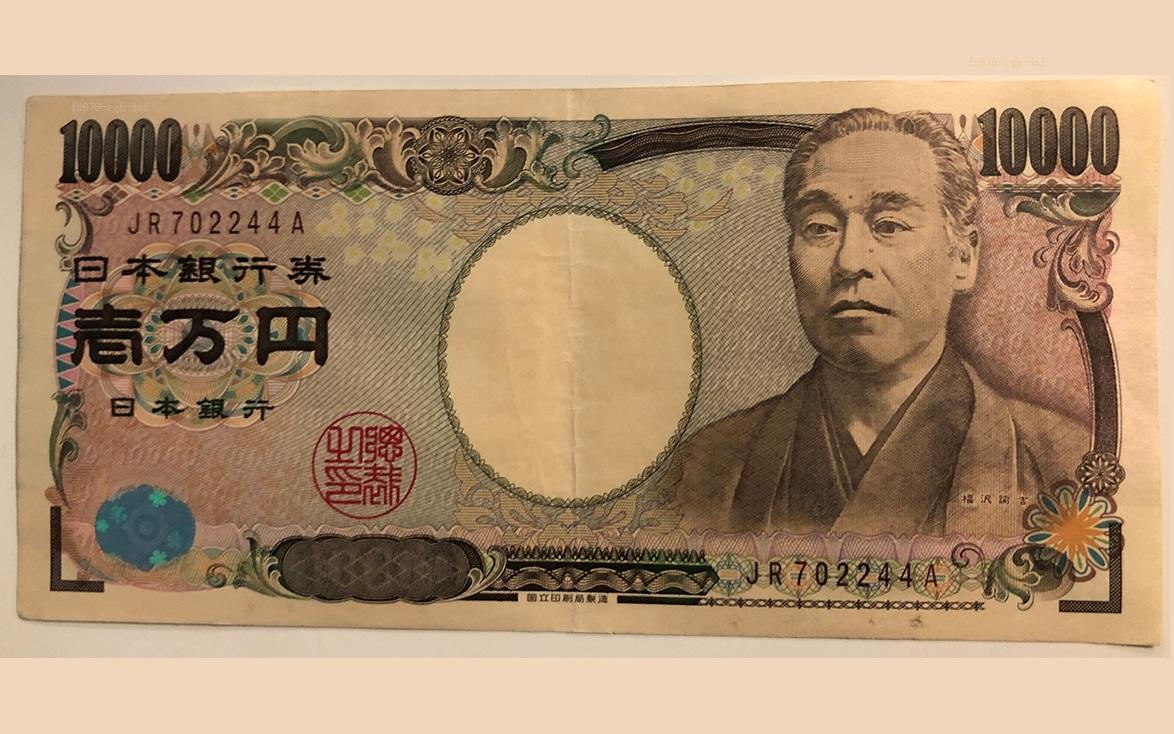
At its first FOMC meeting chaired by Warsh, the Federal Reserve unanimously decided to maintain the target range for the federal funds rate at 3.50%-3.75%, in line with market expectations. However, changes in the policy statement and adjustments to the quarterly forecasts sent a strong hawkish signal.
The statement was significantly streamlined, eliminating all forward guidance and returning to the concise style of the Greenspan era. Walsh explicitly stated that forward guidance is "unsuitable" in the current environment, emphasizing the two-way risks to policy direction.
More importantly, the latest dot plot shows that 9 out of 19 policymakers expect at least one rate hike before the end of 2026, a stark contrast to the zero-opponent expectation at the March meeting. The overall PCE inflation forecast for 2026 has been revised upward from 2.7% to 3.6%, while the unemployment rate forecast has been slightly lowered to 4.3%. This combination of signals has completely shattered market illusions about a short-term rate cut, and interest rate futures have already priced in the possibility of a rate hike as early as September.
While Warsh downplayed the absolute nature of the dot plot, calling it "written in pencil," the market has come to regard it as a clear indication of the Fed's priority in combating inflation.
The hawkish shift within the Federal Reserve is providing policy support for the dollar, while at the same time, the external geopolitical environment is also facing a key variable – the easing of tensions in the Middle East is weakening the dollar's additional momentum from a safe-haven perspective.
The Middle East geopolitical situation has recently seen a significant easing of tensions, with US President Donald Trump and Iranian President Masoud Pezechiyan signing a memorandum of understanding online. The core objective is to end the long-standing hostile stance between the two sides and restore normal navigation in the Strait of Hormuz, greatly alleviating concerns about disruptions to the global energy supply chain.
Trump simultaneously stated publicly that the 60-day negotiation period set for the Iran nuclear issue was not a hard deadline, and that both sides could flexibly extend it depending on the progress of the negotiations. This accommodative statement dispelled market concerns about a hasty conclusion to the negotiations and a renewed escalation of tensions, significantly restoring global investors' risk appetite.
Previously, persistent tensions in the Middle East fueled safe-haven demand, leading to a continuous influx of funds into dollar assets and supporting the dollar's sustained strength. However, with the current easing of geopolitical tensions, the safe-haven trading logic has quickly reversed, with many previous long positions choosing to take profits, resulting in a significant weakening of the dollar's upward momentum.
In terms of exchange rates, the USD/JPY pair lost its core upward support, and its upward trend encountered significant resistance. Market funds are gradually flowing out of safe-haven assets such as the US dollar and into riskier assets such as equities and industrial commodities, resulting in a comprehensive shift in the pricing logic of major global asset classes in the short term.
Amidst the backdrop of easing geopolitical tensions weakening the US dollar, another key variable influencing the USD/JPY exchange rate remains in the market. Major trading institutions and forex traders remain highly vigilant about the possibility of Japanese officials intervening in the market to support the yen, and are generally cautious in their trading operations, not daring to blindly bet on a continued rise in the US dollar.
Recently, Japanese foreign exchange official Jun Mimura and Finance Minister Katsunobu Kato have made strong statements, continuously sending intervention signals to the market. They stated that regulators are closely monitoring speculative activities in the foreign exchange market around the clock, and are keeping a close watch on speculative funds that are simply betting on a one-sided depreciation of the yen. They also made it clear that the government has prepared sufficient funds and policy tools for intervention, and will immediately take action to stabilize the exchange rate should the yen experience a sustained and irrational sharp weakening.
The continued intervention and deterrent effect has provided direct support for the yen, effectively limiting the upside potential of the USD/JPY exchange rate. Even if the dollar experiences short-term fluctuations and rebounds, the exchange rate is unlikely to experience a sustained upward trend.
In addition, the Bank of Japan recently completed a round of interest rate hikes, bringing current interest rates to their highest level since the mid-1990s, a landmark monetary tightening measure. Compared to the previous long-term loose monetary environment, the rise in interest rates can increase the attractiveness of yen assets to foreign investors, alleviating the pressure of continued yen depreciation from the underlying logic of monetary policy.
The expectation of intervention, coupled with the tightening of monetary policy, provided dual support, jointly weakening the upward momentum of the USD/JPY exchange rate.
Although the yen has received some support due to expectations of official intervention and the Bank of Japan's interest rate hike policy, it still has a natural weakness from the perspective of core interest rate differentials. Japan's overall borrowing costs are still significantly lower than those of major developed economies such as the United States, and the divergence in monetary policy has not been reversed.
The Federal Reserve kept its benchmark interest rate range unchanged at its policy meeting this Wednesday, while sending a hawkish signal that there is still a possibility of at least one more rate hike this year, reinforcing market expectations of a tighter monetary policy for the US dollar.
The continued misalignment of monetary policies between the US and Japan has further widened the interest rate differential between the two countries, reinforcing the carry trade logic in the market. The low-interest-rate yen remains a traditional carry trade currency, and arbitrage trading involving shorting the yen and going long on the dollar remains active, becoming the core underlying logic supporting the USD/JPY exchange rate.
Supported by these fundamentals, the overall trend of USD/JPY remains unchanged, and the path of least resistance for upward movement still leans towards a gradual rise. The recent price pullback, influenced by easing geopolitical tensions and expectations of yen intervention, is merely a temporary technical correction and not a signal of a trend reversal.
In market trading logic, every pullback low is likely to become an opportunity for funds to buy on dips, and the medium- to long-term upward trend of the USD/JPY exchange rate will continue based on the interest rate differential advantage.
From a technical perspective, according to the daily chart, the USD/JPY pair rose to a high of 160.79 before slightly retreating. Currently, the price is firmly above the 20-day, 50-day, 100-day, and 200-day moving averages (MA20, MA50, MA100, MA200), with all moving averages trending upwards in tandem, indicating a complete medium-to-long-term bullish trend with multiple support levels formed by the moving averages. The key support level below is the MA20 at 159.910, with strong medium-term support at the previous lows of 155.03 and 152.09. The key short-term resistance level is 160.79. In terms of indicators, the MACD lines remain above the zero line, with the DIFF line consistently above the DEA line. The red histogram is slightly narrowing, indicating a slight weakening of bullish momentum but no bearish reversal signal. The RSI value is 62.8, within the neutral-to-bullish range and has not yet entered extreme overbought territory, suggesting limited downside potential in the short term.
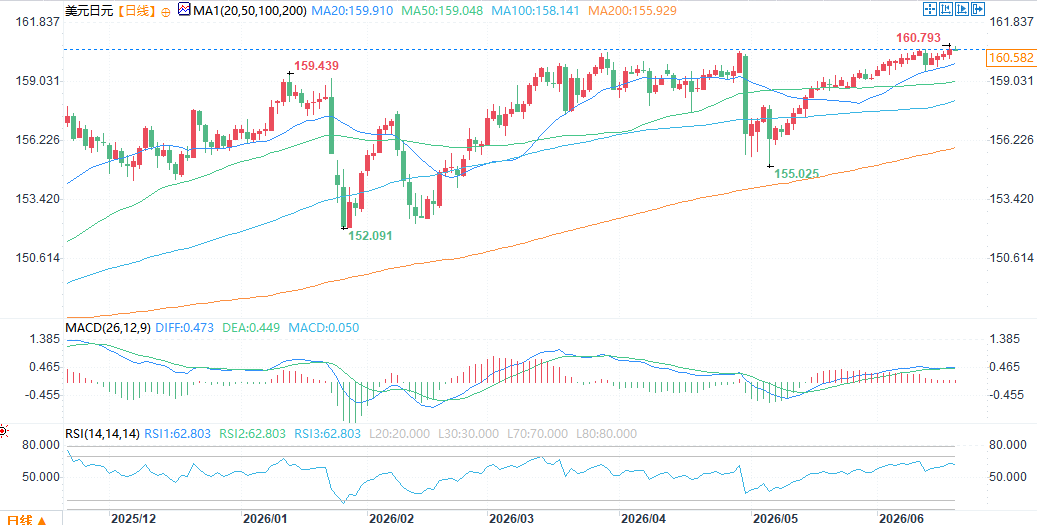
(USD/JPY daily chart, source: FX678)
At 13:23 Beijing time on June 18, the USD/JPY exchange rate was 160.59/60.
Although the dollar retreated after hitting a new high since the end of March, boosted by hawkish signals from the Federal Reserve, optimism surrounding the US-Iran peace agreement and market concerns about the risk of Japanese intervention limited the upside potential of the currency pair.
Federal Reserve Interest Rate Decision: Holds Rates Steady but Sends Hawkish Signals
At its first FOMC meeting chaired by Warsh, the Federal Reserve unanimously decided to maintain the target range for the federal funds rate at 3.50%-3.75%, in line with market expectations. However, changes in the policy statement and adjustments to the quarterly forecasts sent a strong hawkish signal.
The statement was significantly streamlined, eliminating all forward guidance and returning to the concise style of the Greenspan era. Walsh explicitly stated that forward guidance is "unsuitable" in the current environment, emphasizing the two-way risks to policy direction.
More importantly, the latest dot plot shows that 9 out of 19 policymakers expect at least one rate hike before the end of 2026, a stark contrast to the zero-opponent expectation at the March meeting. The overall PCE inflation forecast for 2026 has been revised upward from 2.7% to 3.6%, while the unemployment rate forecast has been slightly lowered to 4.3%. This combination of signals has completely shattered market illusions about a short-term rate cut, and interest rate futures have already priced in the possibility of a rate hike as early as September.
While Warsh downplayed the absolute nature of the dot plot, calling it "written in pencil," the market has come to regard it as a clear indication of the Fed's priority in combating inflation.
The US-Iran peace agreement weakened the dollar, prompting short sellers to take profits.
The hawkish shift within the Federal Reserve is providing policy support for the dollar, while at the same time, the external geopolitical environment is also facing a key variable – the easing of tensions in the Middle East is weakening the dollar's additional momentum from a safe-haven perspective.
The Middle East geopolitical situation has recently seen a significant easing of tensions, with US President Donald Trump and Iranian President Masoud Pezechiyan signing a memorandum of understanding online. The core objective is to end the long-standing hostile stance between the two sides and restore normal navigation in the Strait of Hormuz, greatly alleviating concerns about disruptions to the global energy supply chain.
Trump simultaneously stated publicly that the 60-day negotiation period set for the Iran nuclear issue was not a hard deadline, and that both sides could flexibly extend it depending on the progress of the negotiations. This accommodative statement dispelled market concerns about a hasty conclusion to the negotiations and a renewed escalation of tensions, significantly restoring global investors' risk appetite.
Previously, persistent tensions in the Middle East fueled safe-haven demand, leading to a continuous influx of funds into dollar assets and supporting the dollar's sustained strength. However, with the current easing of geopolitical tensions, the safe-haven trading logic has quickly reversed, with many previous long positions choosing to take profits, resulting in a significant weakening of the dollar's upward momentum.
In terms of exchange rates, the USD/JPY pair lost its core upward support, and its upward trend encountered significant resistance. Market funds are gradually flowing out of safe-haven assets such as the US dollar and into riskier assets such as equities and industrial commodities, resulting in a comprehensive shift in the pricing logic of major global asset classes in the short term.
Concerns about intervention are rising, and Japanese officials are issuing frequent verbal warnings.
Amidst the backdrop of easing geopolitical tensions weakening the US dollar, another key variable influencing the USD/JPY exchange rate remains in the market. Major trading institutions and forex traders remain highly vigilant about the possibility of Japanese officials intervening in the market to support the yen, and are generally cautious in their trading operations, not daring to blindly bet on a continued rise in the US dollar.
Recently, Japanese foreign exchange official Jun Mimura and Finance Minister Katsunobu Kato have made strong statements, continuously sending intervention signals to the market. They stated that regulators are closely monitoring speculative activities in the foreign exchange market around the clock, and are keeping a close watch on speculative funds that are simply betting on a one-sided depreciation of the yen. They also made it clear that the government has prepared sufficient funds and policy tools for intervention, and will immediately take action to stabilize the exchange rate should the yen experience a sustained and irrational sharp weakening.
The continued intervention and deterrent effect has provided direct support for the yen, effectively limiting the upside potential of the USD/JPY exchange rate. Even if the dollar experiences short-term fluctuations and rebounds, the exchange rate is unlikely to experience a sustained upward trend.
In addition, the Bank of Japan recently completed a round of interest rate hikes, bringing current interest rates to their highest level since the mid-1990s, a landmark monetary tightening measure. Compared to the previous long-term loose monetary environment, the rise in interest rates can increase the attractiveness of yen assets to foreign investors, alleviating the pressure of continued yen depreciation from the underlying logic of monetary policy.
The expectation of intervention, coupled with the tightening of monetary policy, provided dual support, jointly weakening the upward momentum of the USD/JPY exchange rate.
With interest rate differentials remaining, yen carry trades remain attractive.
Although the yen has received some support due to expectations of official intervention and the Bank of Japan's interest rate hike policy, it still has a natural weakness from the perspective of core interest rate differentials. Japan's overall borrowing costs are still significantly lower than those of major developed economies such as the United States, and the divergence in monetary policy has not been reversed.
The Federal Reserve kept its benchmark interest rate range unchanged at its policy meeting this Wednesday, while sending a hawkish signal that there is still a possibility of at least one more rate hike this year, reinforcing market expectations of a tighter monetary policy for the US dollar.
The continued misalignment of monetary policies between the US and Japan has further widened the interest rate differential between the two countries, reinforcing the carry trade logic in the market. The low-interest-rate yen remains a traditional carry trade currency, and arbitrage trading involving shorting the yen and going long on the dollar remains active, becoming the core underlying logic supporting the USD/JPY exchange rate.
Supported by these fundamentals, the overall trend of USD/JPY remains unchanged, and the path of least resistance for upward movement still leans towards a gradual rise. The recent price pullback, influenced by easing geopolitical tensions and expectations of yen intervention, is merely a temporary technical correction and not a signal of a trend reversal.
In market trading logic, every pullback low is likely to become an opportunity for funds to buy on dips, and the medium- to long-term upward trend of the USD/JPY exchange rate will continue based on the interest rate differential advantage.
From a technical perspective, according to the daily chart, the USD/JPY pair rose to a high of 160.79 before slightly retreating. Currently, the price is firmly above the 20-day, 50-day, 100-day, and 200-day moving averages (MA20, MA50, MA100, MA200), with all moving averages trending upwards in tandem, indicating a complete medium-to-long-term bullish trend with multiple support levels formed by the moving averages. The key support level below is the MA20 at 159.910, with strong medium-term support at the previous lows of 155.03 and 152.09. The key short-term resistance level is 160.79. In terms of indicators, the MACD lines remain above the zero line, with the DIFF line consistently above the DEA line. The red histogram is slightly narrowing, indicating a slight weakening of bullish momentum but no bearish reversal signal. The RSI value is 62.8, within the neutral-to-bullish range and has not yet entered extreme overbought territory, suggesting limited downside potential in the short term.
(USD/JPY daily chart, source: FX678)
At 13:23 Beijing time on June 18, the USD/JPY exchange rate was 160.59/60.
- Risk Warning and Disclaimer
- The market involves risk, and trading may not be suitable for all investors. This article is for reference only and does not constitute personal investment advice, nor does it take into account certain users’ specific investment objectives, financial situation, or other needs. Any investment decisions made based on this information are at your own risk.